Gustave Eiffel: Eiffel Tower, Statue of Liberty Frame & Iron Bridges
Encyclopedia/2. Technology & The Built World/3. Civil, Architectural & Structural Engineering/03. Civil Engineering Biographies • Curated by Admin Timeline.sg
A biographical timeline of Gustave Eiffel (1832-1923), the French structural engineer renowned for designing the Eiffel Tower and the internal iron framework of the Statue of Liberty, as well as pioneering works in metal arch bridges and aerodynamics.
Chronological Storyline (41 Milestones)
Dec 15, 1832 CE
Gustave Eiffel Born in Dijon
Alexandre Gustave Eiffel is born in Dijon, France, to a family of modest means. His mother ran a charcoal business while his father was a former military officer. #engineering #birth
Gustave Eiffel Born in Dijon By Nadar - https://www.gettyimages.co.uk/detail/news-photo/portrait-of-the-french-engineer-gustave-eiffel-1890s-news-photo/141551141, Public domain, https://commons.wikimedia.org/w/index.php?curid=41304911
1852 CE
Enrolls at École Centrale Paris
Eiffel enters the prestigious École Centrale des Arts et Manufactures in Paris, where he studies chemistry and engineering. He graduates in 1855. #education #engineering
1855 CE
Graduates from École Centrale
Eiffel earns his diploma and begins his career. His early work focuses on railway bridges and metal structures. #engineering #graduation
1856 CE
First Job at Railroad Company
Eiffel is employed by the Compagnie des Chemins de Fer de l'Ouest, where he gains experience in constructing iron bridges. This marks the start of his career in structural engineering. #engineering #bridges
1858 CE
Supervises Construction of Saint-Jean Bridge
Eiffel is put in charge of building the Saint-Jean Bridge in Bordeaux, his first major project. This railway bridge showcases his innovative use of wrought iron. #engineering #bridges
1860 CE
Becomes Independent Contractor
Eiffel leaves the railway company and starts his own engineering firm, initially working on small projects. This independence allows him to pursue larger contracts. #engineering #career
Dec 8, 1862 CE
Marries Marie Gaudelet
Eiffel marries Marie Gaudelet, with whom he will have five children. The marriage lasts until her death in 1877. #personal #marriage
1866 CE
Founds Eiffel & Cie.
Eiffel establishes his own engineering company, Eiffel & Cie., which becomes a leading firm in metal construction. The company undertakes projects worldwide. #engineering #business
1867 CE
Exhibits at Paris Exposition
Eiffel presents his work at the 1867 Paris Exposition, gaining international recognition. He showcases models of his bridges and structural innovations. #engineering #exhibition
1869 CE
Builds Viaduc de la Souleuvre
Eiffel completes the Souleuvre Viaduct in Normandy, a wrought-iron bridge known for its innovative design and slender appearance. #engineering #bridges
1870 CE
Constructs Viaduc de Rouzat
Eiffel builds the Rouzat Viaduct, a major railway bridge in central France. It demonstrates his expertise in using metal trusses for long spans. #engineering #bridges
1875 CE
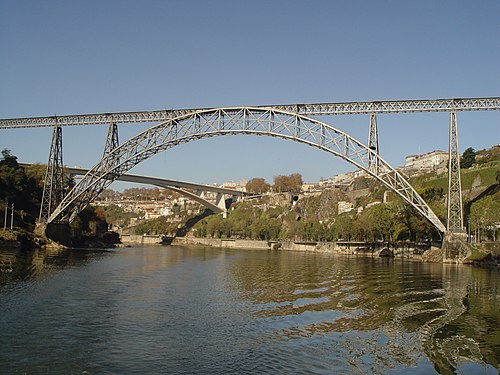
Maria Pia Bridge in Porto
Eiffel completes the Maria Pia Bridge over the Douro River in Porto, Portugal. This wrought-iron arch bridge holds the world record for span at the time. #engineering #bridges
Maria Pia Bridge in Porto By Joseolgon - Own work, Public domain, https://commons.wikimedia.org/w/index.php?curid=3127206
1877 CE
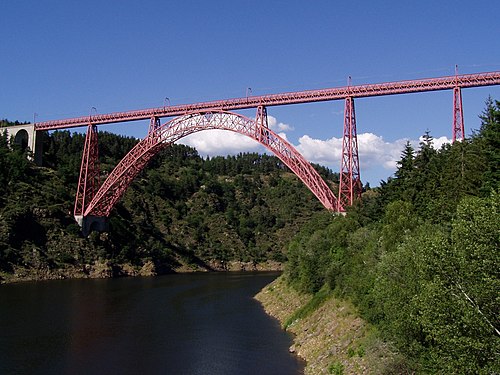
Completes Garabit Viaduct
The Garabit Viaduct, a spectacular railway arch bridge in southern France, is finished. With a span of 165 meters, it is the longest arch bridge in the world at the time. #engineering #bridges
Completes Garabit Viaduct By Unknown author, CC BY-SA 3.0, https://commons.wikimedia.org/w/index.php?curid=343732
1879 CE
Designs Budapest Nyugati Railway Station
Eiffel's firm designs the iron and glass roof of the Nyugati Railway Station in Budapest, Hungary. The structure is noted for its elegant, airy design. #engineering #architecture
Designs Budapest Nyugati Railway Station By Varius - Own work, CC BY-SA 3.0, https://commons.wikimedia.org/w/index.php?curid=28484124
1881 CE
Begins Work on Statue of Liberty Internal Frame
Eiffel is commissioned to design the internal iron framework for the Statue of Liberty, ensuring stability against wind. He develops a flexible structure that allows the copper skin to expand and contract. #engineering #statueofliberty
Begins Work on Statue of Liberty Internal Frame By AskALotl - Own work, CC0, https://commons.wikimedia.org/w/index.php?curid=175770064
1883 CE
Completes Internal Structure of Statue of Liberty
The internal skeleton of the Statue of Liberty is finished in France. It is then disassembled and shipped to the United States for assembly on Bedloe's Island. #engineering #statueofliberty
Jun 1, 1884 CE
Eiffel Tower Design Proposed
Eiffel's engineers Maurice Koechlin and Émile Nouguier propose the idea of a tall iron tower for the 1889 Exposition Universelle. Eiffel refines the design and presents it to the public. #engineering #eiffeltower
Eiffel Tower Design Proposed By Benh LIEU SONG - This image has been extracted from another file, Public domain, https://commons.wikimedia.org/w/index.php?curid=48220385
1885 CE
Statue of Liberty Erected in New York
The Statue of Liberty is dedicated on October 28, 1886. Eiffel's internal frame is crucial for its longevity. #engineering #statueofliberty
Jan 8, 1886 CE
Eiffel Tower Construction Contract Signed
Eiffel signs the contract with the French government to build the tower for the 1889 World's Fair. The tower is to be completed in 2 years. #engineering #eiffeltower
Jan 28, 1887 CE
Construction of Eiffel Tower Begins
Ground is broken on the Champ de Mars in Paris. The tower's assembly involves 18,038 pieces of iron and 2.5 million rivets. #engineering #eiffeltower
1888 CE
Eiffel Tower Reaches Half Height
By mid-1888, the tower's first level is completed. Workers use innovative scaffolding techniques. #engineering #eiffeltower
Mar 31, 1889 CE
Eiffel Tower Inaugurated
The Eiffel Tower opens to the public after 2 years, 2 months, and 5 days of construction. It is the tallest structure in the world at 312 meters. #engineering #eiffeltower
May 6, 1889 CE
Eiffel Tower Opens for 1889 Exposition
The tower serves as the grand entrance to the World's Fair. Nearly 2 million visitors ascend during the exposition. #engineering #exposition
1889 CE
Eiffel Receives Legion of Honour
Gustave Eiffel is awarded the Legion of Honour for his contributions to engineering and the successful completion of the Eiffel Tower. #engineering #award
1890 CE
Designs the Dome of the Nice Observatory
Eiffel's company designs the movable dome of the Nice Observatory, a pioneering structure in astronomical engineering. #engineering #astronomy
Designs the Dome of the Nice Observatory By ClaireL28 - Own work, CC BY-SA 3.0, https://commons.wikimedia.org/w/index.php?curid=35646956
1892 CE
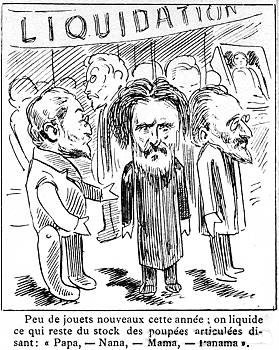
Involved in Panama Canal Scandal
Eiffel is implicated in the Panama Canal financial scandal due to his involvement in constructing locks for the failed French attempt. He is fined and his reputation suffers. #engineering #scandal
Involved in Panama Canal Scandal By Unknown author, Public domain, https://commons.wikimedia.org/w/index.php?curid=2961190
Feb 1, 1893 CE
Retires from Active Engineering
After the Panama affair, Eiffel retires from his company and focuses on scientific research, particularly aerodynamics. #engineering #career
1900 CE
Constructs Wind Tunnel at Auteuil
Eiffel builds his first wind tunnel in his private laboratory in Auteuil, Paris, to study aerodynamics. This makes him a pioneer in aviation science. #science #aerodynamics
1902 CE
Publishes Aerodynamic Research
Eiffel publishes 'The Resistance of the Air and Aviation', detailing experiments on air friction and lift. His work influences early aircraft design. #science #aerodynamics
1905 CE
Builds Larger Wind Tunnel at Auteuil
Eiffel constructs a second, larger wind tunnel with a 1.5-meter diameter. It becomes a key research facility for French aviation pioneers. #science #aerodynamics
1909 CE
Designs Wright Brothers' Wind Tunnel Tests
Eiffel assists the Wright brothers by testing their aircraft models in his wind tunnel, contributing to the development of controlled flight. #aviation #aerodynamics
1910 CE
Donates Wind Tunnel to French Government
Eiffel donates his wind tunnel laboratory to the French government to further aeronautical research. It becomes part of the Institute of Fluid Mechanics. #science #donation
1912 CE
Eiffel Tower Used for Radio Transmission
The Eiffel Tower is used for long-distance radio experiments, proving its value for communications. Eiffel supports this use. #technology #radio
1914 CE
Eiffel Tower as Strategic Antenna in WWI
During World War I, the Eiffel Tower serves as a strategic radio antenna, intercepting enemy communications. #history #wwi
1921 CE
Eiffel's Health Declines
Gustave Eiffel's health deteriorates in his late 80s. He continues to follow scientific developments until his death. #personal #health
Dec 27, 1923 CE
Gustave Eiffel Dies
Gustave Eiffel passes away in Paris at the age of 91. He is buried in the family tomb in Levallois-Perret. #obituary #engineering
1924 CE
Eiffel's Legacy Continues
The Eiffel Tower remains the tallest structure in the world until 1930 and becomes the global symbol of Paris. Eiffel's engineering principles are studied worldwide. #legacy #engineering
1944 CE
Eiffel Tower Survives WWII
During World War II, the Eiffel Tower is spared from destruction. It continues to serve as a symbol of French resilience. #history #eiffeltower
1984 CE
Eiffel Tower Renovated
The Eiffel Tower undergoes a major renovation to modernize its facilities and preserve its structure. It remains a top tourist attraction. #architecture #renovation
2000 CE
Eiffel Tower Illuminated for Millennium
The Eiffel Tower is decorated with sparkling lights for the millennium celebration, a tradition that continues nightly. #culture #celebration
2013 CE
Statue of Liberty Frame Restoration
The internal iron frame of the Statue of Liberty, designed by Eiffel, undergoes restoration to address corrosion. #engineering #restoration