Group Theory & Symmetry: Pioneer Biographies & Lasting Legacies
Encyclopedia/1. The Cosmos & The Natural World/1. Mathematics & Formal Systems/02. Algebra & Symbolic Systems • Curated by Admin Timeline.sg
A biographical timeline chronicling the key figures and their contributions to group theory and symmetry, from ancient geometric symmetries to the modern classification of finite simple groups. It highlights the evolution of abstract algebraic structures and their profound influence on mathematics, physics, and chemistry.
Chronological Storyline (42 Milestones)
300 BCE
Euclid's Elements on Symmetry
Euclid's Elements defines the five regular Platonic solids, capturing early notions of symmetry. This work lays the geometric foundation for later concepts of symmetry groups. #math #geometry #symmetry
Euclid's Elements on Symmetry By University of Pennsylvania Museum of Archaeology and Anthropology - https://openn.library.upenn.edu/Data/0016/html/e2748.html, CC BY-SA 4.0, https://commons.wikimedia.org/w/index.php?curid=169166171
225 CE
Archimedean Solids
Archimedes identifies 13 semi-regular convex polyhedra, now known as Archimedean solids, which exhibit high degrees of symmetry. This work extends the study of symmetric forms in geometry. #geometry #symmetry
Archimedean Solids By Frankee 67 - Own work, Public domain, https://commons.wikimedia.org/w/index.php?curid=10339193
360 CE
Plato's Timaeus and the Platonic Solids
Plato's Timaeus associates the four classical elements with regular polyhedra, reflecting an early philosophical exploration of symmetry. This work influences later mathematical studies of symmetric objects. #philosophy #symmetry #geometry )
1011 CE
Alhazen's Optics and Symmetry
Ibn al-Haytham (Alhazen) publishes his Book of Optics, discussing principles of symmetry in visual perception. His work influences later scientific thought on symmetry and reflection. #optics #symmetry #science
Alhazen's Optics and Symmetry By Ibn al-Haytham, Vitello, Friedrich Risner - University of Oklahoma History of Science Collections et BnF Gallica : http://gallica.bnf.fr/ark:/12148/bpt6k312873d.r=Haytham?rk=407727;2, Public domain, https://commons.wikimedia.org/w/index.php?curid=48189707
1247 CE
Qin Jiushao's Mathematical Treatise
Chinese mathematician Qin Jiushao publishes Mathematical Treatise in Nine Sections, which includes methods for solving polynomial equations. His work contributes to the algebraic foundations that later inform group theory. #math #history
Qin Jiushao's Mathematical Treatise By Qin Jiushao 秦九韶 - 1842 printing Shu Shu Jiu Zhang, Public domain, https://commons.wikimedia.org/w/index.php?curid=3414657
1545 CE
Cardano's Ars Magna
Gerolamo Cardano publishes Ars Magna, providing the first systematic solution of cubic and quartic equations. This work highlights the role of permutations of roots, a precursor to group theory. #algebra #math #history )
1770 CE
Lagrange's Reflections on Equations
Joseph-Louis Lagrange publishes Réflexions sur la résolution des équations algébriques, studying permutations of roots and laying groundwork for group theory. His work directly inspires later mathematicians. #algebra #groupTheory #math
Lagrange's Reflections on Equations By Unknown author - File:Joseph_Louis_Lagrange.jpg, CC0, https://commons.wikimedia.org/w/index.php?curid=155608232
1799 CE
Ruffini's Attempt on Quintic
Paolo Ruffini publishes an attempted proof that the general quintic equation is unsolvable by radicals, using permutation groups. Though incomplete, his work advances the study of solvable groups. #algebra #groupTheory
Ruffini's Attempt on Quintic By Unknown - https://i.bigenc.ru/Azc5DHKsI0yKslqp0YR2mSpJo4HQq_Eu-YfQ3CG3hiU/xl/ODNlOGVjODZkZTQ2OTkyM2NmYTMyNWVlMDNiZmY0Y2YuanBn.webp, CC0, https://commons.wikimedia.org/w/index.php?curid=130821361
1824 CE
Abel's Proof of Quintic Unsolvability
Niels Henrik Abel publishes a rigorous proof that the general quintic equation is unsolvable by radicals. His work relies on properties of permutation groups, cementing the link between algebra and groups. #algebra #math
Abel's Proof of Quintic Unsolvability By Johan Gørbitz - Originally uploaded to English wikipedia by en:User:Pladask, http://www.math.uio.no/div/abelkonkurransen/, Public domain, https://commons.wikimedia.org/w/index.php?curid=90392
May 30, 1832 CE
Galois's Last Letter
Évariste Galois, on the eve of his fatal duel, writes a letter outlining his theory of groups and solvability of polynomial equations. This foundational work introduces the concept of a group as an abstract structure. #groupTheory #algebra #math
Galois's Last Letter By Unknown author - Iyanaga, Shokichi, "ガロアの時代 ガロアの数学 第一部 時代篇" , Springer-Verlag Tokyo, 1999 http://www.win.tue.nl/~aeb/at/GaloisCorrespondence.html, Public domain, https://commons.wikimedia.org/w/index.php?curid=103351
1844 CE
Cayley's Abstract Group Definition
Arthur Cayley publishes the first abstract definition of a group, including the use of a multiplication table (Cayley table). This marks the beginning of modern group theory. #groupTheory #math
Cayley's Abstract Group Definition By Herbert Beraud (1845–1896) - http://www-groups.dcs.st-and.ac.uk/~history/PictDisplay/Cayley.html, Public domain, https://commons.wikimedia.org/w/index.php?curid=904674
1846 CE
Cauchy's Permutation Groups
Augustin-Louis Cauchy publishes papers on permutation groups, establishing key theorems such as Cauchy's theorem on the existence of elements of prime order. His work systematizes the theory. #groupTheory #math
Cauchy's Permutation Groups By Public domain - Library of Congress Prints and Photographs Division. From an illustration in: Das neunzehnte Jahrhundert in Bildnissen / Karl Werckmeister, ed. Berlin : Kunstverlag der photographische gesellschaft, 1840, vol. V, no. 581., Public domain, https://commons.wikimedia.org/w/index.php?curid=7059486
1854 CE
Cayley's Theorem
Arthur Cayley proves that every group is isomorphic to a permutation group, linking abstract groups to concrete symmetries. This theorem is fundamental in group theory. #groupTheory #math
1869 CE
Jordan's Traité des Substitutions
Camille Jordan publishes Traité des substitutions et des équations algébriques, the first comprehensive book on group theory. It consolidates the works of Galois, Cauchy, and others. #groupTheory #math
Jordan's Traité des Substitutions By Eugène Pirou - Archivio storico dell'Accademia delle Scienze - Catalogo digitale, Public domain, https://commons.wikimedia.org/w/index.php?curid=106265667
1872 CE
Klein's Erlangen Program
Felix Klein presents the Erlangen program, which classifies geometries based on their symmetry groups. This unifies various geometries and highlights the central role of groups in mathematics. #geometry #groupTheory #math
Klein's Erlangen Program By Unknown author, Public domain, https://commons.wikimedia.org/w/index.php?curid=38617
1873 CE
Sophus Lie Begins Continuous Groups
Sophus Lie initiates the study of continuous transformation groups, later known as Lie groups. His work applies group theory to differential equations and geometry. #groupTheory #LieGroups #math
Sophus Lie Begins Continuous Groups By L. Szaciński (Christiania) - Flickr: Portrett av Sophus Lie, 1896, No restrictions, https://commons.wikimedia.org/w/index.php?curid=64917266
1896 CE
Frobenius and Representation Theory
Ferdinand Georg Frobenius lays the foundation of group representation theory, studying how groups act on vector spaces. This becomes a vital tool in many branches of mathematics and physics. #representationTheory #groupTheory #math
Frobenius and Representation Theory By Furfur - (de): Oberwolfach Photo Collection, aus einem Fotoalbum der Mathematischen Gesellschaft (Hamburg)(en): Oberwolfach Photo Collection, from a photo album of the Mathematische Gesellschaft (Hamburg), CC BY-SA 3.0, https://commons.wikimedia.org/w/index.php?curid=59417515
1897 CE
Burnside's Theory of Groups
William Burnside publishes the first English textbook on group theory, later expanded. He contributes Burnside's lemma and the theory of finite groups. #groupTheory #math
Burnside's Theory of Groups By Unknown author, Copyrighted free use, https://commons.wikimedia.org/w/index.php?curid=545215
1905 CE
Schur's Lemma
Issai Schur proves Schur's lemma, a fundamental result in representation theory showing that certain intertwining maps are scalar multiples. This lemma is crucial for studying irreducible representations. #representationTheory #groupTheory #math
1913 CE
Cartan's Classification of Simple Lie Algebras
Élie Cartan completes the classification of finite-dimensional simple Lie algebras over the complex numbers, uncovering the Dynkin diagram classification. This is a landmark in Lie theory. #LieAlgebras #groupTheory #math
1916 CE
Ramanujan's Modular Forms
Srinivasa Ramanujan publishes his work on modular forms, which exhibit rich symmetries and connect deeply to group theory. His discoveries later influence the Langlands program. #modularForms #symmetry #math
Ramanujan's Modular Forms By Unknown author - https://mss-cat.trin.cam.ac.uk/manuscripts/uv/view.php?n=Add.Ms.a.94.7#?c=0&m=0&s=0&cv=6&xywh=-2849%2C-273%2C9238%2C5258, CC BY 4.0, https://commons.wikimedia.org/w/index.php?curid=153767257
1918 CE
Noether's Theorem
Emmy Noether proves Noether's theorem, linking conservation laws to continuous symmetries. This profound result establishes the central role of symmetry in physics. #symmetry #physics #math
Noether's Theorem By Emmy Noether - "Invariante Variationsprobleme" (Nachrichten von der Gesellschaft der Wissenschaften zu Göttingen, Mathematisch-Physikalische Klasse 1918 (1918): 235-257. <http://eudml.org/doc/59024>), Public domain, https://commons.wikimedia.org/w/index.php?curid=69398536
1925 CE
Weyl on Group Theory and Quantum Mechanics
Hermann Weyl publishes Group Theory and Quantum Mechanics, applying group representation theory to quantum physics. This book influences the development of quantum theory. #groupTheory #quantumMechanics #physics
Weyl on Group Theory and Quantum Mechanics By ETH Zürich - ETH-Bibliothek Zürich, Bildarchiv, CC BY-SA 3.0, https://commons.wikimedia.org/w/index.php?curid=8098412
1927 CE
Artin Reciprocity Law
Emil Artin formulates the Artin reciprocity law using group theory, a cornerstone of class field theory. This connects Galois groups to arithmetic data. #numberTheory #groupTheory #math
1930 CE
Brauer's Modular Representation Theory
Richard Brauer develops modular representation theory, studying group representations over fields of prime characteristic. This theory is essential for the classification of finite simple groups. #representationTheory #groupTheory #math
Brauer's Modular Representation Theory By Jacobs, Konrad - https://opc.mfo.de/detail?photo_id=467, CC BY-SA 2.0 de, https://commons.wikimedia.org/w/index.php?curid=7756475
1937 CE
Hall's Theorem on Solvable Groups
Philip Hall proves Hall's theorem on the existence of Hall subgroups in solvable groups, a key result in finite group theory. His work revitalizes the study of finite groups. #groupTheory #math
Hall's Theorem on Solvable Groups By Konrad Jacobs, Erlangen, Copyright is MFO - Mathematisches Forschungsinstitut Oberwolfach,https://opc.mfo.de/detail?photo_id=1531, CC BY-SA 2.0 de, https://commons.wikimedia.org/w/index.php?curid=12364673
1939 CE
Zassenhaus's Work on Permutation Groups
Hans Zassenhaus develops the theory of sharply transitive permutation groups, leading to results on finite geometries. #groupTheory #math
Zassenhaus's Work on Permutation Groups By Konrad Jacobs, Erlangen - Mathematisches Institut Oberwolfach (MFO), https://opc.mfo.de/detail?photoID=4641, CC BY-SA 2.0 de, https://commons.wikimedia.org/w/index.php?curid=3934815
1950 CE
Iwasawa Theory
Kenkichi Iwasawa introduces Iwasawa theory, linking Galois groups and p-adic L-functions. This becomes a central tool in algebraic number theory. #numberTheory #groupTheory #math
1954 CE
Klein's Erlangen Program Expanded
John G. Thompson proves Thompson's theorem on normalizers of Sylow subgroups, crucial for the classification. #groupTheory #math
Klein's Erlangen Program Expanded By Renate Schmid - Mathematisches Forschungsinstitut Oberwolfach, https://opc.mfo.de/detail?photoID=9723, CC BY-SA 2.0 de, https://commons.wikimedia.org/w/index.php?curid=3921915
1955 CE
Chevalley's Classification of Simple Algebraic Groups
Claude Chevalley classifies simple algebraic groups over arbitrary fields, constructing the Chevalley groups. This extends Lie theory to finite fields. #algebraicGroups #groupTheory #math
Chevalley's Classification of Simple Algebraic Groups By Konrad Jacobs - MFO, CC BY-SA 2.0 de, https://commons.wikimedia.org/w/index.php?curid=8046334
1963 CE
Feit–Thompson Theorem
Walter Feit and John Thompson prove that every finite group of odd order is solvable, a monumental result in the classification of finite simple groups. #groupTheory #math #finiteGroups
1965 CE
Suzuki's Sporadic Groups
Michio Suzuki discovers the Suzuki sporadic groups, a family of finite simple groups. His work contributes to the classification. #groupTheory #math )
1967 CE
Langlands Program Conjectures
Robert Langlands formulates the Langlands program, a series of deep conjectures linking number theory, representation theory, and automorphic forms. This program uses group theory extensively. #numberTheory #representationTheory #math
1968 CE
Conway's Sporadic Groups
John Horton Conway discovers three sporadic groups (the Conway groups) related to the Leech lattice, a highly symmetric structure in 24 dimensions. #groupTheory #math
Conway's Sporadic Groups By "Thane Plambeck" - "https://www.flickr.com/photos/thane/20366806/", CC BY 2.0, https://commons.wikimedia.org/w/index.php?curid=13076802
1970 CE
Gorenstein's Work on Finite Simple Groups
Daniel Gorenstein becomes a leading architect of the classification of finite simple groups, organizing efforts and writing key surveys. #groupTheory #math
Gorenstein's Work on Finite Simple Groups By Jacobs, Konrad - https://opc.mfo.de/detail?photo_id=1403, CC BY-SA 2.0 de, https://commons.wikimedia.org/w/index.php?curid=6100068
1972 CE
Fischer's Sporadic Groups
Bernd Fischer discovers three sporadic simple groups (the Fischer groups), expanding the list of known finite simple groups. This contributes to the classification effort. #groupTheory #math )
Fischer's Sporadic Groups By Katrin Breithaupt - https://opc.mfo.de/detail?photo_id=10605, CC BY-SA 2.0 de, https://commons.wikimedia.org/w/index.php?curid=6248056
1974 CE
Tits Buildings and the Tits Alternative
Jacques Tits develops the theory of buildings, a geometric approach to groups, and proves the Tits alternative for linear groups. These ideas unify group theory with geometry. #groupTheory #geometry #math
Tits Buildings and the Tits Alternative By Harald Hanche-Olsen - Own work, CC BY 3.0, https://commons.wikimedia.org/w/index.php?curid=110912509
1980 CE
Monster Group Constructed by Griess
Robert Griess constructs the Monster group, the largest sporadic simple group, using a 196,883-dimensional representation. This completes the discovery of sporadic groups. #groupTheory #math #finiteGroups
Monster Group Constructed by Griess By Original: Jakob.scholbach Vector: Pbroks13 - Own work based on: Cyclic group.png, CC BY-SA 3.0, https://commons.wikimedia.org/w/index.php?curid=4370108
1981 CE
Classification of Finite Simple Groups Announced
After decades of work by many mathematicians, the classification of finite simple groups is completed. This theorem lists all finite simple groups, a towering achievement in mathematics. #groupTheory #math
1994 CE
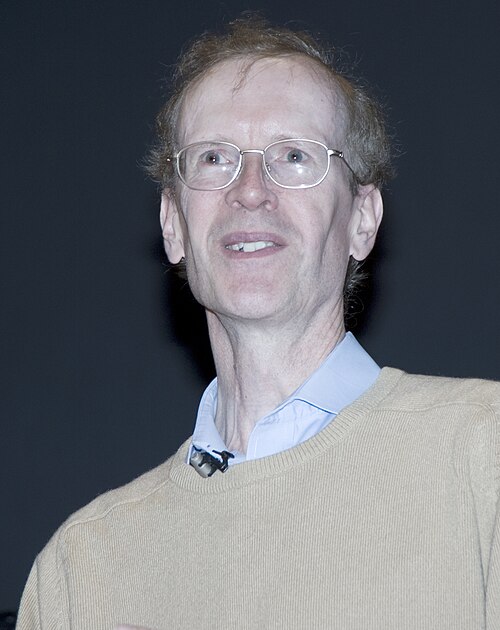
Wiles Proves Fermat's Last Theorem
Andrew Wiles proves Fermat's Last Theorem using modular forms and Galois representations, deep tools from group theory and number theory. This landmark result showcases the power of symmetry. #numberTheory #groupTheory #math
Wiles Proves Fermat's Last Theorem By "copyright C. J. Mozzochi, Princeton N.J" - http://www.mozzochi.org/deligne60/Deligne1/_DSC0024.jpg, Attribution, https://commons.wikimedia.org/w/index.php?curid=2635913
2004 CE
Atlas of Finite Groups Published
The Atlas of Finite Groups is published, providing a comprehensive database of finite group properties. This resource is invaluable for researchers. #groupTheory #math
Atlas of Finite Groups Published By John Horton Conway, Robert Turner Curtis, Simon Phillips Norton, Richard Alan Parker and Robert Arnott Wilson - https://www.amazon.com/Atlas-Finite-Groups-Subgroups-Characters/dp/0198531990, Public domain, https://commons.wikimedia.org/w/index.php?curid=157380096
2021 CE
New Sporadic Group Candidate?
Recent computational searches suggest the possible existence of a new sporadic simple group, though unconfirmed. The classification remains under scrutiny. #groupTheory #math #finiteGroups