Group Theory & Symmetry: Modern Frontiers & Breakthrough Innovations
Encyclopedia/1. The Cosmos & The Natural World/1. Mathematics & Formal Systems/02. Algebra & Symbolic Systems • Curated by Admin Timeline.sg
This timeline traces the development of group theory and symmetry from ancient algebraic roots to modern frontiers, highlighting landmark theorems, classification milestones, and applications in physics and computing. It encompasses contributions from diverse cultures and emphasizes breakthrough innovations that have shaped the field.
Chronological Storyline (41 Milestones)
2000 BCE
Babylonian Algebra Precursors
Babylonian mathematicians develop early algebraic methods for solving quadratic equations, laying groundwork for later symmetry concepts. #mathematics #history
Babylonian Algebra Precursors By Urcia, A., Yale Peabody Museum of Natural History, https://peabody.yale.edu, http://hdl.handle.net/10079/8931zqj derivative work, user:Theodor Langhorne Franklin - File:YBC-7289-OBV.jpg, CC0, https://commons.wikimedia.org/w/index.php?curid=76347956
800 CE
Al-Khwarizmi's Algebra
Persian mathematician Al-Khwarizmi publishes 'The Compendious Book on Calculation by Completion and Balancing', formalizing algebraic equations and influencing later group theory. #algebra #history
Al-Khwarizmi's Algebra By Zarateman - Own work, CC0, https://commons.wikimedia.org/w/index.php?curid=162213187
1400 CE
Islamic Geometric Patterns
Islamic artisans create intricate tilings exhibiting wallpaper group symmetries, centuries before formal classification. #symmetry #art
Islamic Geometric Patterns By Ian Alexander - Own work, CC BY-SA 4.0, https://commons.wikimedia.org/w/index.php?curid=45782132
1770 CE
Lagrange's Permutation Theory
Joseph-Louis Lagrange studies permutations of roots of equations, a precursor to group theory. #mathematics #algebra
Lagrange's Permutation Theory By Unknown author - File:Joseph_Louis_Lagrange.jpg, CC0, https://commons.wikimedia.org/w/index.php?curid=155608232
1824 CE
Abel's Impossibility Proof
Niels Henrik Abel proves that the general quintic equation is unsolvable by radicals, using permutation groups. #mathematics #history
May 30, 1832 CE
Galois's Last Letter
Évariste Galois writes his final letter outlining Galois theory, linking field extensions to group theory, founding modern abstract algebra. #mathematics #Galois
Galois's Last Letter By Unknown author - Iyanaga, Shokichi, "ガロアの時代 ガロアの数学 第一部 時代篇" , Springer-Verlag Tokyo, 1999 http://www.win.tue.nl/~aeb/at/GaloisCorrespondence.html, Public domain, https://commons.wikimedia.org/w/index.php?curid=103351
1849 CE
Cauchy's Permutation Group Work
Augustin-Louis Cauchy publishes extensive work on permutation groups, introducing notation and concepts. #mathematics #groupTheory
Cauchy's Permutation Group Work By Public domain - Library of Congress Prints and Photographs Division. From an illustration in: Das neunzehnte Jahrhundert in Bildnissen / Karl Werckmeister, ed. Berlin : Kunstverlag der photographische gesellschaft, 1840, vol. V, no. 581., Public domain, https://commons.wikimedia.org/w/index.php?curid=7059486
1854 CE
Cayley Defines Abstract Group
Arthur Cayley gives the first abstract definition of a group as a set with a binary operation satisfying axioms. #mathematics #algebra
Cayley Defines Abstract Group By Herbert Beraud (1845–1896) - http://www-groups.dcs.st-and.ac.uk/~history/PictDisplay/Cayley.html, Public domain, https://commons.wikimedia.org/w/index.php?curid=904674
1872 CE
Klein's Erlangen Program
Felix Klein proposes that geometry be studied via group symmetries, profoundly unifying mathematics. #geometry #symmetry
Klein's Erlangen Program By Unknown author, Public domain, https://commons.wikimedia.org/w/index.php?curid=38617
1878 CE
Cayley's Theorem
Cayley proves every group is isomorphic to a permutation group, establishing the fundamental relationship. #mathematics #groupTheory
1884 CE
Lie's Continuous Groups
Sophus Lie develops the theory of continuous transformation groups, now called Lie groups, essential for physics. #mathematics #physics
Lie's Continuous Groups By L. Szaciński (Christiania) - Flickr: Portrett av Sophus Lie, 1896, No restrictions, https://commons.wikimedia.org/w/index.php?curid=64917266
1897 CE
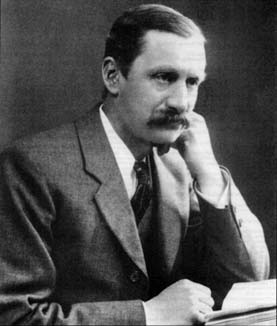
Burnside's Group Theory Book
William Burnside publishes 'Theory of Groups of Finite Order', the first comprehensive text on finite groups. #mathematics #book
Burnside's Group Theory Book By Unknown author, Copyrighted free use, https://commons.wikimedia.org/w/index.php?curid=545215
1900 CE
Hilbert's Fifth Problem
David Hilbert poses the problem of characterizing Lie groups, spurring decades of research. #mathematics #problems
1908 CE
Frobenius Character Theory
Ferdinand Georg Frobenius develops representation theory of finite groups via characters. #mathematics #representation
Frobenius Character Theory By Furfur - (de): Oberwolfach Photo Collection, aus einem Fotoalbum der Mathematischen Gesellschaft (Hamburg)(en): Oberwolfach Photo Collection, from a photo album of the Mathematische Gesellschaft (Hamburg), CC BY-SA 3.0, https://commons.wikimedia.org/w/index.php?curid=59417515
1911 CE
Wedderburn's Theorem
Joseph Wedderburn proves that finite division rings are fields, fundamental for algebra. #mathematics #algebra
1915 CE
Noether's Theorem
Emmy Noether establishes the deep connection between symmetries and conservation laws in physics. #physics #symmetry
Noether's Theorem By Emmy Noether - "Invariante Variationsprobleme" (Nachrichten von der Gesellschaft der Wissenschaften zu Göttingen, Mathematisch-Physikalische Klasse 1918 (1918): 235-257. <http://eudml.org/doc/59024>), Public domain, https://commons.wikimedia.org/w/index.php?curid=69398536
1933 CE
Peter-Weyl Theorem
Hermann Weyl and F. Peter prove the Peter-Weyl theorem, decomposing unitary representations of compact groups. #mathematics #representation
1936 CE
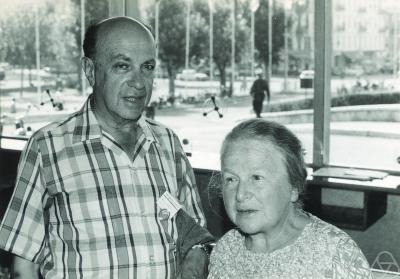
Brauer's Modular Characters
Richard Brauer introduces modular representation theory, crucial for group classification. #mathematics #representation
Brauer's Modular Characters By Jacobs, Konrad - https://opc.mfo.de/detail?photo_id=467, CC BY-SA 2.0 de, https://commons.wikimedia.org/w/index.php?curid=7756475
1939 CE
Hall's Enumeration Theorems
Philip Hall publishes fundamental theorems on counting subgroups and Sylow theory. #mathematics #groupTheory
Hall's Enumeration Theorems By Konrad Jacobs, Erlangen, Copyright is MFO - Mathematisches Forschungsinstitut Oberwolfach,https://opc.mfo.de/detail?photo_id=1531, CC BY-SA 2.0 de, https://commons.wikimedia.org/w/index.php?curid=12364673
1940 CE
Hua Luogeng's Work on Groups
Chinese mathematician Hua Luogeng makes significant contributions to classical group theory and geometry. #mathematics #China
Hua Luogeng's Work on Groups By 牛畏予 - http://baike.baidu.com/albums/6351/6351.html#0$e78c65898b37b4d30e244463, Public domain, https://commons.wikimedia.org/w/index.php?curid=17315495
1948 CE
Zassenhaus Lemma
Hans Zassenhaus proves the butterfly lemma, a key tool in group theory and the Schreier refinement theorem. #mathematics #algebra
Zassenhaus Lemma By Claudio Rocchini - Own work, CC BY 3.0, https://commons.wikimedia.org/w/index.php?curid=2773335
1954 CE
Harish-Chandra's Representation Theory
Indian mathematician Harish-Chandra develops fundamental theory of representations of semisimple Lie groups. #mathematics #representation
Harish-Chandra's Representation Theory By Unknown author - https://mathshistory.st-andrews.ac.uk/Biographies/Harish-Chandra/, CC BY 4.0, https://commons.wikimedia.org/w/index.php?curid=147431356
1963 CE
Feit-Thompson Odd Order Theorem
Walter Feit and John Thompson prove that every finite group of odd order is solvable, a milestone in classification. #mathematics #classification
1968 CE
Janko's Sporadic Group
Zvonimir Janko discovers the first new sporadic simple group in a century, J1, sparking modern sporadic group research. #mathematics #discovery
Janko's Sporadic Group By Original: Jakob.scholbach Vector: Pbroks13 - Own work based on: Cyclic group.png, CC BY-SA 3.0, https://commons.wikimedia.org/w/index.php?curid=4370108
1972 CE
Gorenstein Launches Classification
Daniel Gorenstein outlines a program to classify all finite simple groups, a huge collaborative effort. #mathematics #classification
1975 CE
Tits Buildings and Groups of Lie Type
Jacques Tits develops the theory of buildings, providing geometric insight into groups of Lie type. #mathematics #geometry )
1980 CE
Preliminary Classification Announced
Gorenstein announces that the classification of finite simple groups is almost complete, later requiring corrections. #mathematics #milestone
1982 CE
Griess Constructs the Monster Group
Robert Griess explicitly constructs the Monster group, the largest sporadic simple group, a monumental achievement. #mathematics #monster
1984 CE
Monstrous Moonshine Conjecture
John Conway and Simon Norton observe deep connections between the Monster group and modular functions, later proved by Borcherds. #mathematics #conjecture
1990 CE
Atiyah-Singer Index Theorem
The theorem linking analysis, geometry, and topology, using symmetry and group actions, widely applied in physics. #mathematics #physics
1992 CE
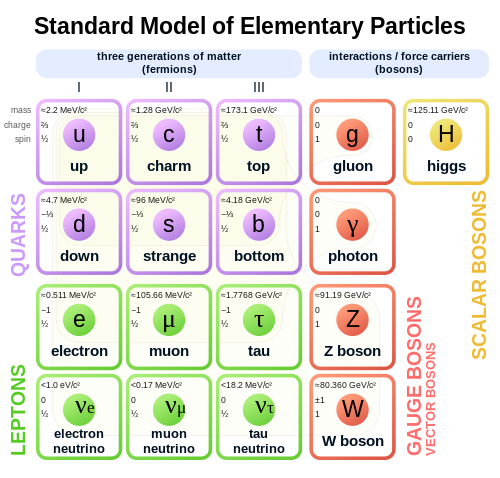
Standard Model Gauge Symmetries
The Standard Model of particle physics is fully formulated with gauge group SU(3)×SU(2)×U(1), highlighting symmetry in nature. #physics #symmetry
Standard Model Gauge Symmetries By Cush - Own work using: PBS NOVA [1], Fermilab, Office of Science, United States Department of Energy, Particle Data Group, Public domain, https://commons.wikimedia.org/w/index.php?curid=4286964
1995 CE
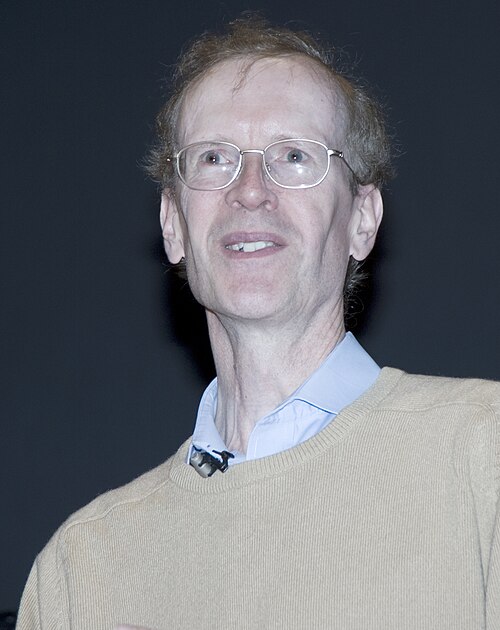
Wiles Proves Fermat's Last Theorem
Andrew Wiles uses modular forms and Galois representations, powerful symmetry tools, to prove Fermat's Last Theorem. #mathematics #theorem
Wiles Proves Fermat's Last Theorem By "copyright C. J. Mozzochi, Princeton N.J" - http://www.mozzochi.org/deligne60/Deligne1/_DSC0024.jpg, Attribution, https://commons.wikimedia.org/w/index.php?curid=2635913
1998 CE
Langlands Program Advances
Laurent Lafforgue proves the Langlands correspondence for function fields, linking number theory and representation theory. #mathematics #Langlands
2004 CE
Classification Completed (Aschbacher)
Michael Aschbacher finishes the last steps of the classification of finite simple groups, a landmark in group theory. #mathematics #classification
2008 CE
GAP Computational Group Theory
The GAP system for computational discrete algebra becomes a standard tool for group theory research. #mathematics #software )
GAP Computational Group Theory By Max Horn aka BlackFingolfin - Own work, CC BY-SA 4.0, https://commons.wikimedia.org/w/index.php?curid=176689757
Jul 4, 2012 CE
Higgs Boson Discovery
CERN announces discovery of Higgs boson, confirming spontaneous symmetry breaking in the Standard Model. #physics #symmetry
Higgs Boson Discovery By CERN for the ATLAS and CMS Collaborations - https://cds.cern.ch/record/1630222, CC BY-SA 3.0, https://commons.wikimedia.org/w/index.php?curid=29737816
2013 CE
Quasithin Groups Classification
Aschbacher and Smith complete the classification of quasithin groups, a remaining piece of the finite simple group classification. #mathematics #milestone
2015 CE
Langlands Program: Fundamental Lemma Proved
Ngô Bảo Châu proves the fundamental lemma, a key step in the Langlands program, earning a Fields Medal. #mathematics #FieldsMedal
Langlands Program: Fundamental Lemma Proved By Nguyentrongphu - Own work, CC BY-SA 4.0, https://commons.wikimedia.org/w/index.php?curid=169783860
2018 CE
Machine Learning Discovers Symmetries
Researchers use neural networks to automatically detect symmetries in physical systems, opening new AI-driven approaches. #AI #symmetry )
Machine Learning Discovers Symmetries By Inductiveload - Own work, Public domain, https://commons.wikimedia.org/w/index.php?curid=3999372
2020 CE
Quantum Groups and Topological Quantum Computing
Quantum groups, non-commutative symmetries, become central to topological quantum computing and knot theory. #mathematics #quantum
2022 CE
Symmetry in Deep Learning Architectures
Equivariant neural networks leveraging group theory achieve state-of-the-art performance in scientific applications. #AI #deeplearning