Group Theory & Symmetry: Major Case Studies & Paradigm Shifts
Encyclopedia/1. The Cosmos & The Natural World/1. Mathematics & Formal Systems/02. Algebra & Symbolic Systems • Curated by Admin Timeline.sg
A comprehensive timeline tracing the evolution of group theory and symmetry from ancient pattern recognition to modern abstract algebra and its applications in physics, chemistry, and beyond.
Chronological Storyline (37 Milestones)
500 BCE
Panini's Sanskrit Grammar
Panini formulates a generative grammar of Sanskrit using formal rules and transformations, predating modern group theory concepts with its algebraic approach to linguistic symmetry. #mathematics #linguistics #history
300 BCE
Euclid's Elements and Symmetry of Solids
Euclid's 'Elements' systematically studies the symmetries of regular polygons and polyhedra, laying geometric foundations for later group theory. #mathematics #geometry #history
Euclid's Elements and Symmetry of Solids By University of Pennsylvania Museum of Archaeology and Anthropology - https://openn.library.upenn.edu/Data/0016/html/e2748.html, CC BY-SA 4.0, https://commons.wikimedia.org/w/index.php?curid=169166171
200 BCE
Lo Shu Magic Square
The Lo Shu square, a 3x3 magic square from ancient China, exhibits symmetry and additive properties, representing early combinatorial symmetry. #mathematics #china #history
Lo Shu Magic Square By AnonMoos - Own work - Made by self from scratch, following layout of PD image Luo4shu1.jpg., Public domain, https://commons.wikimedia.org/w/index.php?curid=8888999
200 CE
Pingala's Combinatorics of Meters
Indian scholar Pingala develops a system for enumerating poetic meters using binary sequences, anticipating symmetric group concepts. #mathematics #india #combinatorics
499 CE
Aryabhata's Sine Tables and Cyclic Permutations
Aryabhata's work on sine differences implicitly uses cyclic symmetry and permutation ideas, influencing later Indian mathematics. #mathematics #india #astronomy
Aryabhata's Sine Tables and Cyclic Permutations By Cpjha13 - Own work, CC BY-SA 4.0, https://commons.wikimedia.org/w/index.php?curid=49883192
800 CE
Al-Khwarizmi's Algebra
Al-Khwarizmi's 'The Compendious Book on Calculation by Completion and Balancing' systematizes algebraic methods, later crucial for solving symmetric equations. #mathematics #islamicgoldenage #algebra
Al-Khwarizmi's Algebra By Zarateman - Own work, CC0, https://commons.wikimedia.org/w/index.php?curid=162213187
1000 CE
Alhambra Tessellations
The intricate geometric patterns of the Alhambra in Spain exhibit all 17 wallpaper symmetry groups, demonstrating advanced intuitive understanding of symmetry. #mathematics #art #islamic
Alhambra Tessellations By Jebulon - Own work, CC0, https://commons.wikimedia.org/w/index.php?curid=52005558
1130 CE
Bhaskara II's Lilavati on Permutations
Bhaskara II's 'Lilavati' includes combinatorial formulas for permutations and combinations, essential for later group theory. #mathematics #india #combinatorics
Bhaskara II's Lilavati on Permutations By Bhaskaracharya - http://unesdoc.unesco.org/images/0008/000842/084201eo.pdf, Public domain, https://commons.wikimedia.org/w/index.php?curid=42777313
1202 CE
Fibonacci's Liber Abaci
Fibonacci's book introduces Hindu-Arabic numerals and combinatorial methods to Europe, influencing permutation studies. #mathematics #europe #combinatorics
Fibonacci's Liber Abaci By Unknown author, Public domain, https://commons.wikimedia.org/w/index.php?curid=720501
1300 CE
Yang Hui's Magic Squares
Chinese mathematician Yang Hui constructs and studies magic squares of various orders, exploring their symmetrical properties. #mathematics #china #recreation
Yang Hui's Magic Squares By Yáng Huī (楊輝), ca. 1238–1298) - w:en:Image:Yanghui_triangle.gif, Public domain, https://commons.wikimedia.org/w/index.php?curid=1189650
1545 CE
Cardano's Ars Magna and Cubic Formula
Cardano publishes the general solution to cubic equations, involving symmetric expressions that foreshadow group theory. #mathematics #algebra #history )
1572 CE
Bombelli's Algebra and Complex Numbers
Rafael Bombelli introduces complex numbers in solving cubic equations, highlighting symmetry between roots. #mathematics #algebra #complex
Bombelli's Algebra and Complex Numbers By Unknown author - Book printed by editor Giovanni Rossi, Public domain, https://commons.wikimedia.org/w/index.php?curid=1591687
1682 CE
Leibniz's Work on Permutations
Gottfried Wilhelm Leibniz writes 'De Arte Combinatoria' and studies permutations of symbols, early steps toward symmetric groups. #mathematics #combinatorics #history
Leibniz's Work on Permutations By Unknown author - Deutsche Fotothek, Public domain, https://commons.wikimedia.org/w/index.php?curid=6476680
1770 CE
Lagrange's Memoir on Permutations
Joseph-Louis Lagrange's landmark paper analyzes polynomial root permutations, founding the theory of permutation groups. #mathematics #algebra #history
Lagrange's Memoir on Permutations By Unknown author - File:Joseph_Louis_Lagrange.jpg, CC0, https://commons.wikimedia.org/w/index.php?curid=155608232
1799 CE
Ruffini's Attempt to Prove Quintic Unsolvability
Paolo Ruffini publishes an incomplete proof that the quintic equation is unsolvable by radicals, using permutation group ideas. #mathematics #algebra #history
Ruffini's Attempt to Prove Quintic Unsolvability By Unknown - https://i.bigenc.ru/Azc5DHKsI0yKslqp0YR2mSpJo4HQq_Eu-YfQ3CG3hiU/xl/ODNlOGVjODZkZTQ2OTkyM2NmYTMyNWVlMDNiZmY0Y2YuanBn.webp, CC0, https://commons.wikimedia.org/w/index.php?curid=130821361
1824 CE
Abel's Proof of Quintic Unsolvability
Niels Henrik Abel proves the insolvability of the general quintic equation using radicals, a milestone in group theory's birth. #mathematics #algebra #history
Abel's Proof of Quintic Unsolvability By Johan Gørbitz - Originally uploaded to English wikipedia by en:User:Pladask, http://www.math.uio.no/div/abelkonkurransen/, Public domain, https://commons.wikimedia.org/w/index.php?curid=90392
1832 CE
Galois's Theory of Equations
Évariste Galois develops the theory linking polynomial equations to group theory, founding Galois theory before his death. #mathematics #algebra #galoistheory
Galois's Theory of Equations By Unknown author - Iyanaga, Shokichi, "ガロアの時代 ガロアの数学 第一部 時代篇" , Springer-Verlag Tokyo, 1999 http://www.win.tue.nl/~aeb/at/GaloisCorrespondence.html, Public domain, https://commons.wikimedia.org/w/index.php?curid=103351
1849 CE
Cayley's Abstract Group Definition
Arthur Cayley defines a group as an abstract algebraic structure, moving beyond permutations. #mathematics #abstractalgebra #history
Cayley's Abstract Group Definition By Herbert Beraud (1845–1896) - http://www-groups.dcs.st-and.ac.uk/~history/PictDisplay/Cayley.html, Public domain, https://commons.wikimedia.org/w/index.php?curid=904674
1854 CE
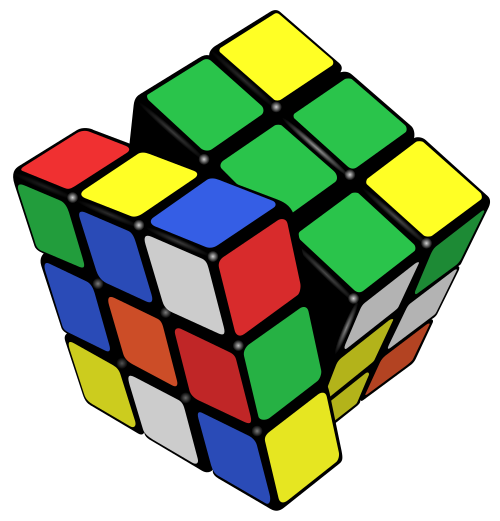
Cayley's First Abstract Group Paper
Cayley publishes 'On the theory of groups' establishing the modern definition of a group with closure, associativity, identity, and inverses. #mathematics #abstractalgebra #history )
Cayley's First Abstract Group Paper By This image was created by me, Booyabazooka - Based on Image:Rubiks cube.jpg, CC BY-SA 3.0, https://commons.wikimedia.org/w/index.php?curid=4771790
1869 CE
Jordan's Traité des Substitutions
Camille Jordan publishes 'Traité des substitutions et des équations algébriques', the first comprehensive book on permutation groups and Galois theory. #mathematics #algebra #history
Jordan's Traité des Substitutions By Eugène Pirou - Archivio storico dell'Accademia delle Scienze - Catalogo digitale, Public domain, https://commons.wikimedia.org/w/index.php?curid=106265667
1870 CE
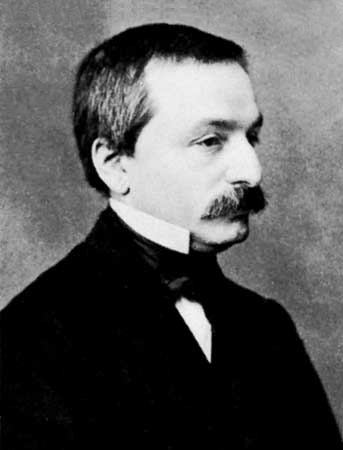
Kronecker's Theorem on Abelian Groups
Leopold Kronecker proves the structure theorem for finitely generated abelian groups, a fundamental result. #mathematics #abstractalgebra #history
Kronecker's Theorem on Abelian Groups By Unknown author - http://www.britannica.com/EBchecked/media/28346/Kronecker-1865, Public domain, https://commons.wikimedia.org/w/index.php?curid=33753789
1872 CE
Klein's Erlangen Program
Felix Klein's Erlangen Program classifies geometries by their symmetry groups, profoundly linking group theory to geometry. #mathematics #geometry #groups
Klein's Erlangen Program By Unknown author, Public domain, https://commons.wikimedia.org/w/index.php?curid=38617
1884 CE
Lie's Continuous Groups
Sophus Lie publishes 'Theorie der Transformationsgruppen', founding the theory of continuous groups (Lie groups). #mathematics #analysis #geometry
Lie's Continuous Groups By L. Szaciński (Christiania) - Flickr: Portrett av Sophus Lie, 1896, No restrictions, https://commons.wikimedia.org/w/index.php?curid=64917266
1897 CE
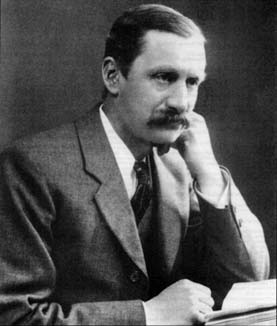
Burnside's Theory of Groups
William Burnside publishes the first English textbook on group theory, 'Theory of Groups of Finite Order', a standard reference. #mathematics #abstractalgebra #history
Burnside's Theory of Groups By Unknown author, Copyrighted free use, https://commons.wikimedia.org/w/index.php?curid=545215
1900 CE
Hilbert's 19th Problem
David Hilbert poses the 19th problem concerning variational problems and symmetry, stimulating research in group actions. #mathematics #analysis #history
1905 CE
Noether's Theorem
Emmy Noether proves that every continuous symmetry corresponds to a conservation law, linking group theory to physics. #mathematics #physics #symmetry
Noether's Theorem By Emmy Noether - "Invariante Variationsprobleme" (Nachrichten von der Gesellschaft der Wissenschaften zu Göttingen, Mathematisch-Physikalische Klasse 1918 (1918): 235-257. <http://eudml.org/doc/59024>), Public domain, https://commons.wikimedia.org/w/index.php?curid=69398536
1913 CE
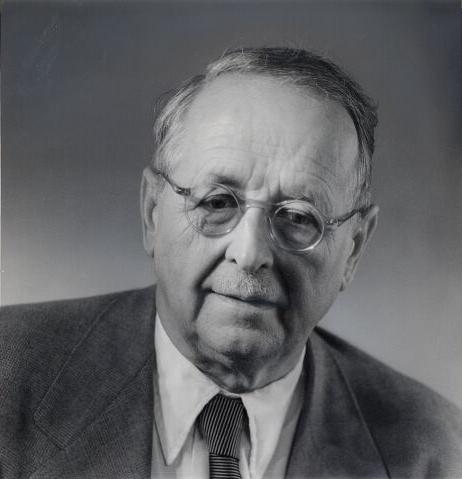
Weyl's Representation Theory
Hermann Weyl publishes 'Die Theorie der Gruppen und Quantenmechanik', applying group representation theory to quantum mechanics. #mathematics #quantum #physics
Weyl's Representation Theory By ETH Zürich - ETH-Bibliothek Zürich, Bildarchiv, CC BY-SA 3.0, https://commons.wikimedia.org/w/index.php?curid=8098412
1925 CE
Quantum Mechanics and Group Theory
Wigner, Heisenberg, and others use group theory to classify atomic spectra and understand symmetries in quantum systems. #physics #quantum #symmetry
1939 CE
Chevalley's Algebraic Groups
Claude Chevalley develops the theory of algebraic groups over arbitrary fields, unifying concepts from group theory, geometry, and number theory. #mathematics #algebraicgeometry #history
Chevalley's Algebraic Groups By Original: Jakob.scholbach Vector: Pbroks13 - Own work based on: Cyclic group.png, CC BY-SA 3.0, https://commons.wikimedia.org/w/index.php?curid=4370108
1955 CE
Tits Buildings and Spherical Buildings
Jacques Tits introduces buildings as simplicial complexes with group actions, providing geometric structures for Lie groups and algebraic groups. #mathematics #geometry #groups )
1960 CE
Feit-Thompson Theorem
Walter Feit and John G. Thompson prove that every finite group of odd order is solvable, a key step toward classifying finite simple groups. #mathematics #finitegroups #history
1970 CE
Discovery of the Monster Group
Bernd Fischer and Robert Griess discover the Monster group, the largest sporadic simple group with size about 8×10^53. #mathematics #finitegroups #discovery
1982 CE
Classification of Finite Simple Groups
The classification of finite simple groups is announced as complete after decades of effort by hundreds of mathematicians. #mathematics #finitegroups #history
1990 CE
GAP Computer Algebra System
The GAP system for computational discrete algebra is released, enabling group theorists to explore and compute with groups efficiently. #mathematics #computational #software )
GAP Computer Algebra System By Max Horn aka BlackFingolfin - Own work, CC BY-SA 4.0, https://commons.wikimedia.org/w/index.php?curid=176689757
2004 CE
Atlas of Finite Group Representations
The Atlas of Finite Group Representations is published online, providing detailed information about finite simple groups and their representations. #mathematics #finitegroups #data
2016 CE
Completion of the Classification Proof
The final proof of the classification of finite simple groups is published in book series, confirming the theorem's validity. #mathematics #finitegroups #history
2020 CE
Monstrous Moonshine Conjectures Proven
The Monstrous Moonshine conjectures linking the Monster group to modular functions are fully proven, revealing deep connections between group theory and number theory. #mathematics #numer theory #groups