Group Theory & Symmetry: Global Cross-Cultural Perspectives
Encyclopedia/1. The Cosmos & The Natural World/1. Mathematics & Formal Systems/02. Algebra & Symbolic Systems • Curated by Admin Timeline.sg
This timeline traces the global evolution of group theory and symmetry concepts from ancient geometric intuitions to the modern classification of finite simple groups, highlighting contributions from diverse civilizations including Greek, Islamic, Indian, Chinese, Japanese, and European mathematicians.
Chronological Storyline (35 Milestones)
300 BCE
Euclid Explores Geometric Symmetry
Euclid's 'Elements' systematically studies geometric transformations and symmetries, laying foundational ideas for later group theory. #mathematics #history
Euclid Explores Geometric Symmetry By University of Pennsylvania Museum of Archaeology and Anthropology - https://openn.library.upenn.edu/Data/0016/html/e2748.html, CC BY-SA 4.0, https://commons.wikimedia.org/w/index.php?curid=169166171
100 BCE
Pingala's Combinatorial Mathematics
Ancient Indian scholar Pingala develops combinatorial formulas for permutations and combinations in his Chandas Shastra, anticipating group-theoretic concepts. #mathematics #India
500 CE
Aryabhata's Cyclic Concepts
Indian mathematician Aryabhata uses cyclic permutations in astronomical calculations, reflecting early symmetry thinking. #mathematics #astronomy
Aryabhata's Cyclic Concepts By Cpjha13 - Own work, CC BY-SA 4.0, https://commons.wikimedia.org/w/index.php?curid=49883192
820 CE
Al-Khwarizmi's Algebra
Persian scholar Al-Khwarizmi publishes 'The Compendious Book on Calculation by Completion and Balancing', systematically solving linear and quadratic equations, indirectly influencing later algebraic structures. #algebra #IslamicGoldenAge
Al-Khwarizmi's Algebra By Zarateman - Own work, CC0, https://commons.wikimedia.org/w/index.php?curid=162213187
1303 CE
Zhu Shijie's Polynomial Equations
Chinese mathematician Zhu Shijie in 'Jade Mirror of the Four Unknowns' solves systems of polynomial equations, advancing algebraic symmetry methods. #mathematics #China
Zhu Shijie's Polynomial Equations By Zhu Shijie - mybook 唐戈藏书, Public domain, https://commons.wikimedia.org/w/index.php?curid=19268418
1480 CE
Nilakantha's Cyclic Permutations
Indian mathematician Nilakantha Somayaji in 'Tantrasamgraha' uses cyclic permutations in celestial mechanics, demonstrating early group-like reasoning. #mathematics #India
1683 CE
Seki Takakazu's Determinant Theory
Japanese mathematician Seki Takakazu independently develops determinant theory and studies permutation patterns, contributing to early group theory. #mathematics #Japan
Seki Takakazu's Determinant Theory By upload by AMorozov - Gakken, Public domain, https://commons.wikimedia.org/w/index.php?curid=710154
1770 CE
Lagrange's Réflexions on Equations
Joseph-Louis Lagrange publishes 'Réflexions sur la résolution algébrique des équations', studying permutations of roots and laying groundwork for group theory. #mathematics #algebra
Lagrange's Réflexions on Equations By Unknown author - File:Joseph_Louis_Lagrange.jpg, CC0, https://commons.wikimedia.org/w/index.php?curid=155608232
1799 CE
Ruffini's Partial Proof on Quintic
Paolo Ruffini attempts to prove the unsolvability of quintic equations by radicals, using permutation groups. #mathematics #history
Ruffini's Partial Proof on Quintic By Unknown - https://i.bigenc.ru/Azc5DHKsI0yKslqp0YR2mSpJo4HQq_Eu-YfQ3CG3hiU/xl/ODNlOGVjODZkZTQ2OTkyM2NmYTMyNWVlMDNiZmY0Y2YuanBn.webp, CC0, https://commons.wikimedia.org/w/index.php?curid=130821361
1812 CE
Cauchy's Permutation Group Work
Augustin-Louis Cauchy publishes on permutation groups, formalizing group properties and introducing the concept of a subgroup. #mathematics #groupTheory
Cauchy's Permutation Group Work By Public domain - Library of Congress Prints and Photographs Division. From an illustration in: Das neunzehnte Jahrhundert in Bildnissen / Karl Werckmeister, ed. Berlin : Kunstverlag der photographische gesellschaft, 1840, vol. V, no. 581., Public domain, https://commons.wikimedia.org/w/index.php?curid=7059486
1824 CE
Abel Proves Quintic Unsolvability
Niels Henrik Abel proves that the general quintic equation is unsolvable by radicals, a key result in Galois theory. #mathematics #algebra
Abel Proves Quintic Unsolvability By Johan Gørbitz - Originally uploaded to English wikipedia by en:User:Pladask, http://www.math.uio.no/div/abelkonkurransen/, Public domain, https://commons.wikimedia.org/w/index.php?curid=90392
May 30, 1832 CE
Galois Develops Group Theory
Évariste Galois outlines Galois theory, linking field theory with group theory and introducing the concept of a normal subgroup. #mathematics #galoisTheory
Galois Develops Group Theory By Unknown author - Iyanaga, Shokichi, "ガロアの時代 ガロアの数学 第一部 時代篇" , Springer-Verlag Tokyo, 1999 http://www.win.tue.nl/~aeb/at/GaloisCorrespondence.html, Public domain, https://commons.wikimedia.org/w/index.php?curid=103351
Oct 16, 1843 CE
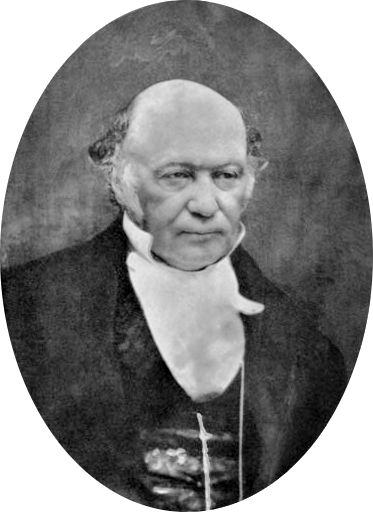
Hamilton Discovers Quaternions
William Rowan Hamilton crafts the quaternion system, a non-commutative division algebra that inspires matrix group theory. #mathematics #algebra
Hamilton Discovers Quaternions By William_Rowan_Hamilton_portrait_oval.png: UnknownUnknown William_Rowan_Hamilton_portrait_oval_2.png: UnknownUnknown derivative work: Quibik (talk) - William_Rowan_Hamilton_portrait_oval.png William_Rowan_Hamilton_portrait_oval_2.png, Public domain, https://commons.wikimedia.org/w/index.php?curid=11336587
1849 CE
Cayley Defines Abstract Group
Arthur Cayley gives the first abstract definition of a finite group, ignoring the nature of elements and focusing on axioms. #mathematics #groupTheory
Cayley Defines Abstract Group By Herbert Beraud (1845–1896) - http://www-groups.dcs.st-and.ac.uk/~history/PictDisplay/Cayley.html, Public domain, https://commons.wikimedia.org/w/index.php?curid=904674
1854 CE
Cayley's Theorem on Permutation Groups
Cayley proves that every finite group is isomorphic to a subgroup of a symmetric group. #mathematics #groupTheory
1870 CE
Jordan's Traité des Substitutions
Camille Jordan publishes 'Traité des substitutions et des équations algébriques', a comprehensive treatise on permutation groups. #mathematics #groupTheory
Jordan's Traité des Substitutions By Eugène Pirou - Archivio storico dell'Accademia delle Scienze - Catalogo digitale, Public domain, https://commons.wikimedia.org/w/index.php?curid=106265667
1872 CE
Klein's Erlangen Program
Felix Klein proposes the Erlangen program, classifying geometries via transformation groups. #mathematics #geometry
Klein's Erlangen Program By Unknown author, Public domain, https://commons.wikimedia.org/w/index.php?curid=38617
1878 CE
Frobenius on Group Representations
Ferdinand Georg Frobenius initiates representation theory of finite groups. #mathematics #representationTheory
Frobenius on Group Representations By Furfur - (de): Oberwolfach Photo Collection, aus einem Fotoalbum der Mathematischen Gesellschaft (Hamburg)(en): Oberwolfach Photo Collection, from a photo album of the Mathematische Gesellschaft (Hamburg), CC BY-SA 3.0, https://commons.wikimedia.org/w/index.php?curid=59417515
1882 CE
Dyck's Abstract Group Definition
Walter Dyck gives the first abstract definition of a group using generators and relations. #mathematics #groupTheory
1897 CE
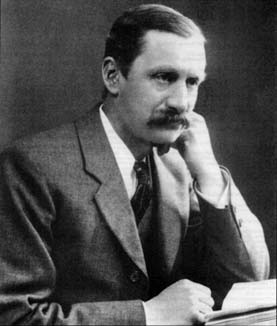
Burnside's Group Theory Book
William Burnside publishes 'Theory of Groups of Finite Order', a standard reference. #mathematics #groupTheory
Burnside's Group Theory Book By Unknown author, Copyrighted free use, https://commons.wikimedia.org/w/index.php?curid=545215
Aug 8, 1900 CE
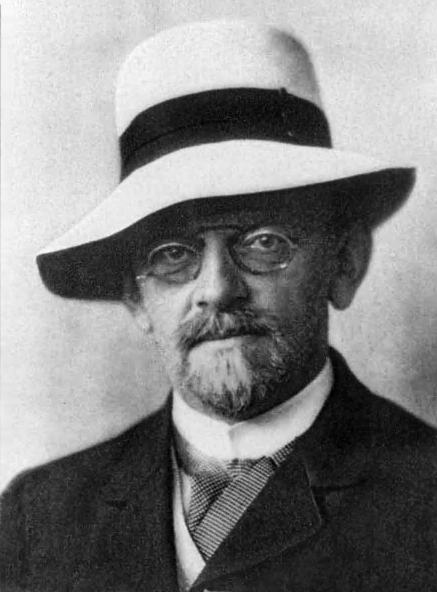
Hilbert's Problems Include Groups
David Hilbert includes the problem of determining solvability of polynomial equations by radicals (Galois theory) in his famous list. #mathematics #history
Hilbert's Problems Include Groups By Unknown author - Possibly Reid, Constance (1970) Hilbert, Berlin, Heidelberg: Springer Berlin Heidelberg Imprint Springer, p. 230 ISBN: 978-3-662-27132-2., Public domain, https://commons.wikimedia.org/w/index.php?curid=36302
1913 CE
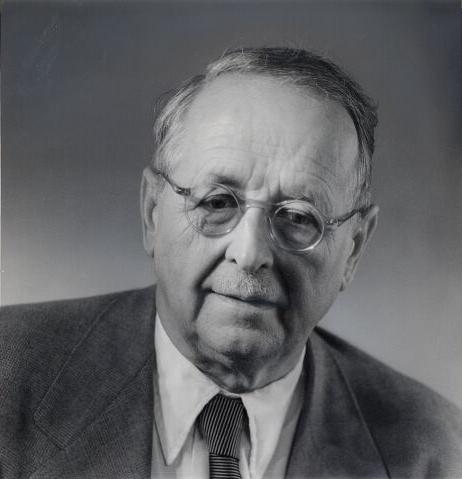
Weyl's Representation Theory
Hermann Weyl publishes 'The Theory of Groups and Quantum Mechanics', applying group representation theory to physics. #mathematics #physics
Weyl's Representation Theory By ETH Zürich - ETH-Bibliothek Zürich, Bildarchiv, CC BY-SA 3.0, https://commons.wikimedia.org/w/index.php?curid=8098412
1925 CE
Heisenberg's Matrix Mechanics
Werner Heisenberg develops matrix mechanics, using non-commutative algebra underlying quantum symmetries. #physics #quantum
1928 CE
Wigner's Group Theory in Quantum Mechanics
Eugene Wigner publishes 'Group Theory and Its Application to the Quantum Mechanics of Atomic Spectra'. #physics #mathematics
Wigner's Group Theory in Quantum Mechanics By Nobel foundation - https://nobelprize.org/nobel_prizes/physics/laureates/1963/wigner-bio.html, Public domain, https://commons.wikimedia.org/w/index.php?curid=6141135
1939 CE
Brauer's Modular Representation Theory
Richard Brauer develops modular representation theory of finite groups. #mathematics #representationTheory
Brauer's Modular Representation Theory By Jacobs, Konrad - https://opc.mfo.de/detail?photo_id=467, CC BY-SA 2.0 de, https://commons.wikimedia.org/w/index.php?curid=7756475
1955 CE
Chevalley's Classification of Semisimple Groups
Claude Chevalley classifies semisimple algebraic groups over algebraically closed fields. #mathematics #algebra
Chevalley's Classification of Semisimple Groups By Konrad Jacobs - MFO, CC BY-SA 2.0 de, https://commons.wikimedia.org/w/index.php?curid=8046334
1963 CE
Feit-Thompson Theorem on Odd Order
Walter Feit and John G. Thompson prove that every finite group of odd order is solvable, a milestone. #mathematics #groupTheory
1968 CE
Conway's Groups Discovered
John Horton Conway discovers three sporadic simple groups (Co1, Co2, Co3). #mathematics #groupTheory
Conway's Groups Discovered By Original: Jakob.scholbach Vector: Pbroks13 - Own work based on: Cyclic group.png, CC BY-SA 3.0, https://commons.wikimedia.org/w/index.php?curid=4370108
1972 CE
Classification of Finite Simple Groups Begins
Work begins on the classification of finite simple groups, involving many mathematicians. #mathematics #groupTheory
1981 CE
Babai's Algorithm for Graph Isomorphism
László Babai uses group theory to develop a quasipolynomial-time algorithm for graph isomorphism. #mathematics #computerscience
Babai's Algorithm for Graph Isomorphism By Unknown author, CC BY-SA 3.0, https://commons.wikimedia.org/w/index.php?curid=1347424
1983 CE
Aschbacher's Theorem on Subgroup Structure
Michael Aschbacher publishes his theorem on subgroup structure of finite simple groups. #mathematics #groupTheory
1994 CE
Wiles Uses Galois Groups for Fermat's Last Theorem
Andrew Wiles proves Fermat's Last Theorem using Galois representations and modular forms. #mathematics #numberTheory
Wiles Uses Galois Groups for Fermat's Last Theorem By "copyright C. J. Mozzochi, Princeton N.J" - http://www.mozzochi.org/deligne60/Deligne1/_DSC0024.jpg, Attribution, https://commons.wikimedia.org/w/index.php?curid=2635913
2004 CE
Monster Group Construction Verified
The existence and uniqueness of the Monster group is computer-verified by the Atlas project. #mathematics #groupTheory
2012 CE
Langlands Program Links Groups and Number Theory
Robert Langlands' program connecting Galois groups with automorphic forms becomes a central research area. #mathematics #numberTheory
2020 CE
Gruber's Group Theory in Machine Learning
Research on symmetry groups and invariant theory enhances neural network design. #mathematics #machinelearning