Group Theory & Symmetry: Foundational Epochs & Key Milestones
Encyclopedia/1. The Cosmos & The Natural World/1. Mathematics & Formal Systems/02. Algebra & Symbolic Systems • Curated by Admin Timeline.sg
Group theory originated from the study of polynomial equations and symmetry, evolving into a central branch of modern mathematics with deep applications in physics. This timeline traces key milestones from ancient geometry to the classification of finite simple groups.
Chronological Storyline (39 Milestones)
300 BCE
Euclid's Elements on Symmetry of Regular Polyhedra
Euclid's Elements lays foundation for geometry, including the five Platonic solids, which exhibit high symmetry. This work influenced later mathematical concepts of symmetry groups. #math #history
Euclid's Elements on Symmetry of Regular Polyhedra By University of Pennsylvania Museum of Archaeology and Anthropology - https://openn.library.upenn.edu/Data/0016/html/e2748.html, CC BY-SA 4.0, https://commons.wikimedia.org/w/index.php?curid=169166171
1770 CE
Lagrange's Memoir on Permutations
Joseph-Louis Lagrange publishes reflections on the solution of algebraic equations, introducing the study of permutations of roots. This work is a precursor to group theory. #algebra #history
Lagrange's Memoir on Permutations By Unknown author - File:Joseph_Louis_Lagrange.jpg, CC0, https://commons.wikimedia.org/w/index.php?curid=155608232
1799 CE
Ruffini's Attempt on Quintic Unsolvability
Paolo Ruffini attempts to prove that the general quintic equation cannot be solved by radicals, using permutation groups. Though incomplete, it sparked important developments. #algebra #groupTheory
Ruffini's Attempt on Quintic Unsolvability By Unknown - https://i.bigenc.ru/Azc5DHKsI0yKslqp0YR2mSpJo4HQq_Eu-YfQ3CG3hiU/xl/ODNlOGVjODZkZTQ2OTkyM2NmYTMyNWVlMDNiZmY0Y2YuanBn.webp, CC0, https://commons.wikimedia.org/w/index.php?curid=130821361
1801 CE
Gauss's Disquisitiones Arithmeticae
Carl Friedrich Gauss publishes Disquisitiones Arithmeticae, establishing modular arithmetic and cyclic groups. This work laid the foundation for abelian group theory and number theory. #numberTheory #groupTheory
Gauss's Disquisitiones Arithmeticae By Unknown author, Public domain, https://commons.wikimedia.org/w/index.php?curid=641724
1824 CE
Abel Proves Quintic Unsolvability
Niels Henrik Abel proves that the general quintic equation cannot be solved by radicals, leading to the concept of Abelian groups. His work highlighted the role of group structure in solvability. #algebra #groupTheory
Abel Proves Quintic Unsolvability By Johan Gørbitz - Originally uploaded to English wikipedia by en:User:Pladask, http://www.math.uio.no/div/abelkonkurransen/, Public domain, https://commons.wikimedia.org/w/index.php?curid=90392
1832 CE
Galois Develops Group Theory
Évariste Galois develops the theory of groups and Galois theory, linking polynomial equations to symmetries of their roots. This work founded abstract group theory and solvability criteria. #groupTheory #algebra
Galois Develops Group Theory By Unknown author - Iyanaga, Shokichi, "ガロアの時代 ガロアの数学 第一部 時代篇" , Springer-Verlag Tokyo, 1999 http://www.win.tue.nl/~aeb/at/GaloisCorrespondence.html, Public domain, https://commons.wikimedia.org/w/index.php?curid=103351
1843 CE
Hamilton Discovers Quaternions
William Rowan Hamilton discovers quaternions, the first non-commutative algebraic structure. This provided an early example of a non-abelian group and impacted group theory. #algebra #groupTheory
Hamilton Discovers Quaternions By Cmglee - Own work, CC BY-SA 4.0, https://commons.wikimedia.org/w/index.php?curid=145997978
1844 CE
Grassmann's Ausdehnungslehre
Hermann Grassmann publishes his work on vector spaces and exterior algebra. Though not directly group theory, it influenced the development of algebraic structures and symmetries. #linearAlgebra #algebra
Grassmann's Ausdehnungslehre By Unknown author - From the beginning of vol. 1 of Grassmann's collected works (1894), Public domain, https://commons.wikimedia.org/w/index.php?curid=174414110
1846 CE
Cauchy's Work on Permutation Groups
Augustin-Louis Cauchy publishes important results on permutation groups, including Cauchy's theorem on the existence of elements of prime order. #groupTheory #algebra
Cauchy's Work on Permutation Groups By Public domain - Library of Congress Prints and Photographs Division. From an illustration in: Das neunzehnte Jahrhundert in Bildnissen / Karl Werckmeister, ed. Berlin : Kunstverlag der photographische gesellschaft, 1840, vol. V, no. 581., Public domain, https://commons.wikimedia.org/w/index.php?curid=7059486
1854 CE
Cayley Defines Abstract Group
Arthur Cayley gives the first abstract definition of a group as a set with a binary operation, and introduces Cayley tables. This formalized group theory as a distinct field. #groupTheory #algebra
Cayley Defines Abstract Group By Herbert Beraud (1845–1896) - http://www-groups.dcs.st-and.ac.uk/~history/PictDisplay/Cayley.html, Public domain, https://commons.wikimedia.org/w/index.php?curid=904674
1870 CE
Jordan's Traité des Substitutions
Camille Jordan publishes a comprehensive treatise on permutation groups, systematizing finite group theory. This work became a standard reference for decades. #groupTheory #history
Jordan's Traité des Substitutions By Eugène Pirou - Archivio storico dell'Accademia delle Scienze - Catalogo digitale, Public domain, https://commons.wikimedia.org/w/index.php?curid=106265667
1872 CE
Klein's Erlangen Program
Felix Klein presents the Erlangen Program, classifying geometries by their symmetry groups. This unified geometry through group theory and transformed mathematical thinking. #geometry #groupTheory
Klein's Erlangen Program By Unknown author, Public domain, https://commons.wikimedia.org/w/index.php?curid=38617
1878 CE
Cayley's Theorem
Arthur Cayley proves that every group can be represented as a permutation group, now known as Cayley's theorem. This result connects abstract groups to concrete symmetries. #groupTheory #algebra
1880 CE
Sophus Lie Begins Lie Groups
Sophus Lie introduces continuous transformation groups (Lie groups) to study differential equations. This founded a major branch of group theory with applications in geometry and physics. #lieGroups #differentialEquations
Sophus Lie Begins Lie Groups By L. Szaciński (Christiania) - Flickr: Portrett av Sophus Lie, 1896, No restrictions, https://commons.wikimedia.org/w/index.php?curid=64917266
1885 CE
Poincaré on Fuchsian Groups
Henri Poincaré studies Fuchsian groups, discrete subgroups of the special linear group. This work linked group theory, geometry, and complex analysis. #groupTheory #geometry
Poincaré on Fuchsian Groups By Adam majewski - Own work, CC BY-SA 4.0, https://commons.wikimedia.org/w/index.php?curid=62205191
1887 CE
Killing Classifies Simple Lie Algebras
Wilhelm Killing begins the classification of simple Lie algebras, a pivotal step in Lie theory. This work was completed by Élie Cartan and is fundamental to group theory. #lieTheory #algebra
Killing Classifies Simple Lie Algebras By Unknown author - http://www-history.mcs.st-andrews.ac.uk/Mathematicians/Killing.html, Public domain, https://commons.wikimedia.org/w/index.php?curid=26763585
1891 CE
Fedorov Classifies Crystallographic Groups
Evgraf Fedorov, and independently Arthur Schoenflies, classify the 230 space groups (crystallographic groups). This applied group theory to symmetry in crystals. #crystallography #groupTheory
Fedorov Classifies Crystallographic Groups By Dbuckingham42 - Own work, CC BY-SA 4.0, https://commons.wikimedia.org/w/index.php?curid=42700216
1897 CE
Frobenius Begins Representation Theory
Ferdinand Georg Frobenius develops character theory for finite groups, initiating representation theory. This became a powerful tool in group theory and other fields. #groupTheory #representationTheory
Frobenius Begins Representation Theory By Furfur - (de): Oberwolfach Photo Collection, aus einem Fotoalbum der Mathematischen Gesellschaft (Hamburg)(en): Oberwolfach Photo Collection, from a photo album of the Mathematische Gesellschaft (Hamburg), CC BY-SA 3.0, https://commons.wikimedia.org/w/index.php?curid=59417515
1900 CE
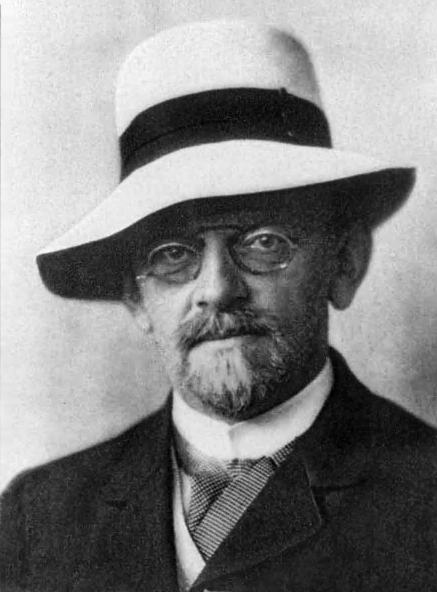
Hilbert's Problem List Includes Group Theory
David Hilbert presents 23 problems for the 20th century, including questions on group theory and its applications, motivating extensive research. #mathematics #history
Hilbert's Problem List Includes Group Theory By Unknown author - Possibly Reid, Constance (1970) Hilbert, Berlin, Heidelberg: Springer Berlin Heidelberg Imprint Springer, p. 230 ISBN: 978-3-662-27132-2., Public domain, https://commons.wikimedia.org/w/index.php?curid=36302
1902 CE
Burnside's Problem
William Burnside poses the Burnside problem, asking whether every finitely generated group with all elements of finite order is finite. This fueled research in group theory. #groupTheory #openProblem
Burnside's Problem By Original: Jakob.scholbach Vector: Pbroks13 - Own work based on: Cyclic group.png, CC BY-SA 3.0, https://commons.wikimedia.org/w/index.php?curid=4370108
1913 CE
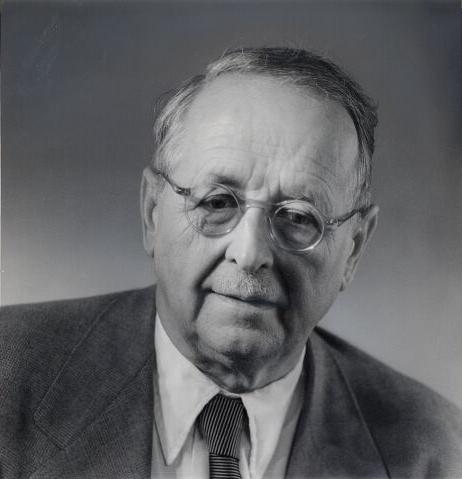
Weyl's Representation Theory
Hermann Weyl publishes work on representation theory of continuous groups, applying group theory to quantum mechanics and establishing key results. #groupTheory #physics
Weyl's Representation Theory By ETH Zürich - ETH-Bibliothek Zürich, Bildarchiv, CC BY-SA 3.0, https://commons.wikimedia.org/w/index.php?curid=8098412
1916 CE
Noether's Theorem
Emmy Noether proves Noether's theorem, linking symmetry groups to conservation laws in physics. This is a cornerstone of modern theoretical physics. #physics #symmetry
Noether's Theorem By Emmy Noether - "Invariante Variationsprobleme" (Nachrichten von der Gesellschaft der Wissenschaften zu Göttingen, Mathematisch-Physikalische Klasse 1918 (1918): 235-257. <http://eudml.org/doc/59024>), Public domain, https://commons.wikimedia.org/w/index.php?curid=69398536
1925 CE
Schrödinger Equation and Symmetry
Erwin Schrödinger formulates the wave equation; its solutions reflect symmetries described by group theory. This impact is fundamental in quantum mechanics. #quantumMechanics #groupTheory
1926 CE
Peter-Weyl Theorem
Hermann Weyl and Fritz Peter prove the Peter-Weyl theorem, establishing harmonic analysis on compact groups. This result bridges group theory and analysis. #groupTheory #analysis
1927 CE
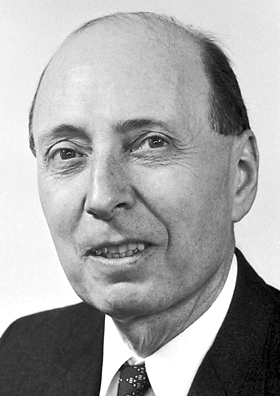
Wigner's Classification of Particles
Eugene Wigner classifies elementary particles by irreducible representations of the Poincaré group, applying group theory to quantum mechanics. #physics #groupTheory
Wigner's Classification of Particles By Nobel foundation - https://nobelprize.org/nobel_prizes/physics/laureates/1963/wigner-bio.html, Public domain, https://commons.wikimedia.org/w/index.php?curid=6141135
1935 CE
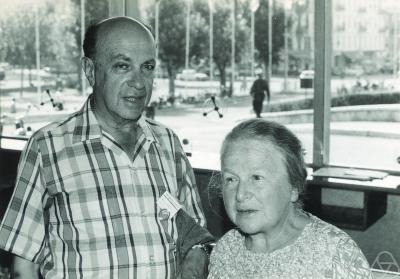
Brauer Begins Modular Representation Theory
Richard Brauer develops modular representation theory, studying representations over fields of positive characteristic. This became crucial for the classification of finite simple groups. #groupTheory #representationTheory
Brauer Begins Modular Representation Theory By Jacobs, Konrad - https://opc.mfo.de/detail?photo_id=467, CC BY-SA 2.0 de, https://commons.wikimedia.org/w/index.php?curid=7756475
1940 CE
Zassenhaus Lemma
Hans Zassenhaus proves the Butterfly lemma (Zassenhaus lemma), a key result in group theory used in the Jordan-Hölder theorem and composition series. #groupTheory #algebra
Zassenhaus Lemma By Claudio Rocchini - Own work, CC BY 3.0, https://commons.wikimedia.org/w/index.php?curid=2773335
1948 CE
Hall's Theorems on Solvable Groups
Philip Hall publishes fundamental theorems on solvable groups, including Hall's existence theorem and Hall's marriage theorem, advancing group theory. #groupTheory #algebra
Hall's Theorems on Solvable Groups By Konrad Jacobs, Erlangen, Copyright is MFO - Mathematisches Forschungsinstitut Oberwolfach,https://opc.mfo.de/detail?photo_id=1531, CC BY-SA 2.0 de, https://commons.wikimedia.org/w/index.php?curid=12364673
1950 CE
Chevalley Groups
Claude Chevalley constructs Chevalley groups, families of finite simple groups of Lie type, providing a systematic construction. #groupTheory #finiteGroups
1954 CE
Classification of Finite Simple Groups Begins
The project to classify all finite simple groups starts, one of the largest collaborative efforts in mathematics. #groupTheory #classification
1955 CE
Tits' Buildings
Jacques Tits introduces buildings, geometric structures that encode symmetries of algebraic groups. This unified aspects of group theory and geometry. #geometry #groupTheory )
1960 CE
Suzuki Groups Discovered
Michio Suzuki discovers the Suzuki groups, a new family of sporadic simple groups. This fueled the classification of finite simple groups. #groupTheory #finiteGroups
1963 CE
Feit-Thompson Theorem Proved
Walter Feit and John Thompson prove the odd order theorem, which states that every finite group of odd order is solvable, a major step in classification. #groupTheory #theorem
1965 CE
Higman-Sims Group Discovered
Donald Higman and Charles Sims discover the Higman-Sims group, a sporadic simple group, expanding the known sporadic families. #groupTheory #finiteGroups
1966 CE
Conway Groups Discovered
John Conway discovers the three Conway sporadic simple groups, named Co1, Co2, Co3, associated with the Leech lattice. #groupTheory #sporadic
1973 CE
Fischer Groups and Monster Group
Bernd Fischer discovers sporadic simple groups (Fischer groups), and Robert Griess predicts the Monster group. The Monster is the largest sporadic group. #groupTheory #sporadic
1981 CE
Classification of Finite Simple Groups Announced
The classification of finite simple groups is announced as essentially complete, although full details were published later. This was a monumental achievement. #groupTheory #classification
1982 CE
Monster Group Constructed
Robert Griess constructs the Monster group explicitly as a group of rotations in 196,883-dimensional space. It is the largest sporadic simple group. #groupTheory #sporadic
2004 CE
Quasithin Case Completed
Michael Aschbacher and Stephen Smith complete the quasithin case, finalizing the classification of finite simple groups. This ended decades of work. #groupTheory #classification