Gottfried Wilhelm Leibniz: Calculus Notation, Binary System & Monadology
Encyclopedia/1. The Cosmos & The Natural World/1. Mathematics & Formal Systems/14. Mathematical Biographies • Curated by Admin Timeline.sg
Timeline of Gottfried Wilhelm Leibniz, German polymath who independently invented calculus and developed the binary number system, covering his life from 1646 to 1716.
Chronological Storyline (36 Milestones)
Jul 1, 1646 CE
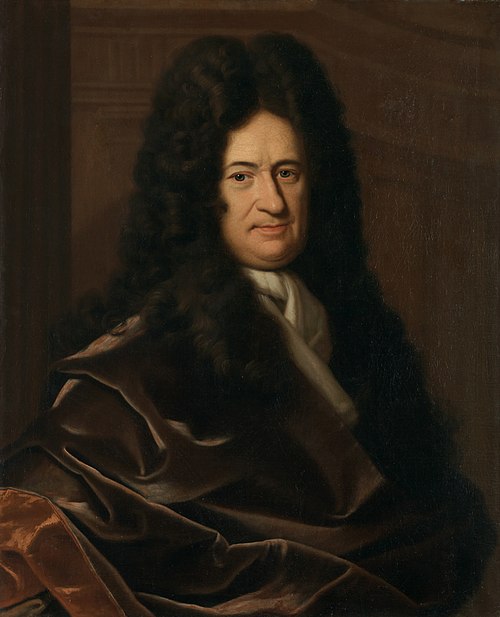
Leibniz Born in Leipzig
Gottfried Wilhelm Leibniz was born on July 1, 1646 (Gregorian calendar) in Leipzig, Holy Roman Empire, to a Lutheran father and a mother from a prominent family. #history #philosophy
Leibniz Born in Leipzig By Christoph Bernhard Francke - Herzog Anton Ulrich-Museum, online, Public domain, https://commons.wikimedia.org/w/index.php?curid=53159699
1653 CE
Enters Nicolai School
Leibniz entered the Nicolai School in Leipzig at age seven, where he studied Latin, Greek, and logic. #education #history
1661 CE
Enrolls at University of Leipzig
Leibniz enrolled at the University of Leipzig at age 14, studying philosophy, mathematics, and law. #education #history
1663 CE
Bachelor's Degree in Philosophy
Leibniz earned his bachelor's degree in philosophy from the University of Leipzig after defending his thesis 'De principio individui'. #philosophy #education
1664 CE
Master's Degree in Philosophy
Leibniz obtained his master's degree in philosophy, furthering his studies in logic and metaphysics. #philosophy #education
1666 CE
Doctorate in Law and De Arte Combinatoria
Leibniz received his doctorate in law from the University of Altdorf and published 'De Arte Combinatoria', a work on combinatorial logic. #philosophy #mathematics #history
1667 CE
Enters Service of Elector of Mainz
Leibniz declined a professorship and became a diplomat and adviser to Johann Philipp von Schönborn, the Elector of Mainz. #history
1668 CE
Writes on Natural Law
Leibniz wrote his first legal-philosophical works, including 'De Usu Doctrinae ab Arte Combinatoria in Rebus Civilibus'. #philosophy #law #history
1671 CE
Publishes Hypothesis Physica Nova
Leibniz published 'Hypothesis Physica Nova', proposing a new physical theory based on motion and his early view of dynamics. #physics #philosophy #history
1672 CE
Diplomatic Mission to Paris
Leibniz traveled to Paris on a diplomatic mission for the Elector of Mainz, where he met mathematicians like Christiaan Huygens and began advanced study of mathematics. #mathematics #history
1673 CE
Demonstrates Calculating Machine to Royal Society
Leibniz visited London and demonstrated his stepped reckoner calculating machine to the Royal Society, which elected him a member. #mathematics #invention #history
Demonstrates Calculating Machine to Royal Society By User:Kolossos - recorded by me in de:Technische Sammlungen der Stadt Dresden (with photo permission), CC BY-SA 3.0, https://commons.wikimedia.org/w/index.php?curid=925505
1673 CE
Elected to Royal Society
Leibniz was elected a Fellow of the Royal Society in recognition of his calculating machine and mathematical interests. #science #history
1674 CE
Begins Work on Stepped Reckoner
Leibniz began designing and building the stepped reckoner, a mechanical calculator capable of all four arithmetic operations. #mathematics #invention
1675 CE
Invents Calculus Notation (dx, dy)
Leibniz developed the differential and integral calculus notation (dx, dy, ∫) that is still used today, based on his work on infinite series. #mathematics #calculus
Invents Calculus Notation (dx, dy) By Andrew Gray — original photos, Alexey Gomankov — collage - 1 and 2, CC BY-SA 3.0, https://commons.wikimedia.org/w/index.php?curid=51521808
1676 CE
First Correspondence with Newton
Leibniz began corresponding with Isaac Newton via letters, sharing mathematical ideas that later became part of the calculus priority dispute. #mathematics #history
1676 CE
Moves to Hanover as Librarian and Historian
Leibniz took up a position as librarian and historian for the House of Brunswick in Hanover, a role he held until his death. #history
1679 CE
Work on Binary Arithmetic
Leibniz began developing the binary number system, building on earlier ideas, as part of his search for a universal language. #mathematics #computing #history
1682 CE
Co-founds Acta Eruditorum
Leibniz co-founded the scientific journal 'Acta Eruditorum' in Leipzig, which became a major platform for the dissemination of his and others' work. #science #history
Co-founds Acta Eruditorum By Unknown author - Available in the BEIC digital library and uploaded in partnership with BEIC Foundation., Public domain, https://commons.wikimedia.org/w/index.php?curid=72347333
1684 CE
Publishes First Calculus Paper 'Nova Methodus'
Leibniz published 'Nova Methodus pro Maximis et Minimis' in Acta Eruditorum, the first paper on differential calculus, introducing his notation. #mathematics #calculus
1685 CE
Begins History of the House of Brunswick
Leibniz started his monumental task of writing a history of the House of Brunswick, which involved extensive archival research. #history
1686 CE
Publishes 'Discourse on Metaphysics'
Leibniz wrote 'Discourse on Metaphysics', outlining his philosophical system including the principle of sufficient reason and the concept of monads. #philosophy
Publishes 'Discourse on Metaphysics' By Minscensus - Own work, CC BY-SA 4.0, https://commons.wikimedia.org/w/index.php?curid=57545027
1690 CE
Work on Integral Calculus
Leibniz continued developing integral calculus, publishing important results and corresponding with the Bernoulli brothers. #mathematics #calculus
1693 CE
Publishes 'Protogaea'
Leibniz published 'Protogaea', a work on geology and paleontology, discussing the formation of the Earth and fossilized remains. #science #geology
Publishes 'Protogaea' By Gottfried Wilhelm Leibniz (author) - *GC6.L5316.749p, Houghton Library, Harvard University, Public domain, https://commons.wikimedia.org/w/index.php?curid=34673623
1695 CE
Publishes 'Specimen Dynamicum'
Leibniz published 'Specimen Dynamicum', presenting his new theory of dynamics and the concept of vis viva (living force). #physics #philosophy
1696 CE
Correspondence with Johann Bernoulli
Leibniz engaged in extensive correspondence with Johann Bernoulli on calculus, sharing and refining methods. #mathematics #history
1700 CE
First President of Berlin Academy of Sciences
Leibniz was appointed the first president of the newly founded Berlin Academy of Sciences, playing a key role in its establishment. #science #history
First President of Berlin Academy of Sciences By Andreas Praefcke - Own work, CC BY 3.0, https://commons.wikimedia.org/w/index.php?curid=4008369
1701 CE
Writes on Philosophy of Mind
Leibniz prepared writings on the philosophy of mind, including his critique of materialism and his concept of petites perceptions. #philosophy
1703 CE
Publishes 'Explication de l'Arithmétique Binaire'
Leibniz published his paper 'Explication de l'Arithmétique Binaire' in the Memoirs of the French Academy, explaining the binary number system. #mathematics #computing
The publication of Newton's 'Opticks' with an appendix on calculus led to renewed accusations against Leibniz of plagiarism. #mathematics #history
1705 CE
Publishes 'New Essays on Human Understanding'
Leibniz completed 'New Essays on Human Understanding', a detailed critique of John Locke's 'Essay Concerning Human Understanding'. #philosophy
1710 CE
Publishes 'Theodicy'
Leibniz published 'Theodicy', his major work on the problem of evil, arguing that this is the best of all possible worlds. #philosophy #religion
Publishes 'Theodicy' By Christoph Bernhard Francke - Herzog Anton Ulrich-Museum Braunschweig, Public domain, https://commons.wikimedia.org/w/index.php?curid=57268659
1712 CE
Review of Newton's Work Leads to Royal Commission
The calculus priority dispute escalated, leading to a review by the Royal Society which eventually sided with Newton. #mathematics #history
1713 CE
Accused by Newton's Disciples
Newton's disciples publicly accused Leibniz of plagiarism, a charge that damaged his reputation despite later vindication. #mathematics #history
1714 CE
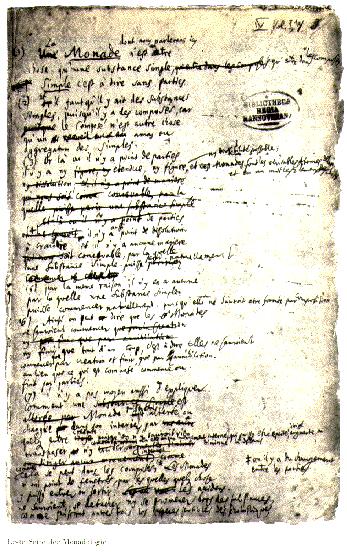
Publishes 'Monadology'
Leibniz wrote the 'Monadology', a concise exposition of his metaphysical system based on monads, pre-established harmony, and the principle of sufficient reason. #philosophy
Publishes 'Monadology' By Unknown author, Public domain, https://commons.wikimedia.org/w/index.php?curid=750850
1714 CE
Publishes 'Principles of Nature and Grace'
Leibniz published 'Principles of Nature and Grace, Based on Reason', summarizing his philosophical system for a general audience. #philosophy
Nov 14, 1716 CE
Death of Leibniz in Hanover
Gottfried Wilhelm Leibniz died on November 14, 1716 in Hanover, largely neglected at the time but later recognized as one of the greatest polymaths. #history #philosophy