Gordon Moore: Moore's Law, Intel Founding & Semiconductor Scaling
Encyclopedia/2. Technology & The Built World/1. Computing, AI & Information Technology/06. Computing & Tech Biographies • Curated by Admin Timeline.sg
Gordon Moore, co-founder of Intel and formulator of Moore's Law, pioneered the exponential growth of semiconductor technology, shaping the modern computing industry.
Chronological Storyline (35 Milestones)
Jan 3, 1929 CE
Gordon Moore born in San Francisco
Gordon Earle Moore is born in San Francisco, California, the second son of Walter Harold Moore and Florence Almira Williamson. #history #technology
Gordon Moore born in San Francisco By Intel Free Press - https://www.flickr.com/photos/intelfreepress/8267616249/in/photostream/lightbox/, CC BY-SA 2.0, https://commons.wikimedia.org/w/index.php?curid=130035378
1947 CE
Enrolls at UC Berkeley
Moore enrolls at the University of California, Berkeley, but later transfers to Caltech. #education
1950 CE
Transfers to Caltech
Moore transfers to the California Institute of Technology (Caltech) to pursue a degree in chemistry. #education
1954 CE
PhD in Chemistry from Caltech
Moore earns his Ph.D. in chemistry from Caltech, studying infrared spectroscopy and physical chemistry. #science
1956 CE
Joins Shockley Semiconductor Laboratory
Moore joins William Shockley's Shockley Semiconductor Laboratory in Mountain View, California, beginning his career in semiconductors. #technology
Aug 1, 1957 CE
Co-founds Fairchild Semiconductor
Moore, along with Robert Noyce and six other colleagues (the 'Traitorous Eight'), leaves Shockley to found Fairchild Semiconductor, a pioneering company in silicon transistors and integrated circuits. #entrepreneurship #technology
Co-founds Fairchild Semiconductor By Fairchild Semiconductor - http://www.fairchildsemi.com/, Public domain, https://commons.wikimedia.org/w/index.php?curid=26763160
Jul 1, 1959 CE
Fairchild files patent for planar process
Fairchild Semiconductor files a patent for the planar process, a key innovation in integrated circuit manufacturing co-invented by Moore and Noyce. #technology #patents
Fairchild files patent for planar process By Robert.Baruch - Own work, CC BY-SA 4.0, https://commons.wikimedia.org/w/index.php?curid=57750460
1960 CE
First commercial integrated circuit from Fairchild
Fairchild introduces the first commercial integrated circuit, the Micrologic family, revolutionizing electronics. #technology
Apr 19, 1965 CE
Publishes Moore's Law paper
Moore publishes 'Cramming more components onto integrated circuits' in Electronics magazine, predicting that the number of transistors on a chip would double every year, later revised to every two years. #mooreslaw #technology
1967 CE
Becomes director of R&D at Fairchild
Moore is promoted to director of research and development at Fairchild Semiconductor, overseeing advanced semiconductor technologies. #career
Jul 18, 1968 CE
Co-founds Intel Corporation
Moore, Robert Noyce, and Andrew Grove found Intel Corporation in Mountain View, California, focusing on semiconductor memory. #entrepreneurship #technology
Co-founds Intel Corporation By Coolcaesar - Own work, CC BY-SA 4.0, https://commons.wikimedia.org/w/index.php?curid=133964425
1969 CE
Intel introduces first product: 3101 Schottky bipolar memory
Intel launches its first product, the 3101 Schottky bipolar random-access memory (RAM), marking the company's entry into the memory market. #technology
1971 CE
Intel introduces 4004 microprocessor
Intel releases the 4004, the world's first commercially available microprocessor, revolutionizing computing. #technology #microprocessor
Intel introduces 4004 microprocessor By Thomas Nguyen - Own work, CC BY-SA 4.0, https://commons.wikimedia.org/w/index.php?curid=47684767
1972 CE
Intel introduces 8008 processor
Intel releases the 8008, an 8-bit microprocessor that expands the capabilities of microcomputers. #technology
Intel introduces 8008 processor By Konstantin Lanzet - CPU Collection Konstantin Lanzet Camera: Canon EOS 400D, CC BY-SA 4.0, https://commons.wikimedia.org/w/index.php?curid=5694177
1975 CE
Becomes president and CEO of Intel
Moore is named president and CEO of Intel, succeeding Robert Noyce, leading the company through rapid growth. #leadership
1975 CE
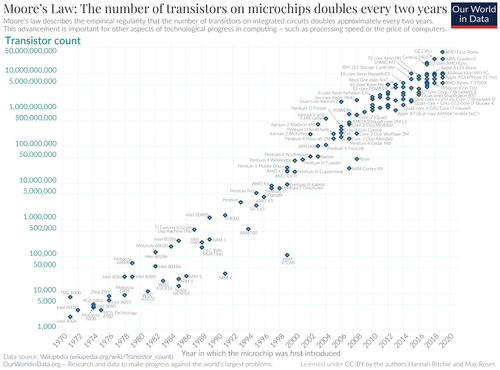
Revises Moore's Law to doubling every two years
Moore updates his prediction, stating that transistor density would double approximately every two years, a pace that held for decades. #mooreslaw #technology
Revises Moore's Law to doubling every two years By Max Roser, Hannah Ritchie - https://ourworldindata.org/uploads/2020/11/Transistor-Count-over-time.png, CC BY 4.0, https://commons.wikimedia.org/w/index.php?curid=98219918
1978 CE
Intel introduces 8086 processor
Intel launches the 8086, a 16-bit microprocessor that became the basis for the x86 architecture, powering the IBM PC and its successors. #technology
Intel introduces 8086 processor By Thomas Nguyen - Own work, CC BY-SA 4.0, https://commons.wikimedia.org/w/index.php?curid=46809082
1982 CE
Intel introduces 80286 processor
Intel releases the 80286, a 16-bit microprocessor with improved performance and memory management, widely used in PCs. #technology
Intel introduces 80286 processor By Konstantin Lanzet (with permission) - CPU collection Konstantin Lanzet, received per EMailCamera: Canon EOS 400D, CC BY-SA 3.0, https://commons.wikimedia.org/w/index.php?curid=4213086
1985 CE
Intel introduces i386 processor
Intel launches the 80386 (i386), a 32-bit microprocessor that enabled advanced operating systems like Windows. #technology
Intel introduces i386 processor By Konstantin Lanzet (with permission) - CPU collection Konstantin Lanzet, received per EMailCamera: Canon EOS 400D, CC BY-SA 3.0, https://commons.wikimedia.org/w/index.php?curid=4213308
1987 CE
Steps down as CEO, becomes chairman
Moore relinquishes the CEO role to Andrew Grove but remains chairman of Intel, guiding strategic direction. #leadership
1992 CE
Intel becomes largest semiconductor company
Intel surpasses all competitors to become the world's largest semiconductor company by revenue, solidifying its dominance. #business
1997 CE
Elected to National Inventors Hall of Fame
Moore is inducted into the National Inventors Hall of Fame for his contributions to semiconductor technology and integrated circuits. #awards
Elected to National Inventors Hall of Fame By Kazuhisa OTSUBO from Tokyo, Japan - 発明者を検索し、情報を見ることができるシステム。 USPTO, CC BY 2.0, https://commons.wikimedia.org/w/index.php?curid=37843226
2000 CE
Retires from Intel board
Moore retires from Intel's board of directors, concluding his formal affiliation with the company he co-founded. #retirement
2000 CE
Establishes Gordon and Betty Moore Foundation
Moore and his wife establish the Gordon and Betty Moore Foundation, focusing on environmental conservation, science, and patient care. #philanthropy
Establishes Gordon and Betty Moore Foundation By Gordon and Betty Moore Foundation - https://tukuz.com/gordon-and-betty-moore-foundation-logo-vector-svg, Public domain, https://commons.wikimedia.org/w/index.php?curid=116461964
2001 CE
Receives Othmer Gold Medal
Moore is awarded the Othmer Gold Medal for outstanding contributions to chemical science and technology. #awards
Receives Othmer Gold Medal By Staff photographer - Science History Institute., CC BY-SA 3.0, https://commons.wikimedia.org/w/index.php?curid=63330881
2002 CE
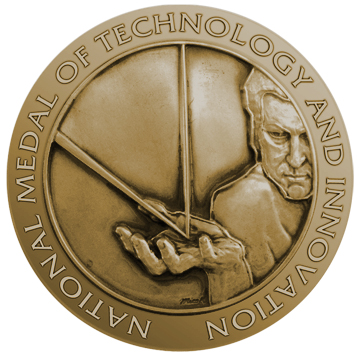
Receives National Medal of Technology
Moore is awarded the National Medal of Technology by President George W. Bush for his pioneering work in microelectronics. #awards
Receives National Medal of Technology By Mico Kaufman - http://www.uspto.gov/nmti/2009/nmti_tla.doc, Public domain, https://commons.wikimedia.org/w/index.php?curid=10870537
2003 CE
Receives IEEE Robert N. Noyce Award
Moore receives the IEEE Robert N. Noyce Award for exceptional contributions to the microelectronics industry. #awards
2008 CE
Receives IEEE Medal of Honor
Moore is awarded the IEEE Medal of Honor, the highest IEEE award, for his role in integrated circuits and Moore's Law. #awards
Receives IEEE Medal of Honor By Tiginbeg - Own work, CC BY-SA 4.0, https://commons.wikimedia.org/w/index.php?curid=128356112
2010 CE
Donates $100 million to Caltech
Moore and his foundation donate $100 million to Caltech to support scientific research and education. #philanthropy #education
2012 CE
Donates natural history collection to California Academy of Sciences
Moore donates a landmark collection of minerals, gems, and fossils to the California Academy of Sciences, valued at millions. #philanthropy #science
2013 CE
Receives Presidential Medal of Freedom
President Barack Obama awards Moore the Presidential Medal of Freedom, the highest civilian honor, for his contributions to technology and philanthropy. #awards #presidential
2015 CE
Celebrates 50th anniversary of Moore's Law
Moore participates in celebrations and interviews marking the 50th anniversary of his seminal paper on Moore's Law. #mooreslaw #history
2017 CE
Publishes essay on his legacy
Moore reflects on his career and the impact of Moore's Law in an essay for the IEEE Spectrum. #technology #reflection
2020 CE
Moore Foundation commits to environmental conservation
The Gordon and Betty Moore Foundation announces major commitments to conservation, including protection of the Amazon and Andes. #philanthropy #environment
Mar 24, 2023 CE
Gordon Moore dies at age 94
Gordon Moore passes away in Hawaii, leaving a legacy as a visionary entrepreneur and philanthropist. #obituary #technology