Global History of Medicine: From Huangdi Neijing & Hippocrates to Modern Hospitals
Encyclopedia/1. The Cosmos & The Natural World/6. Medicine & Human Biology/01. Global History of Medicine • Curated by Admin Timeline.sg
This timeline traces the global evolution of medicine from ancient healing systems like the Huangdi Neijing and Hippocratic medicine to the rise of modern hospitals and germ theory, highlighting contributions from China, India, the Islamic world, Europe, and beyond.
Chronological Storyline (47 Milestones)
500 BCE
Huangdi Neijing Compiled
The Huangdi Neijing (Yellow Emperor's Inner Canon), a foundational text of Traditional Chinese Medicine, is compiled, outlining theories of yin-yang, five phases, and acupuncture. #TCM #history
Huangdi Neijing Compiled By Unknown author - [1], Public domain, https://commons.wikimedia.org/w/index.php?curid=11662446
460 BCE
Hippocrates Born on Kos
Hippocrates, often called the Father of Western Medicine, is born. He establishes a rational approach to medicine, moving away from supernatural explanations. #ancient #medicine
Hippocrates Born on Kos By Unidentified engraver - 1881 Young Persons' Cyclopedia of Persons and Places Upload by RedWolf 05:45, Jan 10, 2005 (UTC), Public domain, https://commons.wikimedia.org/w/index.php?curid=164808
400 BCE
Hippocratic Oath Composed
The Hippocratic Oath, a seminal ethical code for physicians, is written, emphasizing principles like non-maleficence and confidentiality. #ethics #medicine
300 BCE
Charaka Samhita Authored
The Charaka Samhita, a key Ayurvedic text, is compiled in India, detailing internal medicine, diagnosis, and treatment using herbal remedies. #Ayurveda #history
Charaka Samhita Authored By Unknown author - https://wellcomeimages.org/indexplus/obf_images/ea/3a/3951eb729fdec6d8916e8d8be07e.jpg Gallery: https://wellcomeimages.org/indexplus/image/L0040423.html Wellcome Collection gallery (2018-03-22): https://wellcomecollection.org/works/f2kqft8j CC-BY-4.0, CC BY 4.0, https://commons.wikimedia.org/w/index.php?curid=36096211
280 BCE
Herophilus Studies Anatomy in Alexandria
Greek physician Herophilus performs systematic human dissections in Alexandria, identifying the brain, nerves, and distinguishing veins from arteries. #anatomy #ancient
Herophilus Studies Anatomy in Alexandria By Ecelan - Own work, CC BY-SA 3.0 es, https://commons.wikimedia.org/w/index.php?curid=16641053
129 CE
Galen of Pergamon Born
Galen, whose theories dominate Western medicine for over 1,300 years, is born. He advances humoral theory and anatomy through animal dissections. #history #medicine
Galen of Pergamon Born By Georg Paul Busch (engraver) - The Lancet, Public domain, https://commons.wikimedia.org/w/index.php?curid=40855568
610 CE
Susruta Samhita Translated into Arabic
The Susruta Samhita, an ancient Indian surgical text, is translated into Arabic, spreading knowledge of plastic surgery and cataract procedures to the Islamic world. #Ayurveda #surgery
Susruta Samhita Translated into Arabic By Unknown author - Image: http://collections.lacma.org/sites/default/files/remote_images/piction/ma-31972784-O3.jpg Gallery: http://collections.lacma.org/node/170472 archive copy at the Wayback Machine, Public domain, https://commons.wikimedia.org/w/index.php?curid=32452002
750 CE
First Bimaristan Hospital Built in Baghdad
The first documented bimaristan (hospital) is established in Baghdad, providing free care and medical education, a model later spread across the Islamic world. #hospital #history
First Bimaristan Hospital Built in Baghdad By Unknown author - http://www.wellcomecollection.org/explore/time--place/topics/islam-and-medicine/images.aspx, CC BY 2.5, https://commons.wikimedia.org/w/index.php?curid=28974890
1025 CE
Ibn Sina's Canon of Medicine Published
Avicenna (Ibn Sina) completes Al-Qanun fi al-Tibb (The Canon of Medicine), an encyclopedia that becomes the standard medical text in Europe and the Islamic world for centuries. #medicine #history
Ibn Sina's Canon of Medicine Published By Coffeetalkh - Own work, CC BY-SA 3.0, https://commons.wikimedia.org/w/index.php?curid=11906621
1090 CE
Al-Zahrawi's Kitab al-Tasrif Completed
Al-Zahrawi (Abulcasis) finishes his medical encyclopedia Kitab al-Tasrif, featuring surgical instruments and techniques, influencing European surgery. #surgery #history
1240 CE
University of Salerno Medical School Flourishes
The Schola Medica Salernitana in Salerno, Italy, reaches its peak, blending Greek, Roman, and Islamic medical knowledge, and allowing female physicians. #education #medicine
University of Salerno Medical School Flourishes By Unknown author - fol. 317v, Public domain, https://commons.wikimedia.org/w/index.php?curid=354555
1242 CE
Ibn al-Nafis Discovers Pulmonary Circulation
Ibn al-Nafis challenges Galen by describing pulmonary circulation, correctly stating blood flows from the right ventricle to the lungs and back to the left heart. #anatomy #science
Ibn al-Nafis Discovers Pulmonary Circulation By Unknown author - Arabic book on ibn al Nafis Takrouri M.S. M & Khalaf M 2003, CC BY-SA 3.0, https://commons.wikimedia.org/w/index.php?curid=4759221
1363 CE
Guy de Chauliac's Chirurgia Magna
Guy de Chauliac publishes Chirurgia Magna, a comprehensive surgical textbook that consolidates medieval surgery and remains influential for centuries. #surgery #history
Guy de Chauliac's Chirurgia Magna By Unknown author - Fielding Hudson Garrison, An introduction to the history of medicine: with medical chronology, bibliographic data, and test questions London & Philadelphia, W.B. Saunders, 1914., Public domain, https://commons.wikimedia.org/w/index.php?curid=8104966
1490 CE
Li Shizhen Begins Compiling Bencao Gangmu
Chinese physician Li Shizhen starts work on the Bencao Gangmu (Compendium of Materia Medica), a monumental pharmacopoeia detailing thousands of medicinal substances. #TCM #pharmacology
Li Shizhen Begins Compiling Bencao Gangmu By Unknown author - http://huntbot.andrew.cmu.edu/hibd/departments/Library/ChineseHerbal.shtml, Public domain, https://commons.wikimedia.org/w/index.php?curid=19570678
1543 CE
Vesalius Publishes De Humani Corporis Fabrica
Andreas Vesalius publishes De Humani Corporis Fabrica, a groundbreaking anatomy text based on human dissection, correcting many of Galen's errors. #anatomy #science
Vesalius Publishes De Humani Corporis Fabrica By Unknown author, Public domain, https://commons.wikimedia.org/w/index.php?curid=457251
1578 CE
William Harvey Born
William Harvey is born; he will later revolutionize physiology by discovering the circulation of blood. #medicine #history
William Harvey Born By After Daniël Mijtens - National Portrait Gallery: NPG 5115, Public domain, https://commons.wikimedia.org/w/index.php?curid=5975113
1628 CE
Harvey Publishes De Motu Cordis
William Harvey publishes Exercitatio Anatomica de Motu Cordis et Sanguinis in Animalibus, describing the systemic circulation of blood and the heart's pumping action. #physiology #science
Harvey Publishes De Motu Cordis By Unknown author - Sigerist, Henry E. (1965) Große Ärzte, München, Deutschland: J.F. Lehmans Verlag (5. Auflage) (1. Auflage 1958) plate 26 p 120, Public domain, https://commons.wikimedia.org/w/index.php?curid=4551254
1665 CE
Hooke Discovers Cells in Cork
Robert Hooke observes cork cells under a microscope, coining the term 'cell,' laying foundations for histology and pathology. #microscope #biology
Hooke Discovers Cells in Cork By Mary Beale - https://arthistoryproject.com/artists/mary-beale/portrait-of-a-mathematician/, Public domain, https://commons.wikimedia.org/w/index.php?curid=92677611
1676 CE
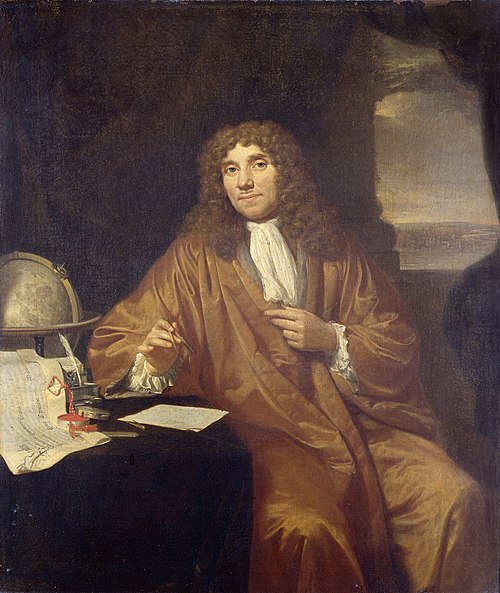
Leeuwenhoek Observes Bacteria
Antonie van Leeuwenhoek reports seeing 'animalcules' (bacteria and protozoa) using his single-lens microscopes, opening the microbial world. #microbiology #science
Leeuwenhoek Observes Bacteria By Jan Verkolje - http://www.rijksmuseum.nl/collectie/SK-A-957, Public domain, https://commons.wikimedia.org/w/index.php?curid=34320547
1701 CE
Earliest Inoculation for Smallpox in Constantinople
Lady Mary Wortley Montagu observes variolation (inoculation) against smallpox in the Ottoman Empire and promotes it in England, foreshadowing vaccination. #vaccine #history
Earliest Inoculation for Smallpox in Constantinople By Jonathan Richardson the younger - The Yorck Project (2002) 10.000 Meisterwerke der Malerei (DVD-ROM), distributed by DIRECTMEDIA Publishing GmbH. ISBN: 3936122202., Public domain, https://commons.wikimedia.org/w/index.php?curid=158365
1750 CE
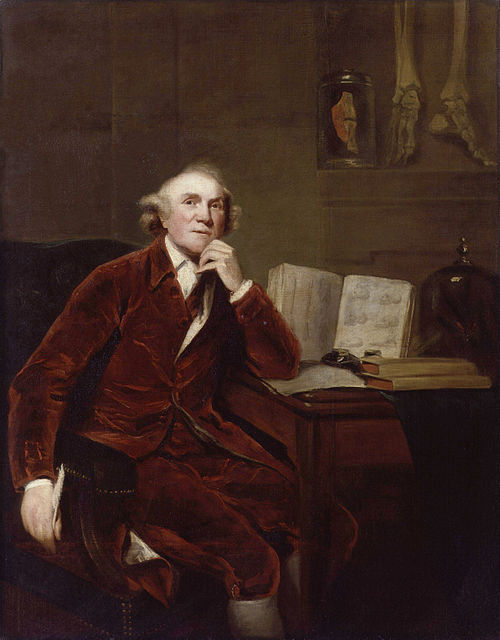
John Hunter Establishes Surgical Pathology
Scottish surgeon John Hunter pioneers scientific surgery and comparative anatomy, emphasizing observation and experimentation. #surgery #pathology )
John Hunter Establishes Surgical Pathology By anonymous - one or more third parties have made copyright claims against Wikimedia Commons in relation to the work from which this is sourced or a purely mechanical reproduction thereof. This may be due to recognition of the "sweat of the brow" doctrine, allowing works to be eligible for protection through skill and labour, and not purely by originality as is the case in the United States (where this website is hosted). These claims may or may not be valid in all jurisdictions. As such, use of this image in the jurisdiction of the claimant or other countries may be regarded as copyright infringement. Please see Commons:When to use the PD-Art tag for more information., Public domain, https://commons.wikimedia.org/w/index.php?curid=6370358
May 14, 1796 CE
Jenner's First Smallpox Vaccination
Edward Jenner tests his smallpox vaccine on James Phipps using cowpox pus, marking the beginning of vaccination. #vaccine #medicine
Jenner's First Smallpox Vaccination By John Raphael Smith - [1] [2], originally uploaded to en by User:Magnus Manske, Public domain, https://commons.wikimedia.org/w/index.php?curid=31245
1800 CE
Hahnemann Develops Homeopathy
Samuel Hahnemann publishes the principles of homeopathy, including the law of similars and potentization, establishing an alternative medical system. #alternative #history
Hahnemann Develops Homeopathy By Yfyyejgjwguj - Own work, CC0, https://commons.wikimedia.org/w/index.php?curid=145608463
1816 CE
Laennec Invents the Stethoscope
René Laennec invents the stethoscope, allowing physicians to listen to internal sounds and improving diagnosis of chest diseases. #diagnosis #invention
Laennec Invents the Stethoscope By Unknown author - Fielding Hudson Garrison, An introduction to the history of medicine: with medical chronology, bibliographic data, and test questions London & Philadelphia, W.B. Saunders, 1914., Public domain, https://commons.wikimedia.org/w/index.php?curid=9970526
1842 CE
Crawford Long Uses Ether for Surgery
Crawford Long performs the first surgical operation using ether anesthesia, ushering in the era of painless surgery. #anesthesia #surgery
Crawford Long Uses Ether for Surgery By Joseph Jacobs - Some Personal Recollections and Private Correspondence of Dr. Crawford Williamson Long, Public domain, https://commons.wikimedia.org/w/index.php?curid=163224118
1847 CE
Semmelweis Introduces Handwashing in Vienna
Ignaz Semmelweis mandates handwashing with chlorinated lime for medical staff, drastically reducing puerperal fever mortality in maternity wards. #infection #hygiene
Semmelweis Introduces Handwashing in Vienna By József Borsos / Albert Doctor - Ágnes Szemerédi: A fényképészet úttörői, OSZK blog, 2022 [1], Public domain, https://commons.wikimedia.org/w/index.php?curid=123555011
1851 CE
First International Sanitary Conference
The first International Sanitary Conference is held in Paris to coordinate quarantine measures against cholera, marking early global health cooperation. #publichealth #history
1854 CE
John Snow Maps Cholera Outbreak in London
John Snow traces a cholera outbreak to a contaminated water pump on Broad Street, pioneering epidemiology and disease mapping. #epidemiology #publichealth
John Snow Maps Cholera Outbreak in London By Unknown author - [1] Originally from en.wikipedia; description page is/was here., Public domain, https://commons.wikimedia.org/w/index.php?curid=403227
1854 CE
Florence Nightingale in Crimea
Florence Nightingale and her team of nurses improve sanitary conditions in British military hospitals during the Crimean War, establishing modern nursing. #nursing #publichealth
Florence Nightingale in Crimea By Henry Hering (1814-1893) - NPG x82368 from National Portrait Gallery, London, Public domain, https://commons.wikimedia.org/w/index.php?curid=61520366
1865 CE
Lister Introduces Antiseptic Surgery
Joseph Lister uses carbolic acid as an antiseptic during surgery, dramatically reducing postoperative infections and founding antiseptic surgery. #surgery #infection
Lister Introduces Antiseptic Surgery By Unknown author - Weltrundschau zu Reclams Universum 1902, Public domain, https://commons.wikimedia.org/w/index.php?curid=9647607
1876 CE
Koch Discovers Anthrax Bacillus
Robert Koch identifies Bacillus anthracis as the cause of anthrax, confirming germ theory and introducing Koch's postulates for establishing disease causation. #microbiology #germtheory
Koch Discovers Anthrax Bacillus By Unknown author - https://ihm.nlm.nih.gov/images/B16691, Public domain, https://commons.wikimedia.org/w/index.php?curid=1825905
1881 CE
Pasteur Develops Anthrax Vaccine
Louis Pasteur publicly demonstrates an anthrax vaccine in Pouilly-le-Fort, France, proving the effectiveness of attenuated vaccines. #vaccine #microbiology
Pasteur Develops Anthrax Vaccine By Paul Nadar - File:Louis Pasteur, foto av Paul Nadar.jpg, Public domain, https://commons.wikimedia.org/w/index.php?curid=28039885
Mar 24, 1882 CE
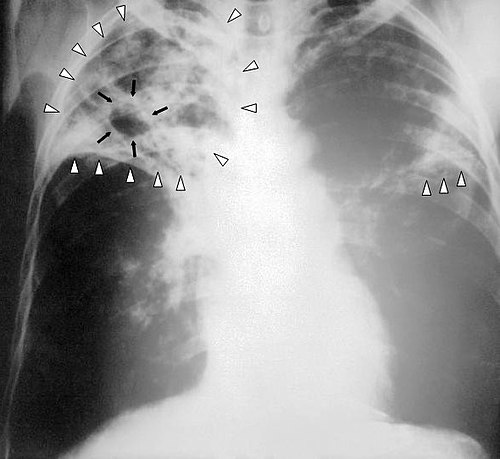
Koch Announces Discovery of Tuberculosis Bacillus
Robert Koch presents his discovery of Mycobacterium tuberculosis, the bacterium that causes tuberculosis, a leading cause of death. #tuberculosis #microbiology
Koch Announces Discovery of Tuberculosis Bacillus By Unknown author - This media comes from the Centers for Disease Control and Prevention's Public Health Image Library (PHIL), with identification number #2543. Note: Not all PHIL images are public domain; be sure to check copyright status and credit authors and content providers. العربية | Deutsch | English | македонски | slovenščina | +/−, Public domain, https://commons.wikimedia.org/w/index.php?curid=978580
1890 CE
Behring and Kitasato Develop Diphtheria Antitoxin
Emil von Behring and Shibasaburo Kitasato create a diphtheria antitoxin, pioneering serum therapy and winning Behring the first Nobel Prize in Medicine. #immunology #serum
Behring and Kitasato Develop Diphtheria Antitoxin By Fritz Schuhmann, Hofphotograph Bad Kissingen - Signatur: EvB/L 1/25 Behring-Nachlass digital, Emil-von-Behring-Bibliothek Marburg, Arbeitsstelle für Geschichte der Medizin, Public domain, https://commons.wikimedia.org/w/index.php?curid=14495196
Nov 8, 1895 CE
Röntgen Discovers X-rays
Wilhelm Röntgen discovers X-rays while experimenting with cathode rays, leading to medical imaging that revolutionizes diagnosis. #radiology #imaging
Röntgen Discovers X-rays By Erwin Hanfstaengl - https://global.museum-digital.org/singleimage?imagenr=2399678, Public domain, https://commons.wikimedia.org/w/index.php?curid=182243188
1897 CE
Aspirin Synthesized by Bayer
Felix Hoffmann at Bayer synthesizes acetylsalicylic acid (Aspirin), which becomes a widely used analgesic and anti-inflammatory drug. #pharmacology #drug
Aspirin Synthesized by Bayer By Oxetane lacx - Own work, CC BY 4.0, https://commons.wikimedia.org/w/index.php?curid=184709189
1900 CE
Landsteiner Discovers Human Blood Groups
Karl Landsteiner identifies A, B, and O blood groups, enabling safe blood transfusions and paving the way for modern transfusion medicine. #blood #immunology
Landsteiner Discovers Human Blood Groups By Bachrach Studios - [2], Public domain, https://commons.wikimedia.org/w/index.php?curid=132640305
1906 CE
Ehrlich Develops Salvarsan for Syphilis
Paul Ehrlich introduces Salvarsan (arsphenamine), the first effective treatment for syphilis, initiating modern chemotherapy. #chemotherapy #drug
Ehrlich Develops Salvarsan for Syphilis By Unknown author, Public domain, https://commons.wikimedia.org/w/index.php?curid=1054621
1908 CE
Wang Qingren's Anatomy Corrections Published
Chinese physician Wang Qingren publishes Yilin Gaicuo (Corrections of Medical Errors), providing corrected anatomy based on dissection of executed criminals, challenging traditional Chinese medicine dogma. #TCM #anatomy
1910 CE
Flexner Report Revolutionizes Medical Education
Abraham Flexner's report on medical education in the US and Canada leads to the closure of substandard schools and the adoption of science-based medical training. #education #reform
Flexner Report Revolutionizes Medical Education By Creator:Abraham Flexner - http://www.carnegiefoundation.org/sites/default/files/elibrary/Carnegie_Flexner_Report.pdf, Public domain, https://commons.wikimedia.org/w/index.php?curid=51763611
1915 CE
Kendall Isolates Thyroxine
Edward Calvin Kendall isolates thyroxine (thyroid hormone), advancing endocrinology and treatment of thyroid disorders. #endocrinology #hormone
Kendall Isolates Thyroxine By Unknown - https://www.nobelprize.org/nobel_prizes/medicine/laureates/1950/, PD-Sweden, https://en.wikipedia.org/w/index.php?curid=34690960
1921 CE
Discovery of Insulin at University of Toronto
Frederick Banting, Charles Best, John Macleod, and James Collip isolate and purify insulin, revolutionizing diabetes management. #diabetes #hormone
Discovery of Insulin at University of Toronto By User:AtikaAtikawa - Own work, CC BY-SA 4.0, https://commons.wikimedia.org/w/index.php?curid=107840330
Sep 28, 1928 CE
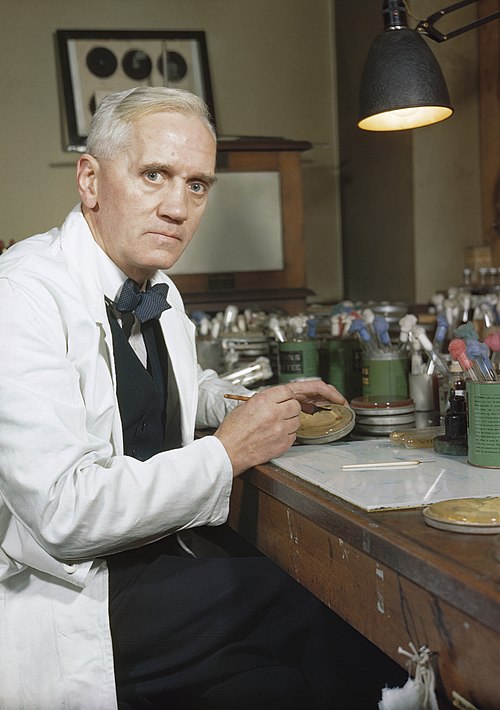
Fleming Discovers Penicillin
Alexander Fleming observes that a mold (Penicillium notatum) inhibits bacterial growth, leading to the development of penicillin, the first antibiotic. #antibiotic #microbiology
Fleming Discovers Penicillin By Official photographer - http://media.iwm.org.uk/iwm/mediaLib//32/media-32192/large.jpg This photograph TR 1468 comes from the collections of the Imperial War Museums., Public domain, https://commons.wikimedia.org/w/index.php?curid=24436974
1932 CE
Tuskegee Syphilis Study Begins
The U.S. Public Health Service initiates the unethical Tuskegee Syphilis Study, observing untreated syphilis in African American men, sparking bioethics reforms. #ethics #history
Tuskegee Syphilis Study Begins By National Archives Atlanta, GA (U.S. government) - [1], originally from National Archives, Public domain, https://commons.wikimedia.org/w/index.php?curid=9774274
1937 CE
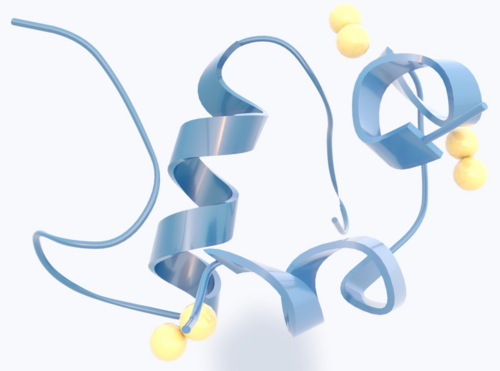
Sulfa Drug Prontosil Discovered
Gerhard Domagk discovers Prontosil, the first sulfonamide antibiotic, effective against streptococcal infections and a precursor to later antibiotics. #antibiotic #pharmacology
Sulfa Drug Prontosil Discovered By Ed (Edgar181) - Own work, Public domain, https://commons.wikimedia.org/w/index.php?curid=30651580
1944 CE
Avery-MacLeod-McCarty Experiment Shows DNA is Genetic Material
Oswald Avery, Colin MacLeod, and Maclyn McCarty demonstrate that DNA (not protein) is the transforming principle in bacteria, founding molecular genetics. #genetics #DNA
Avery-MacLeod-McCarty Experiment Shows DNA is Genetic Material By Bbkkk - self-made in the Naturkunste Museum in Berlin, CC BY-SA 4.0, https://commons.wikimedia.org/w/index.php?curid=3679283
1949 CE
WHO Founded; Cortisone Used for Rheumatoid Arthritis
The World Health Organization is established. Also, Philip Hench and others successfully use cortisone to treat rheumatoid arthritis, ushering in corticosteroid therapy. #publichealth #pharmacology
WHO Founded; Cortisone Used for Rheumatoid Arthritis By Guilhem Vellut from Annecy, France - World Health Organization @ Pregny-Chambésy, CC BY 2.0, https://commons.wikimedia.org/w/index.php?curid=105949300