Encyclopedia/1. The Cosmos & The Natural World/5. Life Sciences • Curated by Admin Timeline.sg
A comprehensive timeline of key milestones in genomics and gene editing, from ancient domestication to modern CRISPR technologies.
Chronological Storyline (41 Milestones)
10000 BCE
Domestication of Wheat in Fertile Crescent
Early farmers in the Fertile Crescent began selectively breeding wild emmer wheat, leading to domesticated wheat with larger grains. This marked one of the first human-driven genetic modifications. #genetics #agriculture
Domestication of Wheat in Fertile Crescent By Painter of the burial chamber of Sennedjem - The Yorck Project (2002) 10.000 Meisterwerke der Malerei (DVD-ROM), distributed by DIRECTMEDIA Publishing GmbH. ISBN: 3936122202., Public domain, https://commons.wikimedia.org/w/index.php?curid=154346
9000 BCE
Domestication of Rice in East Asia
Rice (Oryza sativa) was domesticated in the Yangtze River valley, becoming a staple crop through selective breeding. This event underpinned the rise of civilizations in East Asia. #genetics #agriculture
Domestication of Rice in East Asia By China News Service - YouTube: 第三代杂交水稻晚稻亩产911.7公斤 周年亩产超1500公斤 – View/save archived versions on archive.org, CC BY 3.0, https://commons.wikimedia.org/w/index.php?curid=108022271
8000 BCE
Domestication of Maize in Mesoamerica
Indigenous peoples in Mesoamerica domesticated teosinte into modern maize through centuries of selective breeding. This genetic transformation is a classic example of artificial selection. #genetics #agriculture
5000 BCE
Selective Breeding of Dogs
Humans began selectively breeding wolves into domesticated dogs, creating diverse breeds adapted for hunting, herding, and companionship. This early genetic manipulation predates written history. #genetics #domestication
Selective Breeding of Dogs By Jim Peaco for NPS - https://www.nps.gov/features/yell/slidefile/mammals/wolf/Images/18040d.jpg via https://www.nps.gov/features/yell/slidefile/mammals/wolf/page-17.htm, Public domain, https://commons.wikimedia.org/w/index.php?curid=912828
350 BCE
Aristotle's Theories of Heredity
Aristotle proposed early ideas about inheritance, suggesting that offspring receive traits from both parents via 'pangenesis.' Though incorrect, his work influenced later thought. #genetics #philosophy
Aristotle's Theories of Heredity By SUBnormali Team Original uploader was Yoruno at it.wikipedia - Transferred from it.wikipedia (Original text : subnormali-team.blogspot.com), CC BY-SA 3.0, https://commons.wikimedia.org/w/index.php?curid=6381781
850 CE
Al-Jahiz's Inheritance Ideas
The Islamic scholar Al-Jahiz wrote about inheritance and the struggle for existence, anticipating concepts of natural selection. His work influenced later biological thought. #genetics #islamicgoldenage
Al-Jahiz's Inheritance Ideas By Syrian Post - (2017) Scott Standard Postage Stamp Catalogue, 6, Scott Publishing, p. 731 ISBN: 0894875120., Public domain, https://commons.wikimedia.org/w/index.php?curid=97494174
1665 CE
Hooke Discovers Cells
Robert Hooke observed cork cells under a microscope, coining the term 'cell.' This laid the foundation for cell biology and later understanding of heredity. #cellbiology #microscopy
Hooke Discovers Cells By Mary Beale - https://arthistoryproject.com/artists/mary-beale/portrait-of-a-mathematician/, Public domain, https://commons.wikimedia.org/w/index.php?curid=92677611
Nov 24, 1859 CE
Darwin Publishes On the Origin of Species
Charles Darwin introduced the theory of evolution by natural selection, providing a framework for understanding how genetic variation drives species change. #evolution #genetics
Darwin Publishes On the Origin of Species By John Murray, Publisher - This image has an extracted file: Origin of Species.jpg., Public domain, https://commons.wikimedia.org/w/index.php?curid=320416
1865 CE
Mendel's Laws of Inheritance
Gregor Mendel presented experiments on pea plants, establishing the laws of segregation and independent assortment. His work became the foundation of classical genetics. #genetics #science
Mendel's Laws of Inheritance By Unknown author - NIH, Public domain, https://commons.wikimedia.org/w/index.php?curid=1394893
1881 CE
Weismann's Germ Plasm Theory
August Weismann proposed that hereditary information is carried only by germ cells, rejecting the inheritance of acquired characteristics. This concept shaped modern genetics. #genetics #biology
Weismann's Germ Plasm Theory By Ian Alexander - Own work, CC BY-SA 4.0, https://commons.wikimedia.org/w/index.php?curid=62047505
1900 CE
Rediscovery of Mendel's Work
Hugo de Vries, Carl Correns, and Erich von Tschermak independently rediscovered Mendel's laws, sparking the modern era of genetics. #genetics #science
Rediscovery of Mendel's Work By Original: Darekk2, SVG: Palosirkka - File:Hybridogenesis in water frogs gametes.gif, CC BY-SA 4.0, https://commons.wikimedia.org/w/index.php?curid=67142604
1902 CE
Sutton-Boveri Chromosome Theory
Walter Sutton and Theodor Boveri proposed that chromosomes carry hereditary units, linking Mendel's factors to physical structures. #genetics #chromosomes
Sutton-Boveri Chromosome Theory By Walter_sutton.jpg: Unknown Theodor_Boveri.jpg: Unknown derivative work: Earthdirt (talk) - Walter_sutton.jpg Theodor_Boveri.jpg, Public domain, https://commons.wikimedia.org/w/index.php?curid=8550969
1910 CE
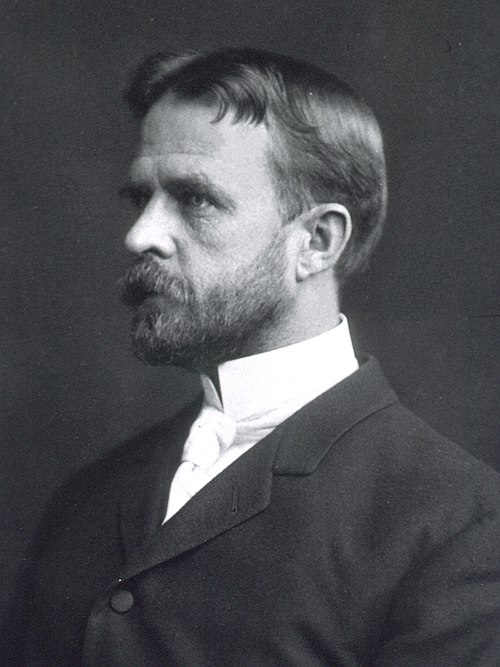
Morgan's Fruit Fly Genetics
Thomas Hunt Morgan used Drosophila to discover sex-linked inheritance and genetic mapping, establishing the chromosome theory. #genetics #fruitflies
Morgan's Fruit Fly Genetics By Unknown author - http://resource.nlm.nih.gov/101422222, Public domain, https://commons.wikimedia.org/w/index.php?curid=549067
1944 CE
Avery-MacLeod-McCarty: DNA is the Transforming Principle
Oswald Avery and colleagues demonstrated that DNA, not protein, carries genetic information in bacteria. This was a pivotal discovery. #genetics #DNA
Avery-MacLeod-McCarty: DNA is the Transforming Principle By Bbkkk - self-made in the Naturkunste Museum in Berlin, CC BY-SA 4.0, https://commons.wikimedia.org/w/index.php?curid=3679283
1952 CE
Hershey-Chase Experiment Confirms DNA
Alfred Hershey and Martha Chase used bacteriophages to confirm that DNA, not protein, is the genetic material. #genetics #DNA
Hershey-Chase Experiment Confirms DNA By Thomasione - Modified from German Wikipedia [1], GFDL, https://commons.wikimedia.org/w/index.php?curid=15034881
Apr 25, 1953 CE
Watson and Crick Determine DNA Structure
James Watson and Francis Crick proposed the double helix structure of DNA, explaining how genetic information is stored and replicated. #genetics #DNA #nobel
Watson and Crick Determine DNA Structure By Unknown author, Public domain, https://commons.wikimedia.org/w/index.php?curid=510095
Matthew Meselson and Franklin Stahl demonstrated that DNA replication is semiconservative, confirming a key prediction of the double helix model. #genetics #DNA
1961 CE
Nirenberg Cracks the Genetic Code
Marshall Nirenberg deciphered the first codon (UUU for phenylalanine), breaking the genetic code and linking DNA to protein synthesis. #genetics #geneticcode
Nirenberg Cracks the Genetic Code By The original uploader was Sverdrup at English Wikipedia. Vectorized by: User:VectorVoyager - Vectorization of https://commons.wikimedia.org/wiki/File:RNA-codon.png, Public domain, https://commons.wikimedia.org/w/index.php?curid=124414787
1970 CE
Discovery of Restriction Enzymes
Werner Arber, Hamilton Smith, and Daniel Nathans discovered restriction enzymes, which cut DNA at specific sequences, enabling genetic engineering. #genetics #biotech
1972 CE
First Recombinant DNA Molecule
Paul Berg created the first recombinant DNA by combining DNA from different organisms, pioneering genetic engineering. #genetics #biotech
First Recombinant DNA Molecule By Minestrone Soup at English Wikipedia - Transferred from en.wikipedia to Commons., CC BY-SA 3.0, https://commons.wikimedia.org/w/index.php?curid=46890662
1977 CE
Sanger Sequencing Method Developed
Frederick Sanger introduced the chain-termination method for DNA sequencing, enabling the first full genome sequences. #genomics #sequencing
Sanger Sequencing Method Developed By Estevezj - Own work, CC BY-SA 3.0, https://commons.wikimedia.org/w/index.php?curid=23264166
1980 CE
First Transgenic Mouse
Jon Gordon and Frank Ruddle produced the first genetically modified mouse by injecting foreign DNA into embryos. This advanced gene editing in animals. #genetics #transgenic
First Transgenic Mouse By Maggie Bartlett, NHGRI. - http://www.genome.gov/pressDisplay.cfm?photoID=5006, Public domain, https://commons.wikimedia.org/w/index.php?curid=19805359
Kary Mullis developed PCR, a method to amplify specific DNA sequences exponentially. PCR revolutionized genetics and diagnostics. #genetics #PCR
Kary Mullis Invents Polymerase Chain Reaction (PCR) By Madprime - Own work, CC0, https://commons.wikimedia.org/w/index.php?curid=2104468
Oct 1, 1990 CE
Human Genome Project Launched
An international consortium began sequencing the entire human genome. This monumental effort aimed to map all human genes. #genomics #HGP
Human Genome Project Launched By U.S. Department of Energy, Human Genome Project - http://www.ornl.gov/hgmis, Public domain, https://commons.wikimedia.org/w/index.php?curid=2485616
Jul 5, 1996 CE
Dolly the Sheep Cloned
Ian Wilmut and colleagues cloned Dolly from an adult somatic cell, proving that nuclear transfer could create a genetic copy. #cloning #genetics )
Jun 26, 2000 CE
First Draft of Human Genome Completed
The Human Genome Project and Celera Genomics jointly announced a working draft of the human genome, a landmark in genomics. #genomics #HGP
Apr 5, 2002 CE
Rice Genome Sequenced
International teams, including Chinese and Japanese researchers, sequenced the rice genome, a key crop feeding billions. #genomics #agriculture
Oct 1, 2005 CE
Next-Generation Sequencing Introduced
454 Life Sciences launched the first next-generation sequencing platform, dramatically reducing sequencing cost and time. #genomics #sequencing
2008 CE
1000 Genomes Project Launched
An international effort to sequence over 1000 human genomes to catalog genetic variation. This project advanced understanding of human diversity. #genomics #variation
1000 Genomes Project Launched By Jthiele (talk) - Own work, CC BY-SA 3.0, https://commons.wikimedia.org/w/index.php?curid=54137526
May 20, 2010 CE
First Synthetic Bacterial Genome Created
J. Craig Venter Institute created a synthetic cell with a chemically synthesized genome, pioneering synthetic biology. #syntheticbiology #genomics
Jun 28, 2012 CE
CRISPR-Cas9 Published as Gene Editing Tool
Jennifer Doudna, Emmanuelle Charpentier, and others described CRISPR-Cas9 for precise genome editing, revolutionizing molecular biology. #genomics #geneediting #CRISPR
CRISPR-Cas9 Published as Gene Editing Tool By Deposition authors: Nishimasu, H., Ishitani, R., Nureki, O.; Visualization author: Synpath - Atom coordinates: https://www.rcsb.org/structure/4OO8; Visualization: Own work, CC0, https://commons.wikimedia.org/w/index.php?curid=133423568
Jan 1, 2013 CE
First CRISPR Editing in Mammalian Cells
Feng Zhang and George Church independently adapted CRISPR-Cas9 for use in human and mouse cells, opening the door for therapeutic applications. #genomics #CRISPR
Apr 1, 2015 CE
First CRISPR Editing of Human Embryos in China
A Chinese team edited the genomes of non-viable human embryos, sparking global ethical debates about germline editing. #genomics #ethics #CRISPR
Dec 1, 2016 CE
CRISPR Used in Human Cancer Trial (China)
Chinese scientists injected CRISPR-edited immune cells into a patient with lung cancer, the first clinical use of the technology. #genomics #cancer #CRISPR
Nov 1, 2017 CE
First CRISPR Clinical Trial in the United States
A US trial began using CRISPR to edit T cells in patients with cancer, marking regulatory acceptance. #genomics #CRISPR #clinicaltrial
Nov 26, 2018 CE
He Jiankui Announces CRISPR Babies
He Jiankui claimed to have created the first gene-edited babies, Lulu and Nana, sparking international condemnation and calls for stricter oversight. #genomics #ethics #CRISPR
May 1, 2019 CE
First CRISPR Trial for Sickle Cell Disease
A patient with sickle cell disease received CRISPR-edited stem cells in a landmark clinical trial, aiming for a functional cure. #genomics #sicklecell #CRISPR
Oct 7, 2020 CE
Nobel Prize in Chemistry to Doudna and Charpentier
Jennifer Doudna and Emmanuelle Charpentier received the Nobel Prize for developing CRISPR-Cas9, the first Nobel for gene editing. #genomics #CRISPR #nobel
Dec 1, 2021 CE
First CRISPR Gene Therapy Approved (Exagamglogene Autotemcel)
The FDA approved Casgevy (exagamglogene autotemcel) for sickle cell disease and beta-thalassemia, marking the first regulatory approval of a CRISPR-based therapy. #genomics #geneediting #CRISPR
Dec 8, 2023 CE
FDA Approves First CRISPR Gene Editing Therapy for Sickle Cell
The FDA approved Casgevy, a CRISPR-based treatment for sickle cell disease, a historic milestone in gene therapy. #genomics #sicklecell #CRISPR
2024 CE
Base Editing Advances in Clinical Trials
Base editing, a newer CRISPR technique, entered clinical trials for conditions like progeria and hypercholesterolemia, expanding the gene editing toolkit. #genomics #geneediting #baseediting
Base Editing Advances in Clinical Trials By Mazhar Adli - review article : The CRISPR tool kit for genome editing and beyond DOI: 10.1038/s41467-018-04252-2, CC BY 4.0, https://commons.wikimedia.org/w/index.php?curid=81074194