Genomics & Gene Editing: Global Cross-Cultural Perspectives
Encyclopedia/1. The Cosmos & The Natural World/5. Life Sciences • Curated by Admin Timeline.sg
This timeline traces the global history of genomics and gene editing, from early classical genetics to modern CRISPR-based therapies. It highlights multi-contributions across civilizations, including key discoveries from Asia, Europe, the Americas, and the Middle East, and explores the scientific and ethical milestones that shaped the field.
Chronological Storyline (40 Milestones)
1866 CE
Mendel Publishes Laws of Inheritance
Gregor Mendel's experiments on pea plants establish the fundamental laws of heredity, laying the groundwork for genetics. #genetics #history
Mendel Publishes Laws of Inheritance By Unknown author - NIH, Public domain, https://commons.wikimedia.org/w/index.php?curid=1394893
1909 CE
Johannsen Coins the Term 'Gene'
Danish botanist Wilhelm Johannsen introduces the term 'gene' to describe the fundamental unit of heredity. #genetics #terminology
Johannsen Coins the Term 'Gene' By Unknown author - The History of Biology de Erik Nordenskiöld, Ed. Knopf, 1928 (domaine public), Copyrighted free use, https://commons.wikimedia.org/w/index.php?curid=743923
1913 CE
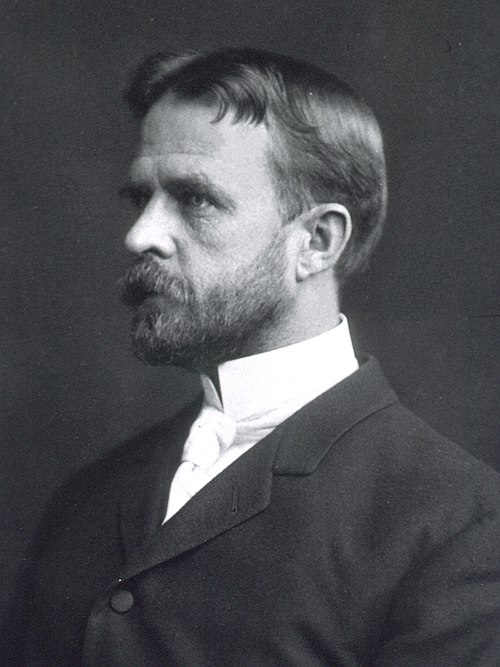
Morgan Links Genes to Chromosomes
Thomas Hunt Morgan's work with fruit flies demonstrates that genes are located on chromosomes. #genetics #chromosomes
Morgan Links Genes to Chromosomes By Unknown author - http://resource.nlm.nih.gov/101422222, Public domain, https://commons.wikimedia.org/w/index.php?curid=549067
1944 CE
Avery–MacLeod–McCarty: DNA is Genetic Material
Oswald Avery and colleagues show that DNA, not protein, carries genetic information in bacteria. #DNA #genetics
Avery–MacLeod–McCarty: DNA is Genetic Material By Bbkkk - self-made in the Naturkunste Museum in Berlin, CC BY-SA 4.0, https://commons.wikimedia.org/w/index.php?curid=3679283
1952 CE
Hershey–Chase Experiment Confirms DNA as Genetic Material
Alfred Hershey and Martha Chase use phage radioactive labeling to prove DNA is the genetic material. #DNA #virology
Hershey–Chase Experiment Confirms DNA as Genetic Material By Thomasione - Modified from German Wikipedia [1], GFDL, https://commons.wikimedia.org/w/index.php?curid=15034881
Apr 25, 1953 CE
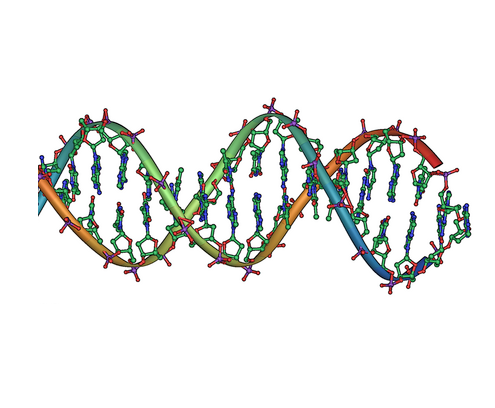
Watson and Crick Propose DNA Double Helix
James Watson and Francis Crick, using Rosalind Franklin's X-ray data, publish the double-helix structure of DNA. #DNA #structure
Watson and Crick Propose DNA Double Helix By 84user adapting file originally uploaded by Richard Wheeler (Zephyris) at en.wikipedia - Derived from File:DNA orbit animated.gif originally from here., CC BY-SA 3.0, https://commons.wikimedia.org/w/index.php?curid=6285050
Matthew Meselson and Franklin Stahl confirm that DNA replication is semi-conservative using density-gradient centrifugation. #DNA #replication
1961 CE
Nirenberg Cracks the Genetic Code
Marshall Nirenberg and Heinrich Matthaei decipher the first codon (UUU) coding for phenylalanine. #geneticcode #biochemistry
Nirenberg Cracks the Genetic Code By The original uploader was Sverdrup at English Wikipedia. Vectorized by: User:VectorVoyager - Vectorization of https://commons.wikimedia.org/wiki/File:RNA-codon.png, Public domain, https://commons.wikimedia.org/w/index.php?curid=124414787
1968 CE
Khorana Synthesizes First Artificial Gene
Indian-American biochemist Har Gobind Khorana chemically synthesizes a complete gene, a yeast alanine tRNA gene. #syntheticbiology #genomics
Khorana Synthesizes First Artificial Gene By Unknown author - http://www.nobelprize.org/nobel_prizes/medicine/laureates/1968/, Public domain, https://commons.wikimedia.org/w/index.php?curid=194932927
1970 CE
Discovery of Restriction Enzymes
Hamilton Smith and Daniel Nathans isolate the first restriction enzyme (HindII), enabling DNA cutting and manipulation. #molecularbiology #enzymes
1972 CE
First Recombinant DNA Molecule
Paul Berg and colleagues create the first recombinant DNA molecule by combining SV40 virus and lambda phage DNA. #biotechnology #recombinantDNA
First Recombinant DNA Molecule By Unknown author - http://profiles.nlm.nih.gov/CD/B/B/L/L/, Public domain, https://commons.wikimedia.org/w/index.php?curid=3702286
1973 CE
Cohen and Boyer Develop First Genetically Engineered Organism
Stanley Cohen and Herbert Boyer use restriction enzymes and plasmids to create the first recombinant bacterium. #geneticengineering
Cohen and Boyer Develop First Genetically Engineered Organism By Crystal Rictor 12 - Own work, CC0, https://commons.wikimedia.org/w/index.php?curid=149912102
1975 CE
Asilomar Conference on Recombinant DNA Safety
Scientists gather to establish voluntary guidelines for recombinant DNA research, addressing biosafety concerns. #bioethics #regulation
1977 CE
Sanger Develops DNA Sequencing Method
Frederick Sanger introduces chain-termination sequencing, enabling rapid reading of DNA base sequences. #sequencing #genomics
Sanger Develops DNA Sequencing Method By Estevezj - Own work, CC BY-SA 3.0, https://commons.wikimedia.org/w/index.php?curid=23264166
1983 CE
Kary Mullis Invents PCR
Kary Mullis conceives the polymerase chain reaction (PCR), a technique to amplify DNA exponentially. #PCR #molecularbiology
Kary Mullis Invents PCR By Madprime - Own work, CC0, https://commons.wikimedia.org/w/index.php?curid=2104468
1985 CE
First Genetic Fingerprint
Alec Jeffreys develops DNA fingerprinting, using variable number tandem repeats (VNTRs) for identification. #forensics #genetics
First Genetic Fingerprint By Jerome Walker - Own work, created from GDFL work created by Michael Ströck, Public domain, https://commons.wikimedia.org/w/index.php?curid=934419
1987 CE
CRISPR Repeats Discovered in Bacteria
Japanese scientist Yoshizumi Ishino discovers unusual repeated sequences in E. coli DNA, later named CRISPR. #CRISPR #microbiology
CRISPR Repeats Discovered in Bacteria By Boghog - Own work, CC BY-SA 4.0, https://commons.wikimedia.org/w/index.php?curid=68597347
Oct 1, 1990 CE
Human Genome Project Launches
An international consortium begins the Human Genome Project to sequence all 3 billion base pairs of human DNA. #genomics #HGP
Human Genome Project Launches By U.S. Department of Energy, Human Genome Project - http://www.ornl.gov/hgmis, Public domain, https://commons.wikimedia.org/w/index.php?curid=2485616
Jul 5, 1996 CE
Dolly the Sheep Cloned
Ian Wilmut and colleagues at the Roslin Institute clone Dolly the sheep from an adult somatic cell. #cloning #biotechnology
1998 CE
RNA Interference Discovered
Andrew Fire and Craig Mello describe RNA interference (RNAi), a mechanism for gene silencing. #RNAi #genetics
RNA Interference Discovered By Dan Cojocari ✉·✍· - Own, This W3C-unspecified vector image was created with Adobe Illustrator., CC BY-SA 3.0, https://commons.wikimedia.org/w/index.php?curid=8697221
Dec 1, 1999 CE
First Human Chromosome Sequenced
Chromosome 22 is fully sequenced as part of the Human Genome Project. #genomics #chromosome22
First Human Chromosome Sequenced By National Human Genome Research Institute - Cropped from File:Human male karyotpe high resolution.jpg, Public domain, https://commons.wikimedia.org/w/index.php?curid=41377308
Jun 26, 2000 CE
Draft Human Genome Announced
President Bill Clinton and Prime Minister Tony Blair announce the completion of a working draft of the human genome. #genomics #announcement
Feb 15, 2001 CE
Human Genome Sequence Published
The International Human Genome Sequencing Consortium publishes the human genome sequence in Nature and Science. #genomics #publication
Dec 5, 2002 CE
Rice Genome Sequenced
The International Rice Genome Sequencing Project (IRGSP) completes the high-quality draft of the rice genome, a major advance for agriculture. #genomics #rice
Apr 14, 2003 CE
Human Genome Project Completed
The Human Genome Project officially ends, having sequenced 99% of the human genome with 99.99% accuracy. #genomics #milestone
2005 CE
International HapMap Project
The HapMap project maps haplotype patterns in multiple populations to aid genome-wide association studies. #genomics #variation
2007 CE
First Next-Generation Sequencing Platform
454 Life Sciences launches the first next-generation sequencer (GS 20), dramatically increasing sequencing speed. #NGS #sequencing
2008 CE
1000 Genomes Project Begins
An international collaboration aims to sequence genomes from 1,000 individuals to capture human genetic variation. #genomics #variation
1000 Genomes Project Begins By Jthiele (talk) - Own work, CC BY-SA 3.0, https://commons.wikimedia.org/w/index.php?curid=54137526
May 20, 2010 CE
First Synthetic Cell Created
J. Craig Venter and colleagues create the first self-replicating bacterium with a synthetic genome (Mycoplasma mycoides JCVI-syn1.0). #syntheticbiology #genomics
First Synthetic Cell Created By David S. Goodsell - https://pdb101.rcsb.org/sci-art/goodsell-gallery/jcvi-syn3a-minimal-cell, CC BY 4.0, https://commons.wikimedia.org/w/index.php?curid=118463017
Aug 17, 2012 CE
CRISPR-Cas9 Used for Genome Editing in Bacteria
Emmanuelle Charpentier and Jennifer Doudna demonstrate that CRISPR-Cas9 can be programmed to cut specific DNA sequences in vitro. #CRISPR #geneediting
CRISPR-Cas9 Used for Genome Editing in Bacteria By Deposition authors: Nishimasu, H., Ishitani, R., Nureki, O.; Visualization author: Synpath - Atom coordinates: https://www.rcsb.org/structure/4OO8; Visualization: Own work, CC0, https://commons.wikimedia.org/w/index.php?curid=133423568
Jan 3, 2013 CE
CRISPR Edits Human Cells
Feng Zhang and colleagues use CRISPR-Cas9 to edit genes in human embryonic 293T cells. #CRISPR #human
CRISPR Edits Human Cells By PuppyEggs - Own work, CC BY-SA 4.0, https://commons.wikimedia.org/w/index.php?curid=66224602
Apr 18, 2015 CE
First CRISPR Editing of Human Embryos in China
Chinese scientists led by Junjiu Huang edit the genomes of non-viable human zygotes, sparking ethical debates. #CRISPR #embryo #ethics
2016 CE
Gene Drive Technology Proposed
Researchers suggest using CRISPR to create gene drives that spread altered genes through populations, aiming to control disease vectors. #genedrive #biotechnology
Gene Drive Technology Proposed By Mariuswalter - Own work, CC BY-SA 4.0, https://commons.wikimedia.org/w/index.php?curid=62766590
Oct 16, 2017 CE
First In Vivo CRISPR Editing in Human Trial
A US patient receives the first CRISPR gene-editing therapy inside the body to correct a genetic eye disease. #CRISPR #therapy
Nov 28, 2018 CE
He Jiankui Announces CRISPR-Edited Babies
Chinese researcher He Jiankui claims to have created the first gene-edited babies, David and Nana, using CRISPR to confer HIV resistance, leading to global condemnation. #CRISPR #ethics #controversy
He Jiankui Announces CRISPR-Edited Babies By The He Lab - This image has been extracted from another file, CC BY 3.0, https://commons.wikimedia.org/w/index.php?curid=74768423
2019 CE
CRISPR Used to Treat Sickle Cell Disease
A patient with sickle cell disease is successfully treated with CRISPR therapy (CTX001) in a clinical trial. #CRISPR #sicklecell
Oct 7, 2020 CE
Nobel Prize Awarded for CRISPR-Cas9
Emmanuelle Charpentier and Jennifer Doudna win the Nobel Prize in Chemistry for developing the CRISPR-Cas9 gene-editing tool. #CRISPR #Nobel
2021 CE
Base Editing Enters Clinical Trials
Base editing, a precise form of gene editing that changes single DNA bases without double-strand breaks, begins clinical trials. #baseediting #genetherapy
Base Editing Enters Clinical Trials By Mazhar Adli - review article : The CRISPR tool kit for genome editing and beyond DOI: 10.1038/s41467-018-04252-2, CC BY 4.0, https://commons.wikimedia.org/w/index.php?curid=81074194
Apr 1, 2022 CE
First Complete Human Genome (T2T)
The Telomere-to-Telomere (T2T) Consortium publishes the first truly complete human genome sequence, filling gaps left by the HGP. #genomics #T2T
Nov 16, 2023 CE
First CRISPR Therapy Approved by UK Regulator
The UK's MHRA approves Casgevy (exagamglogene autotemcel) for sickle cell disease and beta-thalassemia, the first CRISPR-based therapy to receive marketing authorization. #CRISPR #therapy #approval