Encyclopedia/1. The Cosmos & The Natural World/5. Life Sciences • Curated by Admin Timeline.sg
This timeline traces the foundational epochs and key milestones in genomics and gene editing, from ancient selective breeding to modern CRISPR technology, highlighting global contributions.
Chronological Storyline (43 Milestones)
10000 BCE
Selective Breeding in Fertile Crescent
Early farmers in the Fertile Crescent begin selective breeding of crops and animals, laying the groundwork for genetic manipulation. #genomics #agriculture
Selective Breeding in Fertile Crescent By Elembis - File:Mutation and selection diagram.svg, CC BY-SA 3.0, https://commons.wikimedia.org/w/index.php?curid=145716525
5000 BCE
Maize Domestication in Mesoamerica
Indigenous peoples in Mesoamerica domesticate maize (corn) from teosinte, demonstrating early artificial selection and genetic modification. #genomics #agriculture
Maize Domestication in Mesoamerica By Franz Eugen Köhler, Köhler's Medizinal-Pflanzen - Köhler's Medizinal-Pflanzen in naturgetreuen Abbildungen mit kurz erläuterndem Texte, Vol. 3, Plate 78 Old source: List of Koehler Images, Public domain, https://commons.wikimedia.org/w/index.php?curid=255643
3000 BCE
Rice Domestication in East Asia
Rice (Oryza sativa) is domesticated in the Yangtze River basin, providing a genetic foundation for one of the world's staple crops. #genomics #agriculture
Rice Domestication in East Asia By China News Service - YouTube: 第三代杂交水稻晚稻亩产911.7公斤 周年亩产超1500公斤 – View/save archived versions on archive.org, CC BY 3.0, https://commons.wikimedia.org/w/index.php?curid=108022271
400 BCE
Hippocrates' Pangenesis Theory
Greek physician Hippocrates proposes pangenesis, an early concept of heredity suggesting that particles from all body parts contribute to offspring. #genetics #history
Hippocrates' Pangenesis Theory By Ian Alexander - Own work, CC BY-SA 4.0, https://commons.wikimedia.org/w/index.php?curid=62047504
1865 CE
Mendel's Laws of Inheritance
Gregor Mendel publishes his experiments on pea plants, establishing the fundamental laws of heredity now known as Mendelian genetics. #genetics #science
Mendel's Laws of Inheritance By Unknown author - NIH, Public domain, https://commons.wikimedia.org/w/index.php?curid=1394893
1869 CE
Miescher Discovers DNA
Friedrich Miescher isolates a substance from white blood cells that he calls nuclein, later identified as DNA. #genomics #science
Miescher Discovers DNA By Unknown author - copied from http://www.pbs.org/wgbh/nova/photo51/images/befo-miescher.jpg, Public domain, https://commons.wikimedia.org/w/index.php?curid=789048
1900 CE
Rediscovery of Mendel's Work
Hugo de Vries, Carl Correns, and Erich von Tschermak independently rediscover Mendel's principles, sparking modern genetics. #genetics #history
Rediscovery of Mendel's Work By Unknown (Mondadori Publishers) - http://www.gettyimages.co.uk/detail/news-photo/portrait-of-the-german-botanist-and-geneticist-carl-correns-news-photo/141551139, Public domain, https://commons.wikimedia.org/w/index.php?curid=41282248
1902 CE
Chromosome Theory of Inheritance
Walter Sutton and Theodor Boveri propose that chromosomes carry genetic material, laying the foundation for cytogenetics. #genetics #science
Chromosome Theory of Inheritance By Walter_sutton.jpg: Unknown Theodor_Boveri.jpg: Unknown derivative work: Earthdirt (talk) - Walter_sutton.jpg Theodor_Boveri.jpg, Public domain, https://commons.wikimedia.org/w/index.php?curid=8550969
1905 CE
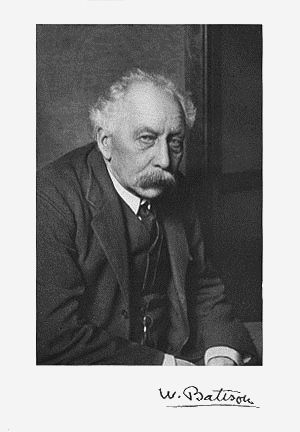
Bateson Coins 'Genetics'
William Bateson introduces the term 'genetics' to describe the study of heredity and variation. #genetics #history
Bateson Coins 'Genetics' By Unknown author - https://web.archive.org/web/20051027192232/http://www.amphilsoc.org/library/images/genetics/bateson2.jpg, Public domain, https://commons.wikimedia.org/w/index.php?curid=671689
1910 CE
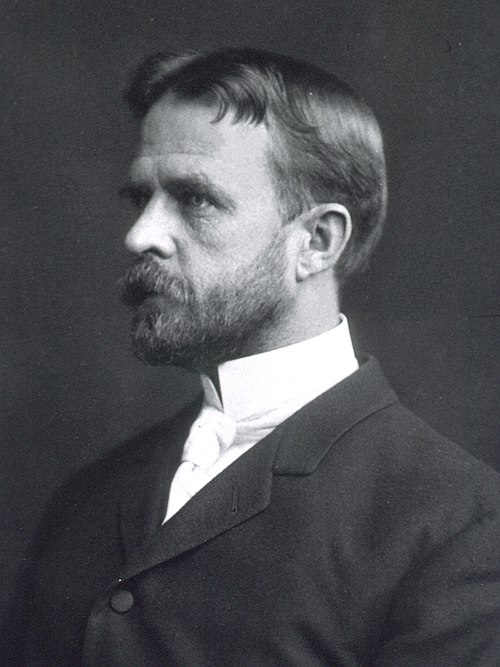
Morgan Links Genes to Chromosomes
Thomas Hunt Morgan discovers that genes are located on chromosomes through experiments on fruit flies, earning a Nobel Prize. #genetics #science
Morgan Links Genes to Chromosomes By Unknown author - http://resource.nlm.nih.gov/101422222, Public domain, https://commons.wikimedia.org/w/index.php?curid=549067
1928 CE
Griffith's Transformation Experiment
Frederick Griffith demonstrates that a 'transforming principle' from dead bacteria can genetically alter live bacteria, foreshadowing DNA's role. #genetics #science
Griffith's Transformation Experiment By No machine-readable author provided. Madprime assumed (based on copyright claims). - No machine-readable source provided. Own work assumed (based on copyright claims)., CC BY-SA 3.0, https://commons.wikimedia.org/w/index.php?curid=1819839
1944 CE
Avery-MacLeod-McCarty Identify DNA as Transforming Principle
Oswald Avery, Colin MacLeod, and Maclyn McCarty show that DNA, not protein, carries genetic information in bacteria. #genomics #science
Avery-MacLeod-McCarty Identify DNA as Transforming Principle By Bbkkk - self-made in the Naturkunste Museum in Berlin, CC BY-SA 4.0, https://commons.wikimedia.org/w/index.php?curid=3679283
1951 CE
McClintock Discovers Transposable Elements
Barbara McClintock reports mobile genetic elements in maize, challenging static views of genomes and later winning a Nobel Prize. #genomics #science
McClintock Discovers Transposable Elements By Smithsonian Institution/Science Service; Restored by Adam Cuerden - Flickr: Barbara McClintock (1902-1992)Smithsonian original, Public domain, https://commons.wikimedia.org/w/index.php?curid=25629182
1952 CE
Hershey-Chase Experiment Confirms DNA as Genetic Material
Alfred Hershey and Martha Chase use phage viruses to confirm DNA is the genetic material. #genomics #science
Hershey-Chase Experiment Confirms DNA as Genetic Material By Thomasione - Modified from German Wikipedia [1], GFDL, https://commons.wikimedia.org/w/index.php?curid=15034881
1953 CE
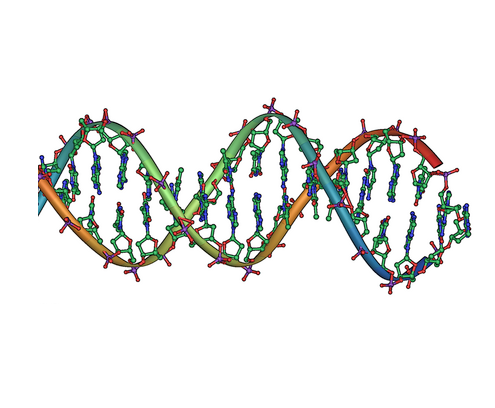
Watson and Crick Propose DNA Double Helix
James Watson and Francis Crick, using Rosalind Franklin's X-ray data, publish the double helix structure of DNA. #genomics #science
Watson and Crick Propose DNA Double Helix By Unknown author, Public domain, https://commons.wikimedia.org/w/index.php?curid=510095
1955 CE
Tjio Determines Human Chromosome Number
Joe Hin Tjio, a Chinese-born cytogeneticist, correctly identifies 46 chromosomes in human cells, correcting previous counts. #genetics #science
Tjio Determines Human Chromosome Number By crop of photo by Sam Silverman (File:Leonard A. Scheele and J.H. Tjio.jpg) - Images from the History of Medicine (NLM) (http://ihm.nlm.nih.gov/luna/servlet/view/search?q=B010173) Portrait no. G. 61-60 Call Number: PP050091 num Record UI: 101442455, Public domain, https://commons.wikimedia.org/w/index.php?curid=17949766
Matthew Meselson and Franklin Stahl show that DNA replicates semiconservatively, confirming a prediction of the double helix model. #genomics #science
1961 CE
Discovery of Messenger RNA
François Jacob and Jacques Monod identify messenger RNA (mRNA) as the molecule that conveys genetic information from DNA to ribosomes. #genomics #science
Discovery of Messenger RNA By National Human Genome Research Institute, NIH - Own work using: mRNA illustration, NIH, Public domain, https://commons.wikimedia.org/w/index.php?curid=126381443
1966 CE
Genetic Code Deciphered
Marshall Nirenberg, Har Gobind Khorana, and others crack the genetic code, mapping each codon to its corresponding amino acid. #genomics #science
Genetic Code Deciphered By The original uploader was Sverdrup at English Wikipedia. Vectorized by: User:VectorVoyager - Vectorization of https://commons.wikimedia.org/wiki/File:RNA-codon.png, Public domain, https://commons.wikimedia.org/w/index.php?curid=124414787
1970 CE
Discovery of Reverse Transcriptase
Howard Temin and David Baltimore independently discover reverse transcriptase, an enzyme that synthesizes DNA from RNA, revolutionizing molecular biology. #genomics #science
Discovery of Reverse Transcriptase By Thomas Splettstoesser (www.scistyle.com) - Own work, CC BY-SA 3.0, https://commons.wikimedia.org/w/index.php?curid=33598425
1970 CE
First Restriction Enzyme Isolated
Werner Arber and Hamilton Smith isolate restriction enzymes that cut DNA at specific sequences, enabling genetic engineering. #genomics #science
1972 CE
First Recombinant DNA Molecule
Paul Berg creates the first recombinant DNA molecule by splicing DNA from different organisms, foundational to genetic engineering. #genomics #science
First Recombinant DNA Molecule By Unknown author - http://profiles.nlm.nih.gov/CD/B/B/L/L/, Public domain, https://commons.wikimedia.org/w/index.php?curid=3702286
1973 CE
Cohen and Boyer Develop Recombinant DNA Technology
Stanley Cohen and Herbert Boyer transform bacteria with recombinant plasmids, creating the first genetically modified organism. #genomics #science )
Cohen and Boyer Develop Recombinant DNA Technology By Unknown author - https://www.nobelprize.org/prizes/medicine/1986/cohen/facts/, Public domain, https://commons.wikimedia.org/w/index.php?curid=182894690
1975 CE
Sanger Develops First DNA Sequencing Method
Frederick Sanger introduces the chain-termination method for DNA sequencing, later enabling the human genome project. #genomics #science
Sanger Develops First DNA Sequencing Method By Estevezj - Own work, CC BY-SA 3.0, https://commons.wikimedia.org/w/index.php?curid=23264166
1977 CE
Discovery of Introns
Philip Sharp and Richard Roberts independently discover split genes and introns, revealing the complexity of eukaryotic genomes. #genomics #science
1983 CE
PCR Invented by Kary Mullis
Kary Mullis develops the polymerase chain reaction (PCR), a method to amplify specific DNA sequences, revolutionizing molecular biology. #genomics #science
PCR Invented by Kary Mullis By Madprime - Own work, CC0, https://commons.wikimedia.org/w/index.php?curid=2104468
1985 CE
DNA Fingerprinting Developed
Alec Jeffreys invents DNA fingerprinting, a technique that identifies individuals by their unique DNA patterns, used in forensics. #genomics #science
DNA Fingerprinting Developed By Jerome Walker - Own work, created from GDFL work created by Michael Ströck, Public domain, https://commons.wikimedia.org/w/index.php?curid=934419
1990 CE
Human Genome Project Launched
An international collaboration begins sequencing the entire human genome, with contributions from the US, UK, China, and other countries. #genomics #science
Human Genome Project Launched By U.S. Department of Energy, Human Genome Project - http://www.ornl.gov/hgmis, Public domain, https://commons.wikimedia.org/w/index.php?curid=2485616
1995 CE
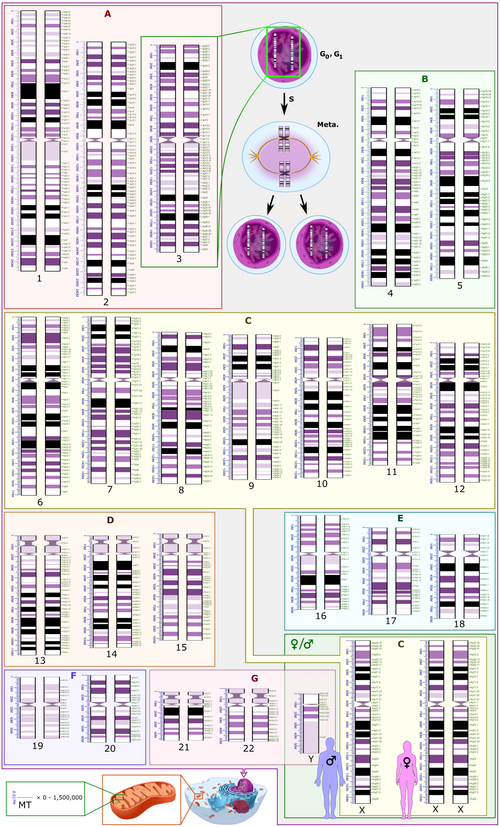
First Bacterial Genome Sequenced
The complete genome of Haemophilus influenzae is sequenced, the first free-living organism to have its genome fully sequenced. #genomics #science
First Bacterial Genome Sequenced By Mikael Häggström, M.D. Author info - Reusing images- Conflicts of interest: None Mikael Häggström, M.D.- The work integrates Public Domain source images by Was A Bee, Kelvin Ma and Michał Komorniczak- Also, a special acknowledgement to everyone involved in the Human Genome Project for generating the source data.edit - editOwn work, integrating the following Public Domain pictures: Chromosomes, with annotated bands and sub-bands, by User:Was a bee, in turn using data from the Human Genome Project, as displayed in the Ensembl genome database: Ensembl - Homo sapiens: Animal Cell.svg by Kelvin Ma (for mitochondrial localization) Animal cell cycle-en.svg by Kelvin Ma (for cell cycle changes at top) Female shadow (for the female silhouette), by Mikael Häggström Autodominant en.svg by Michał Komorniczak (for the male silhouette) The purple hue for the chromosomes and cell nuclei was digitally sampled from the following image: Human Chromosomes (crop), before conversion to grayscale, by SANCHITA20. Creative Commons Attribution 4.0 International license., CC0, https://commons.wikimedia.org/w/index.php?curid=125968286
1996 CE
Dolly the Sheep Cloned
Ian Wilmut and colleagues clone Dolly the sheep from a somatic cell, demonstrating that differentiated cells can be reprogrammed. #genomics #science )
1998 CE
RNA Interference Discovered
Andrew Fire and Craig Mello discover that double-stranded RNA can silence specific gene expression, a powerful tool for research and therapy. #genomics #science
RNA Interference Discovered By Dan Cojocari ✉·✍· - Own, This W3C-unspecified vector image was created with Adobe Illustrator., CC BY-SA 3.0, https://commons.wikimedia.org/w/index.php?curid=8697221
1999 CE
First Human Chromosome Sequenced
Chromosome 22 is the first human chromosome to be fully sequenced, providing insights into genomic organization and disease. #genomics #science
First Human Chromosome Sequenced By National Human Genome Research Institute - Cropped from File:Human male karyotpe high resolution.jpg, Public domain, https://commons.wikimedia.org/w/index.php?curid=41377308
2000 CE
First Draft of Human Genome Announced
The Human Genome Project and Celera Genomics jointly announce the first draft of the human genome, a milestone in genomics. #genomics #science
2002 CE
Rice Genome Sequenced
An international consortium including Japan, China, and the US sequences the rice genome (Oryza sativa), a key crop for global food security. #genomics #agriculture
2003 CE
Human Genome Project Completed
The Human Genome Project finishes sequencing the human genome, providing a reference map for biomedical research. #genomics #science
2005 CE
First Cancer Genome Sequenced
The first complete genome of a cancer (lung) is sequenced, opening the door to personalized oncology and understanding tumor genomics. #genomics #medicine
2008 CE
1000 Genomes Project Launched
An international initiative to sequence over a thousand human genomes, capturing global genetic diversity for research. #genomics #science
1000 Genomes Project Launched By Jthiele (talk) - Own work, CC BY-SA 3.0, https://commons.wikimedia.org/w/index.php?curid=54137526
2010 CE
First Synthetic Cell Created
Craig Venter's team creates the first synthetic bacterial cell (Mycoplasma mycoides JCVI-syn1.0), with a genome synthesized in the lab. #genomics #science
2012 CE
CRISPR-Cas9 Gene Editing Developed
Jennifer Doudna and Emmanuelle Charpentier demonstrate that CRISPR-Cas9 can be programmed to cut specific DNA sequences, revolutionizing genome editing. #genomics #science
CRISPR-Cas9 Gene Editing Developed By Deposition authors: Nishimasu, H., Ishitani, R., Nureki, O.; Visualization author: Synpath - Atom coordinates: https://www.rcsb.org/structure/4OO8; Visualization: Own work, CC0, https://commons.wikimedia.org/w/index.php?curid=133423568
2015 CE
First Human Embryo Editing with CRISPR
Chinese scientists led by Junjiu Huang edit human embryos using CRISPR, sparking ethical debates about germline modification. #genomics #ethics
2017 CE
FDA Approves First Gene Therapy
The US FDA approves Kymriah (tisagenlecleucel) for B-cell acute lymphoblastic leukemia, the first gene therapy in the US. #genomics #medicine
2018 CE
He Jiankui Announces Gene-Edited Babies
Chinese scientist He Jiankui claims to have created the first gene-edited babies using CRISPR, causing global controversy over ethics and safety. #genomics #ethics
He Jiankui Announces Gene-Edited Babies By The He Lab - This image has been extracted from another file, CC BY 3.0, https://commons.wikimedia.org/w/index.php?curid=74768423
2020 CE
Nobel Prize for CRISPR-Cas9
Emmanuelle Charpentier and Jennifer Doudna win the Nobel Prize in Chemistry for developing CRISPR-Cas9 gene editing. #genomics #science