Encyclopedia/1. The Cosmos & The Natural World/5. Life Sciences • Curated by Admin Timeline.sg
Genetics and genomic editing trace the journey from Mendel's pea plant experiments to CRISPR-Cas9, revealing the molecular basis of heredity and enabling precise DNA modification. This timeline spans ancient agricultural selection, foundational discoveries in DNA structure, the Human Genome Project, and revolutionary gene-editing technologies.
Chronological Storyline (43 Milestones)
8000 BCE
Domestication of Plants and Animals
Early humans begin selective breeding of crops and livestock, unknowingly applying genetic principles to enhance traits like yield and tameness. This marks the dawn of applied genetics. #genetics #agriculture
Domestication of Plants and Animals By Elembis - File:Mutation and selection diagram.svg, CC BY-SA 3.0, https://commons.wikimedia.org/w/index.php?curid=145716525
500 BCE
Hippocrates' Theory of Pangenesis
Greek physician Hippocrates proposes that hereditary traits are transmitted via 'seeds' from all body parts, an early but incorrect theory of inheritance. #genetics #history
Hippocrates' Theory of Pangenesis By Ian Alexander - Own work, CC BY-SA 4.0, https://commons.wikimedia.org/w/index.php?curid=62047504
1665 CE
Robert Hooke Discovers Cells
Robert Hooke observes cork cells under a microscope, coining the term 'cell' and laying the foundation for cell theory, essential for understanding heredity. #biology #microscopy
Robert Hooke Discovers Cells By Mary Beale - https://arthistoryproject.com/artists/mary-beale/portrait-of-a-mathematician/, Public domain, https://commons.wikimedia.org/w/index.php?curid=92677611
1831 CE
Brown Describes the Cell Nucleus
Scottish botanist Robert Brown identifies the nucleus in plant cells, a key organelle for genetic material. #cytology #genetics
Brown Describes the Cell Nucleus By TenOfAllTrades at English Wikipedia - Own work, Public domain, https://commons.wikimedia.org/w/index.php?curid=1583880
1856 CE
Mendel Begins Pea Plant Experiments
Gregor Mendel starts his hybridization experiments on pea plants at his monastery in Brno, establishing the laws of segregation and independent assortment. #genetics #history
Mendel Begins Pea Plant Experiments By Unknown author - http://0.tqn.com/d/biology/1/0/l/e/3244238.jpg, Public domain, https://commons.wikimedia.org/w/index.php?curid=33347279
1866 CE
Mendel Publishes 'Experiments on Plant Hybrids'
Mendel presents his findings on inheritance patterns, but his work is largely ignored until its rediscovery in 1900. #genetics #science
Mendel Publishes 'Experiments on Plant Hybrids' By Unknown author - NIH, Public domain, https://commons.wikimedia.org/w/index.php?curid=1394893
1869 CE
Miescher Discovers DNA
Swiss physician Friedrich Miescher isolates a substance from white blood cell nuclei, which he calls 'nuclein', later identified as DNA. #biochemistry #genetics
Miescher Discovers DNA By Unknown author - copied from http://www.pbs.org/wgbh/nova/photo51/images/befo-miescher.jpg, Public domain, https://commons.wikimedia.org/w/index.php?curid=789048
1900 CE
Rediscovery of Mendel's Work
Hugo de Vries, Carl Correns, and Erich von Tschermak independently rediscover Mendel's laws, sparking modern genetics. #genetics #history
Rediscovery of Mendel's Work By Original: Darekk2, SVG: Palosirkka - File:Hybridogenesis in water frogs gametes.gif, CC BY-SA 4.0, https://commons.wikimedia.org/w/index.php?curid=67142604
1902 CE
Sutton and Boveri Propose Chromosome Theory
Walter Sutton and Theodor Boveri independently propose that chromosomes carry hereditary units, linking Mendel's factors to physical structures. #cytogenetics #genetics
Sutton and Boveri Propose Chromosome Theory By Walter_sutton.jpg: Unknown Theodor_Boveri.jpg: Unknown derivative work: Earthdirt (talk) - Walter_sutton.jpg Theodor_Boveri.jpg, Public domain, https://commons.wikimedia.org/w/index.php?curid=8550969
1909 CE
Johannsen Coins 'Gene' and 'Genotype'
Danish botanist Wilhelm Johannsen introduces the term 'gene' to describe Mendel's hereditary units, and distinguishes genotype from phenotype. #genetics #terminology
Johannsen Coins 'Gene' and 'Genotype' By Unknown author - The History of Biology de Erik Nordenskiöld, Ed. Knopf, 1928 (domaine public), Copyrighted free use, https://commons.wikimedia.org/w/index.php?curid=743923
1910 CE
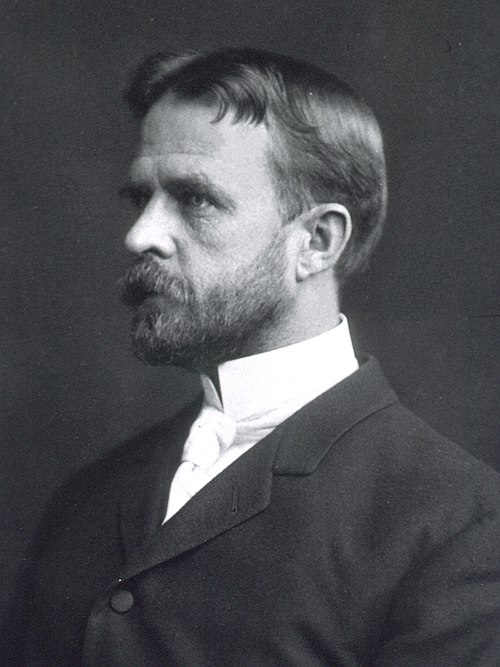
Morgan Discovers Sex-Linked Inheritance
Thomas Hunt Morgan identifies the white-eyed mutation in fruit flies, demonstrating that genes are located on chromosomes and establishing Drosophila as a model organism. #genetics #drosophila
Morgan Discovers Sex-Linked Inheritance By Unknown author - http://resource.nlm.nih.gov/101422222, Public domain, https://commons.wikimedia.org/w/index.php?curid=549067
1913 CE
Sturtevant Creates First Genetic Map
Alfred Sturtevant, a student of Morgan, constructs the first linear genetic map of chromosome regions based on recombination frequencies. #genomics #genetics
1928 CE
Griffith's Transformation Experiment
Frederick Griffith discovers that non-virulent bacteria can become virulent through uptake of genetic material from dead bacteria, hinting at DNA as the transforming principle. #microbiology #genetics
Griffith's Transformation Experiment By No machine-readable author provided. Madprime assumed (based on copyright claims). - No machine-readable source provided. Own work assumed (based on copyright claims)., CC BY-SA 3.0, https://commons.wikimedia.org/w/index.php?curid=1819839
1941 CE
Beadle and Tatum Propose One Gene-One Enzyme
George Beadle and Edward Tatum use Neurospora crassa to show that each gene controls the production of a single enzyme, linking genes to proteins. #genetics #biochemistry
1944 CE
Avery, MacLeod, and McCarty Identify DNA as Genetic Material
Oswald Avery, Colin MacLeod, and Maclyn McCarty demonstrate that DNA, not protein, is the transforming principle in bacteria, conclusively proving DNA carries genetic information. #genetics #molecularbiology
Avery, MacLeod, and McCarty Identify DNA as Genetic Material By Bbkkk - self-made in the Naturkunste Museum in Berlin, CC BY-SA 4.0, https://commons.wikimedia.org/w/index.php?curid=3679283
1950 CE
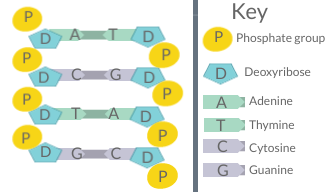
Chargaff's Rules Established
Erwin Chargaff discovers that in DNA, the amount of adenine equals thymine, and guanine equals cytosine, providing key clues for the double helix structure. #biochemistry #dna
Chargaff's Rules Established By Christinelmiller - Own work, CC BY 4.0, https://commons.wikimedia.org/w/index.php?curid=79905324
1952 CE
Hershey-Chase Experiment Confirms DNA as Genetic Material
Alfred Hershey and Martha Chase use radioactive labeling to show that bacteriophage DNA enters bacterial cells, while protein does not, solidifying DNA's role. #genetics #virology
Hershey-Chase Experiment Confirms DNA as Genetic Material By Thomasione - Modified from German Wikipedia [1], GFDL, https://commons.wikimedia.org/w/index.php?curid=15034881
Apr 25, 1953 CE
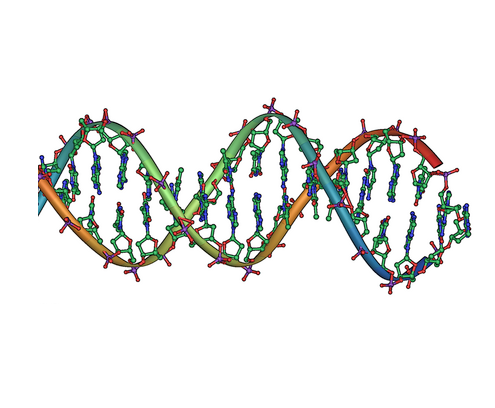
Watson and Crick Propose Double Helix Model
James Watson and Francis Crick publish the double helix structure of DNA, based on X-ray diffraction data from Rosalind Franklin and Maurice Wilkins. #dna #molecularbiology
Watson and Crick Propose Double Helix Model By Unknown author, Public domain, https://commons.wikimedia.org/w/index.php?curid=510095
1956 CE
Tijo and Levan Determine Human Chromosome Number
Joe Hin Tjio and Albert Levan correctly count 46 chromosomes in human cells, correcting the previous belief of 48. #cytogenetics #genetics
Matthew Meselson and Franklin Stahl use isotope labeling to show that DNA replication is semi-conservative, confirming Watson and Crick's model. #molecularbiology #dna
1961 CE
Nirenberg and Matthaei Crack the Genetic Code
Marshall Nirenberg and Heinrich Matthaei use a synthetic RNA to show that UUU codes for phenylalanine, beginning the deciphering of the genetic code. #genetics #biochemistry
Nirenberg and Matthaei Crack the Genetic Code By NIH History Office from Bethesda - J. Heinreich Matthaei and Marshall Nirenberg, Public domain, https://commons.wikimedia.org/w/index.php?curid=82867048
1970 CE
Discovery of Restriction Enzymes
Hamilton Smith and Daniel Nathans isolate the first restriction enzyme, HindII, enabling precise DNA cutting and the birth of genetic engineering. #biotechnology #genetics
1972 CE
First Recombinant DNA Molecule Created
Paul Berg and colleagues create the first recombinant DNA molecule by combining DNA from different species, laying the foundation for genetic engineering. #biotechnology #genetics
First Recombinant DNA Molecule Created By Minestrone Soup at English Wikipedia - Transferred from en.wikipedia to Commons., CC BY-SA 3.0, https://commons.wikimedia.org/w/index.php?curid=46890662
1977 CE
Sanger Develops DNA Sequencing Method
Frederick Sanger introduces the chain-termination method for DNA sequencing, enabling the reading of genetic code. #genomics #biochemistry
Sanger Develops DNA Sequencing Method By Estevezj - Own work, CC BY-SA 3.0, https://commons.wikimedia.org/w/index.php?curid=23264166
1983 CE
PCR Invented by Kary Mullis
Kary Mullis develops the polymerase chain reaction (PCR), a technique to amplify specific DNA sequences, revolutionizing molecular biology. #biotechnology #molecularbiology
PCR Invented by Kary Mullis By Madprime - Own work, CC0, https://commons.wikimedia.org/w/index.php?curid=2104468
1985 CE
First Genetic Fingerprinting
Alec Jeffreys develops DNA fingerprinting, using variable number tandem repeats to identify individuals, transforming forensics. #genetics #forensics
First Genetic Fingerprinting By Jerome Walker - Own work, created from GDFL work created by Michael Ströck, Public domain, https://commons.wikimedia.org/w/index.php?curid=934419
Oct 1, 1990 CE
Human Genome Project Launched
An international consortium begins the Human Genome Project to sequence the entire human genome, a monumental effort in genomics. #genomics #human
Human Genome Project Launched By U.S. Department of Energy, Human Genome Project - http://www.ornl.gov/hgmis, Public domain, https://commons.wikimedia.org/w/index.php?curid=2485616
Jul 5, 1996 CE
Dolly the Sheep Cloned
Ian Wilmut and colleagues at the Roslin Institute clone Dolly the sheep using somatic cell nuclear transfer, the first mammal cloned from an adult cell. #cloning #genetics )
1998 CE
RNA Interference Discovered
Andrew Fire and Craig Mello discover RNA interference (RNAi), a mechanism for gene silencing, earning them the Nobel Prize. #genetics #rnai
RNA Interference Discovered By Dan Cojocari ✉·✍· - Own, This W3C-unspecified vector image was created with Adobe Illustrator., CC BY-SA 3.0, https://commons.wikimedia.org/w/index.php?curid=8697221
Jun 26, 2000 CE
Draft Human Genome Announced
The Human Genome Project and Celera Genomics jointly announce a draft sequence of the human genome, covering about 90% of the genome. #genomics #human
Apr 14, 2003 CE
Human Genome Project Completed
The Human Genome Project finishes sequencing the entire human genome, two years ahead of schedule, providing a reference for biomedical research. #genomics #human
2005 CE
Next-Generation Sequencing Emerges
New sequencing technologies like 454 and Illumina dramatically reduce cost and increase speed, enabling widespread genomic studies. #genomics #technology
2007 CE
First Personal Genome Sequenced
James Watson's genome is sequenced and made publicly available, marking the first individual human genome to be fully sequenced. #genomics #personal
Jun 28, 2012 CE
CRISPR-Cas9 Gene Editing Demonstrated
Emmanuelle Charpentier and Jennifer Doudna publish a method for using CRISPR-Cas9 as a programmable gene-editing tool, revolutionizing genetics. #genetics #crispr
CRISPR-Cas9 Gene Editing Demonstrated By Deposition authors: Nishimasu, H., Ishitani, R., Nureki, O.; Visualization author: Synpath - Atom coordinates: https://www.rcsb.org/structure/4OO8; Visualization: Own work, CC0, https://commons.wikimedia.org/w/index.php?curid=133423568
Jan 1, 2013 CE
First CRISPR Editing in Human Cells
Feng Zhang and George Church independently demonstrate CRISPR-Cas9 editing in human cells, opening doors for therapeutic applications. #genetics #crispr
Apr 1, 2015 CE
First CRISPR Editing of Human Embryos (China)
Chinese scientists report editing non-viable human embryos using CRISPR, sparking global ethical debates. #genetics #ethics
2016 CE
First CRISPR Clinical Trial Approved
The US National Institutes of Health approves a clinical trial using CRISPR to engineer T cells for cancer immunotherapy. #crispr #medicine
Nov 26, 2018 CE
He Jiankui Announces CRISPR Babies
Chinese scientist He Jiankui claims to have created the first gene-edited babies, altering CCR5 to confer HIV resistance, leading to widespread condemnation. #genetics #ethics
He Jiankui Announces CRISPR Babies By The He Lab - This image has been extracted from another file, CC BY 3.0, https://commons.wikimedia.org/w/index.php?curid=74768423
Oct 7, 2020 CE
Nobel Prize for CRISPR-Cas9
Emmanuelle Charpentier and Jennifer Doudna win the Nobel Prize in Chemistry for developing CRISPR-Cas9 gene editing. #crispr #nobel
Dec 1, 2020 CE
First CRISPR Therapy Approved (Casgevy)
The UK approves Casgevy (exagamglogene autotemcel) for sickle cell disease and beta-thalassemia, the first CRISPR-based therapy. #crispr #medicine
2021 CE
Base Editing and Prime Editing Advances
New CRISPR-derived techniques like base editing and prime editing enable precise single-nucleotide changes without double-strand breaks. #genetics #crispr
Base Editing and Prime Editing Advances By Mazhar Adli - review article : The CRISPR tool kit for genome editing and beyond DOI: 10.1038/s41467-018-04252-2, CC BY 4.0, https://commons.wikimedia.org/w/index.php?curid=81074194
2022 CE
Complete Human Genome Sequence Published
The Telomere-to-Telomere consortium publishes the first truly complete human genome sequence, filling in gaps from the HGP. #genomics #human
2023 CE
First In Vivo CRISPR Therapy for Genetic Disease
A clinical trial reports successful in vivo CRISPR editing to treat transthyretin amyloidosis, reducing toxic protein levels. #crispr #medicine