Genetics & DNA Architecture: Mendel's Peas to CRISPR Gene Editing
Encyclopedia/1. The Cosmos & The Natural World/5. Life Sciences/02. Genetics & DNA Architecture • Curated by Admin Timeline.sg
A chronological overview of key discoveries and milestones in genetics and DNA architecture, from Mendel's laws of inheritance to the CRISPR-Cas9 gene-editing revolution.
Chronological Storyline (37 Milestones)
1866 CE
Mendel Publishes Laws of Inheritance
Gregor Mendel publishes 'Experiments on Plant Hybrids', establishing the fundamental laws of heredity. His work on pea plants introduces the concepts of dominant and recessive traits, laying the groundwork for genetics. #genetics #science
Mendel Publishes Laws of Inheritance By Unknown author - NIH, Public domain, https://commons.wikimedia.org/w/index.php?curid=1394893
1869 CE
Miescher Discovers DNA
Friedrich Miescher isolates 'nuclein' from white blood cell nuclei, later identified as deoxyribonucleic acid (DNA). This first extraction of DNA opens the door to understanding the molecular basis of heredity. #dna #science
Miescher Discovers DNA By Unknown author - copied from http://www.pbs.org/wgbh/nova/photo51/images/befo-miescher.jpg, Public domain, https://commons.wikimedia.org/w/index.php?curid=789048
1900 CE
Rediscovery of Mendel's Laws
Hugo de Vries, Carl Correns, and Erich von Tschermak independently rediscover Mendel's work, confirming his laws of inheritance. This marks the birth of modern genetics. #genetics #science
1902 CE
Garrod's Inborn Errors of Metabolism
Archibald Garrod proposes that certain metabolic diseases are inherited, providing the first link between genes and biochemical pathways. His work introduces the concept of 'inborn errors of metabolism'. #genetics #medicine
Garrod's Inborn Errors of Metabolism By Unknown author - https://wellcomeimages.org/indexplus/image/M0018311.html, CC BY 4.0, https://commons.wikimedia.org/w/index.php?curid=33658267
1905 CE
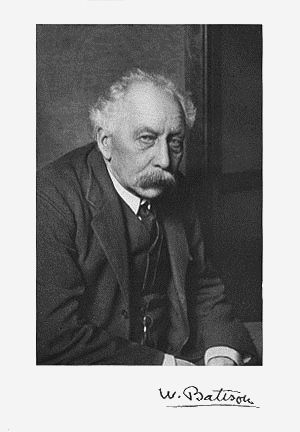
Bateson Coins 'Genetics'
William Bateson introduces the term 'genetics' to describe the study of heredity. He becomes a prominent advocate for Mendel's work and a key figure in the early genetics community. #genetics #science
Bateson Coins 'Genetics' By Unknown author - https://web.archive.org/web/20051027192232/http://www.amphilsoc.org/library/images/genetics/bateson2.jpg, Public domain, https://commons.wikimedia.org/w/index.php?curid=671689
1910 CE
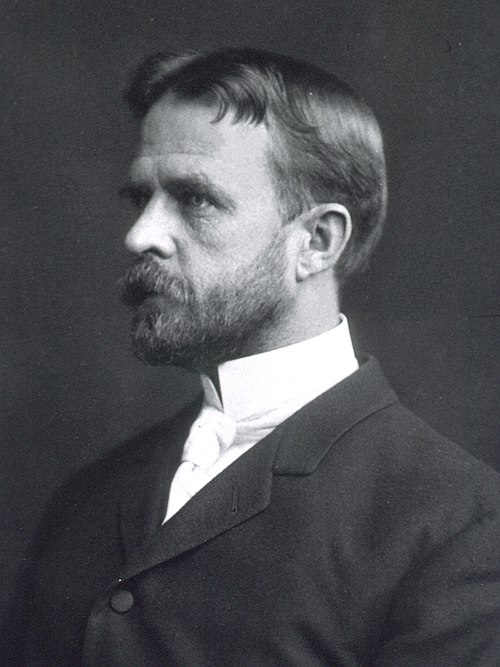
Morgan Discovers Sex-Linked Inheritance
Thomas Hunt Morgan identifies a white-eyed mutation in fruit flies that is inherited differently between sexes, demonstrating chromosomal theory of inheritance. This discovery confirms genes reside on chromosomes. #genetics #science
Morgan Discovers Sex-Linked Inheritance By Unknown author - http://resource.nlm.nih.gov/101422222, Public domain, https://commons.wikimedia.org/w/index.php?curid=549067
1913 CE
First Genetic Map by Sturtevant
Alfred Sturtevant, a student of Morgan, creates the first genetic linkage map by analyzing recombination frequencies in fruit fly genes. This demonstrates that genes are arranged linearly on chromosomes. #genetics #science
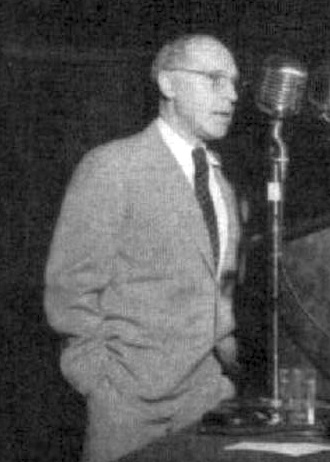
1927 CE
Muller Discovers X-Ray Mutagenesis
Hermann Muller demonstrates that X-rays can induce mutations in fruit flies, proving that external agents can cause genetic changes. This work earns him a Nobel Prize and paves the way for radiation genetics. #genetics #science
Muller Discovers X-Ray Mutagenesis By Alfred De Bat - The Journal of Science Fiction #4, 1953, Public domain, https://commons.wikimedia.org/w/index.php?curid=77035739
1928 CE
Griffith's Transformation Experiment
Frederick Griffith discovers that non-virulent bacteria can become virulent by taking up material from dead virulent bacteria, a phenomenon he calls 'transformation'. This hints at a genetic material capable of transfer. #genetics #science
Griffith's Transformation Experiment By No machine-readable author provided. Madprime assumed (based on copyright claims). - No machine-readable source provided. Own work assumed (based on copyright claims)., CC BY-SA 3.0, https://commons.wikimedia.org/w/index.php?curid=1819839
1941 CE
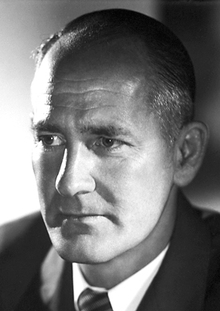
Beadle and Tatum: One Gene-One Enzyme
George Beadle and Edward Tatum use Neurospora crassa to show that each gene controls the production of a specific enzyme, formulating the 'one gene-one enzyme' hypothesis. This connects genes directly to biochemical functions. #genetics #science
Beadle and Tatum: One Gene-One Enzyme By Unknown - http://www.nobelprize.org/nobel_prizes/medicine/laureates/1958/, PD-Sweden, https://en.wikipedia.org/w/index.php?curid=31240247
1944 CE
Avery-MacLeod-McCarty: DNA is the Genetic Material
Oswald Avery, Colin MacLeod, and Maclyn McCarty demonstrate that DNA, not protein, is responsible for bacterial transformation. This landmark experiment provides the first strong evidence that DNA carries genetic information. #dna #genetics
Avery-MacLeod-McCarty: DNA is the Genetic Material By Bbkkk - self-made in the Naturkunste Museum in Berlin, CC BY-SA 4.0, https://commons.wikimedia.org/w/index.php?curid=3679283
1950 CE
Chargaff's Rules
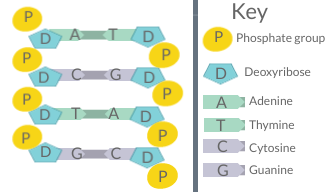
Erwin Chargaff discovers that DNA bases pair in specific ratios: adenine equals thymine, and guanine equals cytosine. These 'Chargaff's rules' become crucial for the later elucidation of the DNA double helix. #dna #science
Chargaff's Rules By Christinelmiller - Own work, CC BY 4.0, https://commons.wikimedia.org/w/index.php?curid=79905324
1952 CE
Hershey-Chase Experiment Confirms DNA
Alfred Hershey and Martha Chase use radioactive labeling to show that bacteriophage DNA enters bacterial cells during infection, while protein does not. This conclusively proves DNA is the genetic material. #dna #genetics
Hershey-Chase Experiment Confirms DNA By Thomasione - Modified from German Wikipedia [1], GFDL, https://commons.wikimedia.org/w/index.php?curid=15034881
Apr 25, 1953 CE
Watson and Crick Discover DNA Double Helix
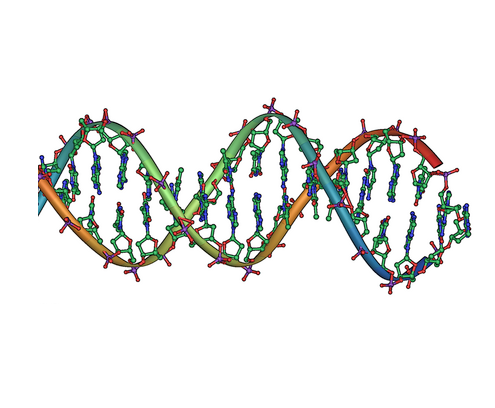
James Watson and Francis Crick publish the double-helix model of DNA, based on X-ray diffraction data from Rosalind Franklin and others. This revolutionary structure reveals how genetic information is stored and replicated. #dna #science
Watson and Crick Discover DNA Double Helix By 84user adapting file originally uploaded by Richard Wheeler (Zephyris) at en.wikipedia - Derived from File:DNA orbit animated.gif originally from here., CC BY-SA 3.0, https://commons.wikimedia.org/w/index.php?curid=6285050
1956 CE
Human Chromosome Number Determined
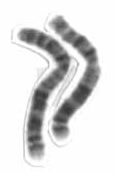
Joe Hin Tjio and Albert Levan correct the previously accepted human chromosome count from 48 to 46, using improved techniques. This sets the stage for studying human genetic disorders. #genetics #science
Human Chromosome Number Determined By National Human Genome Research Institute - Cropped from File:Human male karyotpe high resolution.jpg, Public domain, https://commons.wikimedia.org/w/index.php?curid=40960106
1957 CE
Crick's Central Dogma
Francis Crick articulates the central dogma of molecular biology: genetic information flows from DNA to RNA to protein. This framework guides understanding of gene expression. #molecularbiology #dna
1958 CE
Meselson-Stahl Experiment
Matthew Meselson and Franklin Stahl use isotope labeling and density gradient centrifugation to demonstrate that DNA replication is semiconservative. This confirms a key prediction of the double-helix model. #dna #science
1960 CE
Nirenberg Cracks the First Genetic Code
Marshall Nirenberg and Johann Matthaei discover that the RNA triplet UUU codes for the amino acid phenylalanine. This is the first breakthrough in deciphering the genetic code. #genetics #science
Nirenberg Cracks the First Genetic Code By The original uploader was Sverdrup at English Wikipedia. Vectorized by: User:VectorVoyager - Vectorization of https://commons.wikimedia.org/wiki/File:RNA-codon.png, Public domain, https://commons.wikimedia.org/w/index.php?curid=124414787
1961 CE
Jacob and Monod Propose Operon Model
François Jacob and Jacques Monod propose the operon model for gene regulation in bacteria, describing how genes are turned on and off. This introduces concepts like repressors and promoters. #molecularbiology #genetics
1966 CE
Complete Genetic Code Deciphered
By 1966, the full genetic code is established: all 64 RNA codons are mapped to their corresponding amino acids. This completes the translation of the language of DNA. #genetics #science
1970 CE
Restriction Enzymes Discovered
Hamilton Smith and Daniel Nathans discover restriction enzymes that cut DNA at specific sequences. These enzymes become essential tools for genetic manipulation. Wernher Arber also shares the Nobel Prize. #biotechnology #dna
1972 CE
First Recombinant DNA Molecule
Paul Berg successfully combines DNA from two different organisms, creating the first recombinant DNA molecule. This landmark achievement launches the field of genetic engineering. #biotechnology #dna
First Recombinant DNA Molecule By Minestrone Soup at English Wikipedia - Transferred from en.wikipedia to Commons., CC BY-SA 3.0, https://commons.wikimedia.org/w/index.php?curid=46890662
1973 CE
Cohen and Boyer: First Genetic Engineering
Stanley Cohen and Herbert Boyer develop a method to insert foreign DNA into bacteria, creating the first genetically engineered organism. This work revolutionizes biotechnology and medicine. #biotechnology #genetics )
Cohen and Boyer: First Genetic Engineering By Unknown author - https://www.nobelprize.org/prizes/medicine/1986/cohen/facts/, Public domain, https://commons.wikimedia.org/w/index.php?curid=182894690
1977 CE
Sanger Develops DNA Sequencing
Frederick Sanger develops the chain-termination method for DNA sequencing. This 'Sanger sequencing' becomes the gold standard for decades, enabling the reading of genetic code. #dna #science
Sanger Develops DNA Sequencing By Estevezj - Own work, CC BY-SA 3.0, https://commons.wikimedia.org/w/index.php?curid=23264166
1983 CE
Kary Mullis Invents PCR
Kary Mullis devises the polymerase chain reaction (PCR), a technique to amplify specific DNA sequences exponentially. PCR becomes a cornerstone of molecular biology and diagnostics. #biotechnology #dna
Kary Mullis Invents PCR By Madprime - Own work, CC0, https://commons.wikimedia.org/w/index.php?curid=2104468
1985 CE
First Genetic Fingerprinting
Alec Jeffreys develops DNA fingerprinting, using variable number tandem repeats to distinguish individuals. This technique transforms forensic science and paternity testing. #forensics #dna
First Genetic Fingerprinting By Jerome Walker - Own work, created from GDFL work created by Michael Ströck, Public domain, https://commons.wikimedia.org/w/index.php?curid=934419
1990 CE
Human Genome Project Launched
The International Human Genome Project, led by James Watson and later Francis Collins, officially begins with a $3 billion budget to sequence the entire human genome. This global collaboration marks a new era in genomics. #genomics #science
Human Genome Project Launched By U.S. Department of Energy, Human Genome Project - http://www.ornl.gov/hgmis, Public domain, https://commons.wikimedia.org/w/index.php?curid=2485616
1995 CE
First Bacterial Genome Sequenced
The genome of Haemophilus influenzae is sequenced, becoming the first complete genome of a free-living organism. This achievement demonstrates the feasibility of whole-genome sequencing. #genomics #science
First Bacterial Genome Sequenced By Stefan Walkowski - Own work, CC BY-SA 4.0, https://commons.wikimedia.org/w/index.php?curid=41492226
1996 CE
First Eukaryotic Genome Sequenced
The genome of the yeast Saccharomyces cerevisiae is completed, becoming the first eukaryotic organism to have its full DNA sequence determined. This provides insights into cellular biology. #genomics #science
First Eukaryotic Genome Sequenced By Mogana Das Murtey and Patchamuthu Ramasamy - https://www.intechopen.com/chapters/49652, CC BY 3.0, https://commons.wikimedia.org/w/index.php?curid=52254246
Feb 12, 2001 CE
Human Genome Draft Published
The International Human Genome Project and Celera Genomics jointly publish a draft of the human genome in Nature and Science. This milestone sequence covers about 90% of the genome and accelerates biomedical research. #genomics #science
Apr 14, 2003 CE
Human Genome Project Completed
The Human Genome Project announces the successful completion of sequencing the entire human genome, with 99% accuracy. This landmark achievement provides a reference for human genetics and disease research. #genomics #science
2005 CE
First Next-Generation Sequencing Platform
454 Life Sciences introduces the first next-generation DNA sequencing technology, dramatically reducing cost and time for genome sequencing. This revolutionizes genomic research and personalized medicine. #biotechnology #genomics
May 20, 2010 CE
First Synthetic Cell Created
J. Craig Venter and colleagues create the first synthetic bacterial cell with a genome entirely constructed in the lab. This achievement demonstrates the potential for designing and building new life forms. #biotechnology #syntheticbiology
First Synthetic Cell Created By Alexander van Dijk from San Francisco, United States - Synthetic Biology Research at NASA Ames, CC BY 2.0, https://commons.wikimedia.org/w/index.php?curid=26376516
Jun 28, 2012 CE
CRISPR-Cas9 Genome Editing Demonstrated
Emmanuelle Charpentier and Jennifer Doudna publish a method for using CRISPR-Cas9 as a programmable genome-editing tool. This breakthrough enables precise, efficient, and easy genetic modifications in diverse organisms. #genetics #crispr
CRISPR-Cas9 Genome Editing Demonstrated By Deposition authors: Nishimasu, H., Ishitani, R., Nureki, O.; Visualization author: Synpath - Atom coordinates: https://www.rcsb.org/structure/4OO8; Visualization: Own work, CC0, https://commons.wikimedia.org/w/index.php?curid=133423568
Apr 1, 2015 CE
First CRISPR Editing of Human Embryos
Chinese scientists report the first use of CRISPR to modify non-viable human embryos, sparking global ethical debates about germline editing. This research highlights the power and risks of the technology. #crispr #ethics
Nov 28, 2018 CE
He Jiankui Announces CRISPR Babies
Chinese scientist He Jiankui claims to have created the first gene-edited babies, using CRISPR to modify the CCR5 gene. The announcement is widely condemned due to safety and ethical concerns, leading to legal repercussions. #crispr #ethics
He Jiankui Announces CRISPR Babies By The He Lab - This image has been extracted from another file, CC BY 3.0, https://commons.wikimedia.org/w/index.php?curid=74768423
Oct 7, 2020 CE
Nobel Prize for CRISPR-Cas9
Emmanuelle Charpentier and Jennifer Doudna are awarded the Nobel Prize in Chemistry for developing the CRISPR-Cas9 gene-editing tool. This recognition highlights the transformative impact of genome editing on science and medicine. #crispr #nobel