General Relativity & Curvature: Pioneer Biographies & Lasting Legacies
Encyclopedia/1. The Cosmos & The Natural World/2. Physics & Chemistry/02. Relativity & Gravitational Physics • Curated by Admin Timeline.sg
This timeline traces the key figures and milestones in the development of general relativity and curvature, from ancient geometric foundations to modern black hole imaging and gravitational wave detection. It highlights the contributions of mathematicians and physicists across cultures—including Euclid, Gauss, Riemann, Einstein, Schwarzschild, Lemaître, Chandrasekhar, Penrose, and Hawking—and their enduring legacy in reshaping our understanding of gravity, space, and time.
Chronological Storyline (30 Milestones)
300 BCE
Euclid's Elements
Euclid publishes the Elements, establishing foundational principles of geometry that later influence the concept of curved space. #mathematics #history
Euclid's Elements By University of Pennsylvania Museum of Archaeology and Anthropology - https://openn.library.upenn.edu/Data/0016/html/e2748.html, CC BY-SA 4.0, https://commons.wikimedia.org/w/index.php?curid=169166171
Jul 5, 1687 CE
Newton's Principia Mathematica
Isaac Newton publishes Philosophiæ Naturalis Principia Mathematica, formulating the law of universal gravitation and laying the groundwork for classical gravity. #physics #history
Newton's Principia Mathematica By The original uploader was Zhaladshar at English Wikisource. - Transferred from en.wikisource to Commons. (previous image from another copy) Internet Archive (current image from the Bern Dibner copy), Public domain, https://commons.wikimedia.org/w/index.php?curid=2681838
1827 CE
Gauss's Theorema Egregium
Carl Friedrich Gauss publishes the Theorema Egregium, proving that intrinsic curvature is an inherent property of surfaces, independent of embedding. #mathematics #geometry
Gauss's Theorema Egregium By Eric Gaba (Sting - fr:Sting) - Own work Data : U.S. NGDC World Coast Line (public domain), CC BY-SA 4.0, https://commons.wikimedia.org/w/index.php?curid=4677929
Jun 10, 1854 CE
Riemann's Habilitation Lecture
Bernhard Riemann delivers his habilitation lecture 'On the Hypotheses which lie at the Bases of Geometry', introducing Riemannian geometry and the concept of an n-dimensional manifold with a metric. #mathematics #geometry
Sep 26, 1905 CE
Einstein's Special Relativity
Albert Einstein publishes his paper 'On the Electrodynamics of Moving Bodies', introducing the special theory of relativity, which unifies space and time. #physics #relativity
Einstein's Special Relativity By Lucien Chavan [1] (1868 - 1942), a friend of Einstein's when he was living in Berne. - Cropped from original at the The Albert Einstein Archives, The Hebrew University of Jerusalem., Public domain, https://commons.wikimedia.org/w/index.php?curid=16699199
1907 CE
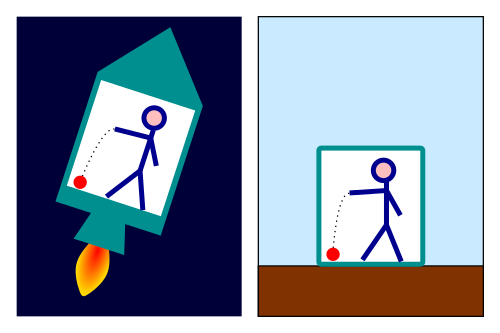
Einstein's Equivalence Principle
Albert Einstein formulates the equivalence principle, stating that gravitational mass and inertial mass are equivalent, a cornerstone of general relativity. #physics #relativity
Einstein's Equivalence Principle By derivative work: Pbroks13 (talk) Elevator_gravity2.png: Markus Poessel (Mapos) - Elevator_gravity2.png, CC BY-SA 3.0, https://commons.wikimedia.org/w/index.php?curid=4381205
Nov 25, 1915 CE
Einstein Completes General Relativity
Albert Einstein presents the final form of the Einstein field equations to the Prussian Academy, completing the general theory of relativity. #physics #relativity
Einstein Completes General Relativity By Simulating eXtreme Spacetimes Lensing (SXS) - https://www.ligo.caltech.edu/video/ligo20160211v3 (video link); see also http://www.black-holes.org/gw150914, CC BY-SA 4.0, https://commons.wikimedia.org/w/index.php?curid=46994894
Jan 13, 1916 CE
Schwarzschild Solution
Karl Schwarzschild publishes the first exact solution to the Einstein field equations, describing the spacetime around a non-rotating spherical mass and predicting black holes. #physics #blackholes
Jun 1, 1916 CE
Einstein Predicts Gravitational Waves
Albert Einstein publishes a paper predicting the existence of gravitational waves as ripples in spacetime. #physics #gravitationalwaves
Einstein Predicts Gravitational Waves By Simulating eXtreme Spacetimes Collaboration/Canadian Institute for Theoretical Astrophysics/SciNet - http://www.black-holes.org/gw150914 (see https://www.youtube.com/watch?v=c-2XIuNFgD0), CC BY-SA 4.0, https://commons.wikimedia.org/w/index.php?curid=46983496
1918 CE
Lense-Thirring Effect
Josef Lense and Hans Thirring predict the dragging of inertial frames (frame-dragging) near rotating masses, a general relativistic effect. #physics #relativity
May 29, 1919 CE
Eddington's Eclipse Expedition
Arthur Eddington leads an expedition to Principe to observe a total solar eclipse, confirming the bending of starlight by the Sun as predicted by general relativity. #physics #astronomy
Eddington's Eclipse Expedition By ESO/Landessternwarte Heidelberg-Königstuhl/F. W. Dyson, A. S. Eddington, & C. Davidson - https://www.eso.org/public/images/potw1926a/, CC BY 4.0, https://commons.wikimedia.org/w/index.php?curid=80091497
1922 CE
Friedmann's Expanding Universe
Alexander Friedmann publishes solutions to the Einstein field equations showing that the universe can expand or contract, laying the foundation for Big Bang theory. #cosmology #physics
Friedmann's Expanding Universe By NASA / WMAP Science Team - http://map.gsfc.nasa.gov/media/121238/ilc_9yr_moll4096.png, Public domain, https://commons.wikimedia.org/w/index.php?curid=23285693
1927 CE
Lemaître's Expanding Universe Model
Georges Lemaître proposes an expanding universe model derived from general relativity, later known as the Big Bang theory. #cosmology #physics
Lemaître's Expanding Universe Model By Unknown author - https://societyforthehistoryofastronomy.com/wp-content/uploads/2023/01/AA14-June-20.pdf, Public domain, https://commons.wikimedia.org/w/index.php?curid=154504242
1930 CE
Chandrasekhar Limit
Subrahmanyan Chandrasekhar calculates the maximum mass of a stable white dwarf star, revealing that more massive stars collapse into neutron stars or black holes. #astrophysics #stars
Sep 1, 1939 CE
Oppenheimer-Snyder Collapse
J. Robert Oppenheimer and Hartland Snyder publish a paper describing the gravitational collapse of a massive star into a black hole. #physics #blackholes
1959 CE
Pound-Rebka Experiment
Robert Pound and Glen Rebka measure the gravitational redshift predicted by general relativity using Mössbauer spectroscopy in a tower at Harvard University. #physics #experiment
Pound-Rebka Experiment By http://en.wikipedia.org/wiki/User:Lumidek - http://en.wikipedia.org/wiki/Image:JeffersonLeft.jpg, Public domain, https://commons.wikimedia.org/w/index.php?curid=3421331
1963 CE
Kerr Solution for Rotating Black Holes
Roy Kerr discovers the exact solution for a rotating black hole, described by the Kerr metric, a key development in black hole physics. #physics #blackholes
Kerr Solution for Rotating Black Holes By Yukterez (Simon Tyran, Vienna) - Own work, CC BY-SA 4.0, https://commons.wikimedia.org/w/index.php?curid=50352912
1964 CE
Penrose's Singularity Theorem
Roger Penrose proves that gravitational collapse inevitably leads to a singularity under general relativity, establishing the existence of black holes. #physics #blackholes
1967 CE
Hawking's Area Theorem
Stephen Hawking proves that the event horizon area of a black hole never decreases, analogous to entropy, leading later to black hole thermodynamics. #physics #blackholes
Hawking's Area Theorem By JRennocks - Own work, CC BY-SA 4.0, https://commons.wikimedia.org/w/index.php?curid=128242974
1969 CE
Penrose Process
Roger Penrose proposes a mechanism to extract rotational energy from a black hole via particle decay, deepening understanding of black hole energy. #physics #blackholes
Penrose Process By L3erdnik - Own work, CC BY-SA 4.0, https://commons.wikimedia.org/w/index.php?curid=114665784
1974 CE
Hawking Radiation
Stephen Hawking predicts that black holes emit thermal radiation due to quantum effects near the event horizon, leading to black hole evaporation. #physics #quantum
1974 CE
Hulse-Taylor Binary Pulsar Discovered
Russell Hulse and Joseph Taylor discover the binary pulsar PSR B1913+16, providing an indirect proof of gravitational waves via orbital decay matching GR predictions. #astronomy #physics
Oct 13, 1993 CE
Hulse and Taylor Win Nobel Prize
Russell Hulse and Joseph Taylor receive the Nobel Prize in Physics for their discovery of the binary pulsar and its confirmation of general relativity. #physics #nobel
Apr 20, 2004 CE
Gravity Probe B Launched
NASA's Gravity Probe B mission launches to test the geodetic effect and frame-dragging predicted by general relativity, providing precise measurements by 2011. #space #physics
Gravity Probe B Launched By NASA/MSFC - http://www.nasa.gov/mission_pages/gpb/gpb_013.html, Public domain, https://commons.wikimedia.org/w/index.php?curid=5532645
Sep 14, 2015 CE
First Direct Detection of Gravitational Waves
LIGO detects gravitational waves from the merger of two black holes (GW150914), confirming a century-old prediction of general relativity. #physics #gravitationalwaves
First Direct Detection of Gravitational Waves By B. P. Abbott et al. (LIGO Scientific Collaboration and Virgo Collaboration) — full list at the end of the article - http://physics.aps.org/featured-article-pdf/10.1103/PhysRevLett.116.061102 . See also the associated Jupyter notebook., CC BY 3.0, https://commons.wikimedia.org/w/index.php?curid=46987868
Feb 11, 2016 CE
LIGO Announces GW150914
The LIGO collaboration announces the first direct detection of gravitational waves, opening a new window onto the universe. #physics #astronomy
Aug 17, 2017 CE
GW170817: Neutron Star Merger
LIGO and Virgo detect gravitational waves from a neutron star merger, accompanied by electromagnetic observations, ushering in multi-messenger astronomy. #astrophysics #gravitationalwaves
GW170817: Neutron Star Merger By LIGO Scientific Collaboration and Virgo Collaboration - https://journals.aps.org/prl/abstract/10.1103/PhysRevLett.119.161101 This W3C-unspecified plot was created with Matplotlib., CC BY-SA 4.0, https://commons.wikimedia.org/w/index.php?curid=63455773
Oct 3, 2017 CE
Nobel Prize for Gravitational Waves
Rainer Weiss, Kip Thorne, and Barry Barish win the Nobel Prize in Physics for decisive contributions to the LIGO detector and the discovery of gravitational waves. #physics #nobel
Apr 10, 2019 CE
First Image of a Black Hole (M87)
The Event Horizon Telescope collaboration releases the first direct image of a black hole's shadow in the center of galaxy M87, consistent with general relativity predictions. #astronomy #blackholes
First Image of a Black Hole (M87) By D. Marrone/UofA - Event Horizon Telescope Collaboration, CC BY 4.0, https://commons.wikimedia.org/w/index.php?curid=133002860
Oct 6, 2020 CE
Penrose Wins Nobel Prize for Black Hole Theory
Roger Penrose receives the Nobel Prize in Physics for proving that black hole formation is a robust prediction of general relativity. #physics #nobel
Penrose Wins Nobel Prize for Black Hole Theory By Cirone-Musi, Festival della Scienza - Flickr, CC BY-SA 2.0, https://commons.wikimedia.org/w/index.php?curid=19318743