General Relativity & Curvature: Modern Frontiers & Breakthrough Innovations
Encyclopedia/1. The Cosmos & The Natural World/2. Physics & Chemistry/02. Relativity & Gravitational Physics • Curated by Admin Timeline.sg
This timeline traces the evolution of general relativity and curvature from ancient philosophical concepts to modern cutting-edge discoveries, highlighting key figures, experimental tests, and future frontiers such as gravitational waves and black hole imaging.
Chronological Storyline (42 Milestones)
300 BCE
Euclid's Elements on Geometry
Euclid's foundational work defines the geometry of flat space, establishing axioms that later influence the concept of curvature. #math #history
Euclid's Elements on Geometry By University of Pennsylvania Museum of Archaeology and Anthropology - https://openn.library.upenn.edu/Data/0016/html/e2748.html, CC BY-SA 4.0, https://commons.wikimedia.org/w/index.php?curid=169166171
250 BCE
Archimedes on Gravity and Buoyancy
Archimedes formulates principles of buoyancy and levers, laying groundwork for understanding gravity and equilibrium. #physics #history
Archimedes on Gravity and Buoyancy By Domenico Fetti - http://archimedes2.mpiwg-berlin.mpg.de/archimedes_templates/popup.htm, Public domain, https://commons.wikimedia.org/w/index.php?curid=146592
200 CE
Indian Astronomer Aryabhata Proposes Rotating Earth
Aryabhata's astronomical model postulates Earth's rotation, influencing later concepts of inertial frames. #astronomy #india
Indian Astronomer Aryabhata Proposes Rotating Earth By Cpjha13 - Own work, CC BY-SA 4.0, https://commons.wikimedia.org/w/index.php?curid=49883192
1010 CE
Ibn al-Haytham's Optics on Light Paths
Alhazen's work on optics includes early ideas of light traveling in straight lines, relevant to later relativistic spacetime. #optics #islamicgoldenage
Ibn al-Haytham's Optics on Light Paths By Adolph Boÿ, engraved by Jeremias Falck. Used as the frontispiece to Johannes Hevelius, Selenographia, 1647 - https://www.loc.gov/resource/rbctos.2017rosen1321/?sp=9&r=0.059,0.617,0.327,0.182,0, Public domain, https://commons.wikimedia.org/w/index.php?curid=165125519
1638 CE
Galileo's Discourse on Two New Sciences
Galileo publishes his studies on motion and gravity, laying groundwork for classical mechanics and inertia. #physics #renaissance
Galileo's Discourse on Two New Sciences By Unknown author, Public domain, https://commons.wikimedia.org/w/index.php?curid=144961
1687 CE
Newton's Principia Mathematica
Newton publishes laws of motion and universal gravitation, describing gravity as an instantaneous force acting at a distance. #physics #classical
Newton's Principia Mathematica By The original uploader was Zhaladshar at English Wikisource. - Transferred from en.wikisource to Commons. (previous image from another copy) Internet Archive (current image from the Bern Dibner copy), Public domain, https://commons.wikimedia.org/w/index.php?curid=2681838
1854 CE
Riemann's On the Hypotheses which lie at the Bases of Geometry
Riemann introduces non-Euclidean geometries, providing mathematical foundation for curved spaces later used in general relativity. #math #geometry
1905 CE
Einstein's Special Relativity Published
Einstein publishes his paper on special relativity, introducing the constancy of light speed and spacetime. #physics #relativity
Einstein's Special Relativity Published By Lucien Chavan [1] (1868 - 1942), a friend of Einstein's when he was living in Berne. - Cropped from original at the The Albert Einstein Archives, The Hebrew University of Jerusalem., Public domain, https://commons.wikimedia.org/w/index.php?curid=16699199
1907 CE
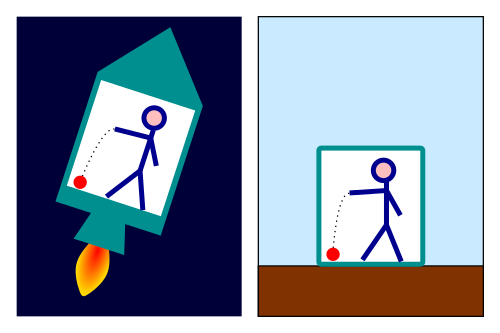
Einstein's Equivalence Principle
Einstein formulates the equivalence principle, stating that gravitational and inertial forces are equivalent, a key insight for general relativity. #physics #gravity
Einstein's Equivalence Principle By derivative work: Pbroks13 (talk) Elevator_gravity2.png: Markus Poessel (Mapos) - Elevator_gravity2.png, CC BY-SA 3.0, https://commons.wikimedia.org/w/index.php?curid=4381205
Nov 25, 1915 CE
Einstein Completes General Relativity Field Equations
Einstein presents the final form of the Einstein field equations, describing gravity as curvature of spacetime. #physics #relativity
Einstein Completes General Relativity Field Equations By Simulating eXtreme Spacetimes Lensing (SXS) - https://www.ligo.caltech.edu/video/ligo20160211v3 (video link); see also http://www.black-holes.org/gw150914, CC BY-SA 4.0, https://commons.wikimedia.org/w/index.php?curid=46994894
1916 CE
Schwarzschild Solution for a Point Mass
Karl Schwarzschild derives the first exact solution to Einstein's field equations, describing the spacetime around a spherically symmetric non-rotating mass, later known as a black hole. #physics #blackhole
1917 CE
Einstein Introduces Cosmological Constant
Einstein modifies his field equations with the cosmological constant to allow for a static universe, later interpreted as dark energy. #physics #cosmology
Einstein Introduces Cosmological Constant By NASA/WMAP Science Team - Original version: NASA; modified by Cherkash, Public domain, https://commons.wikimedia.org/w/index.php?curid=11885244
1918 CE
Lense-Thirring Effect Predicted
Josef Lense and Hans Thirring predict frame-dragging, where rotating masses drag spacetime around them. #physics #relativity
May 29, 1919 CE
Eddington's Eclipse Test Confirms GR
Arthur Eddington observes light deflection during a solar eclipse, providing first experimental confirmation of general relativity. #physics #experiment
Eddington's Eclipse Test Confirms GR By ESO/Landessternwarte Heidelberg-Königstuhl/F. W. Dyson, A. S. Eddington, & C. Davidson - https://www.eso.org/public/images/potw1926a/, CC BY 4.0, https://commons.wikimedia.org/w/index.php?curid=80091497
1931 CE
Chandrasekhar Limit for Stellar Collapse
Subrahmanyan Chandrasekhar calculates the maximum mass of a white dwarf, beyond which gravitational collapse leads to neutron stars or black holes. #astrophysics #india
1935 CE
Einstein-Podolsky-Rosen Paradox and Wormholes
Einstein and Rosen describe the Einstein-Rosen bridge, a wormhole solution, while also exploring quantum non-locality. #physics #quantum
Einstein-Podolsky-Rosen Paradox and Wormholes By MikeRun - Own work, using Wurmloch (Wormhole) by MrFreakmanis (CC BY-SA 3.0) (https://www.thingiverse.com/thing:190022), CC BY-SA 4.0, https://commons.wikimedia.org/w/index.php?curid=100253460
1939 CE
Oppenheimer Predicts Black Holes
J. Robert Oppenheimer and Hartland Snyder show that massive stars can collapse to black holes, a key prediction of general relativity. #physics #blackhole
Pound and Rebka measure the gravitational redshift of gamma rays in a laboratory, confirming a key prediction of GR. #physics #experiment
Pound-Rebka Experiment Tests Gravitational Redshift By http://en.wikipedia.org/wiki/User:Lumidek - http://en.wikipedia.org/wiki/Image:JeffersonLeft.jpg, Public domain, https://commons.wikimedia.org/w/index.php?curid=3421331
1960 CE
Hafele-Keating Experiment Tests Time Dilation
Hafele and Keating fly atomic clocks around the world, confirming relativistic time dilation due to motion and gravity. #physics #relativity
Hafele-Keating Experiment Tests Time Dilation By Binarysequence - Own work, CC BY-SA 3.0, https://commons.wikimedia.org/w/index.php?curid=24592511
1963 CE
Kerr Solution for Rotating Black Holes
Roy Kerr discovers the exact solution for rotating black holes, described by the Kerr metric, a major advance in black hole theory. #physics #blackhole
Kerr Solution for Rotating Black Holes By Yukterez (Simon Tyran, Vienna) - Own work, CC BY-SA 4.0, https://commons.wikimedia.org/w/index.php?curid=50352912
1965 CE
Penrose Singularity Theorem
Roger Penrose proves that singularities inevitably form under gravitational collapse, a fundamental result in GR. #physics #singularity
1967 CE
Neutron Star Discovered as Pulsar
Jocelyn Bell Burnell discovers the first pulsar, later identified as a rapidly rotating neutron star, providing indirect evidence for GR. #astronomy #pulsar
Neutron Star Discovered as Pulsar By NASA/CXC/SAO (X-Ray); NASA/JPL-Caltech (Infrared) - http://www.nasa.gov/sites/default/files/pia18848-wisefacepalm.jpg, Public domain, https://commons.wikimedia.org/w/index.php?curid=36363158
1971 CE
Gravity Probe A Tests Time Dilation
A hydrogen maser clock flown on a rocket confirms gravitational time dilation to high precision. #physics #experiment
Gravity Probe A Tests Time Dilation By Benjamin Crowell - This image has been extracted from another file, CC BY-SA 4.0, https://commons.wikimedia.org/w/index.php?curid=77750634
1974 CE
Hulse-Taylor Binary Pulsar Discovered
Russell Hulse and Joseph Taylor discover a binary pulsar system, whose orbital decay matches GR predictions for gravitational wave emission. #astronomy #gravitationalwaves
1993 CE
Binary Pulsar Confirms Gravitational Waves
Hulse and Taylor receive Nobel Prize for their binary pulsar work, providing indirect confirmation of gravitational waves. #physics #nobel
1998 CE
Discovery of Cosmic Acceleration and Dark Energy
Observations of distant supernovae reveal the universe's expansion is accelerating, implying a cosmological constant or dark energy. #cosmology #darkenergy
Discovery of Cosmic Acceleration and Dark Energy By NASA / WMAP Science Team - http://map.gsfc.nasa.gov/media/121238/ilc_9yr_moll4096.png, Public domain, https://commons.wikimedia.org/w/index.php?curid=23285693
2004 CE
Gravity Probe B Launched to Measure Frame-Dragging
NASA's Gravity Probe B measures the geodetic effect and frame-dragging, confirming two predictions of GR with gyroscopes. #physics #space
Gravity Probe B Launched to Measure Frame-Dragging By NASA/MSFC - http://www.nasa.gov/mission_pages/gpb/gpb_013.html, Public domain, https://commons.wikimedia.org/w/index.php?curid=5532645
2011 CE
Nobel Prize for Dark Energy Discovery
Saul Perlmutter, Brian Schmidt, and Adam Riess receive Nobel Prize for discovering the accelerating expansion of the universe, tied to the cosmological constant. #cosmology #nobel
Nobel Prize for Dark Energy Discovery By Design of the medal: The Nobel Foundation. Sculptor and engraver: Erik Lindberg (1902). - Source of this work Photographer: David Monniaux (2005, 2006, 2007) Edited by: hidro 21:17, 28 July 2008 (UTC) Design of the medal: The Nobel Foundation. Sculptor and engraver: Erik Lindberg (1902)., Cc-by-sa-3.0, https://en.wikipedia.org/w/index.php?curid=18622921
Sep 14, 2015 CE
First Direct Detection of Gravitational Waves
LIGO detects gravitational waves from a binary black hole merger, confirming a century-old prediction of GR and opening a new astronomy window. #physics #gravitationalwaves
First Direct Detection of Gravitational Waves By B. P. Abbott et al. (LIGO Scientific Collaboration and Virgo Collaboration) — full list at the end of the article - http://physics.aps.org/featured-article-pdf/10.1103/PhysRevLett.116.061102 . See also the associated Jupyter notebook., CC BY 3.0, https://commons.wikimedia.org/w/index.php?curid=46987868
Aug 17, 2017 CE
Neutron Star Merger Detected in GW170817
LIGO and Virgo detect gravitational waves from a neutron star merger, accompanied by electromagnetic signals, ushering in multi-messenger astronomy. #astronomy #gravitationalwaves
Neutron Star Merger Detected in GW170817 By LIGO Scientific Collaboration and Virgo Collaboration - https://journals.aps.org/prl/abstract/10.1103/PhysRevLett.119.161101 This W3C-unspecified plot was created with Matplotlib., CC BY-SA 4.0, https://commons.wikimedia.org/w/index.php?curid=63455773
Apr 10, 2019 CE
First Image of a Black Hole (M87*)
The Event Horizon Telescope reveals the first direct image of a black hole's shadow at the center of galaxy M87, confirming GR predictions. #astronomy #blackhole
First Image of a Black Hole (M87*) By D. Marrone/UofA - Event Horizon Telescope Collaboration, CC BY 4.0, https://commons.wikimedia.org/w/index.php?curid=133002860
Oct 6, 2020 CE
Nobel Prize for Black Hole Discoveries
Roger Penrose, Andrea Ghez, and Reinhard Genzel receive Nobel Prize for black hole theory and observation of Sgr A* at galactic center. #physics #nobel
2020 CE
LIGO-Virgo-KAGRA Collaboration Begins
The Japanese KAGRA gravitational wave detector joins the global network, enhancing sensitivity and source localization. #physics #collaboration
LIGO-Virgo-KAGRA Collaboration Begins By Christopher Berry - http://cplberry.com/2015/07/26/whats-up-doc/, CC BY-SA 4.0, https://commons.wikimedia.org/w/index.php?curid=45370733
2021 CE
First Detection of Gravitational Wave from Neutron Star-Black Hole Merger
LIGO and Virgo detect gravitational waves from a neutron star and black hole merger, expanding the catalog of compact object mergers. #astronomy #gravitationalwaves
May 12, 2022 CE
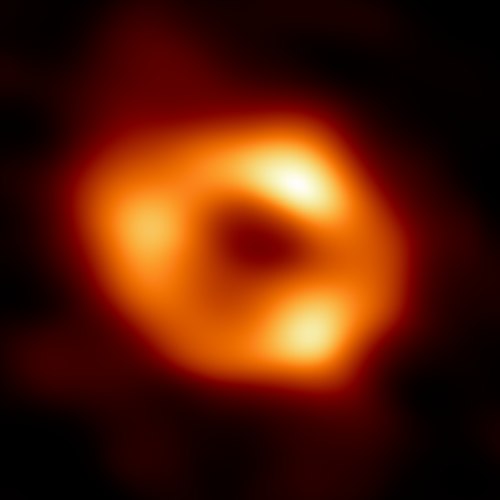
Image of Sagittarius A* Black Hole
Event Horizon Telescope releases the image of Sgr A*, the supermassive black hole at the Milky Way's center, consistent with GR. #astronomy #blackhole
Image of Sagittarius A* Black Hole By EHT Collaboration - https://www.eso.org/public/images/eso2208-eht-mwa/ (image link), CC BY 4.0, https://commons.wikimedia.org/w/index.php?curid=117933557
2023 CE
Pulsar Timing Array Hints at Nanohertz Gravitational Waves
NANOGrav and other collaborations report evidence of a stochastic gravitational wave background at nanohertz frequencies, likely from supermassive black hole binaries. #astronomy #gravitationalwaves
Pulsar Timing Array Hints at Nanohertz Gravitational Waves By NANOGrav - https://nanograv.org/press/image-gallery (info about licence can be found here: https://nanograv.org/resources/press), CC BY 4.0, https://commons.wikimedia.org/w/index.php?curid=171055295
2023 CE
LIGO O4 Run Begins with Enhanced Sensitivity
LIGO's fourth observing run starts with improved detectors, aiming to detect more gravitational waves and probe exotic compact objects. #physics #gravitationalwaves
LIGO O4 Run Begins with Enhanced Sensitivity By Amber Stuver - Own work, CC BY-SA 4.0, https://commons.wikimedia.org/w/index.php?curid=46993713
2024 CE
Quantum Gravity Experiments with Tabletop Sensors
Experiments probing gravity at quantum scales test predictions of theories like loop quantum gravity and string theory. #physics #quantum
Quantum Gravity Experiments with Tabletop Sensors By Cmglee - Own work, CC BY-SA 4.0, https://commons.wikimedia.org/w/index.php?curid=138511396
2025 CE
LISA Pathfinder's Success for Space-Based GW Detection
LISA Pathfinder demonstrates technology for the future Laser Interferometer Space Antenna (LISA), aiming to detect low-frequency gravitational waves. #space #gravitationalwaves
LISA Pathfinder's Success for Space-Based GW Detection By DLR German Aerospace Center - LISA Pathfinder, CC BY 2.0, https://commons.wikimedia.org/w/index.php?curid=32945545
2025 CE
Einstein-Telescope Design Phase Advances
European project for a third-generation gravitational wave detector, Einstein Telescope, enters detailed design and site selection. #physics #engineering
2026 CE
Event Horizon Telescope Expands to Space
Proposed space-based VLBI missions aim to image black hole jets and horizons with higher resolution, testing strong-field GR. #astronomy #future
2030 CE
LISA Launch for Multi-Messenger Astronomy
The LISA mission, planned for launch in the 2030s, will detect gravitational waves from supermassive black hole mergers and extreme mass-ratio inspirals. #space #physics
LISA Launch for Multi-Messenger Astronomy By NASA, Public domain, https://commons.wikimedia.org/w/index.php?curid=10372273