General Relativity & Curvature: Major Case Studies & Paradigm Shifts
Encyclopedia/1. The Cosmos & The Natural World/2. Physics & Chemistry/02. Relativity & Gravitational Physics • Curated by Admin Timeline.sg
Deep dive timeline into major case studies, experimental breakthroughs, and paradigm shifts in General Relativity & Curvature, from ancient geometric foundations to modern gravitational wave astronomy and black hole imaging.
Chronological Storyline (40 Milestones)
300 BCE
Euclid's Elements Published
Euclid's Elements establishes axiomatic geometry, providing the mathematical foundation for later concepts of space and curvature. #mathematics #history
Euclid's Elements Published By University of Pennsylvania Museum of Archaeology and Anthropology - https://openn.library.upenn.edu/Data/0016/html/e2748.html, CC BY-SA 4.0, https://commons.wikimedia.org/w/index.php?curid=169166171
1687 CE
Newton's Principia Published
Isaac Newton publishes Philosophiæ Naturalis Principia Mathematica, formulating the law of universal gravitation and classical mechanics, which Einstein's general relativity later supersedes. #physics #history
Newton's Principia Published By The original uploader was Zhaladshar at English Wikisource. - Transferred from en.wikisource to Commons. (previous image from another copy) Internet Archive (current image from the Bern Dibner copy), Public domain, https://commons.wikimedia.org/w/index.php?curid=2681838
1829 CE
Lobachevsky Publishes Non-Euclidean Geometry
Nikolai Lobachevsky publishes his work on hyperbolic geometry, challenging Euclidean geometry and paving the way for curved spacetime concepts in general relativity. #mathematics #history
Lobachevsky Publishes Non-Euclidean Geometry By Lev Kryukov - http://cczy.blog.ru/?year=2009&month=11, Public domain, https://commons.wikimedia.org/w/index.php?curid=12821190
1854 CE
Riemann's Lecture on the Foundations of Geometry
Bernhard Riemann delivers his habilitation lecture on the hypotheses of geometry, introducing Riemannian geometry and curvature tensors crucial for general relativity. #mathematics #physics
Riemann's Lecture on the Foundations of Geometry By Unknown author - http://www.sil.si.edu/digitalcollections/hst/scientific-identity/explore.htm according to the German Wikipedia., Public domain, https://commons.wikimedia.org/w/index.php?curid=27383
1905 CE
Einstein Publishes Special Relativity
Albert Einstein introduces special relativity, redefining space and time and laying the groundwork for his later theory of general relativity. #physics #relativity
Einstein Publishes Special Relativity By Lucien Chavan [1] (1868 - 1942), a friend of Einstein's when he was living in Berne. - Cropped from original at the The Albert Einstein Archives, The Hebrew University of Jerusalem., Public domain, https://commons.wikimedia.org/w/index.php?curid=16699199
1907 CE
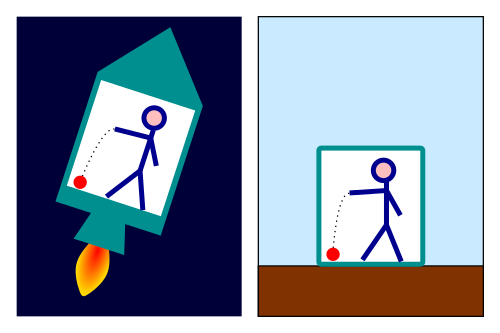
Einstein Formulates Equivalence Principle
Einstein begins developing general relativity with the equivalence principle, equating acceleration and gravity, which leads to curved spacetime. #physics #relativity
Einstein Formulates Equivalence Principle By derivative work: Pbroks13 (talk) Elevator_gravity2.png: Markus Poessel (Mapos) - Elevator_gravity2.png, CC BY-SA 3.0, https://commons.wikimedia.org/w/index.php?curid=4381205
Nov 25, 1915 CE
Einstein's Field Equations Finalized
Albert Einstein presents the final form of the field equations of general relativity, describing gravity as curvature of spacetime caused by mass and energy. #physics #relativity
Einstein's Field Equations Finalized By Simulating eXtreme Spacetimes Lensing (SXS) - https://www.ligo.caltech.edu/video/ligo20160211v3 (video link); see also http://www.black-holes.org/gw150914, CC BY-SA 4.0, https://commons.wikimedia.org/w/index.php?curid=46994894
1916 CE
Schwarzschild Solves Einstein's Equations
Karl Schwarzschild finds the first exact solution to the Einstein field equations, describing the spacetime around a spherical non-rotating mass, predicting black holes. #physics #blackholes
1916 CE
Einstein Predicts Gravitational Waves
Albert Einstein predicts gravitational waves as ripples in spacetime, a key consequence of general relativity confirmed a century later. #physics #gravitationalwaves
Einstein Predicts Gravitational Waves By Simulating eXtreme Spacetimes Collaboration/Canadian Institute for Theoretical Astrophysics/SciNet - http://www.black-holes.org/gw150914 (see https://www.youtube.com/watch?v=c-2XIuNFgD0), CC BY-SA 4.0, https://commons.wikimedia.org/w/index.php?curid=46983496
1917 CE
Einstein Introduces Cosmological Constant
Albert Einstein adds the cosmological constant to his field equations to allow for a static universe, later playing a major role in modern cosmology and dark energy research. #cosmology #physics
Einstein Introduces Cosmological Constant By NASA/WMAP Science Team - Original version: NASA; modified by Cherkash, Public domain, https://commons.wikimedia.org/w/index.php?curid=11885244
May 29, 1919 CE
Eddington's Eclipse Confirms Light Bending
Arthur Eddington leads expeditions to observe a solar eclipse, measuring the deflection of starlight by the Sun's gravity and confirming Einstein's general relativity predictions. #physics #relativity
Eddington's Eclipse Confirms Light Bending By George Grantham Bain Collection, Library of Congress Prints and Photographs Division Washington, D.C. - This image is available from the United States Library of Congress's Prints and Photographs division under the digital ID ggbain.38064.This tag does not indicate the copyright status of the attached work. A normal copyright tag is still required. See Commons:Licensing., Public domain, https://commons.wikimedia.org/w/index.php?curid=6094619
1922 CE
Friedmann Discovers Expanding Universe Solutions
Alexander Friedmann finds solutions to Einstein's equations indicating an expanding universe, foundational for the Big Bang theory and modern cosmology. #cosmology #physics
Friedmann Discovers Expanding Universe Solutions By NASA / WMAP Science Team - http://map.gsfc.nasa.gov/media/121238/ilc_9yr_moll4096.png, Public domain, https://commons.wikimedia.org/w/index.php?curid=23285693
1924 CE
Bose Sends Quantum Statistics Paper to Einstein
Satyendra Nath Bose develops a new quantum statistics and sends his paper to Einstein, leading to Bose-Einstein statistics and Bose-Einstein condensates, with implications for quantum gravity. #physics #quantum
Bose Sends Quantum Statistics Paper to Einstein By Unknown author - Picture in Siliconeer, Public domain, https://commons.wikimedia.org/w/index.php?curid=2201891
1927 CE
Lemaître Proposes Big Bang Theory
Georges Lemaître proposes the primeval atom hypothesis, later known as the Big Bang theory, describing the universe's origin from a hot, dense state as predicted by general relativity. #cosmology #physics
Lemaître Proposes Big Bang Theory By Unknown author - https://societyforthehistoryofastronomy.com/wp-content/uploads/2023/01/AA14-June-20.pdf, Public domain, https://commons.wikimedia.org/w/index.php?curid=154504242
1930 CE
Chandrasekhar Calculates White Dwarf Limit
Subrahmanyan Chandrasekhar uses general relativity and quantum mechanics to determine the maximum mass of a stable white dwarf star, a key concept in stellar astrophysics. #astrophysics #physics
J. Robert Oppenheimer and Hartland Snyder publish a model of gravitational collapse, showing how a massive star can collapse to form a black hole as predicted by general relativity. #physics #blackholes
1955 CE
Raychaudhuri Equation Published
Amal Kumar Raychaudhuri derives the Raychaudhuri equation, a key tool in general relativity for studying spacetime singularities and gravitational focusing. #physics #relativity
1957 CE
Wheeler Coins 'Black Hole'
John Archibald Wheeler popularizes the term 'black hole' for objects with gravitational collapse complete event horizons, cementing the concept in physics. #physics #blackholes
Wheeler Coins 'Black Hole' By Event Horizon Telescope, uploader cropped and converted TIF to JPG - This media was produced by the European Southern Observatory (ESO), under the identifier eso1907a This tag does not indicate the copyright status of the attached work. A normal copyright tag is still required. See Commons:Licensing., CC BY 4.0, https://commons.wikimedia.org/w/index.php?curid=77925953
Robert Pound and Glen Rebka measure the gravitational redshift of gamma rays in a laboratory, verifying a key prediction of general relativity. #physics #relativity
Pound-Rebka Experiment Confirms Gravitational Redshift By http://en.wikipedia.org/wiki/User:Lumidek - http://en.wikipedia.org/wiki/Image:JeffersonLeft.jpg, Public domain, https://commons.wikimedia.org/w/index.php?curid=3421331
1963 CE
Kerr Finds Rotating Black Hole Solution
Roy Kerr solves the Einstein field equations for a rotating black hole, describing the Kerr metric, crucial for understanding astrophysical black holes. #physics #blackholes
Kerr Finds Rotating Black Hole Solution By Yukterez (Simon Tyran, Vienna) - Own work, CC BY-SA 4.0, https://commons.wikimedia.org/w/index.php?curid=50352912
1964 CE
Penrose Proves Singularity Theorem
Roger Penrose proves that singularities are inevitable in gravitational collapse under general relativity, laying foundations for black hole theory. #physics #relativity
1965 CE
Discovery of Cosmic Microwave Background
Arno Penzias and Robert Wilson discover the cosmic microwave background radiation, strong evidence for the Big Bang and a cornerstone of modern cosmology supported by general relativity. #cosmology #physics
Discovery of Cosmic Microwave Background By ESA and the Planck Collaboration - Cosmic Microwave Background, CC BY 4.0, https://commons.wikimedia.org/w/index.php?curid=130789180
1967 CE
First Pulsar Discovered
Jocelyn Bell Burnell and Antony Hewish discover the first pulsar, a rapidly rotating neutron star, providing indirect evidence for general relativity's predictions of compact objects. #astrophysics #physics
First Pulsar Discovered By NASA/CXC/SAO (X-Ray); NASA/JPL-Caltech (Infrared) - http://www.nasa.gov/sites/default/files/pia18848-wisefacepalm.jpg, Public domain, https://commons.wikimedia.org/w/index.php?curid=36363158
1971 CE
Cygnus X-1 Identified as Black Hole Candidate
Cygnus X-1, a strong X-ray source, is confirmed as the first likely stellar-mass black hole, based on general relativistic modeling. #astrophysics #blackholes
Cygnus X-1 Identified as Black Hole Candidate By IAU and Sky & Telescope magazine (Roger Sinnott & Rick Fienberg) - [1], CC BY 4.0, https://commons.wikimedia.org/w/index.php?curid=15406373
1974 CE
Hawking Predicts Hawking Radiation
Stephen Hawking predicts that black holes emit radiation due to quantum effects, merging general relativity with quantum theory and leading to black hole thermodynamics. #physics #blackholes
1974 CE
Hulse and Taylor Discover Binary Pulsar
Russell Hulse and Joseph Taylor discover the binary pulsar PSR B1913+16, providing a natural laboratory to test general relativity's predictions of gravitational waves. #physics #relativity
1978 CE
Binary Pulsar Orbital Decay Matches GR
Hulse and Taylor report orbital period decay of the binary pulsar matching general relativity's prediction, providing the first indirect evidence of gravitational waves. #physics #gravitationalwaves
1993 CE
Gravitational Lensing of Galaxy Cluster
Observation of gravitational lensing in CL0024+1654 and other clusters confirms dark matter's gravitational effects predicted by general relativity. #astrophysics #cosmology
Gravitational Lensing of Galaxy Cluster By Lensshoe_hubble.jpg: ESA/Hubble & NASA derivative work: Bulwersator (talk) - Lensshoe_hubble.jpg, Public domain, https://commons.wikimedia.org/w/index.php?curid=17750437
Apr 20, 2004 CE
Gravity Probe B Launched
NASA's Gravity Probe B satellite launches to test frame-dragging and the geodetic effect, predictions of general relativity near Earth. #physics #space
Gravity Probe B Launched By NASA/MSFC - http://www.nasa.gov/mission_pages/gpb/gpb_013.html, Public domain, https://commons.wikimedia.org/w/index.php?curid=5532645
2007 CE
LIGO Begins Initial Science Run
The Laser Interferometer Gravitational-Wave Observatory (LIGO) starts its first science run, aiming to directly detect gravitational waves predicted by general relativity. #physics #gravitationalwaves
LIGO Begins Initial Science Run By Amber Stuver - Own work, CC BY-SA 4.0, https://commons.wikimedia.org/w/index.php?curid=46993713
2011 CE
Gravity Probe B Results Announced
Final results from Gravity Probe B confirm the geodetic effect and frame-dragging to high precision, validating general relativity. #physics #relativity
Sep 14, 2015 CE
LIGO Detects First Gravitational Waves
LIGO observes gravitational waves from a binary black hole merger (GW150914), the first direct detection, confirming a century-old prediction of general relativity. #physics #gravitationalwaves
LIGO Detects First Gravitational Waves By B. P. Abbott et al. (LIGO Scientific Collaboration and Virgo Collaboration) — full list at the end of the article - http://physics.aps.org/featured-article-pdf/10.1103/PhysRevLett.116.061102 . See also the associated Jupyter notebook., CC BY 3.0, https://commons.wikimedia.org/w/index.php?curid=46987868
2016 CE
Second Gravitational Wave Event Announced
LIGO announces detection of GW151226, another binary black hole merger, reinforcing the prevalence of such events and the validity of general relativity. #physics #gravitationalwaves
Second Gravitational Wave Event Announced By LIGO Scientific Collaboration and Virgo Collaboration - http://journals.aps.org/prl/abstract/10.1103/PhysRevLett.116.241103 This plot was created with Matplotlib., CC BY 3.0, https://commons.wikimedia.org/w/index.php?curid=49503102
Aug 17, 2017 CE
GW170817: First Neutron Star Merger Detected
LIGO-Virgo detect GW170817, a binary neutron star merger, with electromagnetic counterparts observed across the spectrum, multi-messenger astronomy milestone. #physics #gravitationalwaves #astrophysics
GW170817: First Neutron Star Merger Detected By LIGO Scientific Collaboration and Virgo Collaboration - https://journals.aps.org/prl/abstract/10.1103/PhysRevLett.119.161101 This W3C-unspecified plot was created with Matplotlib., CC BY-SA 4.0, https://commons.wikimedia.org/w/index.php?curid=63455773
Apr 10, 2019 CE
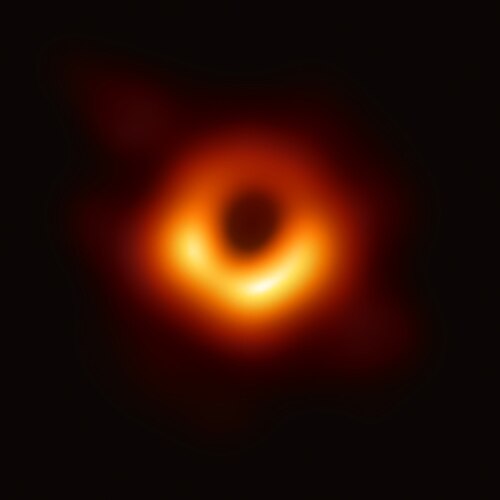
Event Horizon Telescope Images Black Hole
The Event Horizon Telescope collaboration releases the first direct image of the supermassive black hole M87*'s shadow, confirming general relativistic predictions. #astrophysics #blackholes
Event Horizon Telescope Images Black Hole By D. Marrone/UofA - Event Horizon Telescope Collaboration, CC BY 4.0, https://commons.wikimedia.org/w/index.php?curid=133002860
Oct 6, 2020 CE
Nobel Prize for Black Hole Discoveries
KIPAC: Roger Penrose, Andrea Ghez, and Reinhard Genzel share the Nobel Prize in Physics for theoretical and observational work on black holes, directly testing general relativity. #physics #nobel
2021 CE
KAGRA Joins LIGO-Virgo Collaboration
The Japanese gravitational wave detector KAGRA officially joins the LIGO-Virgo network, expanding global capacity to detect and study gravitational waves. #physics #gravitationalwaves
KAGRA Joins LIGO-Virgo Collaboration By Christopher Berry - http://cplberry.com/2015/07/26/whats-up-doc/, CC BY-SA 4.0, https://commons.wikimedia.org/w/index.php?curid=45370733
Dec 25, 2022 CE
James Webb Space Telescope Launched
NASA's James Webb Space Telescope launches, enabling deep observations of the early universe and testing cosmological models based on general relativity. #astrophysics #cosmology
James Webb Space Telescope Launched By NASA - https://www.jwst.nasa.gov/content/webbLaunch/whereIsWebb.html, Public domain, https://commons.wikimedia.org/w/index.php?curid=114125719
2022 CE
LIGO-Virgo-KAGRA O4 Observing Run Begins
The LIGO-Virgo-KAGRA collaboration starts its fourth observing run (O4) with improved sensitivity, aiming to detect more gravitational wave sources. #physics #gravitationalwaves
2023 CE
GRB 230307A: Multi-messenger Neutron Star Merger
Multi-messenger observations of a gamma-ray burst (GRB 230307A) associated with a neutron star merger provide new insights into relativistic jets and gravitational waves. #astrophysics #multi messenger
GRB 230307A: Multi-messenger Neutron Star Merger By NASA Webb Telescope Team - https://www.nasa.gov/missions/webb/nasas-webb-makes-first-detection-of-heavy-element-from-star-merger/, Public domain, https://commons.wikimedia.org/w/index.php?curid=139604646