General Relativity & Curvature: Foundational Epochs & Key Milestones
Encyclopedia/1. The Cosmos & The Natural World/2. Physics & Chemistry/02. Relativity & Gravitational Physics • Curated by Admin Timeline.sg
This timeline traces the historical development of general relativity and the concept of curvature, from ancient geometric foundations to modern experimental confirmations and astrophysical applications.
Chronological Storyline (38 Milestones)
300 BCE
Euclid's Elements
Euclid's 'Elements' formalizes Euclidean geometry, establishing the parallel postulate that later inspires non-Euclidean geometries. #math #history
Euclid's Elements By University of Pennsylvania Museum of Archaeology and Anthropology - https://openn.library.upenn.edu/Data/0016/html/e2748.html, CC BY-SA 4.0, https://commons.wikimedia.org/w/index.php?curid=169166171
240 BCE
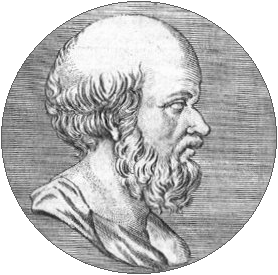
Eratosthenes Measures Earth's Circumference
Eratosthenes uses shadow angles to estimate Earth's circumference, an early measurement of planetary curvature. #science #ancient
Eratosthenes Measures Earth's Circumference By Unknown author, Public domain, https://commons.wikimedia.org/w/index.php?curid=494949
1025 CE
Al-Biruni Measures Earth's Radius
Islamic scholar Al-Biruni develops a trigonometric method to measure Earth's radius, accurate to within 1%. #islamicgoldenage #science
Al-Biruni Measures Earth's Radius By The original uploader was Romanm at Slovenian Wikipedia. - Originally from sl.wikipedia; description page is/was here., Public domain, https://commons.wikimedia.org/w/index.php?curid=2590841
1829 CE
Lobachevsky Presents Non-Euclidean Geometry
Nikolai Lobachevsky publishes the first coherent non-Euclidean geometry, challenging Euclid's parallel postulate. #math #history
Lobachevsky Presents Non-Euclidean Geometry By Lev Kryukov - http://cczy.blog.ru/?year=2009&month=11, Public domain, https://commons.wikimedia.org/w/index.php?curid=12821190
1832 CE
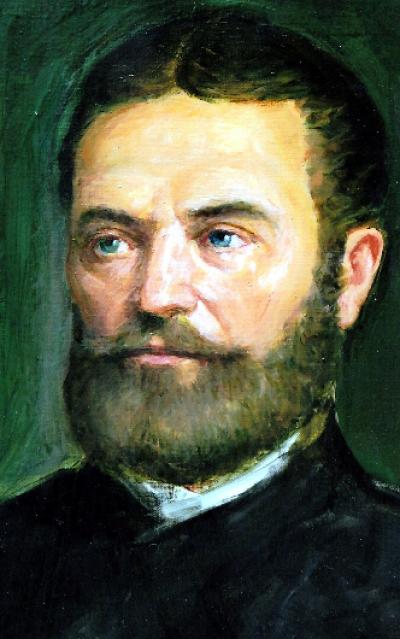
Bolyai's Appendix on Non-Euclidean Geometry
János Bolyai independently develops a non-Euclidean geometry, published as an appendix to his father's book. #math #history
Bolyai's Appendix on Non-Euclidean Geometry By Ferenc Márkos - Transferred from hu.wikipedia to Commons by Tambo., CC BY-SA 3.0, https://commons.wikimedia.org/w/index.php?curid=24338736
1854 CE
Riemann's 'On the Hypotheses which lie at the Bases of Geometry'
Bernhard Riemann's habilitation lecture introduces Riemannian geometry, a curved space framework later crucial for general relativity. #math #physics
Riemann's 'On the Hypotheses which lie at the Bases of Geometry' By Unknown author - http://www.sil.si.edu/digitalcollections/hst/scientific-identity/explore.htm according to the German Wikipedia., Public domain, https://commons.wikimedia.org/w/index.php?curid=27383
Sep 27, 1905 CE
Einstein's Special Relativity
Albert Einstein publishes 'On the Electrodynamics of Moving Bodies', establishing special relativity and the equivalence of mass and energy. #physics #relativity
Einstein's Special Relativity By Lucien Chavan [1] (1868 - 1942), a friend of Einstein's when he was living in Berne. - Cropped from original at the The Albert Einstein Archives, The Hebrew University of Jerusalem., Public domain, https://commons.wikimedia.org/w/index.php?curid=16699199
1907 CE
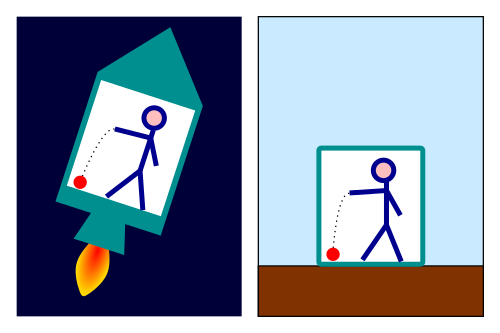
Einstein's Equivalence Principle
Einstein formulates the equivalence principle, stating that gravitational mass and inertial mass are equivalent, a cornerstone of general relativity. #physics #relativity
Einstein's Equivalence Principle By derivative work: Pbroks13 (talk) Elevator_gravity2.png: Markus Poessel (Mapos) - Elevator_gravity2.png, CC BY-SA 3.0, https://commons.wikimedia.org/w/index.php?curid=4381205
Nov 18, 1915 CE
Einstein Explains Mercury's Perihelion Precession
Einstein uses general relativity to account for the anomalous precession of Mercury's orbit, an early success of the theory. #physics #astronomy
Nov 25, 1915 CE
Einstein Completes General Relativity
Albert Einstein presents the final field equations of general relativity at the Prussian Academy, describing gravity as curvature of spacetime. #physics #relativity
Einstein Completes General Relativity By Simulating eXtreme Spacetimes Lensing (SXS) - https://www.ligo.caltech.edu/video/ligo20160211v3 (video link); see also http://www.black-holes.org/gw150914, CC BY-SA 4.0, https://commons.wikimedia.org/w/index.php?curid=46994894
Jan 1, 1916 CE
Schwarzschild Solution
Karl Schwarzschild finds the first exact solution to Einstein's field equations, describing the gravitational field outside a spherical mass and predicting black holes. #physics #relativity
Feb 1, 1917 CE
Einstein Introduces Cosmological Constant
Einstein modifies his equations with a cosmological constant to allow a static universe, later calling it his 'biggest blunder'. #cosmology #physics
Einstein Introduces Cosmological Constant By NASA/WMAP Science Team - Original version: NASA; modified by Cherkash, Public domain, https://commons.wikimedia.org/w/index.php?curid=11885244
Jul 16, 1918 CE
Noether's Theorem
Emmy Noether publishes her theorem linking symmetries and conservation laws, essential for understanding energy conservation in general relativity. #math #physics
Noether's Theorem By Emmy Noether - "Invariante Variationsprobleme" (Nachrichten von der Gesellschaft der Wissenschaften zu Göttingen, Mathematisch-Physikalische Klasse 1918 (1918): 235-257. <http://eudml.org/doc/59024>), Public domain, https://commons.wikimedia.org/w/index.php?curid=69398536
May 29, 1919 CE
Eddington Eclipse Experiment
Arthur Eddington's observations during a solar eclipse confirm that light bends around the Sun, providing first experimental support for general relativity. #physics #astronomy
Eddington Eclipse Experiment By ESO/Landessternwarte Heidelberg-Königstuhl/F. W. Dyson, A. S. Eddington, & C. Davidson - https://www.eso.org/public/images/potw1926a/, CC BY 4.0, https://commons.wikimedia.org/w/index.php?curid=80091497
Nov 6, 1919 CE
Einstein Becomes World Famous
The Royal Society announces the confirmation of general relativity, catapulting Einstein to international fame. #history #science
Einstein Becomes World Famous By George Grantham Bain Collection, Library of Congress Prints and Photographs Division Washington, D.C. - This image is available from the United States Library of Congress's Prints and Photographs division under the digital ID ggbain.38064.This tag does not indicate the copyright status of the attached work. A normal copyright tag is still required. See Commons:Licensing., Public domain, https://commons.wikimedia.org/w/index.php?curid=6094619
1922 CE
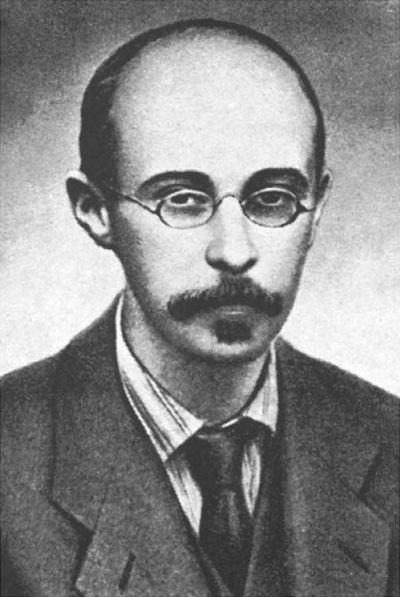
Friedmann Proposes Expanding Universe
Alexander Friedmann derives solutions to Einstein's equations showing the universe may expand or contract, contradicting static models. #cosmology #physics
Friedmann Proposes Expanding Universe By Unknown author - Cropped From, Public domain, https://commons.wikimedia.org/w/index.php?curid=2630080
1927 CE
Lemaître's Big Bang Theory
Georges Lemaître proposes the 'primeval atom' hypothesis, later known as the Big Bang, based on general relativity and expanding universe. #cosmology #physics
Lemaître's Big Bang Theory By Unknown author - https://societyforthehistoryofastronomy.com/wp-content/uploads/2023/01/AA14-June-20.pdf, Public domain, https://commons.wikimedia.org/w/index.php?curid=154504242
1930 CE
Chandrasekhar Limit
Subrahmanyan Chandrasekhar calculates the maximum mass of a stable white dwarf star, above which it must collapse into a neutron star or black hole. #astrophysics #physics
Sep 1, 1939 CE
Einstein-Infeld-Hoffmann Equations
Einstein, Leopold Infeld, and Banesh Hoffmann derive equations of motion in general relativity, showing how gravity influences moving bodies. #physics #relativity
Oct 1, 1959 CE
Pound-Rebka Experiment
Robert Pound and Glen Rebka measure gravitational redshift using Mössbauer spectroscopy, confirming general relativity's prediction. #physics #experiment
Pound-Rebka Experiment By http://en.wikipedia.org/wiki/User:Lumidek - http://en.wikipedia.org/wiki/Image:JeffersonLeft.jpg, Public domain, https://commons.wikimedia.org/w/index.php?curid=3421331
Jul 1, 1963 CE
Kerr Solution for Rotating Black Holes
Roy Kerr discovers the exact solution for a rotating black hole, described by the Kerr metric. #physics #relativity
Kerr Solution for Rotating Black Holes By Yukterez (Simon Tyran, Vienna) - Own work, CC BY-SA 4.0, https://commons.wikimedia.org/w/index.php?curid=50352912
Dec 1, 1964 CE
Shapiro Time Delay
Irwin Shapiro predicts that radar signals passing near the Sun will be delayed due to spacetime curvature, later confirmed. #physics #relativity
Oct 1, 1967 CE
Jocelyn Bell Burnell Discovers Pulsars
Pulsars are discovered, providing natural laboratories for testing general relativity in strong gravitational fields. #astronomy #physics
Jocelyn Bell Burnell Discovers Pulsars By NASA/CXC/SAO (X-Ray); NASA/JPL-Caltech (Infrared) - http://www.nasa.gov/sites/default/files/pia18848-wisefacepalm.jpg, Public domain, https://commons.wikimedia.org/w/index.php?curid=36363158
Oct 1, 1971 CE
Hafele-Keating Experiment
Joseph Hafele and Richard Keating fly atomic clocks around the world, confirming time dilation effects predicted by special and general relativity. #physics #experiment
Hafele-Keating Experiment By Binarysequence - Own work, CC BY-SA 3.0, https://commons.wikimedia.org/w/index.php?curid=24592511
Jan 1, 1974 CE
Hawking Proposes Black Hole Evaporation
Stephen Hawking shows that black holes emit radiation due to quantum effects near the event horizon, linking general relativity and quantum mechanics. #physics #relativity
Jul 2, 1974 CE
Hulse-Taylor Binary Pulsar Discovered
Russell Hulse and Joseph Taylor discover a binary pulsar whose orbital decay matches general relativity's prediction of gravitational waves. #physics #astronomy
Jun 18, 1976 CE
Gravity Probe A Test of Time Dilation
A hydrogen maser clock on a suborbital rocket measures gravitational time dilation with high precision, confirming general relativity. #physics #experiment
Gravity Probe A Test of Time Dilation By Benjamin Crowell - This image has been extracted from another file, CC BY-SA 4.0, https://commons.wikimedia.org/w/index.php?curid=77750634
Feb 14, 1990 CE
Voyager 1 Gravitational Assist
Voyager 1 uses gravity assist from Jupiter, demonstrating practical application of general relativity's curvature for spacecraft navigation. #space #physics
Voyager 1 Gravitational Assist By Phoenix7777 - Own workData source: Index of /pub/naif/VOYAGER/kernels/spk/, NAIF, NASA SPK file: voyager_1.ST+1991_a54418u.merged.bsp, CC BY-SA 4.0, https://commons.wikimedia.org/w/index.php?curid=70689592
Jan 4, 1998 CE
Accelerating Universe Discovery
Two teams (Supernova Cosmology Project and High-Z Supernova Search) find that the universe's expansion is accelerating, implying a cosmological constant. #cosmology #physics
Accelerating Universe Discovery By NASA / WMAP Science Team - http://map.gsfc.nasa.gov/media/121238/ilc_9yr_moll4096.png, Public domain, https://commons.wikimedia.org/w/index.php?curid=23285693
Apr 20, 2004 CE
Gravity Probe B Launched
NASA's Gravity Probe B satellite measures the geodetic and frame-dragging effects predicted by general relativity. #physics #space
Gravity Probe B Launched By NASA/MSFC - http://www.nasa.gov/mission_pages/gpb/gpb_013.html, Public domain, https://commons.wikimedia.org/w/index.php?curid=5532645
May 4, 2011 CE
Gravity Probe B Results Confirm Relativity
Final results from Gravity Probe B confirm the geodetic effect and frame-dragging to within 0.2% and 19% precision, respectively. #physics #relativity
Sep 14, 2015 CE
LIGO Detects Gravitational Waves
The Laser Interferometer Gravitational-Wave Observatory (LIGO) makes the first direct detection of gravitational waves from merging black holes, confirming a prediction of general relativity. #physics #astronomy
LIGO Detects Gravitational Waves By Simulating eXtreme Spacetimes Collaboration/Canadian Institute for Theoretical Astrophysics/SciNet - http://www.black-holes.org/gw150914 (see https://www.youtube.com/watch?v=c-2XIuNFgD0), CC BY-SA 4.0, https://commons.wikimedia.org/w/index.php?curid=46983496
Feb 11, 2016 CE
LIGO Announcement of GW150914
LIGO publicly announces the detection of gravitational waves, opening a new era of gravitational-wave astronomy. #physics #astronomy
LIGO Announcement of GW150914 By B. P. Abbott et al. (LIGO Scientific Collaboration and Virgo Collaboration) — full list at the end of the article - http://physics.aps.org/featured-article-pdf/10.1103/PhysRevLett.116.061102 . See also the associated Jupyter notebook., CC BY 3.0, https://commons.wikimedia.org/w/index.php?curid=46987868
Oct 16, 2017 CE
LIGO-Virgo Detects Neutron Star Merger
Gravitational waves from a neutron star merger are detected along with electromagnetic signals, enabling multi-messenger astrophysics. #astronomy #physics
LIGO-Virgo Detects Neutron Star Merger By LIGO Scientific Collaboration and Virgo Collaboration - https://journals.aps.org/prl/abstract/10.1103/PhysRevLett.119.161101 This W3C-unspecified plot was created with Matplotlib., CC BY-SA 4.0, https://commons.wikimedia.org/w/index.php?curid=63455773
Apr 10, 2019 CE
First Image of a Black Hole (M87)
The Event Horizon Telescope releases the first direct image of a black hole's shadow, confirming predictions of general relativity. #astronomy #physics
First Image of a Black Hole (M87) By D. Marrone/UofA - Event Horizon Telescope Collaboration, CC BY 4.0, https://commons.wikimedia.org/w/index.php?curid=133002860
Sep 3, 2020 CE
Nobel Prize for Black Hole Discoveries
The Nobel Prize in Physics is awarded to Roger Penrose for theoretical black hole work, and to Reinhard Genzel and Andrea Ghez for the discovery of a supermassive black hole at the Milky Way's center. #physics #nobel
May 12, 2022 CE
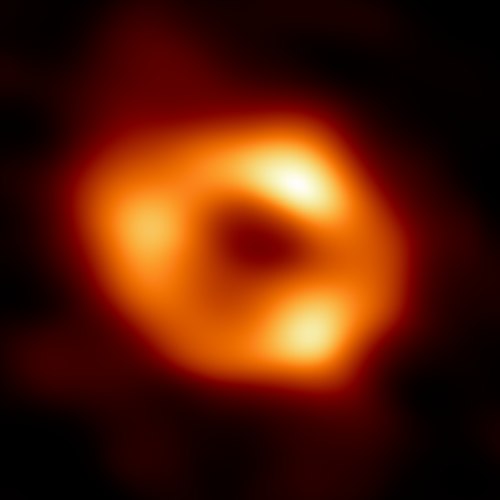
First Image of Milky Way's Black Hole (Sgr A*)
The Event Horizon Telescope reveals the first image of Sagittarius A*, the supermassive black hole at the center of our galaxy. #astronomy #physics
First Image of Milky Way's Black Hole (Sgr A*) By EHT Collaboration - https://www.eso.org/public/images/eso2208-eht-mwa/ (image link), CC BY 4.0, https://commons.wikimedia.org/w/index.php?curid=117933557
Jun 29, 2023 CE
NANOGrav Observes Gravitational Wave Background
The NANOGrav collaboration reports evidence for a stochastic gravitational wave background from supermassive black hole binaries, using pulsar timing. #astronomy #physics
NANOGrav Observes Gravitational Wave Background By NANOGrav - https://nanograv.org/press/image-gallery (info about licence can be found here: https://nanograv.org/resources/press), CC BY 4.0, https://commons.wikimedia.org/w/index.php?curid=171055295