1887 CE
Volterra Founders Integral Equations
Vito Volterra publishes foundational work on integral equations, introducing concepts that would later be unified in functional analysis. #math #history
Functional analysis and Hilbert spaces emerged in the early 20th century, building on earlier work in integral equations and spectral theory. This timeline traces the key contributions of pioneers such as David Hilbert, Stefan Banach, John von Neumann, and others, highlighting their lasting impact on mathematics and physics.
Vito Volterra publishes foundational work on integral equations, introducing concepts that would later be unified in functional analysis. #math #history
David Hilbert presents his famous list of 23 unsolved problems at the International Congress of Mathematicians in Paris, including the spectral theory of integral equations, spurring development of functional analysis. #math #Hilbert
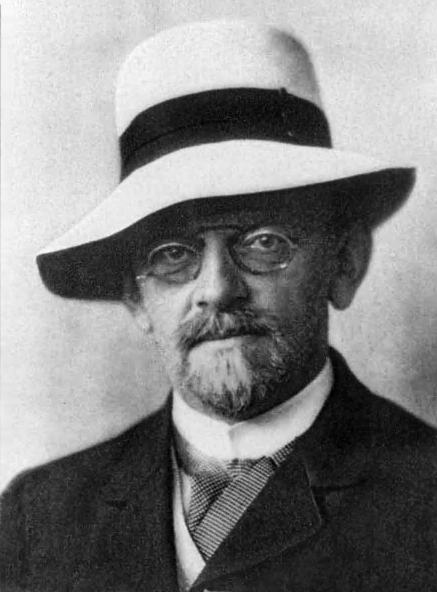
Erik Ivar Fredholm develops the Fredholm theory of integral equations, introducing the concept of the Fredholm operator and laying groundwork for spectral theory. #math #analysis
Maurice Fréchet introduces the concept of metric spaces in his doctoral thesis, providing a general framework for distance and convergence, essential for functional analysis. #math #topology

Erhard Schmidt publishes the first formal definition of a Hilbert space (using the term "Hilbert space" later), developing the theory of orthogonal expansions. #math #Hilbert
Frigyes Riesz develops the spectral theory of operators on Hilbert spaces, including the Riesz representation theorem, a cornerstone of functional analysis. #math #analysis
Stefan Banach introduces the concept of Banach spaces (complete normed vector spaces) in his doctoral dissertation, establishing a fundamental framework for functional analysis. #math #Banach
Hans Hahn and Stefan Banach independently prove the Hahn–Banach theorem on extension of linear functionals, a key tool in functional analysis. #math #theorem
John von Neumann publishes the first complete axiomatic treatment of Hilbert space, abstracting from earlier concrete examples. His work becomes the standard framework for quantum mechanics. #math #physics
John von Neumann introduces the concept of von Neumann algebras (formerly called rings of operators), linking functional analysis with quantum mechanics. #math #algebra
Stefan Banach publishes his seminal book summarizing functional analysis, including the theory of Banach spaces and linear operators. #math #book
Sergei Sobolev develops the theory of generalized functions (distributions) and Sobolev spaces, essential for modern PDE theory and functional analysis. #math #PDE )
Israel Gelfand publishes his theory of commutative C*-algebras, establishing the Gelfand representation and connecting functional analysis with topology. #math #algebra
Jean Leray and Juliusz Schauder prove a fixed point theorem for compact operators, a key tool in nonlinear functional analysis. #math #analysis
Lazar Ljusternik and Lev Schnirelmann develop the concept of category in functional analysis, applied to variational problems. #math #topology
Laurent Schwartz publishes his theory of distributions, providing a rigorous framework for generalized functions and inspiring further work in functional analysis. #math #analysis )
Paul Halmos publishes the influential textbook "Introduction to Hilbert Space and the Theory of Spectral Multiplicity," widely used by mathematicians and physicists. #math #textbook
Mark Krein and David Milman prove the Krein–Milman theorem that any compact convex set in a locally convex space is the closed convex hull of its extreme points. #math #analysis

Israel Gelfand and Mark Naimark publish their abstract C*-algebra theorem, characterizing C*-algebras as algebras of operators on Hilbert space. #math #algebra
Tosio Kato publishes his book "Perturbation Theory for Linear Operators," a landmark in the study of operator perturbations and spectral theory. #math #physics
Michael Atiyah and Isadore Singer prove the index theorem, connecting functional analysis, topology, and differential geometry, with profound applications. #math #theorem
Alain Connes begins his work on noncommutative geometry, blending operator algebras with geometry, and later wins a Fields Medal. #math #geometry
Felix Browder proves the Browder fixed point theorem for monotone operators, advancing nonlinear functional analysis. #math #analysis
Tosio Kato develops a criterion for essential self-adjointness of operators, crucial for quantum mechanics and PDE theory. #math #physics
Jean Bourgain makes deep contributions to the geometry of Banach spaces, proving the Bourgain–Buhovsky theorem and earning a Fields Medal. #math #analysis
Vaughan Jones introduces the Jones index for subfactors, creating a link between operator algebras and knot theory, later awarded a Fields Medal. #math #algebra
Alain Connes publishes his book "Noncommutative Geometry," formalizing the subject and extending functional analysis into new directions. #math #book
Dan Voiculescu develops free probability theory, a noncommutative analog of probability with deep ties to operator algebras. #math #probability
Joram Lindenstrauss makes fundamental contributions to the geometry of Banach spaces, including the nonlinear theory with Lipschitz maps. #math #analysis

Terence Tao, later Fields Medalist, begins his work on nonlinear dispersive equations using functional analysis, including Strichartz estimates on Hilbert spaces. #math #PDE

Grigori Perelman uses functional analytic tools, including Sobolev spaces and heat flow, to solve the Poincaré conjecture, a landmark in topology. #math #topology
Jean Bourgain contributes to compressed sensing theory, using functional analysis in the study of restricted isometry properties for sparse recovery. #math #signal
Narutaka Ozawa makes breakthroughs in the classification of C*-algebras, furthering the structure theory of nuclear C*-algebras. #math #algebra
Adam Marcus, Daniel Spielman, and Nikhil Srivastava prove the Kadison–Singer conjecture, a deep problem in operator theory and functional analysis. #math #conjecture
Vincent Lafforgue proves the Baum–Connes conjecture for certain groups, using advanced functional analysis and geometric group theory. #math #conjecture

Advances in quantum contextuality rely on operator algebras and Hilbert space methods, reigniting interest in the foundations of quantum mechanics. #math #quantum
Emmanuel Candès uses functional analytic tools like nuclear norm minimization for matrix completion, with applications in data science. #math #data

Functional analysis continues to be central in quantum information theory, with Hilbert spaces forming the mathematical foundation of quantum computing. #math #quantum

Kazuyuki Wada and others apply operator algebras to non-abelian gauge theories, showing the continued relevance of functional analysis in theoretical physics. #math #physics

The construction of Ramanujan graphs via operator theory highlights the synergy between functional analysis and combinatorics. #math #graph