Functional Analysis & Hilbert Spaces: Modern Frontiers & Breakthrough Innovations
Encyclopedia/1. The Cosmos & The Natural World/1. Mathematics & Formal Systems/03. Calculus & Mathematical Analysis • Curated by Admin Timeline.sg
Functional analysis and Hilbert spaces, originating from early 20th-century integral equations and quantum mechanics, have evolved into a cornerstone of modern mathematics with applications in physics, engineering, and data science. This timeline highlights key breakthroughs from the 19th-century Fourier analysis to recent advances like compressed sensing and the solution of the Kadison–Singer problem.
Chronological Storyline (35 Milestones)
1807 CE
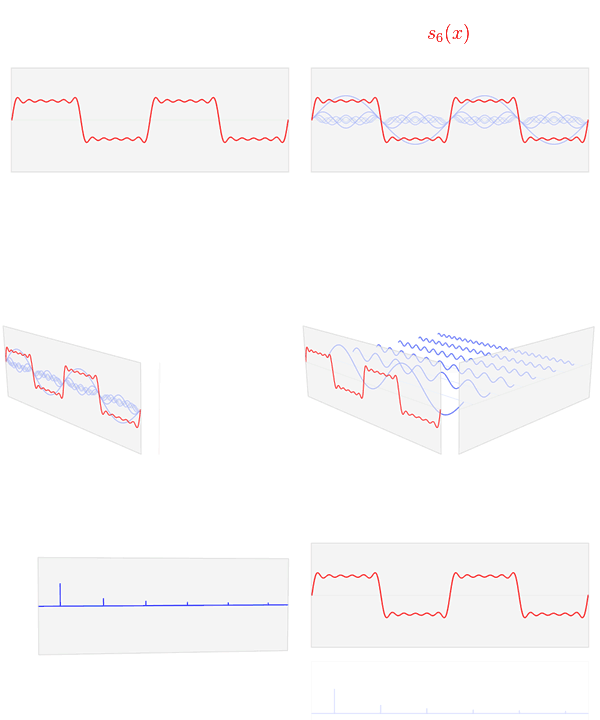
Joseph Fourier Submits Work on Heat Propagation
Fourier presents his theory of heat conduction, introducing Fourier series which represent functions as infinite sums of sines and cosines. This pioneering work lays the groundwork for orthogonal expansions and the concept of function spaces, fundamental to functional analysis. #mathematics #analysis
Joseph Fourier Submits Work on Heat Propagation By Lucas Vieira - File:Fourier transform time and frequency domains (small).gif, CC0, https://commons.wikimedia.org/w/index.php?curid=28399050
1822 CE
Fourier Publishes Analytical Theory of Heat
Fourier's book formalizes the use of trigonometric series for solving partial differential equations, seeding the development of orthogonal function theory. #mathematics #analysis
1837 CE
Dirichlet's Conditions for Fourier Series
Dirichlet formulates sufficient conditions for pointwise convergence of Fourier series, advancing the rigorous study of function representation. #mathematics #analysis
1854 CE
Riemann's Habilitationsschrift on Trigonometric Series
Bernhard Riemann introduces Riemann integration and studies trigonometric series, deepening the connection between functions and series expansions. #mathematics #analysis
Riemann's Habilitationsschrift on Trigonometric Series By Unknown author - http://www.sil.si.edu/digitalcollections/hst/scientific-identity/explore.htm according to the German Wikipedia., Public domain, https://commons.wikimedia.org/w/index.php?curid=27383
1887 CE
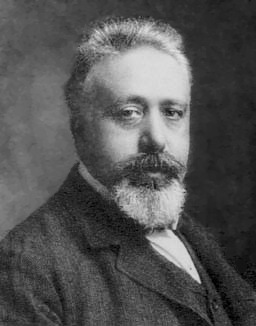
Volterra Begins Work on Integral Equations
Vito Volterra studies integral equations and functionals, founding the theory of integral equations which later evolves into functional analysis. #mathematics #analysis
Volterra Begins Work on Integral Equations By Unknown author - http://www.phys.uniroma1.it/DipWeb/dottorato/SCUO_VOLTERRA/scuola_volterra.html, Public domain, https://commons.wikimedia.org/w/index.php?curid=16117839
1900 CE
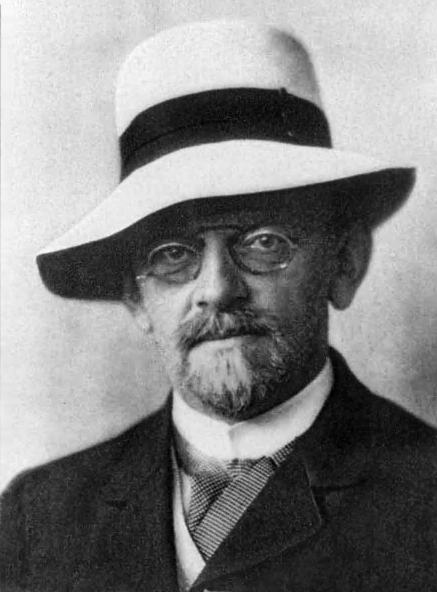
Hilbert's 23 Problems Include Integral Equations
David Hilbert presents his famous list of problems; problems on integral equations and the spectral theory of linear operators spur the development of Hilbert space theory. #mathematics #history
Hilbert's 23 Problems Include Integral Equations By Unknown author - Possibly Reid, Constance (1970) Hilbert, Berlin, Heidelberg: Springer Berlin Heidelberg Imprint Springer, p. 230 ISBN: 978-3-662-27132-2., Public domain, https://commons.wikimedia.org/w/index.php?curid=36302
1903 CE
Lebesgue Introduces Modern Integration Theory
Henri Lebesgue's thesis redefines integration, providing a rigorous basis for function spaces that become central to functional analysis. #mathematics #analysis
Lebesgue Introduces Modern Integration Theory By ~~helix84 15:43, 27 November 2006 (UTC) - own work, based on en:Image:Integral-area-under-curve.png, Public domain, https://commons.wikimedia.org/w/index.php?curid=1409775
1904 CE
Fredholm Publishes Theory of Integral Equations
Ivar Fredholm develops a general theory of linear integral equations, introducing the Fredholm alternative and influencing Hilbert's later work on infinite-dimensional systems. #mathematics #analysis
Fredholm Publishes Theory of Integral Equations By Auguste Léon - https://collections.albert-kahn.hauts-de-seine.fr/document/proprit-d-albert-kahn-boulogne-france-monsieur-erik-ivar-fredholm/617a7a44cf8b8968b33833cb?filtrerParThme%5B0%5D=Personnalit%C3%A9&filtrerParDomaine%5B0%5D=Images%20fixes&s=dateDePriseDeVue&so=desc&pos=3822&pgn=253, Public domain, https://commons.wikimedia.org/w/index.php?curid=143500727
1906 CE
Hilbert's Grundzüge on Integral Equations
David Hilbert publishes 'Grundzüge einer allgemeinen Theorie der linearen Integralgleichungen', establishing the spectral theory for integral operators and a geometric framework for infinite-dimensional spaces. #mathematics #history
1907 CE
Riesz Representation Theorem
Frigyes Riesz proves the Riesz representation theorem, identifying the dual space of a Hilbert space with the space itself, a fundamental result in functional analysis. #mathematics #analysis
1910 CE
Riesz on Orthonormal Systems
Frigyes Riesz publishes papers on orthonormal function systems, advancing Hilbert space theory and laying groundwork for spectral decompositions. #mathematics #analysis
Riesz on Orthonormal Systems By Unknown author, Public domain, https://commons.wikimedia.org/w/index.php?curid=32725
1920 CE
Banach Defines Normed Spaces in PhD Thesis
Stefan Banach in his doctoral dissertation introduces the concept of normed vector spaces (Banach spaces), a cornerstone of functional analysis. #mathematics #history
1925 CE
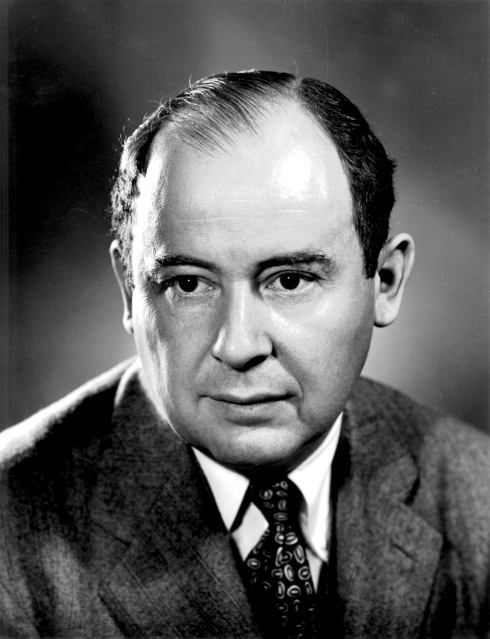
Von Neumann Axiomatizes Hilbert Space
John von Neumann publishes the first axiomatic treatment of Hilbert space, providing a rigorous mathematical foundation for quantum mechanics. #mathematics #physics
Von Neumann Axiomatizes Hilbert Space By LANL - http://www.lanl.gov/history/atomicbomb/images/NeumannL.GIF (archive copy at the Wayback Machine), Attribution, https://commons.wikimedia.org/w/index.php?curid=3429594
1927 CE
Von Neumann's Mathematical Foundations of Quantum Mechanics
Von Neumann's influential work formalizes quantum theory using Hilbert spaces, establishing the spectral theory of self-adjoint operators. #mathematics #physics
1929 CE
Banach–Hahn Separation Theorem
Stefan Banach and Hans Hahn prove the geometric form of the Hahn–Banach theorem, a central tool in functional analysis for separating convex sets. #mathematics #analysis
1930 CE
Von Neumann's Spectral Theorem
John von Neumann proves the spectral theorem for self-adjoint operators on Hilbert space, generalizing the diagonalization of symmetric matrices to infinite dimensions. #mathematics #analysis
1932 CE
Banach Publishes 'Théorie des Opérations Linéaires'
Stefan Banach's monograph is the first comprehensive text on functional analysis, systematically presenting the theory of normed spaces and linear operators. #mathematics #history
1932 CE
Gelfand Introduces Normed Rings (Banach Algebras)
Israel Gelfand begins developing the theory of normed rings, later known as Banach algebras, which combine algebraic and topological structures. #mathematics #analysis
1936 CE
Sobolev Introduces Sobolev Spaces
Sergei Sobolev generalizes function spaces to include weak derivatives, creating Sobolev spaces that become essential in partial differential equations and functional analysis. #mathematics #analysis
1936 CE
Von Neumann Develops Rings of Operators
John von Neumann and Francis Murray start the theory of von Neumann algebras (rings of operators), linking operator algebras with group representations and quantum physics. #mathematics #physics
1941 CE
Kakutani's Fixed Point Theorem
Shizuo Kakutani proves a fixed point theorem for correspondences on Hilbert spaces, with later applications in game theory and economics. #mathematics #analysis
1943 CE
Gelfand Representation Theorem
Israel Gelfand establishes that any commutative C*-algebra is isomorphic to the algebra of continuous functions on a compact Hausdorff space, a key result in functional analysis. #mathematics #analysis
1950 CE
Riesz–Thorin Interpolation Theorem
Marcel Riesz and Olof Thorin develop interpolation theory for linear operators on function spaces, a powerful technique in harmonic analysis and PDEs. #mathematics #analysis
1954 CE
Lax–Milgram Theorem
Peter Lax and Arthur Milgram prove a general theorem on bilinear forms, extending the Riesz representation theorem and providing a framework for finite element methods. #mathematics #analysis
1960 CE
Beurling's Theorem on Invariant Subspaces
Arne Beurling characterizes invariant subspaces of the shift operator on Hardy spaces, a landmark result in operator theory. #mathematics #analysis
1966 CE
Distribution Theory by Laurent Schwartz
Laurent Schwartz's theory of distributions generalizes functions to include derivatives of discontinuities, deeply influencing functional analysis and PDEs. #mathematics #analysis )
1972 CE
Kadison–Singer Problem Proposed
Richard Kadison and Isadore Singer pose a problem in operator algebras about extensions of pure states, which remains open for over 40 years and becomes a central challenge in functional analysis. #mathematics #analysis
1985 CE
Jones Develops Subfactor Theory
Vaughan Jones introduces index for subfactors, linking von Neumann algebras to knot theory and statistical mechanics, earning a Fields Medal. #mathematics #physics
Jones Develops Subfactor Theory By George Bergman - Email correspondence, CC BY-SA 4.0, https://commons.wikimedia.org/w/index.php?curid=93960356
1989 CE
Mallat and Daubechies Develop Wavelet Theory
Stéphane Mallat and Ingrid Daubechies create the mathematical framework for wavelets, using functional analysis to construct orthonormal bases with compact support. #mathematics #computing
Mallat and Daubechies Develop Wavelet Theory By Original: Joshua Doubek Vector: TilmannR - Own work based on: Seismic Wavelet.jpg, CC BY-SA 4.0, https://commons.wikimedia.org/w/index.php?curid=117838685
1994 CE
Voevodsky's Work on Motivic Cohomology
While broader, Voevodsky's use of homotopy theory in algebraic geometry also impacts functional analysis through A^1-homotopy theory. #mathematics #algebra
Voevodsky's Work on Motivic Cohomology By Schmid, Renate - https://opc.mfo.de/detail?photo_id=13818, CC BY-SA 2.0 de, https://commons.wikimedia.org/w/index.php?curid=14715325
2004 CE
Compressed Sensing Introduced
Emmanuel Candès, Justin Romberg, and Terence Tao develop compressed sensing theory, using principles from functional analysis and convex optimization to reconstruct signals from few measurements. #mathematics #computing
2013 CE
Kadison–Singer Problem Solved
Adam Marcus, Daniel Spielman, and Nikhil Srivastava prove the Kadison–Singer conjecture using interlacing families of polynomials, a breakthrough in functional analysis and combinatorics. #mathematics #analysis
2016 CE
Bourgain's Contributions to Analysis
Jean Bourgain receives the Breakthrough Prize for his profound work in mathematical analysis, including functional analysis and geometry of Banach spaces. #mathematics #analysis
Bourgain's Contributions to Analysis By George Bergman - This image has been extracted from another file, CC BY-SA 4.0, https://commons.wikimedia.org/w/index.php?curid=74881233
2019 CE
Resolution of the Baum–Connes Conjecture for Certain Cases
Further progress on the Baum–Connes conjecture in operator K-theory, linking functional analysis to topology and representation theory. #mathematics #topology
Resolution of the Baum–Connes Conjecture for Certain Cases By Renate Schmid - https://opc.mfo.de/detail?photo_id=9826, CC BY-SA 2.0 de, https://commons.wikimedia.org/w/index.php?curid=18715403
2022 CE
Hilbert Space Frames for Data Science
Modern applications of frame theory in Hilbert spaces to machine learning and signal processing see continued growth, with new results in sparse coding and deep learning. #mathematics #computing )