Functional Analysis & Hilbert Spaces: Major Case Studies & Paradigm Shifts
Encyclopedia/1. The Cosmos & The Natural World/1. Mathematics & Formal Systems/03. Calculus & Mathematical Analysis • Curated by Admin Timeline.sg
A timeline tracing the development of functional analysis and Hilbert spaces from the 18th century to the 21st, highlighting key theorems, foundational texts, and paradigm shifts across global contributions.
Chronological Storyline (41 Milestones)
1747 CE
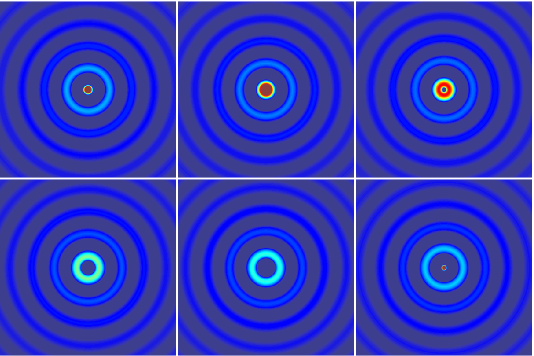
d'Alembert introduces the wave equation
Jean le Rond d'Alembert derives the wave equation, leading to the study of partial differential equations and the need for function spaces. #analysis #pde
d'Alembert introduces the wave equation By Oleg Alexandrov - self-made with MATLAB, Public domain, https://commons.wikimedia.org/w/index.php?curid=3036844
1807 CE
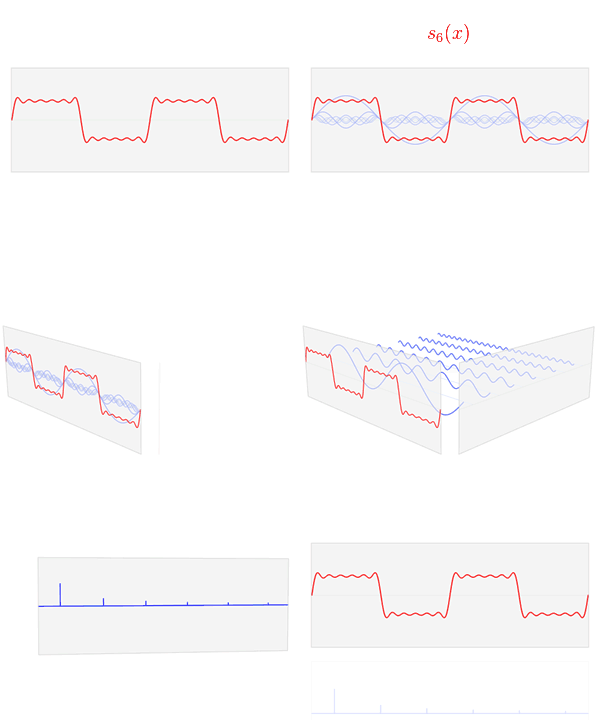
Fourier presents work on heat conduction
Joseph Fourier presents his memoir on heat conduction, introducing Fourier series and the expansion of functions in trigonometric series, a forerunner to functional analysis. #analysis #fourier
Fourier presents work on heat conduction By Lucas Vieira - File:Fourier transform time and frequency domains (small).gif, CC0, https://commons.wikimedia.org/w/index.php?curid=28399050
1822 CE
Fourier publishes 'Théorie analytique de la chaleur'
Fourier publishes his book on the analytical theory of heat, solidifying the use of orthogonal expansions and inspiring later work on function spaces. #analysis #history
1829 CE
Dirichlet's convergence conditions for Fourier series
Dirichlet provides sufficient conditions for the convergence of Fourier series, advancing the rigorous study of function expansions. #analysis #fourier
1837 CE
Dirichlet publishes on Fourier series
Dirichlet publishes a rigorous paper on Fourier series, laying groundwork for pointwise convergence and later functional analysis. #analysis #history
1854 CE
Riemann's habilitation on trigonometric series
Bernhard Riemann's habilitation thesis on trigonometric series introduces Riemann's integral and opens the field to more general functions, influencing functional analysis. #analysis #riemann
Riemann's habilitation on trigonometric series By Brad219 - Own work created using Inkscape 1.3. Redrawn from original PNG source authored by KSmrq, CC0, https://commons.wikimedia.org/w/index.php?curid=150414772
1887 CE
Volterra begins work on integral equations
Vito Volterra studies integral equations, leading to the theory of linear operators and function spaces. #analysis #integralequations
1896 CE
Hadamard's functional calculus
Jacques Hadamard develops a functional calculus for linear operators, contributing to the abstract theory. #analysis #operators
1900 CE
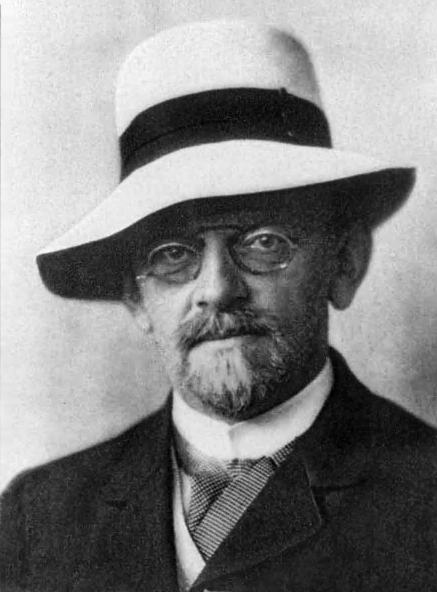
Hilbert lists 23 problems
David Hilbert's address to the International Congress of Mathematicians includes problems on integral equations and spectral theory, spurring functional analysis. #analysis #hilbert
Hilbert lists 23 problems By Unknown author - Possibly Reid, Constance (1970) Hilbert, Berlin, Heidelberg: Springer Berlin Heidelberg Imprint Springer, p. 230 ISBN: 978-3-662-27132-2., Public domain, https://commons.wikimedia.org/w/index.php?curid=36302
1903 CE
Fredholm's integral equation theory
Ivar Fredholm publishes his theory of integral equations, introducing Fredholm operators and the concept of compactness. #analysis #operators
1906 CE
Fréchet introduces abstract metric spaces
Maurice Fréchet defines metric spaces abstractly, providing a framework for convergence and continuity in function spaces. #analysis #topology
Fréchet introduces abstract metric spaces By Qef - Own work by uploader, recreation of bitmap version by en:User:Jhausauer, Public domain, https://commons.wikimedia.org/w/index.php?curid=7082179
1907 CE
Schmidt defines Hilbert spaces
Erhard Schmidt introduces the concept of a Hilbert space (Hilbertraum) in his work on integral equations, using orthogonal sequences. #analysis #hilbert
1907 CE
Riesz-Fischer theorem proved
Frigyes Riesz and Ernst Fischer independently prove the completeness of L^2 spaces, establishing the Hilbert space structure of square-integrable functions. #analysis #l2
1910 CE
Riesz representation theorem
Frigyes Riesz proves that every bounded linear functional on a Hilbert space can be represented as an inner product, a cornerstone of functional analysis. #analysis #hilbert
1912 CE
Hausdorff's 'Grundzüge der Mengenlehre'
Felix Hausdorff publishes his book on set theory, including topological spaces and laying the foundation for general topology crucial to functional analysis. #analysis #topology
Hausdorff's 'Grundzüge der Mengenlehre' By Unknown author, Public domain, https://commons.wikimedia.org/w/index.php?curid=607278
1918 CE
Pincherle introduces linear operators
Salvatore Pincherle uses the term 'lineare Operationen' for linear operators, advancing the abstract approach. #analysis #operators
1920 CE
Banach defines Banach spaces
Stefan Banach introduces Banach spaces in his dissertation, defining complete normed vector spaces. #analysis #banach
1922 CE
Banach publishes axioms for normed spaces
Banach publishes his axioms for complete normed linear spaces, establishing Banach spaces as a central concept. #analysis #banach
1927 CE
von Neumann axiomatizes Hilbert spaces
John von Neumann publishes the first complete axiomatization of Hilbert spaces for quantum mechanics, cementing the role of functional analysis in physics. #analysis #quantum
1929 CE
Stone's theorem on unitary groups
Marshall Stone proves that one-parameter unitary groups are generated by self-adjoint operators, linking functional analysis to quantum dynamics. #analysis #operators
1932 CE
Banach publishes 'Théorie des opérations linéaires'
Banach's monograph systematizes functional analysis, covering Banach spaces, linear operators, and duality. #analysis #banach
1932 CE
von Neumann's 'Mathematical Foundations of Quantum Mechanics'
von Neumann publishes his book, using Hilbert spaces to formalize quantum mechanics and solidifying the subject. #analysis #quantum
1936 CE
Gelfand introduces Banach algebras
Israel Gelfand introduces normed rings (Banach algebras), extending the spectral theory and connecting to harmonic analysis. #analysis #algebra
1941 CE
Gelfand-Naimark theorem
Israel Gelfand and Mark Naimark prove that every C*-algebra is isometrically isomorphic to a closed subalgebra of bounded operators on a Hilbert space. #analysis #algebra
1943 CE
Lax-Milgram lemma
Peter Lax and Arthur Milgram prove a lemma on bilinear forms, fundamental for solving partial differential equations via functional analysis. #analysis #pde
1947 CE
Kakutani's fixed point theorem
Shizuo Kakutani proves a fixed point theorem for set-valued maps, with applications in game theory and functional analysis. #analysis #fixedpoint
1950 CE
Krein-Milman theorem
Mark Krein and David Milman prove that a compact convex set in a locally convex space is the closed convex hull of its extreme points. #analysis #convexity
Krein-Milman theorem By Németh László - Own work, CC0, https://commons.wikimedia.org/w/index.php?curid=32855231
1951 CE
Riesz-Schauder theory of compact operators
Frigyes Riesz and Juliusz Schauder develop the spectral theory of compact operators, extending finite-dimensional results. #analysis #operators
1952 CE
Nachbin's theorem on Banach spaces
Leopoldo Nachbin proves a theorem on the extension of continuous functions, contributing to the geometry of Banach spaces. #analysis #banach
1955 CE
Kato's perturbation theory for linear operators
Tosio Kato publishes his seminal work on perturbation theory, crucial for quantum mechanics and spectral analysis. #analysis #perturbation
1956 CE
Grothendieck's topological tensor products
Alexander Grothendieck's work on topological tensor products and nuclear spaces revolutionizes functional analysis and distribution theory. #analysis #tensor
1960 CE
Schwartz's theory of distributions
Laurent Schwartz develops distribution theory, extending functions and providing a rigorous framework for functional analysis applications. #analysis #distributions )
1963 CE
Atiyah-Singer index theorem
Michael Atiyah and Isadore Singer prove the index theorem for elliptic operators, linking functional analysis, topology, and differential geometry. #analysis #topology
1965 CE
Halmos' 'A Hilbert Space Problem Book'
Paul Halmos publishes a problem book on Hilbert spaces, becoming a standard pedagogical resource. #analysis #hilbert
1970 CE
Connes' noncommutative geometry
Alain Connes introduces noncommutative geometry, using Hilbert modules and operator algebras to generalize spaces. #analysis #geometry
1973 CE
Enflo's counterexample to the approximation problem
Per Enflo constructs a Banach space without the approximation property, solving a major open problem. #analysis #banach
Enflo's counterexample to the approximation problem By The original uploader was Stako at Polish Wikipedia. - Kazimierz Kuratowski "Pół wieku matematyki polskiej 1920-1970" (Książka i Wiedza, 1973 r, bez zastrzeżonych praw autorskich). Transferred from pl.wikipedia to Commons by Pjahr using CommonsHelper., Public domain, https://commons.wikimedia.org/w/index.php?curid=5847552
1980 CE
Fefferman's work on BMO
Charles Fefferman proves the duality of BMO (bounded mean oscillation) with Hardy space, influencing harmonic analysis and functional analysis. #analysis #harmonic
1986 CE
Gromov's work on Banach space geometry
Mikhail Gromov introduces new geometric ideas to Banach space theory, including the concept of coarse geometry. #analysis #geometry )
Gromov's work on Banach space geometry By Institut des Hautes Études Scientifiques - Extracted from https://www.youtube.com/watch?v=aJAQVletzdY&t=385s, CC BY 3.0, https://commons.wikimedia.org/w/index.php?curid=110912121
1990 CE
Gowers' dichotomy theorem for Banach spaces
Timothy Gowers proves the Banach space dichotomy theorem, showing that every infinite-dimensional Banach space contains either an unconditional basic sequence or a space with no unconditional basis. #analysis #banach
2000 CE
Tsirelson's space and operator spaces
Boris Tsirelson's construction of a space with no unconditional basis continues to influence operator space theory and quantum information. #analysis #operator
2013 CE
Kadison-Singer problem solved
Adam Marcus, Daniel Spielman, and Nikhil Srivastava prove the Kadison-Singer conjecture, resolving a major problem in operator algebras and functional analysis. #analysis #conjecture