Functional Analysis & Hilbert Spaces: Global Cross-Cultural Perspectives
Encyclopedia/1. The Cosmos & The Natural World/1. Mathematics & Formal Systems/03. Calculus & Mathematical Analysis • Curated by Admin Timeline.sg
This timeline traces the global development of functional analysis and Hilbert spaces, from early infinite series to modern operator theory, highlighting contributions from diverse cultures and countries.
Chronological Storyline (39 Milestones)
1400 CE
Madhava's Discovery of Infinite Series
Indian mathematician Madhava of Sangamagrama discovers infinite series expansions for trigonometric functions, predating European calculus by centuries. His work lays groundwork for analysis of function spaces. #history #mathematics #india
1748 CE
Euler's Introductio in Analysin Infinitorum
Leonhard Euler publishes his influential textbook on infinite analysis, developing series expansions and functions. This work forms a foundation for functional analysis. #mathematics #history
Euler's Introductio in Analysin Infinitorum By Cronholm144 at English Wikipedia - Transferred from en.wikipedia to Commons., CC BY-SA 3.0, https://commons.wikimedia.org/w/index.php?curid=3128774
1822 CE
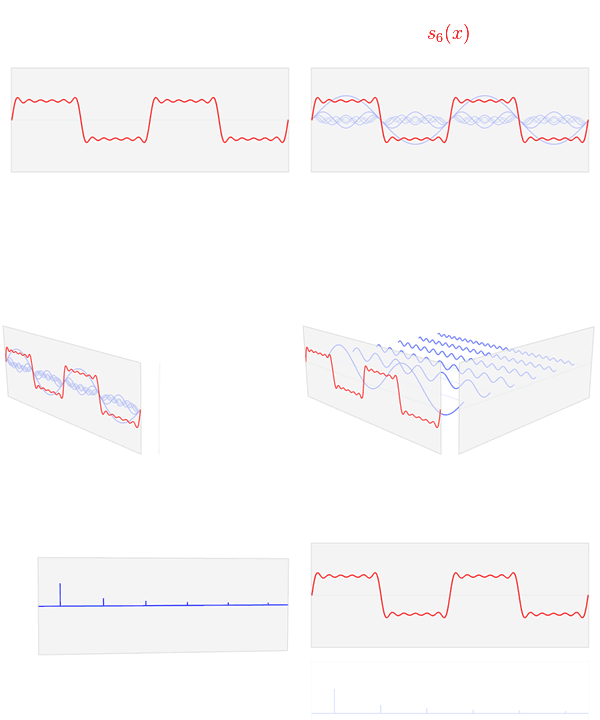
Fourier's Théorie Analytique de la Chaleur
Joseph Fourier publishes his treatise on heat conduction, introducing Fourier series and the concept of representing functions as infinite sums of sines and cosines. This leads to the notion of orthogonal function expansions, a precursor to Hilbert spaces. #mathematics #physics
Fourier's Théorie Analytique de la Chaleur By Lucas Vieira - File:Fourier transform time and frequency domains (small).gif, CC0, https://commons.wikimedia.org/w/index.php?curid=28399050
1829 CE
Dirichlet Conditions for Fourier Series
Peter Gustav Lejeune Dirichlet formulates sufficient conditions for the convergence of Fourier series, establishing a rigorous basis for representing functions. This work contributes to the theory of orthogonal series. #mathematics #analysis
1854 CE
Riemann's Work on Fourier Series
Bernhard Riemann's habilitation thesis 'On the Representability of a Function by a Trigonometric Series' deepens the understanding of Fourier series and integration. His ideas influence later functional analysis. #mathematics #analysis
Riemann's Work on Fourier Series By Unknown author - http://www.sil.si.edu/digitalcollections/hst/scientific-identity/explore.htm according to the German Wikipedia., Public domain, https://commons.wikimedia.org/w/index.php?curid=27383
1887 CE
Volterra's Integral Equations
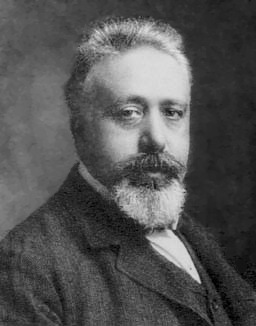
Italian mathematician Vito Volterra studies integral equations, introducing the concept of functionals and operators. His work stimulates the development of functional analysis. #mathematics #analysis
Volterra's Integral Equations By Unknown author - http://www.phys.uniroma1.it/DipWeb/dottorato/SCUO_VOLTERRA/scuola_volterra.html, Public domain, https://commons.wikimedia.org/w/index.php?curid=16117839
1896 CE
Fredholm's Integral Equation Theory
Swedish mathematician Erik Ivar Fredholm develops a theory of integral equations, introducing the Fredholm alternative and laying the groundwork for operator theory. #mathematics #analysis
Fredholm's Integral Equation Theory By Auguste Léon - https://collections.albert-kahn.hauts-de-seine.fr/document/proprit-d-albert-kahn-boulogne-france-monsieur-erik-ivar-fredholm/617a7a44cf8b8968b33833cb?filtrerParThme%5B0%5D=Personnalit%C3%A9&filtrerParDomaine%5B0%5D=Images%20fixes&s=dateDePriseDeVue&so=desc&pos=3822&pgn=253, Public domain, https://commons.wikimedia.org/w/index.php?curid=143500727
1904 CE
Hilbert's Work on Integral Equations
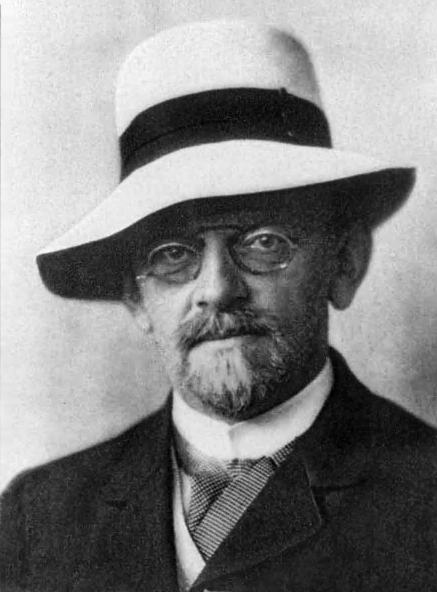
David Hilbert publishes a series of papers on integral equations, introducing the concept of a Hilbert space and spectral theory. His work marks the birth of functional analysis as a discipline. #mathematics #history
Hilbert's Work on Integral Equations By Unknown author - Possibly Reid, Constance (1970) Hilbert, Berlin, Heidelberg: Springer Berlin Heidelberg Imprint Springer, p. 230 ISBN: 978-3-662-27132-2., Public domain, https://commons.wikimedia.org/w/index.php?curid=36302
1907 CE
Riesz Representation Theorem
Hungarian mathematician Frigyes Riesz proves the representation theorem for linear functionals on Lp spaces, a foundational result in functional analysis. #mathematics #analysis
Riesz Representation Theorem By Unknown author, Public domain, https://commons.wikimedia.org/w/index.php?curid=32725
1910 CE
Hahn-Banach Theorem Developed
Austrian mathematician Hans Hahn and later Stefan Banach independently develop the Hahn-Banach extension theorem, a cornerstone of functional analysis. #mathematics #analysis
1913 CE
Ramanujan's Infinite Series Findings
Indian mathematician Srinivasa Ramanujan communicates his discoveries on infinite series and integrals to G.H. Hardy, influencing later analysis and special functions. #mathematics #india
Ramanujan's Infinite Series Findings By Unknown author - https://mss-cat.trin.cam.ac.uk/manuscripts/uv/view.php?n=Add.Ms.a.94.7#?c=0&m=0&s=0&cv=6&xywh=-2849%2C-273%2C9238%2C5258, CC BY 4.0, https://commons.wikimedia.org/w/index.php?curid=153767257
1920 CE
Banach Spaces Defined
Stefan Banach introduces the concept of Banach spaces in his doctoral dissertation, providing an abstract framework for normed linear spaces. #mathematics #poland
1922 CE
Banach Fixed Point Theorem
Stefan Banach proves the contraction mapping principle, a key result in functional analysis with applications in differential equations. #mathematics #analysis
1927 CE
von Neumann's Axiomatization of Hilbert Space
John von Neumann publishes the first rigorous axiomatic definition of Hilbert space, essential for quantum mechanics. #mathematics #physics
von Neumann's Axiomatization of Hilbert Space By Qef - Own work by uploader, recreation of bitmap version by en:User:Jhausauer, Public domain, https://commons.wikimedia.org/w/index.php?curid=7082179
1929 CE
Stone's Theorem on Unitary Groups
Marshall Stone proves the Stone theorem on one-parameter unitary groups, linking functional analysis with quantum dynamics. #mathematics #physics
1930 CE
Gelfand's Theory of Banach Algebras
Israel Gelfand outlines the theory of Banach algebras, introducing the Gelfand transform and spectral theory, profoundly impacting functional analysis. #mathematics #russia
1932 CE
Banach's 'Théorie des Opérations Linéaires'
Stefan Banach publishes his seminal book summarizing the theory of linear operations, the first comprehensive treatise on functional analysis. #mathematics #history
Banach's 'Théorie des Opérations Linéaires' By nieznany/unknown - Warszawski Kalendarz Ilustrowany 1967, Wydawnictwo Warszawskiego Tygodnika "Stolica", Warszawa 1966, p. 152, Public domain, https://commons.wikimedia.org/w/index.php?curid=19058077
1936 CE
Sobolev Spaces Introduced
Sergei Sobolev introduces the concept of Sobolev spaces, which are Banach spaces of functions with weak derivatives, fundamental in partial differential equations and analysis. #mathematics #russia
1940 CE
Kakutani Fixed Point Theorem
Japanese mathematician Shizuo Kakutani generalizes the Brouwer fixed point theorem to set-valued functions, with applications in game theory and analysis. #mathematics #japan
1945 CE
Schwartz Distributions Theory
Laurent Schwartz develops the theory of distributions, extending the concept of functions and enabling rigorous treatment of Dirac delta and partial differential equations. #mathematics #france )
1948 CE
Yosida's Semigroup Theory
Kōsaku Yosida publishes his work on the theory of semigroups of linear operators, establishing a key tool in functional analysis for evolution equations. #mathematics #japan
1950 CE
Harish-Chandra's Representation Theory
Indian mathematician Harish-Chandra develops the representation theory of semisimple Lie groups, using functional analytical methods like harmonic analysis on groups. #mathematics #india
Harish-Chandra's Representation Theory By Unknown author - https://mathshistory.st-andrews.ac.uk/Biographies/Harish-Chandra/, CC BY 4.0, https://commons.wikimedia.org/w/index.php?curid=147431356
1952 CE
Kadison's Work on C*-Algebras
Richard Kadison makes fundamental contributions to the theory of C*-algebras, including the Kadison inequality, advancing operator algebras. #mathematics #usa
1954 CE
Gelfand-Naimark Theorem
Israel Gelfand and Mark Naimark prove the Gelfand-Naimark theorem, characterizing commutative C*-algebras as continuous functions on a compact space, a central result in functional analysis. #mathematics #russia
1960 CE
Atiyah-Singer Index Theorem
Michael Atiyah and Isadore Singer prove the index theorem, linking analysis on manifolds to topology, with deep roots in functional analysis. #mathematics #topology
1964 CE
Krein-Milman Theorem Extended
The Krein-Milman theorem on extreme points is extended and applied in functional analysis, convexity, and optimization. #mathematics #analysis
Krein-Milman Theorem Extended By Németh László - Own work, CC0, https://commons.wikimedia.org/w/index.php?curid=32855231
1965 CE
Lax-Milgram Theorem Developed
Jacques-Louis Lions and others develop the Lax-Milgram theorem, a key result in the analysis of partial differential equations using Hilbert space methods. #mathematics #france
1970 CE
Choquet Theory and Capacity
Gustave Choquet develops his theory of capacity and integral representation, influential in potential theory and functional analysis. #mathematics #france
Choquet Theory and Capacity By Konrad Jacobs - https://opc.mfo.de/detail?photoID=668, CC BY-SA 2.0 de, https://commons.wikimedia.org/w/index.php?curid=4017022
1972 CE
Connes' Noncommutative Geometry Pioneered
Alain Connes lays the foundations of noncommutative geometry, extending functional analysis to noncommutative spaces and revolutionizing operator algebra theory. #mathematics #france
1973 CE
Voiculescu's Free Probability Theory
Dan Voiculescu develops free probability theory, a noncommutative probability theory with deep connections to operator algebras. #mathematics #romania
1975 CE
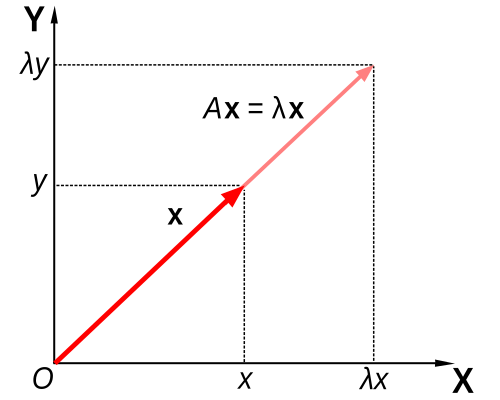
Enflo's Counterexample to Invariant Subspace Problem
Per Enflo constructs the first counterexample to the invariant subspace problem on Banach spaces, a landmark in operator theory. #mathematics #sweden
Enflo's Counterexample to Invariant Subspace Problem By Lyudmil Antonov Lantonov 16:35, 13 March 2008 (UTC) - This W3C-unspecified vector image was created with Inkscape ., CC BY-SA 4.0, https://commons.wikimedia.org/w/index.php?curid=3698599
1983 CE
Jones Index Theory
Vaughan Jones introduces the Jones index for subfactors, leading to connections between operator algebras and knot theory, earning him a Fields Medal. #mathematics #newzealand
Jones Index Theory By George Bergman - Email correspondence, CC BY-SA 4.0, https://commons.wikimedia.org/w/index.php?curid=93960356
1986 CE
Jones Polynomial Discovered
Vaughan Jones discovers the Jones polynomial in knot theory using subfactor theory, demonstrating the power of functional analysis in topology. #mathematics #newzealand
Kiyoshi Oka's work on coherence in several complex variables contributes to functional analysis in complex spaces. #mathematics #japan
Oka's Coherence Theorem Influences Complex Analysis By Konrad Jacobs, Erlangen, Copyright is MFO - Mathematisches Forschungsinstitut Oberwolfach,https://opc.mfo.de/detail?photo_id=3147, CC BY-SA 2.0 de, https://commons.wikimedia.org/w/index.php?curid=12349202
1998 CE
Continuous Wavelet Transform Developed
The continuous wavelet transform is developed as a tool for time-frequency analysis, rooted in functional analysis and Hilbert spaces. #mathematics #signalprocessing
Continuous Wavelet Transform Developed By DaBler - Own work, Public domain, https://commons.wikimedia.org/w/index.php?curid=9163358
2001 CE
Daubechies Wavelets and Function Spaces
Ingrid Daubechies' work on wavelets provides new function space decompositions, with applications in signal processing and functional analysis. #mathematics #belgium
Daubechies Wavelets and Function Spaces By ICM 2018 - PHOTO RODRIGO LEÃO/ R2/ ICM 2018, PDM-owner, https://commons.wikimedia.org/w/index.php?curid=121236820
2006 CE
Tao's Work on Compressed Sensing
Terence Tao contributes to compressed sensing, using functional analysis principles for signal reconstruction. #mathematics #australia
2010 CE
Resolution of the Kadison-Singer Problem
Adam Marcus, Daniel Spielman, and Nikhil Srivastava solve the Kadison-Singer problem, a long-standing question in operator theory and functional analysis. #mathematics #usa
2014 CE
Enflo's Invariant Subspace Counterexample Refined
Further understanding of Per Enflo's 1975 counterexample to the invariant subspace problem deepens insights in operator theory. #mathematics #analysis