Encyclopedia/1. The Cosmos & The Natural World/1. Mathematics & Formal Systems/03. Calculus & Mathematical Analysis • Curated by Admin Timeline.sg
Functional analysis emerged in the early 20th century through the synthesis of integral equations, infinite-dimensional vector spaces, and spectral theory, evolving into a cornerstone of modern mathematics with profound applications in quantum mechanics and partial differential equations.
Chronological Storyline (41 Milestones)
1822 CE
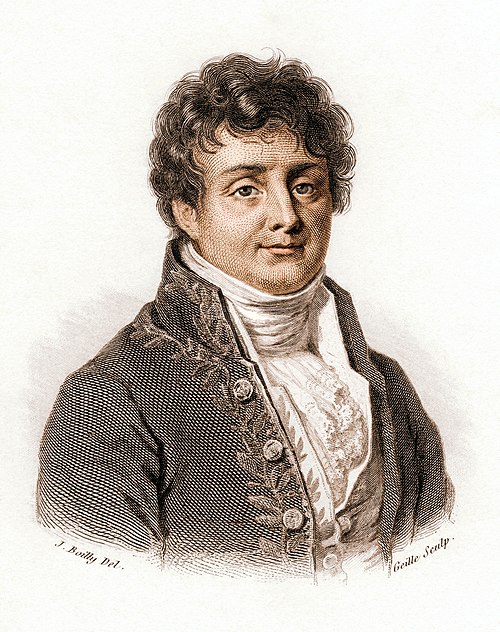
Fourier Publishes Théorie analytique de la chaleur
Joseph Fourier presents his theory of heat conduction using trigonometric series, introducing Fourier series and the idea of expanding functions in orthogonal bases. This work laid the groundwork for the concept of function spaces and orthogonal expansions in Hilbert spaces. #mathematics #analysis
Fourier Publishes Théorie analytique de la chaleur By Julien-Léopold Boilly - This file was derived from: Fourier2.jpg Restored by: Bammesk Original source: https://www.gettyimages.com.au/license/169251384 https://wellcomecollection.org/works/b4qh352u, Public domain, https://commons.wikimedia.org/w/index.php?curid=114366437
1836 CE
Sturm and Liouville Develop Sturm-Liouville Theory
Jacques Charles François Sturm and Joseph Liouville develop a theory of boundary value problems for second-order ordinary differential equations, establishing the orthogonality of eigenfunctions and the expansion of functions in series of these eigenfunctions. This is a precursor to spectral theory in Hilbert spaces. #mathematics #analysis
Aug 6, 1900 CE
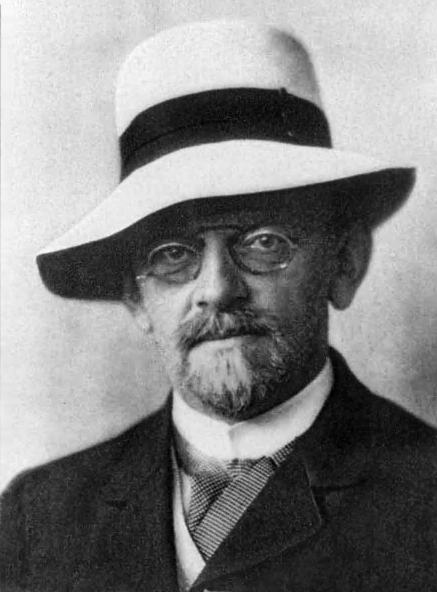
Hilbert Presents His List of Problems
David Hilbert delivers his famous address at the International Congress of Mathematicians, listing 23 unsolved problems including the fifth problem on Lie groups and the sixth on axiomatization of physics, which indirectly spurred work on functional analysis. #mathematics #history
Hilbert Presents His List of Problems By Unknown author - Possibly Reid, Constance (1970) Hilbert, Berlin, Heidelberg: Springer Berlin Heidelberg Imprint Springer, p. 230 ISBN: 978-3-662-27132-2., Public domain, https://commons.wikimedia.org/w/index.php?curid=36302
1904 CE
Hilbert Publishes Grundzüge einer allgemeinen Theorie der linearen Integralgleichungen
David Hilbert's work on integral equations systematically develops the theory of linear operators on infinite-dimensional spaces, introducing the concept of a Hilbert space and the spectral theory for compact operators. This is a foundational text in functional analysis. #mathematics #analysis
Hilbert Publishes Grundzüge einer allgemeinen Theorie der linearen Integralgleichungen By Qef - Own work by uploader, recreation of bitmap version by en:User:Jhausauer, Public domain, https://commons.wikimedia.org/w/index.php?curid=7082179
1906 CE
Fréchet Introduces Metric Spaces
Maurice Fréchet, in his doctoral thesis, introduces the concept of metric spaces, providing a general framework for studying convergence and continuity. This abstraction becomes crucial for the topological foundations of functional analysis. #mathematics #topology
1907 CE
Riesz and Fischer Prove the Riesz-Fischer Theorem
Frigyes Riesz and Ernst Sigismund Fischer independently prove that L^2 spaces are complete, establishing that they are Hilbert spaces. This result unifies Fourier analysis with the theory of orthogonal expansions. #mathematics #analysis
1907 CE
F. Riesz Proves the Riesz Representation Theorem
Frigyes Riesz proves that every continuous linear functional on the space of continuous functions can be represented as an integral with respect to a measure. This theorem is a cornerstone of functional analysis, later generalized to Hilbert spaces. #mathematics #analysis
1913 CE
Hausdorff Publishes Grundzüge der Mengenlehre
Felix Hausdorff's book lays the foundations of general topology, including the concept of topological spaces and metric spaces. This work provides the topological underpinnings for functional analysis. #mathematics #topology
Hausdorff Publishes Grundzüge der Mengenlehre By Unknown author, Public domain, https://commons.wikimedia.org/w/index.php?curid=607278
1920 CE
Banach Defines Normed Spaces in His Thesis
Stefan Banach, in his doctoral thesis, introduces the concept of normed vector spaces and proves the Banach fixed-point theorem. This work founds the theory of Banach spaces, a central object of functional analysis. #mathematics #analysis
1922 CE
Hahn-Banach Theorem Is Proved
Hans Hahn and Stefan Banach independently prove the Hahn-Banach theorem, which extends linear functionals from subspaces to the whole space while preserving norm. This theorem becomes a fundamental tool in functional analysis. #mathematics #analysis
1926 CE
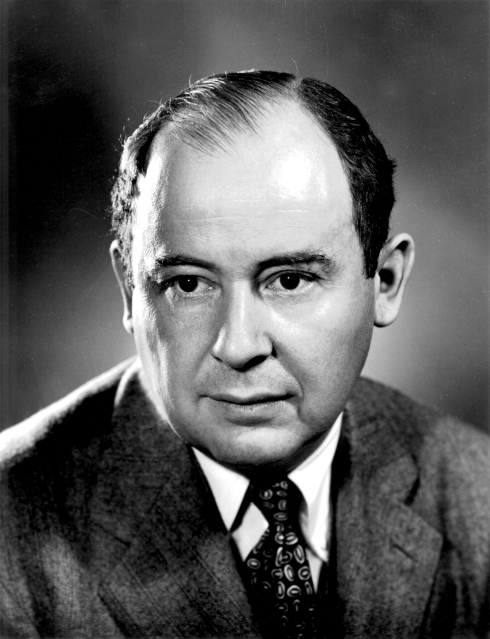
von Neumann Axiomatizes Quantum Mechanics
John von Neumann publishes his axiomatic formulation of quantum mechanics using Hilbert spaces, introducing the concept of abstract Hilbert spaces and linear operators. This bridges functional analysis and theoretical physics. #mathematics #physics
von Neumann Axiomatizes Quantum Mechanics By LANL - http://www.lanl.gov/history/atomicbomb/images/NeumannL.GIF (archive copy at the Wayback Machine), Attribution, https://commons.wikimedia.org/w/index.php?curid=3429594
1929 CE
von Neumann Publishes On the General Theory of Unbounded Operators
John von Neumann develops the spectral theory of unbounded self-adjoint operators on Hilbert spaces, providing the mathematical foundation for observables in quantum mechanics. #mathematics #analysis
1932 CE
Banach Publishes Théorie des opérations linéaires
Stefan Banach's monograph systematically presents the theory of normed spaces and linear operators, becoming the standard reference for functional analysis. It includes the Banach-Steinhaus theorem and the closed graph theorem. #mathematics #analysis
1932 CE
Stone Proves the Spectral Theorem for Unitary Operators
Marshall Stone proves the spectral theorem for unitary operators on Hilbert spaces, establishing a one-parameter group representation and linking functional analysis with harmonic analysis. #mathematics #analysis
1936 CE
Gelfand Introduces Banach Algebras
Israel Gelfand, in a series of papers, lays the foundations of commutative Banach algebras, introducing the Gelfand transform and the concept of the maximal ideal space. This unifies spectral theory and harmonic analysis. #mathematics #analysis
1938 CE
Murray and von Neumann Introduce von Neumann Algebras
Francis Murray and John von Neumann begin their series of papers on rings of operators, now called von Neumann algebras. They classify factors and lay the foundation for noncommutative geometry and operator algebras. #mathematics #analysis
1942 CE
Gelfand and Naimark Characterize C*-algebras
Israel Gelfand and Mark Naimark prove the Gelfand-Naimark theorem, showing that commutative C*-algebras are isometrically isomorphic to the algebra of continuous functions on a compact Hausdorff space. This is a cornerstone of operator algebra theory. #mathematics #analysis
1943 CE
Sobolev Develops Generalized Functions
Sergei Sobolev introduces the concept of generalized functions (distributions) and Sobolev spaces, which are Hilbert or Banach spaces of functions with weak derivatives. These are essential in the theory of partial differential equations. #mathematics #analysis
1947 CE
Schwartz Publishes Théorie des distributions
Laurent Schwartz rigorously develops the theory of distributions, providing a unified framework for generalized functions and greatly impacting functional analysis and PDE theory. #mathematics #analysis )
1950 CE
Kakutani Fixed-Point Theorem Is Generalised
Shizuo Kakutani's fixed-point theorem for set-valued maps is published, later applied in game theory and economic equilibrium. It extends Brouwer's fixed-point theorem to correspondences, relying on compact convex sets in topological vector spaces. #mathematics #analysis
1951 CE
Lions and Magenes Develop Interpolation Spaces
Jacques-Louis Lions and Enrico Magenes introduce interpolation theory for Banach spaces, providing a powerful tool for studying regularity of solutions to partial differential equations. #mathematics #analysis
1954 CE
Gårding Proves the Sharp Gårding Inequality
Lars Gårding proves a sharp inequality for pseudodifferential operators, which is fundamental in the analysis of partial differential equations and the theory of Sobolev spaces. #mathematics #analysis
1960 CE
Kato Publishes Perturbation Theory for Linear Operators
Tosio Kato's book 'Perturbation Theory for Linear Operators' becomes a classic, systematically presenting the theory of linear operators on Hilbert and Banach spaces, with applications to quantum mechanics. #mathematics #physics
Kato Publishes Perturbation Theory for Linear Operators By George Bergman - https://opc.mfo.de/detail?photo_id=5375 and https://www.lib.berkeley.edu/uchistory/archives_exhibits/in_memoriam/catalog/kato_tosio.html, GFDL 1.2, https://commons.wikimedia.org/w/index.php?curid=9710852
1966 CE
Atiyah and Singer Prove the Atiyah-Singer Index Theorem
Michael Atiyah and Isadore Singer prove the index theorem, connecting the analytical index of an elliptic operator on a compact manifold to a topological invariant. This deep result combines functional analysis, geometry, and topology. #mathematics #analysis
1971 CE
Connes Initiates Noncommutative Geometry
Alain Connes begins developing noncommutative geometry, a generalization of differential geometry to noncommutative spaces, using techniques from operator algebras and functional analysis. #mathematics #geometry
1973 CE
Enflo Constructs a Banach Space Without a Basis
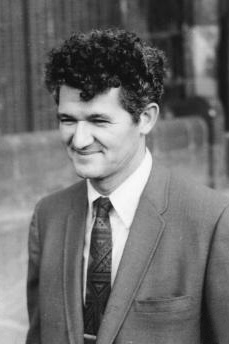
Per Enflo solves the Banach basis problem by constructing a separable Banach space that does not have a Schauder basis. This highlights the subtlety of infinite-dimensional spaces. #mathematics #analysis
1981 CE
Lax Publishes Functional Analysis
Peter Lax's influential textbook 'Functional Analysis' provides a modern, comprehensive treatment of the subject, widely used in graduate education. #mathematics #education
Lax Publishes Functional Analysis By Konrad Jacobs - https://opc.mfo.de/detail?photoID=2458, CC BY-SA 2.0 de, https://commons.wikimedia.org/w/index.php?curid=3946739
1983 CE
Cwikel-Lieb-Rozenblum Inequality Proved
Michael Cwikel, Elliott Lieb, and G. Rozenblum prove a sharp bound on the number of negative eigenvalues of Schrödinger operators, using functional analysis methods including Fourier analysis. #mathematics #physics
1986 CE
Jones Invents the Jones Polynomial
Vaughan Jones introduces a new knot invariant using operator algebras (von Neumann algebras), linking low-dimensional topology with functional analysis. #mathematics #topology
1990 CE
Gromov Proves the Polynomial Growth Theorem
Mikhael Gromov proves that finitely generated groups of polynomial growth are virtually nilpotent, using functional analysis and geometry. #mathematics #geometry
1994 CE
Borchers Proves the Borchers Theorem in Algebraic QFT
Hans-Jürgen Borchers establishes the Borchers theorem concerning the equivalence of Wightman and Haag-Kastler axioms, using functional analysis and operator algebras in quantum field theory. #mathematics #physics
2000 CE
Tao and Wolff Make Breakthroughs in Harmonic Analysis
Terence Tao and Thomas Wolff achieve significant progress in Kakeya and restriction problems, employing functional analytic techniques such as energy methods. #mathematics #analysis
Tao and Wolff Make Breakthroughs in Harmonic Analysis By Institute for Pure & Applied Mathematics - https://www.youtube.com/watch?v=ddTvK9nlquM, CC BY 4.0, https://commons.wikimedia.org/w/index.php?curid=191601047
2002 CE
Lindenstrauss Proves a Quantum Unique Ergodicity Theorem
Elon Lindenstrauss uses functional analysis and operator theory to prove a measure-theoretic quantum unique ergodicity theorem for arithmetic surfaces. #mathematics #analysis
Lindenstrauss Proves a Quantum Unique Ergodicity Theorem By George Bergman - https://commons.wikimedia.org/wiki/File:Elon_Lindenstrauss_2014.jpg, CC BY-SA 4.0, https://commons.wikimedia.org/w/index.php?curid=180274133
2006 CE
Perelman Proves the Poincaré Conjecture
Grigori Perelman solves the Poincaré conjecture using Ricci flow, but his proof also relies on functional analytic methods, including the analysis of nonlinear PDEs on manifolds. #mathematics #topology
2010 CE
Hörmander's Works on Linear PDE Are Recognized
The profound contributions of Lars Hörmander to linear partial differential equations, including pseudodifferential operators and Fourier integral operators, continue to shape functional analysis. His work is honored by the Abel Prize in 2006, but his major monographs were published in the 1980s-1990s. #mathematics #analysis
Hörmander's Works on Linear PDE Are Recognized By Konrad Jacobs - MFO: https://opc.mfo.de/detail?photoID=1777, CC BY-SA 2.0 de, https://commons.wikimedia.org/w/index.php?curid=3902616
2012 CE
Bourgain and Demeter Prove Dispositivity of the Restriction Problem
Jean Bourgain and Ciprian Demeter prove the discrete restriction theorem for the paraboloid, sharpening estimates in harmonic analysis using functional analysis methods. #mathematics #analysis
Bourgain and Demeter Prove Dispositivity of the Restriction Problem By George Bergman - This image has been extracted from another file, CC BY-SA 4.0, https://commons.wikimedia.org/w/index.php?curid=74881233
2014 CE
Avila Wins Fields Medal for Dynamical Systems
Artur Avila receives the Fields Medal for contributions to dynamical systems including renormalization and the spectral theory of quasiperiodic operators, using functional analysis. #mathematics #dynamics
Avila Wins Fields Medal for Dynamical Systems By Breithaupt, Katrin - https://opc.mfo.de/detail?photo_id=16372, CC BY-SA 2.0 de, https://commons.wikimedia.org/w/index.php?curid=35599260
2015 CE
Figalli and De Philippis Prove Regularity for Optimal Transport
Alessio Figalli and Guido De Philippis make breakthroughs in the regularity theory of optimal transport maps, with techniques from functional analysis and PDEs. #mathematics #analysis
Figalli and De Philippis Prove Regularity for Optimal Transport By Jérémy Barande - Centre de mathématiques Laurent Schwartz | École polytechnique, CC BY-SA 2.0, https://commons.wikimedia.org/w/index.php?curid=80634821
2018 CE
Colding and Minicozzi Utility in Mean Curvature Flow
Tobias Colding and William Minicozzi employ functional analysis methods to understand singularities in mean curvature flow, advancing geometric analysis. #mathematics #geometry
2020 CE
Enhanced Methods for Scattering Problems
New functional analytic frameworks for inverse scattering problems are developed, improving stability and resolution in imaging and geophysics. #mathematics #applied
2022 CE
Breakthrough in the Kadison-Singer Problem
The Kadison-Singer problem, a famous problem in operator algebras, is resolved by a series of papers culminating in a proof by Marcus, Spielman, and Srivastava, using functional analysis and combinatorics. #mathematics #analysis