Friedrich Nietzsche: Thus Spoke Zarathustra, Will to Power & Critique of Morality
Encyclopedia/5. Human Thought & Philosophy/1. Philosophy, Religion & Ethics/01. Eastern Philosophy & Religious Thought • Curated by Admin Timeline.sg
Biographical timeline of German philosopher Friedrich Nietzsche, known for his critiques of traditional morality, the concept of the Übermensch, and the Will to Power.
Chronological Storyline (41 Milestones)
Oct 15, 1844 CE
Birth of Friedrich Nietzsche
Friedrich Wilhelm Nietzsche is born in Röcken, Prussia, to a Lutheran pastor and his wife. #philosophy #biography
Birth of Friedrich Nietzsche By Friedrich Hermann Hartmann - https://s-media-cache-ak0.pinimg.com/originals/04/10/0b/04100baec90c105729b47f33c371476b.jpg, Public domain, https://commons.wikimedia.org/w/index.php?curid=95970
Jul 30, 1849 CE
Death of Nietzsche's Father
Nietzsche's father, Carl Ludwig Nietzsche, dies from a brain ailment, deeply affecting young Friedrich. #philosophy #biography
1850 CE
Move to Naumburg
The Nietzsche family moves to Naumburg, where Friedrich grows up surrounded by his mother, sister, and grandmother. #philosophy #biography
Oct 1, 1858 CE
Enters Schulpforta
Nietzsche begins attending the prestigious boarding school Schulpforta, where he receives a classical education. #philosophy #education
Oct 1, 1864 CE
Begins Studies at University of Bonn
Nietzsche enrolls at the University of Bonn to study theology and classical philology. #philosophy #education
Begins Studies at University of Bonn By University of Bonn - Own work based on: Seal of the University of Bonn.png by User:Cekay (imported from German Wikipedia), Public domain, https://commons.wikimedia.org/w/index.php?curid=152029469
Oct 1, 1865 CE
Transfers to University of Leipzig
Following his professor Friedrich Ritschl, Nietzsche transfers to Leipzig and shifts focus entirely to philology. #philosophy #education
Transfers to University of Leipzig By Universität Leipzig - http://www.uni-leipzig.de/intranet/rektorat/universitaetskommunikation/service/corporate-design/logos-und-siegel/logo.html, Public domain, https://commons.wikimedia.org/w/index.php?curid=63296056
Nov 1, 1865 CE
Discovers Schopenhauer's Philosophy
Nietzsche discovers Arthur Schopenhauer's 'The World as Will and Representation', profoundly influencing his thought. #philosophy #schopenhauer
Oct 1, 1867 CE
Voluntary Military Service
Nietzsche enters the Prussian army, serving in a field artillery regiment near Naumburg. #philosophy #biography
Mar 1, 1868 CE
Military Service Ends Due to Injury
Nietzsche is injured while mounting a horse, ending his military service and leaving him with chronic health issues. #philosophy #biography
Nov 8, 1868 CE
Meets Richard Wagner
Nietzsche meets composer Richard Wagner in Leipzig, initiating a complex and influential friendship. #philosophy #music
Feb 2, 1869 CE
Appointed Professor at Basel
At age 24, Nietzsche is appointed Professor of Classical Philology at the University of Basel, without a doctoral degree. #philosophy #academia
Appointed Professor at Basel By Ralf Roletschek (talk) - Infos über Fahrräder auf fahrradmonteur.de - Own work, FAL, https://commons.wikimedia.org/w/index.php?curid=21559869
Aug 1, 1870 CE
Serves as Medical Orderly in Franco-Prussian War
Nietzsche serves as a medical orderly, witnessing the horrors of war; he contracts diphtheria and dysentery. #philosophy #history
Serves as Medical Orderly in Franco-Prussian War By Anton von Werner - Museen Nord / Bismarck Museum: Picture, Public domain, https://commons.wikimedia.org/w/index.php?curid=2481294
Jan 1, 1872 CE
Publishes 'The Birth of Tragedy'
Nietzsche's first major work, arguing for the dualistic nature of Greek tragedy driven by Apollonian and Dionysian forces. #philosophy #aesthetics
First of four Untimely Meditations, attacking David Strauss's shallow optimism and bourgeois culture. #philosophy #critique
Publishes 'Untimely Meditations: David Strauss' By Unknown author, Public domain, https://commons.wikimedia.org/w/index.php?curid=622197
Feb 1, 1874 CE
Publishes 'On the Use and Abuse of History for Life'
Second Untimely Meditation, critiquing the modern obsession with historical knowledge at the expense of life. #philosophy #history
Jul 1, 1874 CE
Publishes 'Schopenhauer as Educator'
Third Untimely Meditation, praising Schopenhauer as a model for authentic self-cultivation and genius. #philosophy #schopenhauer
Aug 1, 1876 CE
Attends Bayreuth Festival; Publishes 'Richard Wagner in Bayreuth'
Nietzsche attends the first Bayreuth Festival, but his enthusiasm for Wagner begins to wane; publishes the fourth Untimely Meditation. #philosophy #music
Attends Bayreuth Festival; Publishes 'Richard Wagner in Bayreuth' By Rico Neitzel - http://www.rizi-online.de, CC BY-SA 2.5, https://commons.wikimedia.org/w/index.php?curid=976810
May 1, 1878 CE
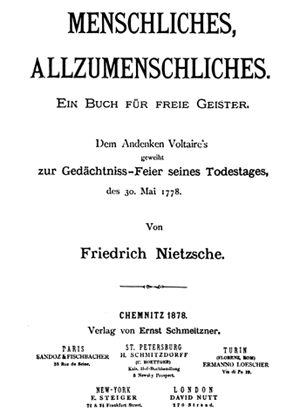
Publishes 'Human, All Too Human'
Aphoristic work marking Nietzsche's break with Wagner and his turn toward a more naturalistic, skeptical philosophy. #philosophy #skepticism
Publishes 'Human, All Too Human' By Friedrich Nietzsche - Nietzsche Chronicle by Malcolm Brown (Dartmouth University), Public domain, https://commons.wikimedia.org/w/index.php?curid=27068631
Jun 14, 1879 CE
Resigns from Basel Due to Health
Chronic migraines and eye problems force Nietzsche to resign his professorship; he receives a pension. #philosophy #biography
Mar 1, 1880 CE
Publishes 'The Wanderer and His Shadow'
Continuation of the aphoristic style of Human, All Too Human, deepening his critique of morality. #philosophy #ethics
Jul 1, 1881 CE
Publishes 'Daybreak: Thoughts on the Prejudices of Morality'
A systematic critique of morality, arguing that moral prejudices must be overcome for a new evaluation of values. #philosophy #ethics )
Aug 1, 1881 CE
First Conception of Eternal Recurrence
While hiking in Sils Maria, Nietzsche experiences the thought of eternal recurrence, a central idea in his later philosophy. #philosophy #eternalrecurrence
Apr 1, 1882 CE
Meets Lou Salomé
Nietzsche meets the young Russian intellectual Lou Salomé in Rome; he falls in love and proposes. #philosophy #biography
Meets Lou Salomé By Hofatelier Elvira - https://www.elle.com/it/magazine/storie-di-donne/a29262677/lou-von-salome-film/, Public domain, https://commons.wikimedia.org/w/index.php?curid=84511314
Aug 1, 1882 CE
Proposal to Lou Salomé Rejected
Lou Salomé rejects Nietzsche's marriage proposal, leading to a breakdown in their friendship and deep personal distress. #philosophy #biography
Aug 1, 1882 CE
Publishes 'The Gay Science'
Aphoristic work including the famous declaration 'God is dead' and the first introduction of the eternal recurrence. #philosophy #godsdeath
Publishes 'The Gay Science' By Unknown author, Public domain, https://commons.wikimedia.org/w/index.php?curid=579794
May 1, 1883 CE
Publishes 'Thus Spoke Zarathustra, Part I'
First part of Nietzsche's most famous work, presenting the Übermensch and the death of God through poetic prose. #philosophy #zarathustra
Publishes 'Thus Spoke Zarathustra, Part I' By Unknown author - https://www.lynge.com/en/philosophy/54128-also-sprach-zarathustra-ein-buch-fur-alle-und-keinen-in-drei-theilen/, Public domain, https://commons.wikimedia.org/w/index.php?curid=107746832
Sep 1, 1883 CE
Publishes 'Thus Spoke Zarathustra, Part II'
Continuation of Zarathustra's journey, developing themes of the will to power and eternal recurrence. #philosophy #zarathustra
Mar 1, 1884 CE
Publishes 'Thus Spoke Zarathustra, Part III'
Part III deepens the doctrine of eternal recurrence, with Zarathustra's most difficult trials. #philosophy #zarathustra
Apr 1, 1885 CE
Publishes 'Thus Spoke Zarathustra, Part IV' (Private Edition)
Part IV is printed privately for friends; it contains satirical episodes and Zarathustra's final transformations. #philosophy #zarathustra
Aug 1, 1886 CE
Publishes 'Beyond Good and Evil'
A major work of philosophy that expands on the ideas of Zarathustra and criticizes previous philosophical systems. #philosophy #willtopower
Publishes 'Beyond Good and Evil' By C. G. Naumann, publisher - Dartmouth College Nietzsche Chronicle, 1886, http://www.dartmouth.edu/~fnchron/1886.html, Public domain, https://commons.wikimedia.org/w/index.php?curid=3345152
Nov 1, 1887 CE
Publishes 'On the Genealogy of Morality'
Genealogical critique of moral concepts, tracing the origin of good/evil to slave morality and ressentiment. #philosophy #morality
Publishes 'On the Genealogy of Morality' By C. G. Naumann, publisher - Dartmouth College Nietzsche Chronicle, 1887, http://www.dartmouth.edu/~fnchron/1887.html, Public domain, https://commons.wikimedia.org/w/index.php?curid=136081739
May 1, 1888 CE
Publishes 'The Case of Wagner'
A polemic against Wagner's music and its decadent influence on culture and philosophy. #philosophy #music
Publishes 'The Case of Wagner' By Unknown author - Benders/Oettermann (ed.): Friedrich Nietzsche - Chronik in Bildern und Texten, Hanser / dtv 2000, p. 781., Public domain, https://commons.wikimedia.org/w/index.php?curid=3819982
Aug 1, 1888 CE
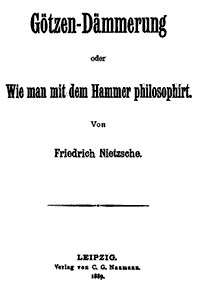
Writes 'Twilight of the Idols'
A concise summary of Nietzsche's philosophy, subtitled 'How to Philosophize with a Hammer' for revaluing all values. #philosophy #idols
Writes 'Twilight of the Idols' By Author: Friedrich Nietzsche and Publisher: Verlag von C. G. Naumann - www.nietzscheana.com.ar/gotzen-dammerung.gif, Public domain, https://commons.wikimedia.org/w/index.php?curid=3556238
Sep 1, 1888 CE
Writes 'The Antichrist'
A fierce critique of Christianity, arguing it is a slave morality that stifles human greatness. #philosophy #religion )
Oct 1, 1888 CE
Writes 'Ecce Homo'
An autobiographical work in which Nietzsche reviews his life and works with characteristic self-celebration and insight. #philosophy #biography )
Writes 'Ecce Homo' By Unknown author - Online source: http://apps.carleton.edu/campus/library/now/exhibits/fineprinting/usandeurope/, Public domain, https://commons.wikimedia.org/w/index.php?curid=126943165
Dec 1, 1888 CE
Writes 'Nietzsche Contra Wagner'
A collection of passages from his earlier works to emphasize his break with Wagner's art and philosophy. #philosophy #music
Writes 'Nietzsche Contra Wagner' By Unknown author - https://www.dartmouth.edu/~fnchron/files/images/NcW.gif, Public domain, https://commons.wikimedia.org/w/index.php?curid=56969811
Jan 3, 1889 CE
Mental Breakdown in Turin
Nietzsche collapses in Turin after a breakdown, allegedly embracing a horse; he loses his sanity permanently. #philosophy #biography
Jan 9, 1889 CE
Committed to Asylum in Jena
Nietzsche is admitted to a psychiatric clinic in Jena under the care of Dr. Otto Binswanger. #philosophy #biography
May 1, 1889 CE
Moved to Naumburg Under Mother's Care
Nietzsche's mother brings him to Naumburg, where she cares for him in his deteriorating mental state. #philosophy #biography
Apr 1, 1897 CE
Death of Nietzsche's Mother
Franziska Nietzsche dies; her daughter Elisabeth takes over Nietzsche's care and literary estate. #philosophy #biography
Aug 25, 1900 CE
Death of Friedrich Nietzsche
Nietzsche dies in Weimar after suffering from pneumonia and a stroke; his legacy grows enormously posthumously. #philosophy #biography