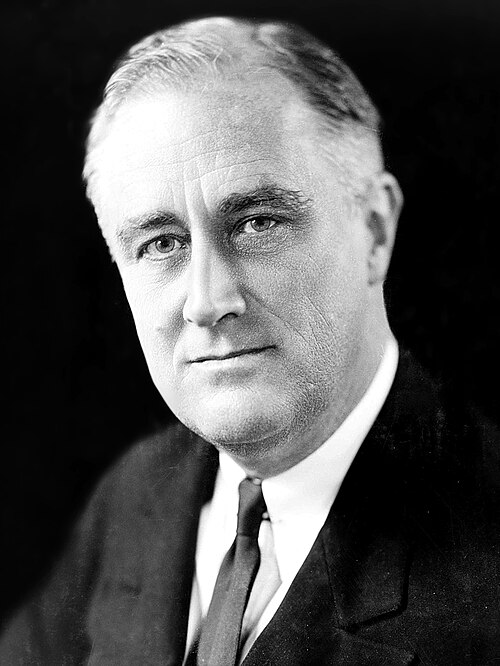
Franklin D. Roosevelt's political trajectory from his New Deal presidency through isolationist challenges, WWII leadership, and his death in office in 1945.
Chronological Storyline (27 Milestones)
Nov 8, 1932 CE
FDR Elected President
Roosevelt defeated incumbent Herbert Hoover in a landslide, promising a New Deal for the American people amid the Great Depression.
Franklin D Roosevelt BiographyFranklin D. Roosevelt Jr. By Unknown, dedicated to Bettmann Archive - Bettmann Archive, Public domain, https://commons.wikimedia.org/w/index.php?curid=169294453
Mar 4, 1933 CE
Inauguration and First Fireside Chat
Taking office amid a banking crisis, FDR told Americans the only thing to fear was fear itself, launching the New Deal's first 100 days.
Fireside chats By Unknown or not provided - This tag does not indicate the copyright status of the attached work. A normal copyright tag is still required. See Commons:Licensing., Public domain, https://commons.wikimedia.org/w/index.php?curid=43446994
Jun 12, 1933 CE
London Economic Conference Collapses
Roosevelt refused to cooperate on international currency stabilization, prioritizing domestic recovery over global economic coordination.
Presidency of Franklin D. Roosevelt (1941–1945) By Leon Perskie - 09-109(16), CC BY 2.0, https://commons.wikimedia.org/w/index.php?curid=195220114
Aug 14, 1935 CE
Social Security Act Signed
FDR signed the Social Security Act, creating a federal safety net for elderly and unemployed Americans as a cornerstone of the Second New Deal.
Social Security Act By U.S. Government - Extracted from PDF version of Our Flag, available here (direct PDF URL here.), Public domain, https://commons.wikimedia.org/w/index.php?curid=41373752
Aug 31, 1935 CE
First Neutrality Act Passed
Congress passed legislation imposing an arms embargo on all belligerents, reflecting strict isolationist sentiment that FDR reluctantly accepted.
Presidency of Franklin D. Roosevelt (1933–1941) By Elias Goldensky (1868-1943) - This image is available from the United States Library of Congress's Prints and Photographs division under the digital ID cph.3c17121.This tag does not indicate the copyright status of the attached work. A normal copyright tag is still required. See Commons:Licensing., Public domain, https://commons.wikimedia.org/w/index.php?curid=56993489
Nov 3, 1936 CE
Landslide Re-election
Roosevelt won re-election carrying 46 of 48 states, validating the New Deal and giving him a mandate to continue domestic reform.
Franklin D. Roosevelt By Leon Perskie - Flickr (FDR Presidential Library & Museum) – Info – Pic, CC BY 2.0, https://commons.wikimedia.org/w/index.php?curid=171293476
Oct 5, 1937 CE
Quarantine Speech in Chicago
FDR called for an international quarantine of aggressor nations, his first significant public step away from strict neutrality and isolationism.
Quarantine Speech By Arthur Szyk - https://digital.wolfsonian.org/WOLF000177, CC BY-SA 4.0, https://commons.wikimedia.org/w/index.php?curid=128457352
Nov 1, 1938 CE
Midterm Elections Weaken New Deal
Republicans gained seats in Congress, reflecting growing conservative opposition to FDR's domestic agenda and complicating his legislative majority.
New Deal By LordHarris at English Wikipedia - Top left: (from here) Top right:(from here) Bottom:(from here). Transferred from en.wikipedia to Commons by Pass3456., Public domain, https://commons.wikimedia.org/w/index.php?curid=17002806
Jan 4, 1939 CE
State of the Union Warns Dictators
Roosevelt warned Congress that the survival of democracy was at stake from fascist aggression, while still navigating isolationist resistance to rearmament.
Sep 8, 1939 CE
Proclamation of Limited Emergency
Following Germany's invasion of Poland, FDR declared a limited national emergency, beginning the gradual expansion of US military readiness.
Sep 2, 1940 CE
Destroyers for Bases Agreement
Roosevelt transferred 50 WWI-era destroyers to Britain in exchange for military base leases, a bold circumvention of isolationist neutrality laws.
Franklin D. Roosevelt Wikimedia Commons
Dec 29, 1940 CE
Arsenal of Democracy Fireside Chat
FDR urged Americans to support the Allied powers with materiel, declaring the US must become the great arsenal of democracy.
Jan 6, 1941 CE
Four Freedoms Address
In his State of the Union, Roosevelt articulated four essential human freedoms: speech, worship, want, and fear, as a framework for the postwar world.
Mar 11, 1941 CE
Lend-Lease Act Signed
FDR signed legislation authorizing the president to provide war supplies to any country whose defense was deemed vital to US security, effectively ending neutrality.
Aug 14, 1941 CE
Atlantic Charter Proclaimed
Roosevelt and Churchill issued a joint declaration of postwar aims including self-determination and disarmament, laying the ideological foundation for the United Nations.
Dec 7, 1941 CE
Pearl Harbor Attacked
A surprise Japanese attack on the US naval base at Pearl Harbor killed over 2,400 Americans and decisively ended the isolationist era.
Dec 8, 1941 CE
Day of Infamy Speech to Congress
FDR addressed a joint session of Congress, declaring December 7 a date which will live in infamy, and requested a declaration of war against Japan.
Jan 1, 1942 CE
Declaration by United Nations
Roosevelt coined the term United Nations as 26 Allied nations pledged to fight the Axis powers and not make separate peace.
Feb 19, 1942 CE
Executive Order 9066 Signed
FDR authorized the forced relocation and internment of over 120,000 Japanese Americans, one of the most controversial domestic actions of the war.
Jan 14, 1943 CE
Casablanca Conference
Roosevelt and Churchill met in Morocco, demanding unconditional Axis surrender and planning the Allied invasion of Europe.
Dec 4, 1943 CE
Cairo and Tehran Conferences
FDR met with Churchill and Chiang Kai-shek in Cairo, then with Stalin in Tehran, coordinating D-Day plans and postwar territorial arrangements.
Jun 6, 1944 CE
D-Day Prayer Broadcast
On the evening of the Normandy landings, FDR led the nation in a radio prayer for the success of the invasion and the safety of American forces.
Jul 11, 1944 CE
Bretton Woods Agreement Signed
Roosevelt's administration championed an international monetary conference establishing the IMF and World Bank to stabilize the postwar global economy.
Nov 7, 1944 CE
Unprecedented Fourth Term Won
Despite declining health, FDR won a fourth presidential term, defeating Thomas Dewey with Harry Truman as his running mate.
Feb 4, 1945 CE
Yalta Conference with Stalin and Churchill
The Big Three met in Crimea to plan the occupation of Germany, Soviet entry into the Pacific war, and the structure of the future United Nations.
Mar 1, 1945 CE
FDR Reports to Congress on Yalta
Roosevelt defended the Yalta agreements before Congress, arguing they provided the best framework for lasting peace and international cooperation.
Apr 12, 1945 CE
Death at Warm Springs
Roosevelt died of a cerebral hemorrhage at his retreat in Georgia, ending a 12-year presidency weeks before the Allied victory in Europe.