Fourier Analysis & Harmonic Series: Global Cross-Cultural Perspectives
Encyclopedia/1. The Cosmos & The Natural World/1. Mathematics & Formal Systems/03. Calculus & Mathematical Analysis • Curated by Admin Timeline.sg
This timeline traces the global history of Fourier analysis and harmonic series, from ancient Greek and Chinese musical discoveries to modern digital signal processing, highlighting contributions from Europe, the Islamic world, India, and East Asia.
Chronological Storyline (42 Milestones)
500 BCE
Pythagoras discovers octave ratios
Pythagoras of Samos discovers that consonant musical intervals correspond to simple integer ratios of string lengths, laying the foundation for harmonic theory. #music #mathematics #history
Pythagoras discovers octave ratios By Parcly Taxel - Own work, FAL, https://commons.wikimedia.org/w/index.php?curid=150519727
400 BCE
Archytas explores harmonic means
Greek mathematician Archytas of Tarentum writes on harmonic means and their role in music theory, influencing later harmonic series concepts. #mathematics #music
Archytas explores harmonic means By NikonZ7II - Own work, CC BY-SA 4.0, https://commons.wikimedia.org/w/index.php?curid=116889537
330 BCE
Aristoxenus writes Elementa Harmonica
Greek music theorist Aristoxenus publishes the earliest known treatise on harmonics, categorizing scales and intervals. #music #history
Aristoxenus writes Elementa Harmonica By Guglielmo Morghen - http://digitalgallery.nypl.org/nypldigital/dgkeysearchdetail.cfm?trg=1&strucID=338476&imageid=1100826&total=1&e=r, Public domain, https://commons.wikimedia.org/w/index.php?curid=22414855
300 BCE
Euclid's Division of the Canon
Euclid writes on musical intervals using geometric and arithmetic means, influencing later harmonic analysis. #mathematics #music
150 CE
Ptolemy's Harmonics
Claudius Ptolemy compiles Harmonics, a treatise on musical intervals and scales based on rational ratios. #music #history
200 CE
Bharata's Natya Shastra on musical scales
Indian sage Bharata writes the Natya Shastra, detailing scales (grams) and intervals, foundational to Indian classical music. #music #india
Bharata's Natya Shastra on musical scales By Unknown author - Shiva_as_the_Lord_of_Dance_LACMA.jpg, photographed by the LACMA. derivative work: Julia\talk, Public domain, https://commons.wikimedia.org/w/index.php?curid=14771931
800 CE
Al-Kindi on musical pitch
Arab philosopher Al-Kindi writes De sonos, relating pitch to string tension and using numerical ratios. #music #islamicgoldenage
Al-Kindi on musical pitch By Iraqi Post - Personal collection, Public domain, https://commons.wikimedia.org/w/index.php?curid=91832934
900 CE
Al-Farabi's Grand Book on Music
Al-Farabi compiles a comprehensive theory of music, including rhythmic and melodic modes, influencing Ottoman and Persian music. #music #islamicgoldenage
Al-Farabi's Grand Book on Music By Mr.Nostalgic - File:Al-Farabi_Alpharabius_philosophus_(titel_op_object)_Liber_Chronicarum_(serietitel),_RP-P-2016-49-86-16.jpg, Public domain, https://commons.wikimedia.org/w/index.php?curid=128430609
1030 CE
Ibn al-Haytham on acoustics
Ibn al-Haytham studies sound propagation, establishing a basis for understanding harmonic motion. #acoustics #physics
Ibn al-Haytham on acoustics By Adolph Boÿ, engraved by Jeremias Falck. Used as the frontispiece to Johannes Hevelius, Selenographia, 1647 - https://www.loc.gov/resource/rbctos.2017rosen1321/?sp=9&r=0.059,0.617,0.327,0.182,0, Public domain, https://commons.wikimedia.org/w/index.php?curid=165125519
1088 CE
Shen Kuo describes resonance and overtones
Chinese polymath Shen Kuo in Dream Pool Essays explains acoustic resonance and the harmonic overtone series in musical instruments. #physics #china
Shen Kuo describes resonance and overtones By Hans A. Rosbach - Own work, CC BY-SA 3.0, https://commons.wikimedia.org/w/index.php?curid=89508454
1250 CE
Safi al-Din al-Urmawi's musical intervals
Persian music theorist Safi al-Din writes Kitab al-Adwar, systematizing intervals and introducing the concept of the harmonic series. #music #islamic
Safi al-Din al-Urmawi's musical intervals By Hossein Behzad - http://sadmu.ir/detail/4663, Public domain, https://commons.wikimedia.org/w/index.php?curid=78155985
1400 CE
Madhava discovers power series for sine and cosine
Indian mathematician Madhava of Sangamagrama develops infinite series expansions for sine and cosine, precursors to Fourier series. #mathematics #india
1584 CE
Zhu Zaiyu calculates equal temperament
Chinese prince and musician Zhu Zaiyu mathematically derives equal temperament, dividing the octave into 12 equal parts. #music #china
1636 CE
Mersenne's laws of vibrating strings
French mathematician Marin Mersenne publishes Harmonie universelle, giving the relationship between string tension, length, and pitch. #physics #music
Mersenne's laws of vibrating strings By Claude Duflos - This file comes from Gallica Digital Library and is available under the digital ID btv1b8422568j/f1.zoom, Public domain, https://commons.wikimedia.org/w/index.php?curid=153647340
1638 CE
Galileo Galilei on resonance and pendulums
Galileo's Dialogues Concerning Two New Sciences discusses sound, resonance, and the harmonic oscillator, laying groundwork for harmonic analysis. #physics #history
Galileo Galilei on resonance and pendulums By Unknown author, Public domain, https://commons.wikimedia.org/w/index.php?curid=144961
1687 CE
Newton's wave equation
Isaac Newton derives the speed of sound and the wave equation in Principia Mathematica, a cornerstone of harmonic motion. #physics #mathematics
1713 CE
Brook Taylor solves vibrating string
Taylor publishes a solution for the vibrating string problem, introducing the sine series representation. #mathematics #physics )
Brook Taylor solves vibrating string By Unknown author - https://wellcomeimages.org/indexplus/obf_images/75/f7/fed90dbc49691836c0c65199855e.jpg Gallery: https://wellcomeimages.org/indexplus/image/V0005742.html Wellcome Collection gallery (2018-03-30): https://wellcomecollection.org/works/pyzywht3 CC-BY-4.0, CC BY 4.0, https://commons.wikimedia.org/w/index.php?curid=36419865
1731 CE
Euler introduces the harmonic series
Leonhard Euler publishes work on the harmonic series 1 + 1/2 + 1/3 + ... and its divergence, linking to Basel problem. #mathematics #analysis )
1747 CE
D'Alembert's wave equation for strings
Jean le Rond d'Alembert derives the one-dimensional wave equation, providing a mathematical framework for vibrating strings. #physics #mathematics
1753 CE
Daniel Bernoulli's superposition principle
Bernoulli proposes that a vibrating string can be represented as a sum of normal modes, anticipating Fourier series. #physics #mathematics
Daniel Bernoulli's superposition principle By UnknownEdited by Bammesk - Basel Historical Museum Link: https://www.hmb.ch/en/museums/objects-in-the-collection/details/s/portraet-des-daniel-bernoulli/, CC BY-SA 4.0, https://commons.wikimedia.org/w/index.php?curid=114825929
1762 CE
Lagrange's work on Fourier series
Joseph-Louis Lagrange develops the theory of sine series for the vibrating string, a precursor to Fourier analysis. #mathematics #physics
Lagrange's work on Fourier series By Unknown author - File:Joseph_Louis_Lagrange.jpg, CC0, https://commons.wikimedia.org/w/index.php?curid=155608232
1807 CE
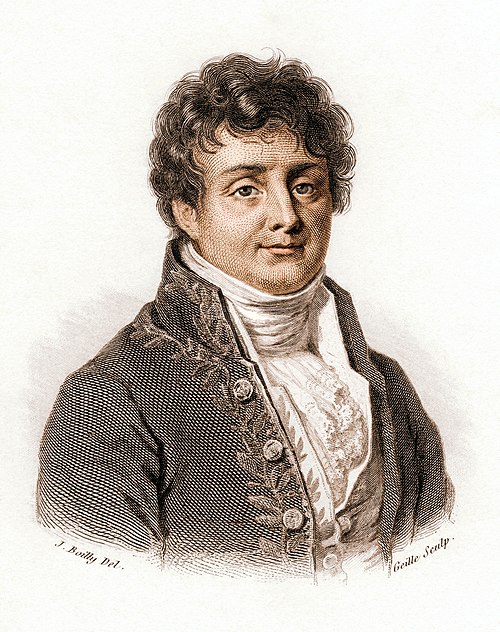
Fourier submits his Théorie de la chaleur
Joseph Fourier presents his work on heat conduction, using trigonometric series to solve the heat equation. #mathematics #physics
Fourier submits his Théorie de la chaleur By Julien-Léopold Boilly - This file was derived from: Fourier2.jpg Restored by: Bammesk Original source: https://www.gettyimages.com.au/license/169251384 https://wellcomecollection.org/works/b4qh352u, Public domain, https://commons.wikimedia.org/w/index.php?curid=114366437
1822 CE
Fourier publishes Analytical Theory of Heat
Fourier's book Théorie analytique de la chaleur formally introduces Fourier series and transforms. #mathematics #physics #analysis
1829 CE
Dirichlet establishes convergence conditions
Peter Gustav Lejeune Dirichlet provides sufficient conditions for the convergence of Fourier series, a key theoretical foundation. #mathematics #analysis
1854 CE
Riemann's work on Fourier series
Bernhard Riemann develops the Riemann integral and studies Fourier series convergence, later influencing Lebesgue. #mathematics #analysis
Riemann's work on Fourier series By Brad219 - Own work created using Inkscape 1.3. Redrawn from original PNG source authored by KSmrq, CC0, https://commons.wikimedia.org/w/index.php?curid=150414772
1870 CE
Cantor's uniqueness theorem for trigonometric series
Georg Cantor proves that if a trigonometric series converges to zero everywhere, all coefficients are zero, initiating set theory. #mathematics #history
Cantor's uniqueness theorem for trigonometric series By Unknown author - https://www.math.cmu.edu/~rcristof/pdf/Cantor_pubblicato.pdf and they had it from https://photos.aip.org/history-programs/niels-bohr-library/photos/cantor-georg-a1, Public domain, https://commons.wikimedia.org/w/index.php?curid=74820875
1873 CE
Du Bois-Reymond's continuous function with divergent Fourier series
Paul Du Bois-Reymond constructs a continuous function whose Fourier series diverges at a point, showing necessity of extra conditions. #mathematics #analysis
Du Bois-Reymond's continuous function with divergent Fourier series By Franz Hanfstaengl - http://www-groups.dcs.st-and.ac.uk/~history/PictDisplay/Du_Bois-Reymond.html, Public domain, https://commons.wikimedia.org/w/index.php?curid=3287390
1900 CE
Fejér's theorem on Cesàro summability
Lipót Fejér proves that Fourier series of continuous functions are Cesàro summable, providing a new convergence method. #mathematics #analysis
1903 CE
Lebesgue integration for Fourier series
Henri Lebesgue develops the Lebesgue integral, enabling broader treatment of Fourier series and transforms. #mathematics #analysis
Lebesgue integration for Fourier series By ~~helix84 15:43, 27 November 2006 (UTC) - own work, based on en:Image:Integral-area-under-curve.png, Public domain, https://commons.wikimedia.org/w/index.php?curid=1409775
1923 CE
Bohr's almost periodic functions
Harald Bohr introduces almost periodic functions, extending Fourier analysis to non-periodic signals. #mathematics #analysis
1930 CE
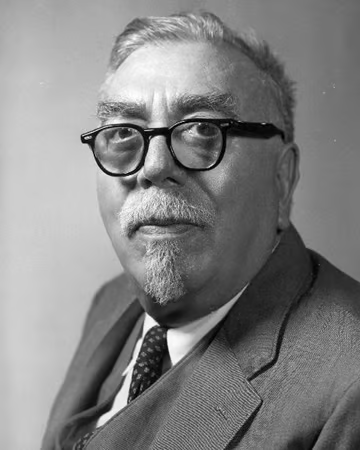
Wiener develops harmonic analysis
Norbert Wiener publishes Generalized Harmonic Analysis, applying Fourier methods to stochastic processes. #mathematics #engineering
Wiener develops harmonic analysis By Garry Olsh - Own work, CC0, https://commons.wikimedia.org/w/index.php?curid=148383228
1942 CE
Hartley transform introduced
Ralph Hartley proposes the Hartley transform as a real-valued alternative to the Fourier transform. #signalprocessing #mathematics
1945 CE
Schwartz distributions for Fourier transforms
Laurent Schwartz develops the theory of distributions, providing a rigorous framework for Fourier transforms of generalized functions. #mathematics #analysis )
1948 CE
Shannon's sampling theorem
Claude Shannon publishes the Nyquist–Shannon sampling theorem, linking Fourier analysis to digital signal processing. #engineering #mathematics
Shannon's sampling theorem By Original: Metacomet Vector: Editor at Large - Own work based on: Bandlimited.png, Public domain, https://commons.wikimedia.org/w/index.php?curid=1873176
1965 CE
Cooley-Tukey FFT algorithm
James Cooley and John Tukey rediscover the Fast Fourier Transform algorithm, revolutionizing digital computation of Fourier series. #computing #mathematics
1966 CE
Carleson's theorem on Fourier series convergence
Lennart Carleson proves that the Fourier series of an L² function converges almost everywhere. #mathematics #analysis
1971 CE
Fefferman's pointwise convergence for Lp
Charles Fefferman refines Carleson's result, determining the range of Lp for which Fourier series converge pointwise. #mathematics #analysis
Fefferman's pointwise convergence for Lp By Gert-Martin Greuel - MFO: https://opc.mfo.de/detail?photoID=8486, CC BY-SA 2.0 de, https://commons.wikimedia.org/w/index.php?curid=3917841
1982 CE
Morlet introduces wavelets
Jean Morlet, a geophysicist, develops wavelets to analyze seismic signals, offering time-frequency localization beyond Fourier. #signalprocessing #mathematics
1985 CE
Meyer constructs orthogonal wavelets
Yves Meyer builds the first orthogonal wavelets with smoothness, launching wavelet analysis. #mathematics #signalprocessing
Meyer constructs orthogonal wavelets By Centre Henri Lebesgue - Extracted from https://www.youtube.com/watch?v=Z1Cj6i8h-ts&t=27s, CC BY 3.0, https://commons.wikimedia.org/w/index.php?curid=110894433
1988 CE
Daubechies' compactly supported wavelets
Ingrid Daubechies constructs a family of orthogonal wavelets with compact support, widely used in signal processing. #mathematics #signalprocessing
Daubechies' compactly supported wavelets By JonMcLoone (talk) - Own work (Original text: I (JonMcLoone (talk)) created this work entirely by myself.), CC BY 3.0, https://commons.wikimedia.org/w/index.php?curid=13575288
1992 CE
JPEG standard adopts DCT
The JPEG image compression standard uses the discrete cosine transform (a Fourier-related transform), revolutionizing digital imaging. #computing #engineering
JPEG standard adopts DCT By AzaToth - File:Felis_silvestris_silvestris_small_gradual_decrease_of_quality.png, CC BY 3.0, https://commons.wikimedia.org/w/index.php?curid=43107801
2006 CE
Compressed sensing theory emerges
Donoho, Candès, et al. develop compressed sensing, enabling signal recovery from fewer samples via sparse Fourier representations. #mathematics #signalprocessing