WW2/Battles of WW2/Date-by-Date/Pacific • Curated by Admin Timeline.sg
Japan's conquest of the Philippines — the retreat to Bataan, the siege of Corregidor, and the surrender that led to the Bataan Death March. (8 December 1941 – 8 May 1942)
Chronological Storyline (21 Milestones)
Dec 8, 1941 CE
Japanese aircraft strike Philippine airfields
Japanese bombers attacked Clark Field and other American airbases on Luzon, destroying over half of MacArthur's Far East Air Force on the ground despite advance warning of the Pearl Harbor attack. · Wikipedia: https://en.wikipedia.org/wiki/Japanese_air_attacks_on_the_Philippines
The Philippines Campaign 1941-1942 | Documentary
Dec 10, 1941 CE
First Japanese landings on Luzon
Japanese forces under General Masaharu Homma made preliminary landings at Aparri, Vigan, and Legazpi on northern Luzon, securing airfields to support the main invasion force. · Wikipedia: https://en.wikipedia.org/wiki/Japanese_invasion_of_the_Philippines
Scope and content: Original caption: This picture, captured from the Japanese, shows American prisoners using improvised litters to carry those of their comrades who, from the lack of food or water on the march from Bataan, fell along the road. Philippines, May 1942. General notes: According to Colonel Melvin H. Rosen (U.S. Army Retired), this image is not a photograph taken during the Bataan Death March, but rather a photograph of a burial detail at Camp O'Donnell, the terminus of the "Death March". Mr. Rosen is a survivor of the "Death March".Use War and Conflict Number 1145 when ordering a reproduction or requesting information on this image. By Unknown authorUnknown author or not provided - U.S. National Archives and Records Administration, Public domain, https://commons.wikimedia.org/w/index.php?curid=17043258
Dec 12, 1941 CE
US Navy withdraws submarines from Manila
Admiral Thomas Hart withdrew the Asiatic Fleet's submarines from Manila Bay to safer bases, reducing naval support for the defense of the Philippines. · Wikipedia: https://en.wikipedia.org/wiki/Asiatic_Fleet
At Tsingtao, China, on 4 July 1933, dressed overall for the holiday. She is flying the four-star flag of Admiral Montgomery M. Taylor, Commander in Chief Asiatic Fleet, at her forepeak. By Chief Radioman W.R. Lucas, USN (Retired) - https://www.history.navy.mil/content/history/nhhc/our-collections/photography/numerical-list-of-images/nhhc-series/nh-series/NH-78000/NH-78368.html, Public domain, https://commons.wikimedia.org/w/index.php?curid=122475602
Dec 22, 1941 CE
Main Japanese invasion force lands at Lingayen
General Homma's 14th Army landed the main invasion force at Lingayen Gulf on northern Luzon, overwhelming defending Filipino units and advancing rapidly toward Manila. · Wikipedia: https://en.wikipedia.org/wiki/Battle_of_the_Philippines_(1941%E2%80%9342)
Scope and content: Original caption: This picture, captured from the Japanese, shows American prisoners using improvised litters to carry those of their comrades who, from the lack of food or water on the march from Bataan, fell along the road. Philippines, May 1942. General notes: According to Colonel Melvin H. Rosen (U.S. Army Retired), this image is not a photograph taken during the Bataan Death March, but rather a photograph of a burial detail at Camp O'Donnell, the terminus of the "Death March". Mr. Rosen is a survivor of the "Death March".Use War and Conflict Number 1145 when ordering a reproduction or requesting information on this image. By Unknown authorUnknown author or not provided - U.S. National Archives and Records Administration, Public domain, https://commons.wikimedia.org/w/index.php?curid=17043258
Dec 24, 1941 CE
MacArthur orders retreat to Bataan
General MacArthur implemented War Plan Orange, ordering American and Philippine forces to withdraw to the Bataan peninsula, abandoning Manila which was declared an open city. · Wikipedia: https://en.wikipedia.org/wiki/Battle_of_Bataan
Japanese tank column advancing in Bataan By Unknown author - http://pwencycl.kgbudge.com/P/h/Philippine_Islands.htm, Public domain, https://commons.wikimedia.org/w/index.php?curid=37120531
Dec 26, 1941 CE
Manila declared an open city
MacArthur declared Manila an open city to spare it from destruction, but Japanese bombers continued attacking the city as Filipino and American forces consolidated defensive positions on Bataan. · Wikipedia: https://en.wikipedia.org/wiki/Manila_(1941%E2%80%9342)
Jan 2, 1942 CE
Japanese forces occupy Manila
Japanese troops entered and occupied Manila without resistance, while the bulk of the defending USAFFE forces under General MacArthur had completed their withdrawal to Bataan. · Wikipedia: https://en.wikipedia.org/wiki/Battle_of_the_Philippines_(1941%E2%80%9342)
Scope and content: Original caption: This picture, captured from the Japanese, shows American prisoners using improvised litters to carry those of their comrades who, from the lack of food or water on the march from Bataan, fell along the road. Philippines, May 1942. General notes: According to Colonel Melvin H. Rosen (U.S. Army Retired), this image is not a photograph taken during the Bataan Death March, but rather a photograph of a burial detail at Camp O'Donnell, the terminus of the "Death March". Mr. Rosen is a survivor of the "Death March".Use War and Conflict Number 1145 when ordering a reproduction or requesting information on this image. By Unknown authorUnknown author or not provided - U.S. National Archives and Records Administration, Public domain, https://commons.wikimedia.org/w/index.php?curid=17043258
Jan 9, 1942 CE
Japanese assault on the Abucay line begins
General Homma's forces attacked the USAFFE defensive line on the eastern side of Bataan, beginning weeks of intense fighting as American and Filipino troops resisted fiercely. · Wikipedia: https://en.wikipedia.org/wiki/Battle_of_Bataan
Japanese tank column advancing in Bataan By Unknown author - http://pwencycl.kgbudge.com/P/h/Philippine_Islands.htm, Public domain, https://commons.wikimedia.org/w/index.php?curid=37120531
Jan 23, 1942 CE
Japanese land behind US lines at Longoskawayan
Japanese naval infantry landed at points on the southern coast of Bataan behind American lines, but USAFFE forces contained and eventually eliminated the beachheads after days of fighting. · Wikipedia: https://en.wikipedia.org/wiki/Battle_of_Bataan
Japanese tank column advancing in Bataan By Unknown author - http://pwencycl.kgbudge.com/P/h/Philippine_Islands.htm, Public domain, https://commons.wikimedia.org/w/index.php?curid=37120531
Feb 8, 1942 CE
Homma halts offensive to regroup
After failing to break the Bataan defenses, General Homma suspended offensive operations and requested reinforcements from Tokyo, giving the defenders a temporary reprieve. · Wikipedia: https://en.wikipedia.org/wiki/Battle_of_Bataan
Japanese tank column advancing in Bataan By Unknown author - http://pwencycl.kgbudge.com/P/h/Philippine_Islands.htm, Public domain, https://commons.wikimedia.org/w/index.php?curid=37120531
Mar 11, 1942 CE
MacArthur departs for Australia
President Roosevelt ordered MacArthur to leave the Philippines; he departed Corregidor by PT boat for Australia, famously promising 'I shall return,' leaving General Jonathan Wainwright in command. · Wikipedia: https://en.wikipedia.org/wiki/Douglas_MacArthur
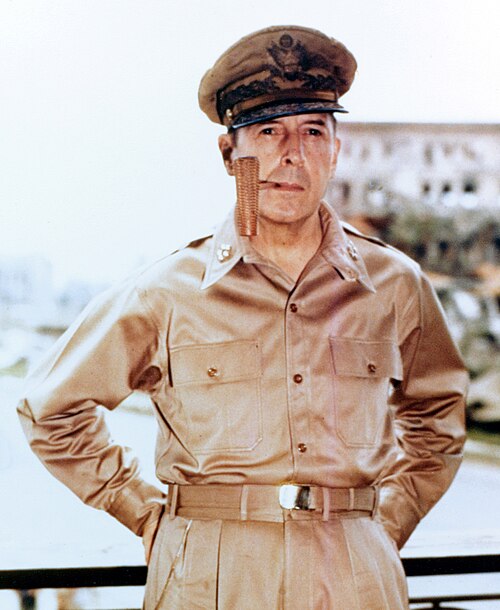
General of the Army Douglas MacArthur smoking his corncob pipe, probably at Manila, Philippine Islands, 2 August 1945. By Photographer not credited. - Naval Historical Center; Direct link. Photo #: USA C-2413 (Color), photograph from the Army Signal Corps Collection in the U.S. National Archives., Public domain, https://commons.wikimedia.org/w/index.php?curid=139743720
Mar 12, 1942 CE
MacArthur arrives in Mindanao
MacArthur and his party reached Mindanao by PT boat, then flew to Australia where he assumed command of Allied forces in the Southwest Pacific Area. · Wikipedia: https://en.wikipedia.org/wiki/Douglas_MacArthur
General of the Army Douglas MacArthur smoking his corncob pipe, probably at Manila, Philippine Islands, 2 August 1945. By Photographer not credited. - Naval Historical Center; Direct link. Photo #: USA C-2413 (Color), photograph from the Army Signal Corps Collection in the U.S. National Archives., Public domain, https://commons.wikimedia.org/w/index.php?curid=139743720
Mar 28, 1942 CE
Japanese reinforcements arrive at Bataan
General Homma received substantial reinforcements including aircraft, artillery, and fresh infantry units, enabling him to resume the offensive against the weakened Bataan defenders. · Wikipedia: https://en.wikipedia.org/wiki/Battle_of_Bataan
Japanese tank column advancing in Bataan By Unknown author - http://pwencycl.kgbudge.com/P/h/Philippine_Islands.htm, Public domain, https://commons.wikimedia.org/w/index.php?curid=37120531
Apr 3, 1942 CE
Final Japanese offensive on Bataan launches
General Homma launched a massive artillery barrage followed by a full-scale infantry assault on the Bataan defensive lines, breaking through the exhausted and starving American and Filipino positions. · Wikipedia: https://en.wikipedia.org/wiki/Battle_of_Bataan
Japanese tank column advancing in Bataan By Unknown author - http://pwencycl.kgbudge.com/P/h/Philippine_Islands.htm, Public domain, https://commons.wikimedia.org/w/index.php?curid=37120531
Apr 8, 1942 CE
Wainwright assumes command of all forces
General Wainwright, commanding from Corregidor, assumed overall command of all USAFFE forces as the situation on Bataan deteriorated, while General Edward King commanded the Bataan forces directly. · Wikipedia: https://en.wikipedia.org/wiki/Jonathan_Wainwright
Apr 9, 1942 CE
Bataan forces surrender to the Japanese
General Edward King surrendered approximately 75,000 American and Filipino troops on Bataan to prevent a massacre, the largest surrender in American military history. · Wikipedia: https://en.wikipedia.org/wiki/Battle_of_Bataan
Japanese tank column advancing in Bataan By Unknown author - http://pwencycl.kgbudge.com/P/h/Philippine_Islands.htm, Public domain, https://commons.wikimedia.org/w/index.php?curid=37120531
Apr 10, 1942 CE
Bataan Death March begins
Japanese forces began marching the captured prisoners from Bataan to prison camps at Camp O'Donnell, a brutal 65-mile journey in which thousands of prisoners died from abuse, starvation, and disease. · Wikipedia: https://en.wikipedia.org/wiki/Bataan_Death_March
Scope and content: Original caption: This picture, captured from the Japanese, shows American prisoners using improvised litters to carry those of their comrades who, from the lack of food or water on the march from Bataan, fell along the road. Philippines, May 1942. General notes: According to Colonel Melvin H. Rosen (U.S. Army Retired), this image is not a photograph taken during the Bataan Death March, but rather a photograph of a burial detail at Camp O'Donnell, the terminus of the "Death March". Mr. Rosen is a survivor of the "Death March".Use War and Conflict Number 1145 when ordering a reproduction or requesting information on this image. By Unknown authorUnknown author or not provided - U.S. National Archives and Records Administration, Public domain, https://commons.wikimedia.org/w/index.php?curid=17043258
Apr 29, 1942 CE
Japanese bombardment of Corregidor intensifies
General Homma turned his full attention to Corregidor, subjecting the island fortress to continuous heavy artillery bombardment from Bataan across the channel. · Wikipedia: https://en.wikipedia.org/wiki/Battle_of_Corregidor
Scope and content: Original Caption: American and Filipino prisoners, captured at Corregidor, arrive at Bilibid prison by foot and truck as Japanese look on. They were taken by boat to Cavite. Those unable to walk were hauled the distance of approximately 40 miles. The guards watch them help each other to the ground. By Unknown authorUnknown author or not provided - U.S. National Archives and Records Administration, Public domain, https://commons.wikimedia.org/w/index.php?curid=62213789
May 5, 1942 CE
Japanese amphibious assault on Corregidor
Japanese forces launched an amphibious night assault on Corregidor's narrow beaches, meeting fierce resistance from American troops under General Wainwright defending the island's tunnels and fortifications. · Wikipedia: https://en.wikipedia.org/wiki/Battle_of_Corregidor
Scope and content: Original Caption: American and Filipino prisoners, captured at Corregidor, arrive at Bilibid prison by foot and truck as Japanese look on. They were taken by boat to Cavite. Those unable to walk were hauled the distance of approximately 40 miles. The guards watch them help each other to the ground. By Unknown authorUnknown author or not provided - U.S. National Archives and Records Administration, Public domain, https://commons.wikimedia.org/w/index.php?curid=62213789
May 6, 1942 CE
Wainwright surrenders Corregidor
Facing overwhelming Japanese forces that had penetrated the island's defenses, General Wainwright surrendered Corregidor and all remaining forces in the Philippines, effectively ending organized resistance. · Wikipedia: https://en.wikipedia.org/wiki/Battle_of_Corregidor
Scope and content: Original Caption: American and Filipino prisoners, captured at Corregidor, arrive at Bilibid prison by foot and truck as Japanese look on. They were taken by boat to Cavite. Those unable to walk were hauled the distance of approximately 40 miles. The guards watch them help each other to the ground. By Unknown authorUnknown author or not provided - U.S. National Archives and Records Administration, Public domain, https://commons.wikimedia.org/w/index.php?curid=62213789
May 8, 1942 CE
Wainwright orders all Philippine forces to surrender
General Wainwright broadcast orders for all remaining American and Filipino forces throughout the Philippine Islands to surrender, completing the Japanese conquest of the Philippines. · Wikipedia: https://en.wikipedia.org/wiki/Battle_of_the_Philippines_(1941%E2%80%9342)
Scope and content: Original caption: This picture, captured from the Japanese, shows American prisoners using improvised litters to carry those of their comrades who, from the lack of food or water on the march from Bataan, fell along the road. Philippines, May 1942. General notes: According to Colonel Melvin H. Rosen (U.S. Army Retired), this image is not a photograph taken during the Bataan Death March, but rather a photograph of a burial detail at Camp O'Donnell, the terminus of the "Death March". Mr. Rosen is a survivor of the "Death March".Use War and Conflict Number 1145 when ordering a reproduction or requesting information on this image. By Unknown authorUnknown author or not provided - U.S. National Archives and Records Administration, Public domain, https://commons.wikimedia.org/w/index.php?curid=17043258