Evolutionary Biology: From Darwin & Wallace to Modern Synthesis
Encyclopedia/1. The Cosmos & The Natural World/5. Life Sciences/01. Evolutionary Developmental Biology • Curated by Admin Timeline.sg
Evolutionary biology traces the development of life's diversity from the 18th-century classification by Linnaeus to the modern synthesis integrating genetics and natural selection, and contemporary fields like evo-devo. This timeline highlights key discoveries, from Darwin and Wallace's theory to molecular phylogenetics and CRISPR.
Chronological Storyline (40 Milestones)
1758 CE
Linnaeus Publishes 10th Edition of Systema Naturae
Carl Linnaeus establishes the binomial nomenclature system, providing a standardized framework for naming species. This foundational work in taxonomy enables future evolutionary comparisons.
#taxonomy #history
Linnaeus Publishes 10th Edition of Systema Naturae By Carl Linnaeus - Sourced from https://resolver.sub.uni-goettingen.de/purl?PPN362053006, Public domain, https://commons.wikimedia.org/w/index.php?curid=11136563
1809 CE
Lamarck Proposes Inheritance of Acquired Characteristics
Jean-Baptiste Lamarck publishes Philosophie Zoologique, outlining a theory of evolution via use and disuse and inheritance of acquired traits. Though later superseded, it was an early comprehensive evolutionary hypothesis. #evolution #history
Lamarck Proposes Inheritance of Acquired Characteristics By Unknown author - https://wellcomeimages.org/indexplus/obf_images/49/d0/402109cb6bf2c4cf565d7db23a7c.jpg Gallery: https://wellcomeimages.org/indexplus/image/L0033032.html, CC BY 4.0, https://commons.wikimedia.org/w/index.php?curid=36059310
Dec 27, 1831 CE
HMS Beagle Departs with Charles Darwin
The HMS Beagle sets sail on a five-year voyage around the world with naturalist Charles Darwin aboard. Darwin's observations, especially in the Galápagos Islands, lay the groundwork for his theory of natural selection. #exploration #evolution
HMS Beagle Departs with Charles Darwin By Conrad Martens (1801 - 21 August 1878) - English Wikipedia (13:42, 15 October 2005. User:Dave souza 1235x821 (73563 bytes) (HMS Beagle in the seaways of Tierra del Fuego, painting by Conrad Martens during the voyage of the Beagle (1831-1836), from The Illustrated Origin of Species by Charles Darwin, abridged and illustrated by Richard Leakey ), Public domain, https://commons.wikimedia.org/w/index.php?curid=1082238
Jul 1, 1837 CE
Darwin Begins First Notebook on Transmutation
Charles Darwin starts a secret notebook on the 'transmutation of species,' first sketching the idea of common descent. This marks the inception of his evolutionary thinking. #evolution #history
Oct 1, 1844 CE
Vestiges of the Natural History of Creation Published
Robert Chambers anonymously publishes Vestiges, a controversial book arguing for evolutionary development from simpler forms. It popularizes the idea of evolution years before Darwin's Origin. #evolution #history
Vestiges of the Natural History of Creation Published By Unknown author, Public domain, https://commons.wikimedia.org/w/index.php?curid=2648106
Jul 1, 1858 CE
Darwin and Wallace Joint Paper on Natural Selection
Alfred Russel Wallace's essay on natural selection prompts Darwin to present a joint paper at the Linnean Society. This co-disclosure formally introduces natural selection to the scientific community. #evolution #science
Nov 24, 1859 CE
Darwin Publishes On the Origin of Species
Charles Darwin's landmark book presents the theory of evolution by natural selection with extensive evidence. It revolutionizes biology and sparks widespread scientific and societal debate. #evolution #science
Darwin Publishes On the Origin of Species By John Murray, Publisher - This image has an extracted file: Origin of Species.jpg., Public domain, https://commons.wikimedia.org/w/index.php?curid=320416
Mar 8, 1865 CE
Mendel Presents His Laws of Inheritance
Gregor Mendel reads his paper 'Experiments on Plant Hybrids' at the Brünn Natural History Society, establishing the laws of segregation and independent assortment. His work remains largely ignored until 1900. #genetics #history
Mendel Presents His Laws of Inheritance By Unknown author - NIH, Public domain, https://commons.wikimedia.org/w/index.php?curid=1394893
Feb 24, 1871 CE
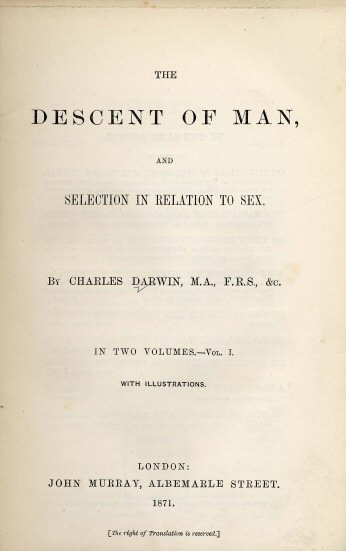
Darwin's Descent of Man Published
Charles Darwin publishes The Descent of Man, applying natural selection to human evolution and arguing that humans share a common ancestor with apes. It fuels intense controversy about human origins. #evolution #anthropology
Darwin's Descent of Man Published By Charles Darwin - http://www.leeds.ac.uk/library/adopt-a-book/darwin.htm, Public domain, https://commons.wikimedia.org/w/index.php?curid=625636
1892 CE
Weismann Proposes Germ Plasm Theory
August Weismann publishes Das Keimplasma (The Germ Plasm), arguing that hereditary information is confined to germ cells and cannot be influenced by somatic changes. This refutes Lamarckian inheritance. #genetics #evolution
Weismann Proposes Germ Plasm Theory By Ian Alexander - Own work, CC BY-SA 4.0, https://commons.wikimedia.org/w/index.php?curid=62047505
Mar 1, 1900 CE
Rediscovery of Mendel's Laws
Hugo de Vries, Carl Correns, and Erich von Tschermak independently rediscover Mendel's work on inheritance. This ignites the field of genetics and later its integration with evolution. #genetics #history
Rediscovery of Mendel's Laws By Original: Darekk2, SVG: Palosirkka - File:Hybridogenesis in water frogs gametes.gif, CC BY-SA 4.0, https://commons.wikimedia.org/w/index.php?curid=67142604
1902 CE
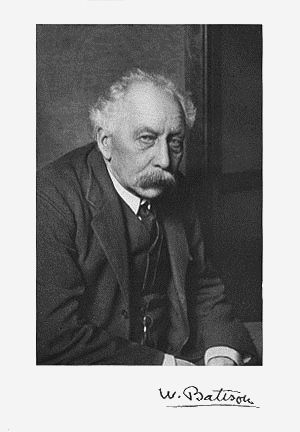
Bateson Coins 'Genetics'
William Bateson introduces the term 'genetics' for the study of heredity and variation. He becomes a leading advocate for Mendelism and its relevance to evolution. #genetics #science
Bateson Coins 'Genetics' By Unknown author - https://web.archive.org/web/20051027192232/http://www.amphilsoc.org/library/images/genetics/bateson2.jpg, Public domain, https://commons.wikimedia.org/w/index.php?curid=671689
1918 CE
Fisher Unifies Mendelian and Biometric Inheritance
R.A. Fisher publishes 'The Correlation Between Relatives on the Supposition of Mendelian Inheritance,' mathematically reconciling continuous traits with Mendelian genetics, a cornerstone of the modern synthesis. #statistics #evolution
Fisher Unifies Mendelian and Biometric Inheritance By Unknown author - https://www.adelaide.edu.au, Public domain, https://commons.wikimedia.org/w/index.php?curid=42616717
1930 CE
Fisher Publishes The Genetical Theory of Natural Selection
R.A. Fisher synthesizes Mendelian genetics with natural selection, laying the mathematical foundation of population genetics. This book is a key pillar of the modern synthesis. #evolution #science
1932 CE
Haldane Publishes The Causes of Evolution
J.B.S. Haldane consolidates population genetics and shows how natural selection operates on Mendelian variation. His work further integrates genetics and evolution. #evolution #genetics
1937 CE
Dobzhansky's Genetics and the Origin of Species
Theodosius Dobzhansky publishes a landmark book that merges genetics with Darwinian evolution, establishing the genetic basis of speciation and bridging experimental and field biology. #evolution #genetics
1942 CE
Mayr's Systematics and the Origin of Species
Ernst Mayr defines the biological species concept and emphasizes the role of geographic isolation in speciation, integrating systematics with evolutionary theory. #evolution #taxonomy
1942 CE
Huxley Coins 'Modern Synthesis'
Julian Huxley's book Evolution: The Modern Synthesis formally names the synthesis of genetics, systematics, and paleontology with Darwinian selection, solidifying the neo-Darwinian paradigm. #evolution #science
Jan 1, 1944 CE
Avery Identifies DNA as Hereditary Material
Oswald Avery, Colin MacLeod, and Maclyn McCarty demonstrate that DNA carries genetic information in bacteria. This discovery revolutionizes genetics and later evolutionary study. #genetics #DNA
Avery Identifies DNA as Hereditary Material By Bbkkk - self-made in the Naturkunste Museum in Berlin, CC BY-SA 4.0, https://commons.wikimedia.org/w/index.php?curid=3679283
1950 CE
Simpson's Tempo and Mode in Evolution
George Gaylord Simpson applies the modern synthesis to paleontology, analyzing rates and patterns of evolution in the fossil record and introducing concepts like quantum evolution. #paleontology #evolution
Apr 25, 1953 CE
Watson and Crick Propose DNA Double Helix
James Watson and Francis Crick publish the structure of DNA, revealing its double helix. This breakthrough explains heredity at the molecular level and underpins molecular evolution. #DNA #genetics
Watson and Crick Propose DNA Double Helix By Unknown author, Public domain, https://commons.wikimedia.org/w/index.php?curid=510095
1962 CE
Kimura Proposes Neutral Theory of Molecular Evolution
Motoo Kimura introduces the neutral theory, arguing that most molecular changes are due to random drift rather than selection. It becomes a central model in molecular evolution. #evolution #genetics
Kimura Proposes Neutral Theory of Molecular Evolution By . The original uploader was Солярист at Russian Wikipedia. - Transferred from ru.wikipedia to Commons., Public domain, https://commons.wikimedia.org/w/index.php?curid=122615219
1968 CE
Kimura's Formal Paper on Neutral Theory
Motoo Kimura publishes 'Evolutionary Rate at the Molecular Level' in Nature, providing mathematical support for the neutral theory and stimulating debates on the role of selection. #evolution #science
Kimura's Formal Paper on Neutral Theory By Unknown author - Sudhir Kumar, Takashi Gojobori, Obituary: Masatoshi Nei (1931–2023), Molecular Biology and Evolution, Volume 40, Issue 6, June 2023, msad149, https://doi.org/10.1093/molbev/msad149, CC BY 4.0, https://commons.wikimedia.org/w/index.php?curid=193306495
1972 CE
Eldredge and Gould Propose Punctuated Equilibrium
Niles Eldredge and Stephen Jay Gould publish a paper arguing that evolution occurs in rapid bursts interspersed with long periods of stasis, challenging the gradualist view. #paleontology #evolution
Eldredge and Gould Propose Punctuated Equilibrium By Miguel Chavez - Own work, CC BY-SA 4.0, https://commons.wikimedia.org/w/index.php?curid=65759614
1975 CE
Wilson's Sociobiology Published
E.O. Wilson's Sociobiology: The New Synthesis applies evolutionary principles to social behavior, sparking controversy but founding the field of sociobiology and influencing evolutionary psychology. #evolution #behavior
Nov 1, 1977 CE
Woese Discovers Archaea
Carl Woese and George Fox use ribosomal RNA sequencing to identify a third domain of life, Archaea, revolutionizing the tree of life and our understanding of early evolution. #microbiology #evolution
Woese Discovers Archaea By Maulucioni - Own work, CC BY-SA 4.0, https://commons.wikimedia.org/w/index.php?curid=89047952
1981 CE
Margulis Endosymbiotic Theory Gains Acceptance
Lynn Margulis's theory that mitochondria and chloroplasts originated from symbiotic bacteria is widely validated by molecular evidence, fundamentally explaining eukaryotic evolution. #evolution #cellbiology
Margulis Endosymbiotic Theory Gains Acceptance By Chiswick Chap. Redrawn from File:Symbiogenesis.svg to reflect more recent science. - Own work, CC BY-SA 4.0, https://commons.wikimedia.org/w/index.php?curid=130625415
Willi Hennig's cladistic methodology, translated into English in 1966, gains widespread adoption. It revolutionizes classification by using shared derived characters to infer evolutionary relationships. #taxonomy #phylogenetics
1990 CE
Hox Gene Research Reveals Deep Homology
Studies of Hox genes across animals show that these developmental regulatory genes are highly conserved, providing evidence for common ancestry and launching evolutionary developmental biology (evo-devo). #evolution #development
1997 CE
Carroll's Work on Evo-Devo
Sean B. Carroll's research demonstrates how changes in regulatory genes drive morphological evolution. His book Endless Forms Most Beautiful (2005) popularizes evo-devo. #evolution #development
Carroll's Work on Evo-Devo By DCPhotog2023 - Own work, CC BY-SA 4.0, https://commons.wikimedia.org/w/index.php?curid=137474477
Jun 26, 2000 CE
Draft Human Genome Sequence Completed
The Human Genome Project releases a draft sequence of the human genome, enabling detailed evolutionary comparisons with other species and insights into human origins. #genomics #evolution
Draft Human Genome Sequence Completed By U.S. Department of Energy, Human Genome Project - http://www.ornl.gov/hgmis, Public domain, https://commons.wikimedia.org/w/index.php?curid=2485616
Dec 1, 2002 CE
First Draft of Mouse Genome
The mouse genome is sequenced, providing a key comparative model for mammalian evolution and highlighting conserved genetic elements. #genomics #evolution
2005 CE
ENCODE Project Begins
The Encyclopedia of DNA Elements (ENCODE) project aims to identify functional elements in the human genome, revealing widespread regulatory activity and challenging views on 'junk DNA'. #genomics #evolution
May 1, 2010 CE
Neanderthal Genome Draft Published
An international team publishes a draft sequence of the Neanderthal genome, showing interbreeding with modern humans and providing insights into human evolution. #genomics #human_evolution
Jun 28, 2012 CE
CRISPR-Cas9 Gene Editing Developed
Emmanuelle Charpentier and Jennifer Doudna demonstrate that CRISPR-Cas9 can be programmed to edit specific genes. This tool revolutionizes genetics and enables evolutionary studies via experimental manipulation. #genetics #biotech
CRISPR-Cas9 Gene Editing Developed By Deposition authors: Nishimasu, H., Ishitani, R., Nureki, O.; Visualization author: Synpath - Atom coordinates: https://www.rcsb.org/structure/4OO8; Visualization: Own work, CC0, https://commons.wikimedia.org/w/index.php?curid=133423568
2015 CE
Large-Scale Phylogenomics Reconstructs Tree of Life
Advancements in sequencing and computation allow construction of comprehensive phylogenies using thousands of genes, resolving many deep evolutionary relationships among species. #phylogenetics #genomics
2016 CE
CRISPR Used in Human Embryos (Controversial)
Chinese scientists perform the first gene editing of human embryos using CRISPR, raising ethical questions and sparking debates on the evolution of human germline modification. #ethics #genetics
2020 CE
COVID-19 Evolution Tracked in Real Time
The rapid spread of SARS-CoV-2 allows researchers to monitor viral evolution in real-time, revealing mutations like D614G and the emergence of variants of concern, highlighting natural selection in action. #virology #evolution
COVID-19 Evolution Tracked in Real Time By NIAID-RML (https://www.niaid.nih.gov/ & https://www.niaid.nih.gov/about/rocky-mountain-laboratories) - https://www.flickr.com/photos/niaid/49534865371/ (flikr), CC BY 2.0, https://commons.wikimedia.org/w/index.php?curid=92612457
2022 CE
Complete Human Genome Published (T2T Consortium)
The Telomere-to-Telomere (T2T) Consortium publishes a complete, gapless human genome sequence, filling in previously missing regions including centromeres and repetitive DNA, crucial for evolutionary studies. #genomics #evolution
2023 CE
Ancient DNA Reveals Complex Human History
Advances in ancient DNA extraction and analysis uncover multiple admixture events among archaic and modern humans in Africa and Eurasia, reshaping our understanding of human evolution. #ancientdna #evolution
Ancient DNA Reveals Complex Human History By Svante Pääbo, Max Planck Institute for Evolutionary Anthropology - Nicholls H: Ancient DNA Comes of Age. PLoS Biol 3/2/2005: e56. doi:10.1371/journal.pbio.0030056, CC BY 2.5, https://commons.wikimedia.org/w/index.php?curid=1378661