Encyclopedia/2. Technology & The Built World/1. Computing, AI & Information Technology/01. Hardware & Electronics • Curated by Admin Timeline.sg
The evolution of microprocessors and semiconductors traces the journey from the invention of the transistor to modern AI accelerators, highlighting key innovations that have driven the digital revolution. This timeline covers the development of integrated circuits, the rise of iconic architectures like x86 and ARM, and the global shift to fabless manufacturing.
Chronological Storyline (27 Milestones)
Dec 23, 1947 CE
Invention of the Point-Contact Transistor
John Bardeen, Walter Brattain, and William Shockley at Bell Labs demonstrated the first working transistor, a point-contact device that could amplify electrical signals. This invention replaced bulky vacuum tubes and laid the foundation for modern electronics. #transistor #electronics #invention
Invention of the Point-Contact Transistor By Ulfbastel - Own work, CC BY-SA 3.0, https://commons.wikimedia.org/w/index.php?curid=3123331
Sep 12, 1958 CE
First Integrated Circuit by Jack Kilby
Jack Kilby of Texas Instruments built the first integrated circuit (IC), combining multiple transistors on a single germanium substrate. This breakthrough allowed complex circuits to be miniaturized, leading to the modern semiconductor industry. #IC #semiconductor #Kilby
First Integrated Circuit by Jack Kilby By cole8888, https://flickr.com/photos/187597251@N05/ (aka Cole L) - https://www.flickr.com/photos/187597251@N05/49899342293/, CC BY-SA 2.0, https://commons.wikimedia.org/w/index.php?curid=95653492
Jan 1, 1959 CE
Planar Process by Jean Hoerni
Jean Hoerni at Fairchild Semiconductor developed the planar process, which used silicon dioxide layers to protect junctions and enable reliable mass production of transistors. This technique became the standard for IC fabrication. #planar #fabrication #semiconductor
Planar Process by Jean Hoerni By Robert.Baruch - Own work, CC BY-SA 4.0, https://commons.wikimedia.org/w/index.php?curid=57750460
Apr 19, 1965 CE
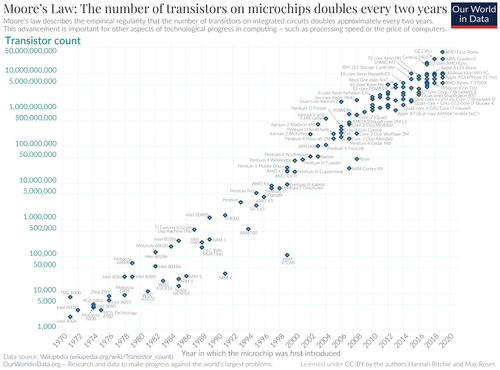
Moore's Law Formulated
Gordon Moore, co-founder of Fairchild and later Intel, predicted that the number of transistors on a chip would double every year (later revised to every two years). This observation became a self-fulfilling prophecy driving the semiconductor industry's rapid advancement. #MooresLaw #transistors #prediction
Moore's Law Formulated By Max Roser, Hannah Ritchie - https://ourworldindata.org/uploads/2020/11/Transistor-Count-over-time.png, CC BY 4.0, https://commons.wikimedia.org/w/index.php?curid=98219918
Nov 15, 1971 CE
Intel 4004 Microprocessor
Intel released the 4004, the first commercially available microprocessor, integrating 2,300 transistors on a single chip. It powered the Busicom calculator and sparked the microprocessor revolution. #microprocessor #Intel #4004
Intel 4004 Microprocessor By Thomas Nguyen - Own work, CC BY-SA 4.0, https://commons.wikimedia.org/w/index.php?curid=47684767
Apr 1, 1974 CE
Intel 8080 Microprocessor
Intel introduced the 8080, an 8-bit microprocessor with 4,500 transistors that became the CPU for early personal computers like the Altair 8800. Its success established Intel as a leader in microprocessors. #Intel #8080 #personalcomputing
Intel 8080 Microprocessor By The Science Museum UK - [1], CC BY 4.0, https://commons.wikimedia.org/w/index.php?curid=133514392
Aug 1, 1975 CE
MOS Technology 6502 Microprocessor
MOS Technology launched the 6502, a low-cost 8-bit microprocessor that powered iconic systems like the Apple II, Commodore 64, and Nintendo Entertainment System. Its affordability democratized computing. #6502 #retrocomputing #AppleII
MOS Technology 6502 Microprocessor By Dirk Oppelt - http://www.cpu-collection.de/, CC BY-SA 3.0, https://commons.wikimedia.org/w/index.php?curid=91538
Jun 8, 1978 CE
Intel 8086 and the x86 Architecture
Intel released the 16-bit 8086 processor, the first of the x86 architecture. Its backward-compatible design and selection for IBM's PC led to x86 becoming the dominant instruction set for decades. #x86 #Intel #architecture
Intel 8086 and the x86 Architecture By Thomas Nguyen - Own work, CC BY-SA 4.0, https://commons.wikimedia.org/w/index.php?curid=46809082
Oct 17, 1985 CE
Intel 80386: 32-bit Computing
Intel introduced the 80386 (386), a 32-bit processor with 275,000 transistors that enabled multitasking operating systems like Windows and Linux. It solidified Intel's dominance in the PC era. #386 #32bit #Intel
Intel 80386: 32-bit Computing By Konstantin Lanzet (with permission) - CPU collection Konstantin Lanzet, received per EMailCamera: Canon EOS 400D, CC BY-SA 3.0, https://commons.wikimedia.org/w/index.php?curid=4213308
Oct 1, 1985 CE
ARM Architecture Founded
Acorn Computers developed the ARM (Acorn RISC Machine) processor, a simple, low-power RISC design. ARM later became the dominant architecture for mobile devices due to its energy efficiency. #ARM #RISC #mobile
ARM Architecture Founded By Logo-rework as vector-graphic: Smartcom5Idea: Arm, Ltd., 2011 for ARMv8 - Own work by the original uploader Vector-rework of official pixel-based image; https://www.sisoftware.co.uk/wp-content/uploads/2022/01/aarch-64-logo.png (vendor of SiSoft Sandra performance-software suite), CC BY-SA 3.0, https://commons.wikimedia.org/w/index.php?curid=159128795
Feb 1, 1987 CE
Founding of TSMC
Morris Chang founded Taiwan Semiconductor Manufacturing Company (TSMC), the world's first dedicated semiconductor foundry. TSMC's pure-play foundry model enabled fabless chip companies like AMD and Qualcomm to thrive. #TSMC #foundry #semiconductor
Founding of TSMC By 曾 成訓 - https://www.flickr.com/photos/tsengphotos/53114942112/, CC BY 2.0, https://commons.wikimedia.org/w/index.php?curid=147718717
Mar 22, 1993 CE
Intel Pentium Processor
Intel launched the Pentium, a superscalar processor with 3.1 million transistors that improved performance for multimedia and business applications. The Pentium brand became synonymous with high-performance computing. #Pentium #Intel #superscalar
Intel Pentium Processor By Intel Corporation - https://www.intel.com/content/www/us/en/products/details/processors/pentium.html, Public domain, https://commons.wikimedia.org/w/index.php?curid=132640549
Nov 1, 1995 CE
DVD Optical Disc Standard
The DVD format was introduced, using semiconductor lasers to read data from optical discs. It provided vastly more storage than CDs, enabling full-length movies and large software distributions. #DVD #optical #storage
DVD Optical Disc Standard By User:Wanted, User:Ochro - Edited by User:Ochro from the original version of User:Wanted, Public domain, https://commons.wikimedia.org/w/index.php?curid=37985
Oct 1, 1999 CE
AMD Athlon Processor
AMD released the Athlon, a high-performance x86 processor that rivaled Intel's Pentium III. It marked AMD's emergence as a serious competitor in the CPU market. #AMD #Athlon #competition
AMD Athlon Processor By AMD - http://en.wikipedia.org/wiki/File:AMD_Athlon_Processor_Logo.svg, Public domain, https://commons.wikimedia.org/w/index.php?curid=48475947
Mar 4, 2000 CE
PlayStation 2 Launch
Sony launched the PlayStation 2, powered by the Emotion Engine CPU and Graphics Synthesizer. It became the best-selling console, showcasing the importance of custom semiconductor design in gaming. #PS2 #gaming #console
PlayStation 2 Launch By Evan-Amos - Own work, Public domain, https://commons.wikimedia.org/w/index.php?curid=12821910
Mar 12, 2003 CE
Intel Centrino Mobile Platform
Intel introduced Centrino, combining a low-power Pentium M processor, chipset, and Wi-Fi. It revolutionized laptop computing by enabling long battery life and wireless connectivity. #Centrino #laptop #WiFi
Apr 1, 2004 CE
Multi-Core Processors: Intel Pentium D
Intel released the Pentium D, its first dual-core desktop processor, packing two cores on one die to improve multitasking. Multi-core designs became the standard to continue performance scaling under power constraints. #multicore #parallel #Intel
Multi-Core Processors: Intel Pentium D By CountingPine at English Wikipedia - Transferred from en.wikipedia to Commons by Liftarn using CommonsHelper., Public domain, https://commons.wikimedia.org/w/index.php?curid=11894458
Jul 27, 2006 CE
Intel Core 2 Duo Processor
Intel launched the Core 2 Duo, a highly efficient dual-core processor based on the Core microarchitecture. It outperformed the Pentium D while consuming less power, re-establishing Intel's lead. #Core2 #Intel #efficiency
Jun 29, 2007 CE
iPhone and Mobile ARM SoCs
Apple released the first iPhone, powered by a Samsung-designed ARM-based system-on-chip (SoC). This sparked the mobile revolution and cemented ARM's dominance in low-power processors. #iPhone #ARM #mobile
iPhone and Mobile ARM SoCs By Rafael Fernandez - Own work, CC BY-SA 4.0, https://commons.wikimedia.org/w/index.php?curid=63395591
Jun 23, 2008 CE
NVIDIA CUDA GPU Computing
NVIDIA introduced CUDA, a parallel computing platform that allowed GPUs to be used for general-purpose computation. This enabled AI and scientific simulations, turning GPUs into accelerators. #CUDA #GPU #parallel
NVIDIA CUDA GPU Computing By Nvidia - https://www.nvidia.com/object/io_1221568471314.html, Apache License 2.0, https://commons.wikimedia.org/w/index.php?curid=70886051
Jan 5, 2011 CE
ARM Cortex-A15 and Big.LITTLE
ARM announced the Cortex-A15 high-performance core and the big.LITTLE architecture, combining powerful and efficient cores. This design became the foundation for modern mobile processors balancing performance and battery life. #ARM #bigLITTLE #mobile
ARM Cortex-A15 and Big.LITTLE By Arndaleboard.org - http://www.arndaleboard.org/wiki/index.php/File:Arm_5250_full_1.jpg, CC BY-SA 3.0, https://commons.wikimedia.org/w/index.php?curid=22452470
May 1, 2011 CE
Intel 3D Tri-Gate Transistors
Intel introduced 3D Tri-Gate transistors at the 22nm node, using a three-dimensional fin structure to reduce leakage and improve performance. This innovation extended Moore's Law into the nanometer era. #FinFET #3D #transistor
Intel 3D Tri-Gate Transistors By Д.Ильин: vectorization - File:Doublegate FinFET.PNG by Irene Ringworm at English Wikipedia, Public domain, https://commons.wikimedia.org/w/index.php?curid=132333446
Mar 2, 2017 CE
AMD Ryzen and Zen Architecture
AMD launched Ryzen processors based on the Zen microarchitecture, offering competitive multi-threaded performance. Ryzen revitalized AMD's position in the CPU market and intensified competition with Intel. #Ryzen #AMD #Zen
AMD Ryzen and Zen Architecture By ICCTsHeY - Own work, CC BY-SA 4.0, https://commons.wikimedia.org/w/index.php?curid=126396535
Dec 12, 2018 CE
Apple M1: ARM for Mac
Apple introduced the M1 chip, an ARM-based SoC for Macs, combining CPU, GPU, and neural engine. It demonstrated that ARM could deliver high performance for desktop computing, challenging x86 dominance. #M1 #Apple #ARM
Apple M1: ARM for Mac By Sonic8400 - Own work, CC BY-SA 4.0, https://commons.wikimedia.org/w/index.php?curid=100628728
May 14, 2020 CE
NVIDIA Ampere GPU Architecture
NVIDIA unveiled the Ampere architecture with third-gen Tensor Cores for AI acceleration. It powered the A100 GPU, widely used in data centers for deep learning and scientific computing. #Ampere #GPU #AI
Sep 20, 2022 CE
TSMC 3nm Process Technology
TSMC began volume production of 3nm chips, offering up to 15% speed improvement and 30% power reduction over 5nm. This node is used in flagship smartphones and high-performance computing. #3nm #TSMC #process
Oct 16, 2023 CE
NVIDIA H100 Tensor Core GPU
NVIDIA launched the H100 GPU based on the Hopper architecture, featuring Transformer Engine for large language models. It became the premier accelerator for generative AI workloads. #H100 #Hopper #AI
NVIDIA H100 Tensor Core GPU By 极客湾Geekerwan - YouTube: 这是史上最快GPU!我们测了四张H100!价值120万元! – View/save archived versions on archive.org Archive link: https://web.archive.org/web/20240405133205/https://www.youtube.com/watch?v=-nb_DZAH-TM, CC BY 3.0, https://commons.wikimedia.org/w/index.php?curid=147108831