Evolution of Mechanical, Electrical & Computer Engineering
Encyclopedia/2. Technology & The Built World/2. Engineering & Applied Sciences/01. Robotics & Automation • Curated by Admin Timeline.sg
This timeline traces the evolution of mechanical, electrical, and computer engineering from the 18th century to the present, highlighting key milestones in power generation, telecommunications, semiconductor fabrication, and robotics.
Chronological Storyline (46 Milestones)
1771 CE
John Smeaton Founds Society of Civil Engineers
John Smeaton, a pioneering civil and mechanical engineer, established the Society of Civil Engineers (later known as the Smeatonian Society). This marked the first professional engineering society, laying the foundation for modern mechanical engineering. #engineering #mechanical #history
John Smeaton Founds Society of Civil Engineers By User Magnus Manske on en.wikipedia - Originally from en.wikipedia; description page is (was) here 14:24, 15 June 2004 Magnus Manske 850x1036 (131,562 bytes) ({{PD}}, from [http://web4.si.edu/sil/scientific-identity/display_results.cfm?alpha_sort=W here]), Public domain, https://commons.wikimedia.org/w/index.php?curid=784255
1800 CE
Alessandro Volta Invents the Voltaic Pile
Alessandro Volta demonstrated the first electric battery, the voltaic pile, providing a continuous source of electrical current. This invention enabled early electrical experiments and powered the development of electrical engineering. #electrical #invention #battery
Alessandro Volta Invents the Voltaic Pile By Borbrav, svg version by Luigi Chiesa - Image:Voltaic pile.png, CC BY-SA 3.0, https://commons.wikimedia.org/w/index.php?curid=5091724
1821 CE
Faraday Demonstrates Electromagnetic Rotation
Michael Faraday built the first electric motor, demonstrating that electricity can produce continuous motion. This principle became fundamental to electrical engineering and power generation. #electrical #motor #physics
Faraday Demonstrates Electromagnetic Rotation By Unknown author - [1], Public domain, https://commons.wikimedia.org/w/index.php?curid=141504840
1831 CE
Faraday Discovers Electromagnetic Induction
Michael Faraday discovered electromagnetic induction, the principle behind transformers and generators. This breakthrough enabled the conversion of mechanical energy into electricity, powering the electrical grid. #electrical #generator #physics
Faraday Discovers Electromagnetic Induction By Ponor - Own work, CC BY-SA 4.0, https://commons.wikimedia.org/w/index.php?curid=95026784
May 24, 1844 CE
First Telegraph Message Sent by Morse
Samuel Morse sent the first telegraph message 'What hath God wrought' from Washington, D.C., to Baltimore. The telegraph revolutionized long-distance communication and spurred electrical engineering advancements. #telecommunications #telegraph #history
First Telegraph Message Sent by Morse By Mathew Benjamin Brady - This image is available from the United States Library of Congress's Prints and Photographs division under the digital ID cwpbh.00853.This tag does not indicate the copyright status of the attached work. A normal copyright tag is still required. See Commons:Licensing., Public domain, https://commons.wikimedia.org/w/index.php?curid=33781
Jul 27, 1866 CE
First Successful Transatlantic Telegraph Cable
After several failures, the first permanent transatlantic telegraph cable was completed, connecting Europe and North America. This engineering marvel required advances in cable manufacturing, laying techniques, and signal transmission. #telecommunications #cable #engineering
First Successful Transatlantic Telegraph Cable By Robert Charles Dudley - https://www.flickr.com/photos/lac-bac/31367042642/in/album-72157677492475586/, Public domain, https://commons.wikimedia.org/w/index.php?curid=55655760
Mar 10, 1876 CE
Alexander Graham Bell Patents the Telephone
Alexander Graham Bell received a patent for the telephone, which converted sound into electrical signals. The telephone transformed personal and business communication, driving the growth of telecommunication networks. #telephone #invention #communication
Alexander Graham Bell Patents the Telephone By Unknown author - Smithsonian NPG, CC0, https://commons.wikimedia.org/w/index.php?curid=181028877
Thomas Edison successfully tested a carbon-filament light bulb that burned for over 13 hours. This invention led to the widespread adoption of electric lighting and the development of power distribution systems. #lighting #electricity #invention
Edison Demonstrates Practical Incandescent Light Bulb By KMJ, alpha masking by Edokter - de.wikipedia, original upload 26. Jun 2004 by, CC BY-SA 3.0, https://commons.wikimedia.org/w/index.php?curid=2954889
Sep 4, 1882 CE
Edison's Pearl Street Station Powers First Electric Grid
Thomas Edison's Pearl Street Station in New York City began supplying direct current (DC) electricity to customers. This was the first commercial electric power plant, marking the birth of the electrical grid. #power #grid #history
Edison's Pearl Street Station Powers First Electric Grid By Earl Morter - IEEE Global History Network and Consolidated Edison Company of New York, Public domain, https://commons.wikimedia.org/w/index.php?curid=8016148
1888 CE
Tesla Patents the AC Induction Motor
Nikola Tesla received patents for his alternating current (AC) induction motor and polyphase power system. These inventions enabled efficient long-distance power transmission and became the basis for modern electrical grids. #AC #motor #Tesla
Tesla Patents the AC Induction Motor By Zureks - Own work, CC BY-SA 3.0, https://commons.wikimedia.org/w/index.php?curid=4169412
Nov 16, 1895 CE
Niagara Falls AC Power Plant Begins Operation
The Adams Power Plant at Niagara Falls, designed by Westinghouse and Tesla, began generating AC power. This landmark project demonstrated the superiority of AC transmission and electrified the region, including Buffalo, New York. #power #AC #Niagara
Niagara Falls AC Power Plant Begins Operation By Unknown author - This image is available from the United States Library of Congress's Prints and Photographs division under the digital ID hhh.ny1014.This tag does not indicate the copyright status of the attached work. A normal copyright tag is still required. See Commons:Licensing., Public domain, https://commons.wikimedia.org/w/index.php?curid=3287807
1904 CE
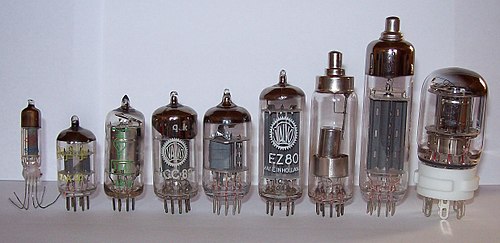
Fleming Invents the Vacuum Tube Diode
John Ambrose Fleming invented the vacuum tube diode, the first electronic device capable of rectifying alternating current. This paved the way for radio, television, and early computers. #electronics #vacuumtube #invention
Fleming Invents the Vacuum Tube Diode By Stefan Riepl (Quark48) - Self-photographed, CC BY-SA 2.0 de, https://commons.wikimedia.org/w/index.php?curid=14682022
1906 CE
Lee De Forest Invents the Audion Triode
Lee De Forest added a grid to the vacuum tube, creating the triode amplifier. The Audion enabled signal amplification, revolutionizing radio and long-distance telephony. #electronics #amplifier #radio
Lee De Forest Invents the Audion Triode By Gregory F. Maxwell <gmaxwell@gmail.com> PGP:0xB0413BFA - Photo by uploader, taken at The History of Audio: The Engineering of Sound, an exhibition of the San Francisco Airport Museums[1] in SFO Airport, Terminal 3 from 2006-09 to 2007-05., GFDL 1.2, https://commons.wikimedia.org/w/index.php?curid=1365357
1925 CE
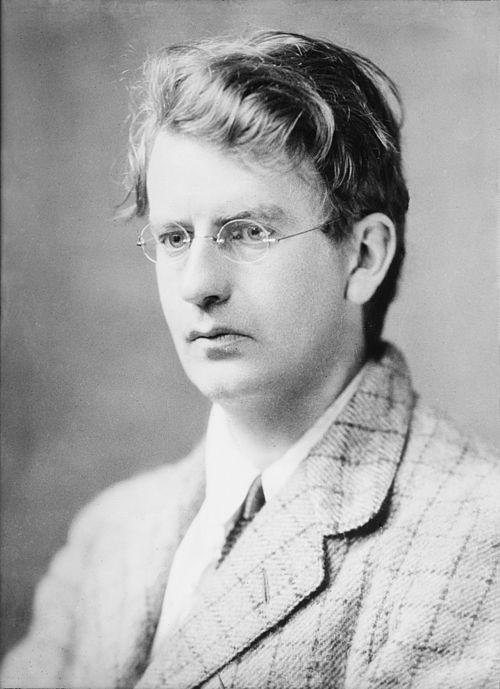
First Television Demonstration by Baird
John Logie Baird publicly demonstrated a mechanical television system transmitting moving images. This early TV system used a Nipkow disk and laid the groundwork for electronic television. #television #broadcast #invention
First Television Demonstration by Baird By Unknown author - This image is available from the United States Library of Congress's Prints and Photographs division under the digital ID ggbain.25629.This tag does not indicate the copyright status of the attached work. A normal copyright tag is still required. See Commons:Licensing., Public domain, https://commons.wikimedia.org/w/index.php?curid=45588313
1941 CE
Konrad Zuse Completes the Z3 Computer
Konrad Zuse built the Z3, the first fully automatic, program-controlled, electromechanical computer. It used binary arithmetic and floating-point numbers, marking a milestone in computer engineering. #computer #history #Zuse
Konrad Zuse Completes the Z3 Computer By File:Z3 Deutsches Museum.JPG: Venusianer at German Wikipedia derivative work: Georgfotoart - This file was derived from: Z3 Deutsches Museum.JPG:, CC BY-SA 3.0, https://commons.wikimedia.org/w/index.php?curid=174765304
Dec 23, 1947 CE
Invention of the Transistor at Bell Labs
John Bardeen, Walter Brattain, and William Shockley demonstrated the first point-contact transistor at Bell Labs. This solid-state device replaced vacuum tubes, enabling miniaturization and the modern electronics revolution. #transistor #electronics #invention
Invention of the Transistor at Bell Labs By Ulfbastel - Own work, CC BY-SA 3.0, https://commons.wikimedia.org/w/index.php?curid=3123331
1951 CE
UNIVAC I Becomes First Commercial Computer
The UNIVAC I (Universal Automatic Computer) was delivered to the U.S. Census Bureau, becoming the first commercially available electronic computer. It used vacuum tubes and magnetic tape for data storage. #computer #history #UNIVAC
UNIVAC I Becomes First Commercial Computer By U.S. Census Bureau employees - https://www.census.gov/history/, Public domain, https://commons.wikimedia.org/w/index.php?curid=61118833
1956 CE
First Transatlantic Telephone Cable (TAT-1)
TAT-1, the first transatlantic telephone cable, began operation, carrying 36 voice channels between North America and Europe. It used coaxial cable and repeaters, greatly improving communication reliability. #telecommunications #cable #history
First Transatlantic Telephone Cable (TAT-1) By American Telephone and Telegraph Company - https://www.flickr.com/photos/internetarchivebookimages/14753547484/ Source book page: https://archive.org/stream/bellvol36systemtechni00amerrich/bellvol36systemtechni00amerrich#page/n305/mode/1up, No restrictions, https://commons.wikimedia.org/w/index.php?curid=44315703
Sep 12, 1958 CE
Jack Kilby Demonstrates First Integrated Circuit
Jack Kilby of Texas Instruments built the first integrated circuit (IC), a phase-shift oscillator on a single germanium chip. This invention miniaturized electronic circuits, leading to modern microchips. #IC #electronics #invention
Jack Kilby Demonstrates First Integrated Circuit By cole8888, https://flickr.com/photos/187597251@N05/ (aka Cole L) - https://www.flickr.com/photos/187597251@N05/49899342293/, CC BY-SA 2.0, https://commons.wikimedia.org/w/index.php?curid=95653492
1959 CE
Robert Noyce Invents the Planar Integrated Circuit
Robert Noyce of Fairchild Semiconductor invented the planar integrated circuit, using silicon and aluminum interconnects. This design became the standard for IC manufacturing, enabling mass production. #IC #silicon #semiconductor
Robert Noyce Invents the Planar Integrated Circuit By Robert.Baruch - Own work, CC BY-SA 4.0, https://commons.wikimedia.org/w/index.php?curid=57750460
Apr 7, 1964 CE
IBM Announces System/360 Mainframe
IBM introduced the System/360, a family of compatible mainframe computers. This unified architecture allowed software compatibility across models, revolutionizing business computing and setting standards. #computers #mainframe #IBM
IBM Announces System/360 Mainframe By ArnoldReinhold - Own work, CC BY-SA 3.0, https://commons.wikimedia.org/w/index.php?curid=47096462
Apr 19, 1965 CE
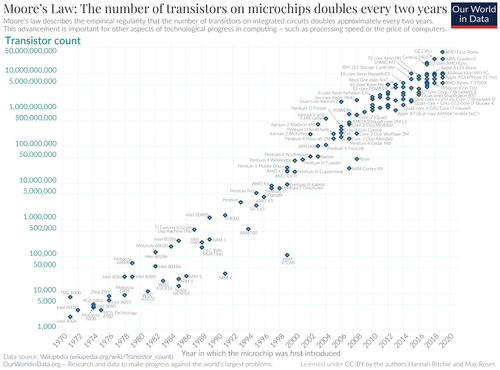
Moore's Law Published
Gordon Moore predicted that the number of transistors on a chip would double every year (later revised to two years). Moore's Law became a driving force and self-fulfilling prophecy for the semiconductor industry. #semiconductor #prediction #technology
Moore's Law Published By Max Roser, Hannah Ritchie - https://ourworldindata.org/uploads/2020/11/Transistor-Count-over-time.png, CC BY 4.0, https://commons.wikimedia.org/w/index.php?curid=98219918
Oct 29, 1969 CE
First ARPANET Message Sent
The first message was sent over ARPANET, the precursor to the internet, between UCLA and Stanford. The system crashed after sending 'LO', but this event marked the birth of packet-switched networking. #internet #networking #history
First ARPANET Message Sent By ARPANET - The Computer History Museum ([1]), en:File:Arpnet-map-march-1977.png, Public domain, https://commons.wikimedia.org/w/index.php?curid=9990864
Nov 15, 1971 CE
Intel 4004 Microprocessor Released
Intel introduced the 4004, the first commercially available microprocessor, with 2,300 transistors. It integrated the CPU onto a single chip, enabling personal computing and embedded systems. #microprocessor #Intel #computing
Intel 4004 Microprocessor Released By Thomas Nguyen - Own work, CC BY-SA 4.0, https://commons.wikimedia.org/w/index.php?curid=47684767
1974 CE
Intel 8080 Microprocessor Powers Early PCs
Intel released the 8080, an 8-bit microprocessor that became the CPU for early personal computers like the Altair 8800. Its performance and low cost spurred the home computer revolution. #microprocessor #PC #history
Intel 8080 Microprocessor Powers Early PCs By The Science Museum UK - [1], CC BY 4.0, https://commons.wikimedia.org/w/index.php?curid=133514392
Jan 1, 1975 CE
Altair 8800 Ushers in Personal Computer Era
The MITS Altair 8800, based on the Intel 8080, was featured on the cover of Popular Electronics. It inspired hobbyists and led to the founding of Microsoft and Apple. #PC #Altair #history
Altair 8800 Ushers in Personal Computer Era By Swtpc6800 en:User:Swtpc6800 Michael Holley - Transfered from en.wikipedia, Public domain, https://commons.wikimedia.org/w/index.php?curid=3185062
1979 CE
Carver Mead and Lynn Conway Publish VLSI Design
Carver Mead and Lynn Conway published 'Introduction to VLSI Systems', a textbook that revolutionized chip design. They introduced structured design methods and design rules, enabling complex microchips with millions of transistors. #VLSI #chipdesign #semiconductor
Carver Mead and Lynn Conway Publish VLSI Design By Norman Seeff - photo and permission emailed by the author's business partner and license manager Charles Hannah, CC BY-SA 4.0, https://commons.wikimedia.org/w/index.php?curid=39749569
Aug 12, 1981 CE
IBM PC Launches
IBM introduced the IBM Personal Computer (IBM PC) with an Intel 8088 processor and Microsoft's MS-DOS. Its open architecture set the standard for PC compatibility and dominated business computing. #PC #IBM #computing
IBM PC Launches By Own work (based on graphics by International Business Machines Corporation) - Own work, derived from various photographs of IBM PCs, Public domain, https://commons.wikimedia.org/w/index.php?curid=115457047
Jan 24, 1984 CE
Apple Macintosh Introduces GUI
Apple launched the Macintosh, featuring a graphical user interface (GUI) and mouse. This made computers more accessible and influenced future operating systems like Windows. #Apple #GUI #computing
Apple Macintosh Introduces GUI By Sailko - Own work, CC BY 3.0, https://commons.wikimedia.org/w/index.php?curid=55033088
1985 CE
Intel 80386 Microprocessor Released
Intel introduced the 80386 (386), a 32-bit processor with 275,000 transistors. It enabled multitasking operating systems like Windows and Linux, and became the foundation for modern x86 computing. #microprocessor #Intel #computing
Intel 80386 Microprocessor Released By Konstantin Lanzet (with permission) - CPU collection Konstantin Lanzet, received per EMailCamera: Canon EOS 400D, CC BY-SA 3.0, https://commons.wikimedia.org/w/index.php?curid=4213308
1989 CE
Tim Berners-Lee Proposes the World Wide Web
Tim Berners-Lee submitted a proposal for a distributed information system at CERN, which became the World Wide Web. He developed HTML, HTTP, and the first web browser, transforming internet usage. #web #internet #invention
Tim Berners-Lee Proposes the World Wide Web By Summit - https://www.flickr.com/photos/websummit/54921652153/in/photolist-2rM7hjw-2rF9mvh-2rFePK8-2rFfj7q-2rFf4Xs-2rwcwe4-2rwMG1Z-2rwNPBM-2rwHdJU, CC BY 4.0, https://commons.wikimedia.org/w/index.php?curid=192817373
1991 CE
First Web Page Goes Live
Tim Berners-Lee published the first website, explaining the World Wide Web project. This marked the beginning of the public web, leading to the information age. #web #history #internet
First Web Page Goes Live By Liamd967 - Own work, CC BY-SA 4.0, https://commons.wikimedia.org/w/index.php?curid=136836404
Apr 22, 1993 CE
Mosaic Web Browser Released
The Mosaic browser, developed at NCSA, was released for free. Its graphical interface made the web accessible to the public, sparking the internet boom. #web #browser #history
Mosaic Web Browser Released By Charles Severance - Screenshot, CC0, https://commons.wikimedia.org/w/index.php?curid=75617889
Sep 7, 1998 CE
Google Founded
Larry Page and Sergey Brin founded Google, developing a search engine using PageRank algorithm. Google revolutionized information retrieval and became the dominant search engine. #search #internet #Google
Google Founded By Asoundd - Own work, CC BY-SA 4.0, https://commons.wikimedia.org/w/index.php?curid=77221979
Oct 23, 2001 CE
Apple Introduces iPod
Apple launched the iPod, a portable digital music player with a 5GB hard drive. It transformed the music industry and paved the way for the iPhone and mobile computing. #Apple #music #portable
Apple Introduces iPod By Kyro - Own work, File:5th Generation iPod Touch.svg, File:7th Generation iPod Nano.svg (by User:Domaina), CC BY 3.0, https://commons.wikimedia.org/w/index.php?curid=6266695
Jan 9, 2007 CE
iPhone Unveiled by Apple
Steve Jobs introduced the iPhone, combining a phone, iPod, and internet communicator with a multi-touch interface. It revolutionized smartphones and mobile computing, setting new standards for design and functionality. #iPhone #smartphone #Apple
iPhone Unveiled by Apple By Rafael Fernandez - Own work, CC BY-SA 4.0, https://commons.wikimedia.org/w/index.php?curid=63395591
Apr 3, 2010 CE
Apple iPad Launches Tablet Computing
Apple released the iPad, a tablet computer with a touchscreen interface. It created a new category of mobile devices and influenced the development of tablets and 2-in-1 laptops. #iPad #tablet #Apple
Apple iPad Launches Tablet Computing By Evan-Amos - Own work, Public domain, https://commons.wikimedia.org/w/index.php?curid=13200117
2011 CE
First Commercial 3D Printer (FDM) Released
Stratasys released the first commercial fused deposition modeling (FDM) 3D printer. Additive manufacturing began to revolutionize prototyping and production in engineering. #3Dprinting #manufacturing #engineering
First Commercial 3D Printer (FDM) Released By John Abella - https://www.flickr.com/photos/jabella/8965235630, CC BY 2.0, https://commons.wikimedia.org/w/index.php?curid=41054993
2012 CE
Tesla Model S Electric Car Launched
Tesla began deliveries of the Model S, a luxury all-electric sedan with a range over 200 miles. It demonstrated the viability of electric vehicles and spurred the automotive industry's shift to electrification. #electricvehicle #Tesla #automotive
Tesla Model S Electric Car Launched By Peteratkins - Own work, CC BY-SA 4.0, https://commons.wikimedia.org/w/index.php?curid=163417196
2015 CE
First Commercial Quantum Computer by D-Wave
D-Wave Systems announced the D-Wave 2X quantum computer, with 1000 qubits. While controversial, it marked a milestone in quantum computing, promising exponential speedups for certain problems. #quantum #computing #technology
First Commercial Quantum Computer by D-Wave By Mwjohnson0 - Own work, CC BY-SA 4.0, https://commons.wikimedia.org/w/index.php?curid=44720502
2018 CE
EUV Lithography Enters Production for Chip Manufacturing
ASML delivered the first extreme ultraviolet (EUV) lithography systems for mass production. EUV enables smaller transistor nodes (7nm and below), extending Moore's Law into the 2020s. #lithography #semiconductor #manufacturing
EUV Lithography Enters Production for Chip Manufacturing By 2pem - Own work, CC BY-SA 3.0, https://commons.wikimedia.org/w/index.php?curid=30619878
2020 CE
Apple M1 Chip Marks Shift to ARM for PCs
Apple released the M1 chip, a system-on-a-chip (SoC) based on ARM architecture for Mac computers. It delivered high performance and energy efficiency, signaling a shift from x86 to ARM in personal computing. #ARM #chip #Apple
Apple M1 Chip Marks Shift to ARM for PCs By Sonic8400 - Own work, CC BY-SA 4.0, https://commons.wikimedia.org/w/index.php?curid=100628728
2021 CE
Tesla Bot Humanoid Robot Announced
Tesla unveiled the Tesla Bot, a humanoid robot designed for repetitive tasks. It represents the convergence of robotics, AI, and engineering, aiming to automate labor in industrial and domestic settings. #robotics #AI #automation
Tesla Bot Humanoid Robot Announced By Sikander - Own work, CC BY-SA 4.0, https://commons.wikimedia.org/w/index.php?curid=178721148
2022 CE
CHIPS Act Signed to Boost US Semiconductor Manufacturing
The U.S. CHIPS and Science Act was signed into law, providing $52 billion to subsidize domestic semiconductor fabrication. This aimed to reduce reliance on Asian foundries and strengthen supply chains. #semiconductor #manufacturing #policy
CHIPS Act Signed to Boost US Semiconductor Manufacturing By U.S. Government - Extracted from PDF version of Our Flag, available here (direct PDF URL here.), Public domain, https://commons.wikimedia.org/w/index.php?curid=41373752
2023 CE
Generative AI Models Like ChatGPT Reach Mainstream
OpenAI's ChatGPT and other large language models gained widespread public attention. These AI systems, powered by advanced hardware, demonstrated capabilities in text generation, coding, and reasoning, impacting engineering and software development. #AI #machinelearning #technology
Generative AI Models Like ChatGPT Reach Mainstream By OpenAI - This file was derived from: OpenAI logo 2025.svg, Public domain, https://commons.wikimedia.org/w/index.php?curid=159145630
2024 CE
First Commercial 2nm Chip Manufacturing Announced
TSMC and Samsung announced plans for 2nm process technology, pushing transistor density further. This continues the scaling of integrated circuits, enabling faster and more efficient processors. #semiconductor #manufacturing #technology