Encyclopedia/1. The Cosmos & The Natural World/1. Mathematics & Formal Systems • Curated by Admin Timeline.sg
This timeline traces the development of Euclidean and non-Euclidean geometry through the lives and works of key mathematicians, from Euclid's foundational Elements to modern applications in physics and computer graphics.
Chronological Storyline (40 Milestones)
300 BCE
Euclid Writes the Elements
Euclid compiles the Elements, a 13-book treatise that becomes the foundation of geometry for over two millennia. His axiomatic method and parallel postulate shape mathematical thinking. #geometry #history
Euclid Writes the Elements By University of Pennsylvania Museum of Archaeology and Anthropology - https://openn.library.upenn.edu/Data/0016/html/e2748.html, CC BY-SA 4.0, https://commons.wikimedia.org/w/index.php?curid=169166171
250 BCE
Archimedes Computes π and Area of a Circle
Archimedes of Syracuse develops methods to approximate π and compute areas and volumes using geometric principles, advancing Euclidean geometry. #geometry #math
Archimedes Computes π and Area of a Circle By Domenico Fetti - http://archimedes2.mpiwg-berlin.mpg.de/archimedes_templates/popup.htm, Public domain, https://commons.wikimedia.org/w/index.php?curid=146592
300 CE
Pappus of Alexandria Writes the Collection
Pappus compiles the Synagoge (Collection), a compendium of Greek geometry that preserves and expands upon earlier works, including theorems on projective geometry. #geometry #history
Pappus of Alexandria Writes the Collection By Pappus Alexandrinus - https://www.christies.com/en/lot/lot-6069499, Public domain, https://commons.wikimedia.org/w/index.php?curid=132586197
813 CE
Al-Khwarizmi Writes on Geometry and Algebra
Persian mathematician Al-Khwarizmi writes works that integrate Greek geometry with Indian algebra, influencing later European mathematics. #math #history
Al-Khwarizmi Writes on Geometry and Algebra By Zarateman - Own work, CC0, https://commons.wikimedia.org/w/index.php?curid=162213187
1020 CE
Ibn al-Haytham Critiques the Parallel Postulate
Ibn al-Haytham (Alhazen) attempts to prove Euclid's parallel postulate, using a quadrilateral configuration that later influences Saccheri. #geometry #history
Ibn al-Haytham Critiques the Parallel Postulate By Adolph Boÿ, engraved by Jeremias Falck. Used as the frontispiece to Johannes Hevelius, Selenographia, 1647 - https://www.loc.gov/resource/rbctos.2017rosen1321/?sp=9&r=0.059,0.617,0.327,0.182,0, Public domain, https://commons.wikimedia.org/w/index.php?curid=165125519
1070 CE
Omar Khayyam Writes on the Parallel Postulate
Persian mathematician Omar Khayyam writes a treatise on the difficulties of Euclid's definitions, including a discussion of the parallel postulate using a quadrilateral. #geometry #history
Omar Khayyam Writes on the Parallel Postulate By Alireza Javaheri - https://web.archive.org/web/20161024154356/http://www.panoramio.com/photo/85093358, CC BY 3.0, https://commons.wikimedia.org/w/index.php?curid=55909539
1260 CE
Nasir al-Din al-Tusi Works on Parallel Lines
Persian scholar Nasir al-Din al-Tusi writes a treatise on the parallel postulate, presenting a proof that is later studied by European mathematicians. #geometry #history
Nasir al-Din al-Tusi Works on Parallel Lines By Unknown author - scan of stamp 30 May 2006, Public domain, https://commons.wikimedia.org/w/index.php?curid=829461
1570 CE
John Dee's Preface to Euclid's Elements
English mathematician John Dee writes a famous preface to the first English translation of Euclid's Elements, promoting the importance of geometry in science and magic. #geometry #history
John Dee's Preface to Euclid's Elements By Unidentified painter - Scan from site of National Maritime Museum, Greenwich http://www.nmm.ac.uk/, Public domain, https://commons.wikimedia.org/w/index.php?curid=62082
1637 CE
Descartes Publishes La Géométrie
René Descartes publishes La Géométrie, introducing coordinate geometry and linking algebra to geometry, revolutionizing the field. #geometry #math
Descartes Publishes La Géométrie By Original uploader was User:Caton at [1] - Originally from fr.wikipedia; description page is/was here., Public domain, https://commons.wikimedia.org/w/index.php?curid=1379032
1665 CE
Newton Develops Calculus and Geometry
Isaac Newton develops calculus and uses geometric methods in his Principia, applying Euclidean geometry to describe planetary motion. #physics #math
Newton Develops Calculus and Geometry By Godfrey Kneller - File:Portrait of Sir Isaac Newton, 1689.jpg from https://exhibitions.lib.cam.ac.uk/linesofthought/artifacts, Public domain, https://commons.wikimedia.org/w/index.php?curid=132521185
1733 CE
Saccheri's Euclides ab Omni Naevo Vindicatus
Giovanni Saccheri publishes a work attempting to prove the parallel postulate, but inadvertently develops theorems of hyperbolic geometry. #geometry #history
Saccheri's Euclides ab Omni Naevo Vindicatus By Girolamo Saccheri (book author) - Girolamo Saccheri Euclide Ab Omni Naevo Vindicatus, Public domain, https://commons.wikimedia.org/w/index.php?curid=680440
1763 CE
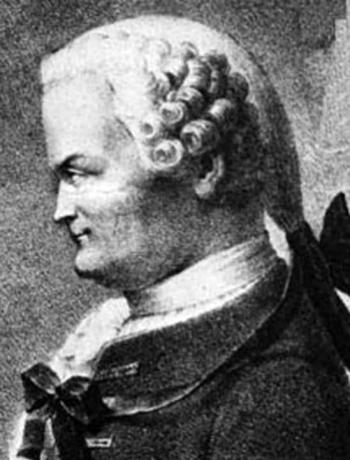
Lambert's Theory of Parallel Lines
Johann Heinrich Lambert writes a treatise on parallel lines, exploring the consequences of denying the parallel postulate and anticipating hyperbolic geometry. #geometry #history
Lambert's Theory of Parallel Lines By Unknown author, Public domain, https://commons.wikimedia.org/w/index.php?curid=370155
1795 CE
Legendre's Elements of Geometry
Adrien-Marie Legendre publishes a highly influential textbook on geometry, attempting to prove the parallel postulate and popularizing Euclidean geometry. #geometry #education
Legendre's Elements of Geometry By Julien-Léopold Boilly - https://www.numericana.com/answer/record.htm#legendre where it was cropped from here, Public domain, https://commons.wikimedia.org/w/index.php?curid=6092195
1826 CE
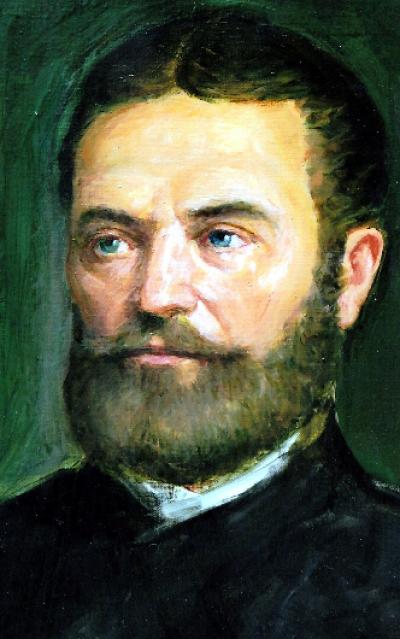
Lobachevsky Presents Hyperbolic Geometry
Nikolai Lobachevsky presents the first complete system of non-Euclidean geometry, hyperbolic geometry, at the University of Kazan. #geometry #math
Lobachevsky Presents Hyperbolic Geometry By Lev Kryukov - http://cczy.blog.ru/?year=2009&month=11, Public domain, https://commons.wikimedia.org/w/index.php?curid=12821190
1829 CE
Lobachevsky Publishes On the Principles of Geometry
Lobachevsky publishes his work on hyperbolic geometry in the Kazan Messenger, laying the foundation for non-Euclidean geometry. #geometry #history
1832 CE
Bolyai's Appendix on Non-Euclidean Geometry
János Bolyai publishes his Appendix, a concise exposition of hyperbolic geometry, independent of Lobachevsky. #geometry #math
Bolyai's Appendix on Non-Euclidean Geometry By Ferenc Márkos - Transferred from hu.wikipedia to Commons by Tambo., CC BY-SA 3.0, https://commons.wikimedia.org/w/index.php?curid=24338736
1854 CE
Riemann's Lecture on the Hypotheses of Geometry
Bernhard Riemann delivers his habilitation lecture, introducing Riemannian geometry and the concept of curved spaces, including elliptic geometry. #geometry #math
Riemann's Lecture on the Hypotheses of Geometry By Unknown author - http://www.sil.si.edu/digitalcollections/hst/scientific-identity/explore.htm according to the German Wikipedia., Public domain, https://commons.wikimedia.org/w/index.php?curid=27383
1868 CE
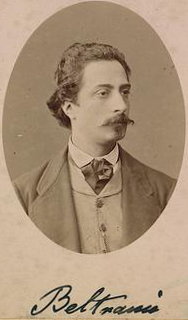
Beltrami's Models of Non-Euclidean Geometry
Eugenio Beltrami publishes models (pseudosphere, projective disk) proving the consistency of hyperbolic geometry. #geometry #math
Beltrami's Models of Non-Euclidean Geometry By Unknown author, Public domain, https://commons.wikimedia.org/w/index.php?curid=2094478
1870 CE
Klein's Erlangen Program
Felix Klein presents the Erlangen Program, classifying geometries by their symmetry groups, unifying Euclidean and non-Euclidean geometries. #geometry #math
Klein's Erlangen Program By Unknown author, Public domain, https://commons.wikimedia.org/w/index.php?curid=38617
1882 CE
Poincaré's Disk Model
Henri Poincaré introduces the Poincaré disk model for hyperbolic geometry, providing a visual representation. #geometry #math
Poincaré's Disk Model By Trevorgoodchild - Own work, Public domain, https://commons.wikimedia.org/w/index.php?curid=36685779
1899 CE
Hilbert's Foundations of Geometry
David Hilbert publishes Grundlagen der Geometrie, providing a rigorous axiomatic foundation for Euclidean geometry and addressing the parallel postulate. #geometry #math
1905 CE
Einstein's Special Relativity Uses Minkowski Geometry
Albert Einstein publishes special relativity, which is later reinterpreted by Hermann Minkowski as a non-Euclidean geometry of spacetime. #physics #geometry
Einstein's Special Relativity Uses Minkowski Geometry By Lucien Chavan [1] (1868 - 1942), a friend of Einstein's when he was living in Berne. - Cropped from original at the The Albert Einstein Archives, The Hebrew University of Jerusalem., Public domain, https://commons.wikimedia.org/w/index.php?curid=16699199
1915 CE
Einstein's General Relativity Uses Riemannian Geometry
Albert Einstein completes general relativity, describing gravity as curvature of spacetime using Riemannian geometry. #physics #geometry
Einstein's General Relativity Uses Riemannian Geometry By Simulating eXtreme Spacetimes Lensing (SXS) - https://www.ligo.caltech.edu/video/ligo20160211v3 (video link); see also http://www.black-holes.org/gw150914, CC BY-SA 4.0, https://commons.wikimedia.org/w/index.php?curid=46994894
1917 CE
de Sitter Space Introduced
Willem de Sitter introduces de Sitter space, a maximally symmetric curved spacetime solution in general relativity. #physics #geometry
1922 CE
Cartan Develops Connections and Curvature
Élie Cartan develops the theory of connections and curvature, generalizing Riemannian geometry and influencing modern differential geometry. #geometry #math
Kurt Gödel publishes his incompleteness theorems, showing limitations of axiomatic systems, affecting the foundations of geometry. #math #logic
1949 CE
Gödel Discovers Rotating Universe Solutions
Kurt Gödel finds a solution to Einstein's field equations describing a rotating universe with closed timelike curves, using non-Euclidean geometry. #physics #geometry
1954 CE
Coxeter Publishes Regular Polytopes
H.S.M. Coxeter publishes Regular Polytopes, a comprehensive work on higher-dimensional geometry, including non-Euclidean polytopes. #geometry #math
Coxeter Publishes Regular Polytopes By Konrad Jacobs, Erlangen - https://opc.mfo.de/detail?photo_id=738, CC BY-SA 2.0 de, https://commons.wikimedia.org/w/index.php?curid=6608250
1963 CE
Penrose's Twistor Theory
Roger Penrose introduces twistor theory, a non-Euclidean geometric approach to physics that aims to unify quantum mechanics and relativity. #physics #geometry
1978 CE
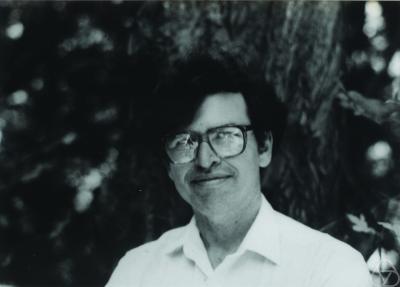
Thurston's Geometrization Conjecture
William Thurston proposes the geometrization conjecture, classifying 3-manifolds using eight geometric structures, including hyperbolic and spherical geometries. #geometry #math
Thurston's Geometrization Conjecture By George Bergman - https://opc.mfo.de/detail?photo_id=6119, GFDL 1.2, https://commons.wikimedia.org/w/index.php?curid=6090942
1982 CE
Atiyah-Singer Index Theorem Applied to Geometry
Michael Atiyah and Isadore Singer prove the index theorem, linking geometry and topology, with applications in non-Euclidean geometry. #geometry #math
1985 CE
Witten's Topological Quantum Field Theory
Edward Witten uses non-Euclidean geometry in topological quantum field theory, influencing both physics and mathematics. #physics #geometry
1995 CE
Perelman Proves the Poincaré Conjecture
Grigori Perelman proves the Poincaré conjecture using Ricci flow, a geometric evolution equation, confirming Thurston's geometrization. #geometry #math
2000 CE
Non-Euclidean Geometry in Computer Graphics
Non-Euclidean geometry is increasingly used in computer graphics and game design, enabling hyperbolic spaces and curved worlds. #geometry #tech
2003 CE
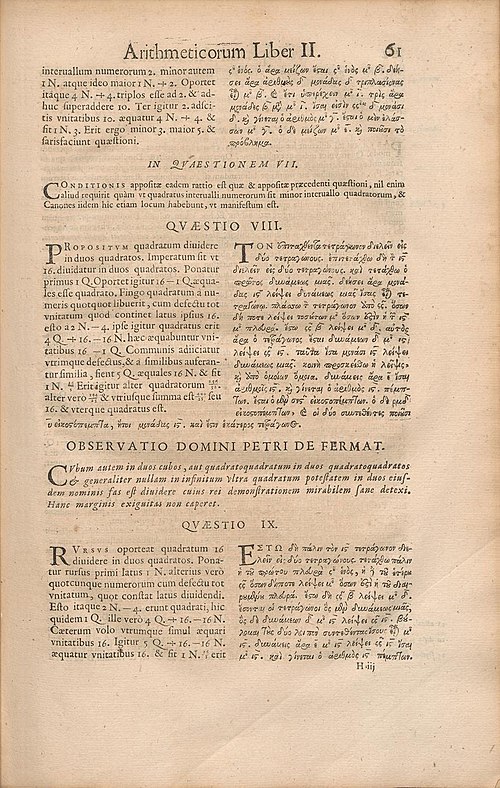
Wiles Proves Fermat's Last Theorem Using Elliptic Curves
Andrew Wiles proves Fermat's Last Theorem, relying on the geometry of elliptic curves and modular forms. #math #geometry
Wiles Proves Fermat's Last Theorem Using Elliptic Curves By Unknown author, Public domain, https://commons.wikimedia.org/w/index.php?curid=533640
2006 CE
Fields Medal for Perelman (Declined)
Grigori Perelman is awarded the Fields Medal for his work on the Poincaré conjecture, but declines it. #geometry #math
Fields Medal for Perelman (Declined) By George Bergman - Scanned via Epson Perfection V370; see also https://opc.mfo.de/detail?photo_id=12890, CC BY-SA 4.0, https://commons.wikimedia.org/w/index.php?curid=126338668
2010 CE
LIGO Detects Gravitational Waves
The LIGO experiment detects gravitational waves, confirming predictions of general relativity and the curvature of spacetime. #physics #geometry
LIGO Detects Gravitational Waves By Simulating eXtreme Spacetimes Collaboration/Canadian Institute for Theoretical Astrophysics/SciNet - http://www.black-holes.org/gw150914 (see https://www.youtube.com/watch?v=c-2XIuNFgD0), CC BY-SA 4.0, https://commons.wikimedia.org/w/index.php?curid=46983496
2015 CE
Hyperbolic Geometry in Network Science
Hyperbolic geometry is applied to model complex networks, revealing hidden geometric structures in social and biological networks. #geometry #science
Hyperbolic Geometry in Network Science By Vladimir0987 - Own work, CC BY-SA 3.0, https://commons.wikimedia.org/w/index.php?curid=7922910
2019 CE
Event Horizon Telescope Images Black Hole
The Event Horizon Telescope captures the first image of a black hole, confirming predictions of general relativity and curved spacetime. #physics #geometry
Event Horizon Telescope Images Black Hole By D. Marrone/UofA - Event Horizon Telescope Collaboration, CC BY 4.0, https://commons.wikimedia.org/w/index.php?curid=133002860
2020 CE
Non-Euclidean Geometry in Machine Learning
Non-Euclidean geometries, especially hyperbolic and spherical spaces, are used in machine learning for embedding hierarchical data. #geometry #AI
Non-Euclidean Geometry in Machine Learning By Unknown author, Public domain, https://commons.wikimedia.org/w/index.php?curid=642235