Euclidean Axioms & Spatial Proofs: Modern Frontiers & Breakthrough Innovations
Encyclopedia/1. The Cosmos & The Natural World/1. Mathematics & Formal Systems/01. Geometry & Spatial Systems • Curated by Admin Timeline.sg
This timeline traces the evolution of Euclidean axioms and spatial proofs from ancient foundations to modern breakthroughs, encompassing non-Euclidean geometries, automated theorem proving, and frontier research. It highlights contributions across cultures and eras, illustrating the enduring quest to understand and formalize space.
Chronological Storyline (44 Milestones)
800 BCE
Sulba Sutras Record Vedic Geometry
The Sulba Sutras contain geometric rules for constructing altars, demonstrating early knowledge of the Pythagorean theorem and geometric transformations. These texts represent the earliest known Indian geometry, influencing later mathematical traditions. #geometry #ancient #India
300 BCE
Euclid's Elements Published
Euclid's 'Elements' establishes the axiomatic foundation of geometry, presenting postulates, definitions, and theorems that would dominate mathematics for two millennia. This work standardizes spatial reasoning and influences all subsequent geometry. #geometry #history #mathematics
Euclid's Elements Published By University of Pennsylvania Museum of Archaeology and Anthropology - https://openn.library.upenn.edu/Data/0016/html/e2748.html, CC BY-SA 4.0, https://commons.wikimedia.org/w/index.php?curid=169166171
260 BCE
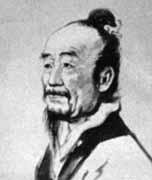
Liu Hui Comments on The Nine Chapters
Chinese mathematician Liu Hui writes a commentary on 'The Nine Chapters on the Mathematical Art', providing geometric proofs and algorithms for area and volume calculations. His work advances Chinese geometry through rigorous reasoning and practical applications. #geometry #China #mathematics
Liu Hui Comments on The Nine Chapters By Unknown - "Liu Hui (220 - 280) - Biography - MacTutor History of Mathematics" https://mathshistory.st-andrews.ac.uk/Biographies/Liu_Hui/, CC BY-SA 4.0, https://commons.wikimedia.org/w/index.php?curid=130481910
240 BCE
Archimedes Computes Area of Circle
Archimedes uses the method of exhaustion to bound π between 3 1/7 and 3 10/71, developing techniques akin to integral calculus. His work on spheres, cylinders, and conoids advances spatial geometry and proofs. #geometry #ancient #Greece
Archimedes Computes Area of Circle By Domenico Fetti - http://archimedes2.mpiwg-berlin.mpg.de/archimedes_templates/popup.htm, Public domain, https://commons.wikimedia.org/w/index.php?curid=146592
100 CE
Heron of Alexandria's Metrica
Heron's 'Metrica' provides geometric formulas for areas and volumes, including the famous Heron's formula for triangle area. This work preserves and expands Hellenistic geometry, influencing later Islamic and European mathematics. #geometry #ancient #mathematics
Heron of Alexandria's Metrica By Unknown author - Historia n° 767 - Novembre 2010 - page, Public domain, https://commons.wikimedia.org/w/index.php?curid=12080168
400 CE
Zu Chongzhi Approximates π
Chinese mathematician Zu Chongzhi computes π to seven decimal places (355/113) using a geometric algorithm based on polygons. This record stands for centuries and demonstrates advanced computational geometry in ancient China. #geometry #China #mathematics
Zu Chongzhi Approximates π By 三猎 - Own work, CC BY-SA 4.0, https://commons.wikimedia.org/w/index.php?curid=54922069
628 CE
Brahmagupta's Geometric Formulas
Indian mathematician Brahmagupta gives formulas for cyclic quadrilaterals and computes areas of geometric figures. His work, including Brahmagupta's formula for the area of a cyclic quadrilateral, enriches Indian geometry and influences Islamic mathematics. #geometry #India #mathematics
820 CE
Al-Khwarizmi's Geometry in Algebra
Al-Khwarizmi's 'Al-Jabr' uses geometric arguments to solve quadratic equations, linking algebra and spatial proofs. His work introduces the Hindu-Arabic numeral system to the West, transforming mathematical practice. #geometry #algebra #IslamicGoldenAge
Al-Khwarizmi's Geometry in Algebra By Zarateman - Own work, CC0, https://commons.wikimedia.org/w/index.php?curid=162213187
1021 CE
Alhazen's Optical Geometry
Alhazen (Ibn al-Haytham) applies geometry to optics, explaining vision through ray diagrams and reflection. His work integrates geometric proofs with physical observations, laying foundations for modern optics and perspective. #geometry #optics #IslamicScience
Alhazen's Optical Geometry By Adolph Boÿ, engraved by Jeremias Falck. Used as the frontispiece to Johannes Hevelius, Selenographia, 1647 - https://www.loc.gov/resource/rbctos.2017rosen1321/?sp=9&r=0.059,0.617,0.327,0.182,0, Public domain, https://commons.wikimedia.org/w/index.php?curid=165125519
1070 CE
Omar Khayyam Solves Cubics Geometrically
Persian mathematician Omar Khayyam uses geometric constructions (intersections of conics) to solve cubic equations, anticipating analytic geometry. His 'Treatise on Demonstration of Problems of Algebra' bridges geometry and algebra. #geometry #algebra #Persia
Omar Khayyam Solves Cubics Geometrically By Alireza Javaheri - https://web.archive.org/web/20161024154356/http://www.panoramio.com/photo/85093358, CC BY 3.0, https://commons.wikimedia.org/w/index.php?curid=55909539
1200 CE
Al-Tusi Critiques Euclid's Parallel Postulate
Nasir al-Din al-Tusi writes a critique of Euclid's parallel postulate, attempting to prove it from other postulates. His work foreshadows non-Euclidean geometry and contributes to the parallel postulate debate. #geometry #parallelpostulate #IslamicScience
Al-Tusi Critiques Euclid's Parallel Postulate By Unknown author - scan of stamp 30 May 2006, Public domain, https://commons.wikimedia.org/w/index.php?curid=829461
1380 CE
Madhava's Series for π
Indian mathematician Madhava of Sangamagrama develops infinite series for π and trigonometric functions using geometric reasoning. This marks the beginning of Indian mathematical analysis and demonstrates early spatial series. #geometry #India #mathematics
1570 CE
First English Euclid Translation
John Dee's preface to the first English translation of Euclid's 'Elements' argues for the practical and philosophical importance of geometry. This translation spreads Euclidean ideas across the English-speaking world. #geometry #Renaissance #England
First English Euclid Translation By Unidentified painter - Scan from site of National Maritime Museum, Greenwich http://www.nmm.ac.uk/, Public domain, https://commons.wikimedia.org/w/index.php?curid=62082
1591 CE
Vieta's Analytic Geometry Precursor
François Viète introduces symbolic algebra and uses letters to denote known and unknown quantities, applying algebraic methods to geometric problems. His work paves the way for Descartes' analytic geometry. #geometry #algebra #France
Vieta's Analytic Geometry Precursor By Unknown author, Public domain, https://commons.wikimedia.org/w/index.php?curid=81021
1637 CE
Descartes' La Géométrie
René Descartes publishes 'La Géométrie', introducing coordinate geometry by representing geometric shapes as algebraic equations. This revolutionizes spatial proofs, allowing problems to be solved through algebra and calculus. #geometry #analyticgeometry #mathematics
Descartes' La Géométrie By Original uploader was User:Caton at [1] - Originally from fr.wikipedia; description page is/was here., Public domain, https://commons.wikimedia.org/w/index.php?curid=1379032
1663 CE
Wallis Attempts Parallel Postulate
John Wallis attempts to prove Euclid's parallel postulate, introducing an equivalent statement (the Wallis postulate). His work keeps the debate alive and influences later non-Euclidean geometry. #geometry #parallelpostulate #England
Wallis Attempts Parallel Postulate By After Godfrey Kneller - one or more third parties have made copyright claims against Wikimedia Commons in relation to the work from which this is sourced or a purely mechanical reproduction thereof. This may be due to recognition of the "sweat of the brow" doctrine, allowing works to be eligible for protection through skill and labour, and not purely by originality as is the case in the United States (where this website is hosted). These claims may or may not be valid in all jurisdictions. As such, use of this image in the jurisdiction of the claimant or other countries may be regarded as copyright infringement. Please see Commons:When to use the PD-Art tag for more information., Public domain, https://commons.wikimedia.org/w/index.php?curid=6365975
1733 CE
Saccheri's Euclid Freed of Every Flaw
Giovanni Saccheri attempts to prove the parallel postulate by contradiction, deriving theorems in 'obtuse angle' and 'acute angle' hypotheses. He unknowingly discovers properties of non-Euclidean geometries, though he rejects them. #geometry #parallelpostulate #Italy
Saccheri's Euclid Freed of Every Flaw By Girolamo Saccheri (book author) - Girolamo Saccheri Euclide Ab Omni Naevo Vindicatus, Public domain, https://commons.wikimedia.org/w/index.php?curid=680440
1766 CE
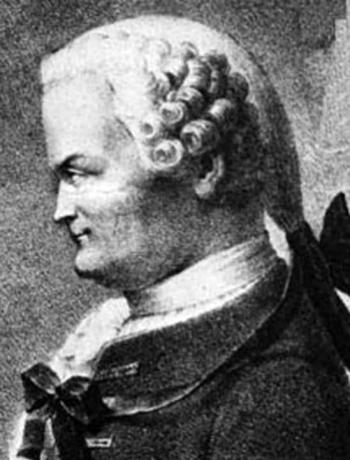
Lambert's Theory of Parallels
Johann Heinrich Lambert develops a rigorous investigation of the parallel postulate, showing that geometries with multiple parallels are logically consistent. His work anticipates hyperbolic geometry and its properties. #geometry #nonEuclidean #Germany
Lambert's Theory of Parallels By Unknown author, Public domain, https://commons.wikimedia.org/w/index.php?curid=370155
1794 CE
Legendre's Elements of Geometry
Adrien-Marie Legendre publishes 'Éléments de Géométrie', a widely used textbook that simplifies and reorganizes Euclid's work. His attempts to prove the parallel postulate further popularize the problem. #geometry #education #France
Legendre's Elements of Geometry By Julien-Léopold Boilly - https://www.numericana.com/answer/record.htm#legendre where it was cropped from here, Public domain, https://commons.wikimedia.org/w/index.php?curid=6092195
1829 CE
Lobachevsky Publishes Non-Euclidean Geometry
Nikolai Lobachevsky presents a consistent geometry where the parallel postulate fails, founding hyperbolic geometry. His work challenges the uniqueness of Euclid's space and opens new mathematical frontiers. #geometry #nonEuclidean #Russia
Lobachevsky Publishes Non-Euclidean Geometry By Lev Kryukov - http://cczy.blog.ru/?year=2009&month=11, Public domain, https://commons.wikimedia.org/w/index.php?curid=12821190
1832 CE
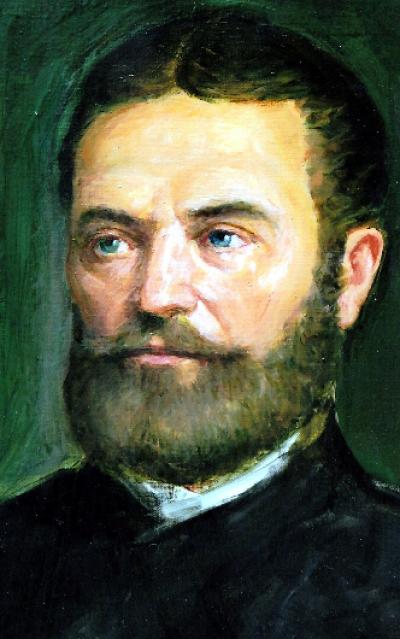
Bolyai's Appendix on Non-Euclidean Space
János Bolyai independently develops hyperbolic geometry and publishes it as an appendix to his father's textbook. His work, alongside Lobachevsky's, establishes non-Euclidean geometry as a valid branch of mathematics. #geometry #nonEuclidean #Hungary
Bolyai's Appendix on Non-Euclidean Space By Ferenc Márkos - Transferred from hu.wikipedia to Commons by Tambo., CC BY-SA 3.0, https://commons.wikimedia.org/w/index.php?curid=24338736
1854 CE
Riemann's Habilitation Lecture on Geometry
Bernhard Riemann's lecture 'On the Hypotheses which lie at the Bases of Geometry' generalizes geometry to n-dimensional manifolds with curvature, laying the foundation for Riemannian geometry. This work later underpins Einstein's general relativity. #geometry #Riemannian #Germany
Riemann's Habilitation Lecture on Geometry By Unknown author - http://www.sil.si.edu/digitalcollections/hst/scientific-identity/explore.htm according to the German Wikipedia., Public domain, https://commons.wikimedia.org/w/index.php?curid=27383
1868 CE
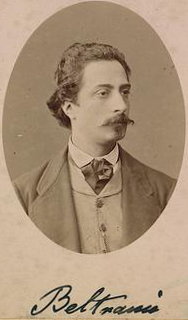
Beltrami's Models of Non-Euclidean Geometry
Eugenio Beltrami constructs the first concrete models (pseudosphere and disk) of hyperbolic geometry, proving its consistency relative to Euclidean geometry. His work legitimizes non-Euclidean geometry within the mathematical community. #geometry #nonEuclidean #Italy
Beltrami's Models of Non-Euclidean Geometry By Unknown author, Public domain, https://commons.wikimedia.org/w/index.php?curid=2094478
1872 CE
Klein's Erlanger Programm
Felix Klein proposes a unifying definition of geometry as the study of invariants under a group of transformations. This program classifies geometries (Euclidean, projective, hyperbolic, etc.) based on symmetry, revolutionizing geometric thinking. #geometry #groupTheory #Germany
Klein's Erlanger Programm By Unknown author, Public domain, https://commons.wikimedia.org/w/index.php?curid=38617
1899 CE
Hilbert's Foundations of Geometry
David Hilbert publishes 'Grundlagen der Geometrie', providing a complete axiomatic system for Euclidean geometry that resolves gaps in Euclid. This work sets the standard for rigorous axiomatic methods in mathematics. #geometry #axioms #Germany
1905 CE
Einstein's Special Relativity
Albert Einstein's special relativity redefines space and time, introducing Minkowski spacetime. This transformation relies on non-Euclidean geometry and alters the conception of spatial geometry in physics. #geometry #relativity #physics
Einstein's Special Relativity By Lucien Chavan [1] (1868 - 1942), a friend of Einstein's when he was living in Berne. - Cropped from original at the The Albert Einstein Archives, The Hebrew University of Jerusalem., Public domain, https://commons.wikimedia.org/w/index.php?curid=16699199
1915 CE
General Relativity: Curved Spacetime
Einstein's general relativity describes gravity as the curvature of spacetime, modeled by Riemannian geometry. This theory confirms that the physical universe's geometry is non-Euclidean, reshaping cosmology and geometry's role in physics. #geometry #relativity #cosmology
General Relativity: Curved Spacetime By Simulating eXtreme Spacetimes Lensing (SXS) - https://www.ligo.caltech.edu/video/ligo20160211v3 (video link); see also http://www.black-holes.org/gw150914, CC BY-SA 4.0, https://commons.wikimedia.org/w/index.php?curid=46994894
1920 CE
Tarski's Decision Procedure for Euclidean Geometry
Alfred Tarski develops a decision procedure for Euclidean geometry, showing that the theory is decidable and can be automated. This foundational work in geometric logic influences both mathematics and computer science. #geometry #logic #decisionProcedure
1930 CE
Van der Waerden's Moderne Algebra
Bartel Leendert van der Waerden's 'Moderne Algebra' systematizes algebraic approach to geometry, integrating group theory and field theory. This text influences how geometry is taught and studied in the modern era. #geometry #algebra #Netherlands )
1940 CE
Coxeter's Introduction to Geometry
Harold Scott MacDonald Coxeter publishes 'Introduction to Geometry', a comprehensive text covering Euclidean, non-Euclidean, and projective geometries. His work popularizes geometric concepts and their symmetries, influencing generations of mathematicians. #geometry #textbook #Canada )
1950 CE
Bourbaki's Geometry and Topology
The Bourbaki group publishes 'Éléments de géométrie', emphasizing the algebraic and topological structures underlying geometry. This work advances the modern, abstract view of geometry within pure mathematics. #geometry #topology #France
1960 CE
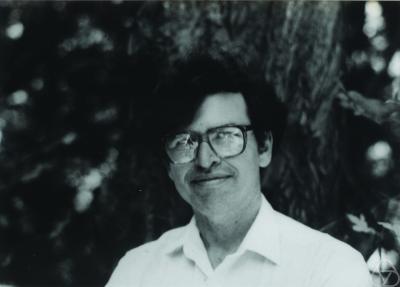
Wu Wen-tsun's Automated Theorem Proving
Wu Wen-tsun develops an algebraic method for proving geometric theorems automatically, using polynomial equations. His work initiates the field of automated geometry reasoning, with applications in computer vision and robotics. #geometry #automatedTheorems #China
Wu Wen-tsun's Automated Theorem Proving By 우원쥔 - Own work, CC BY-SA 4.0, https://commons.wikimedia.org/w/index.php?curid=83949677
1975 CE
Mandelbrot's Fractal Geometry
Benoit Mandelbrot publishes 'The Fractal Geometry of Nature', describing complex spatial patterns with non-integer dimensions. Fractals challenge traditional Euclidean concepts and find applications in chaos theory, computer graphics, and natural sciences. #geometry #fractals #complexity
1978 CE
Thurston's Geometrization Conjecture
William Thurston proposes the geometrization conjecture, classifying three-manifolds into eight geometric types, including Euclidean and hyperbolic geometry. This conjecture, later proved by Perelman, deepens understanding of spatial structures in topology. #geometry #topology #conjecture
Thurston's Geometrization Conjecture By George Bergman - https://opc.mfo.de/detail?photo_id=6119, GFDL 1.2, https://commons.wikimedia.org/w/index.php?curid=6090942
1980 CE
Gromov's Hyperbolic Groups
Mikhail Gromov introduces the concept of hyperbolic groups, linking geometric group theory to negative curvature (hyperbolic geometry). This work bridges group theory and geometry, influencing geometric and combinatorial group theory. #geometry #groupTheory #hyperbolic
Gromov's Hyperbolic Groups By Original: Jakob.scholbach Vector: Pbroks13 - Own work based on: Cyclic group.png, CC BY-SA 3.0, https://commons.wikimedia.org/w/index.php?curid=4370108
1990 CE
Quantum Geometry Emerges
Researchers in theoretical physics develop quantum geometry, including noncommutative geometry and loop quantum gravity. These theories propose discrete spatial structures at Planck scale, challenging classical Euclidean axioms. #geometry #quantum #physics
1995 CE
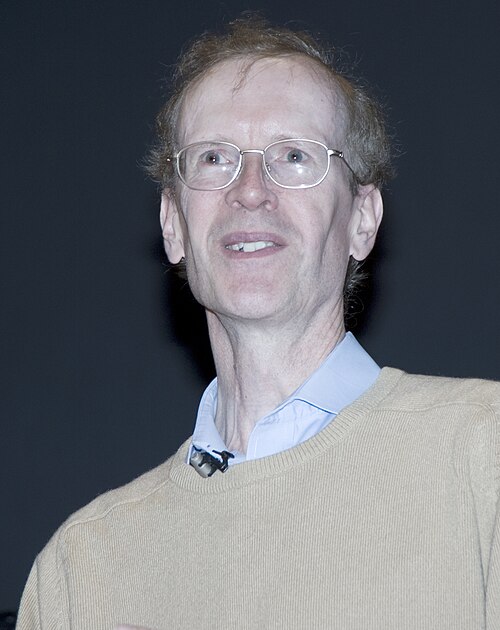
Wiles Proves Fermat's Last Theorem
Andrew Wiles proves Fermat's Last Theorem using elliptic curves and modular forms, heavily drawing on algebraic geometry. This landmark proof demonstrates geometry's power in solving number theory problems. #geometry #numberTheory #proof
Wiles Proves Fermat's Last Theorem By "copyright C. J. Mozzochi, Princeton N.J" - http://www.mozzochi.org/deligne60/Deligne1/_DSC0024.jpg, Attribution, https://commons.wikimedia.org/w/index.php?curid=2635913
2000 CE
Poincaré Conjecture Named Millennium Problem
The Clay Mathematics Institute names the Poincaré conjecture one of seven Millennium Problems, offering a $1 million prize. This topological question about the shape of the universe stimulates research in geometric topology and spatial proofs. #geometry #topology #millennium
2003 CE
Perelman Proves Poincaré Conjecture
Grigori Perelman proves the Poincaré conjecture using Ricci flow, a method from geometric analysis. His proof confirms that every simply connected, closed 3-manifold is homeomorphic to a 3-sphere, solving a century-old problem. #geometry #topology #proof
Perelman Proves Poincaré Conjecture By George Bergman - Scanned via Epson Perfection V370; see also https://opc.mfo.de/detail?photo_id=12890, CC BY-SA 4.0, https://commons.wikimedia.org/w/index.php?curid=126338668
2008 CE
Large Hadron Collider Geometry
The LHC's design uses advanced geometric and spatial calculations to align magnets and detect particles. This engineering feat illustrates the practical application of Euclidean geometry in large-scale physics experiments. #geometry #physics #engineering
Large Hadron Collider Geometry By Arpad Horvath - Drawn by Arpad Horvath with Inkscape., CC BY-SA 2.5, https://commons.wikimedia.org/w/index.php?curid=679693
2015 CE
Geometric Deep Learning Emerges
Researchers develop geometric deep learning, applying symmetry and manifold theory to neural networks. This field extends machine learning to non-Euclidean spaces like graphs and surfaces, with applications in 3D data analysis. #geometry #deepLearning #AI
2020 CE
AlphaGeometry: AI Proves Theorems
DeepMind's AlphaGeometry uses neural networks and symbolic reasoning to solve Olympiad-level geometry problems, achieving near-human performance. This breakthrough showcases AI's capability in spatial proofs and formal reasoning. #geometry #AI #theoremProving
2023 CE
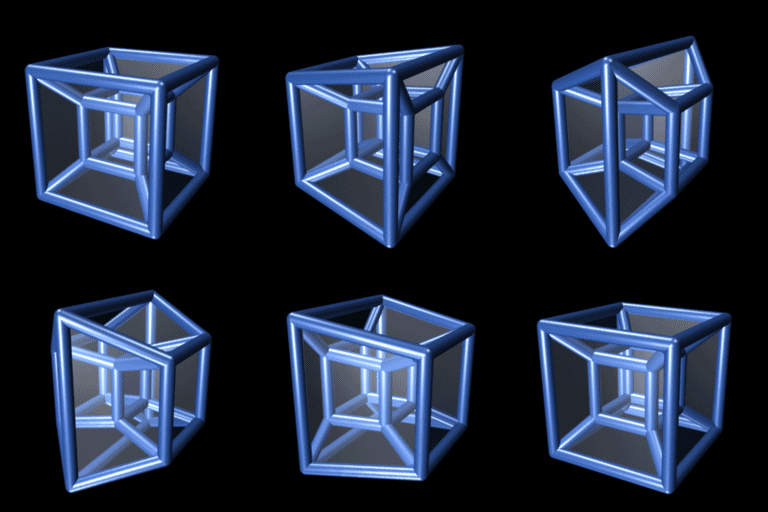
Advances in 4D Geometry Visualization
New VR and computational tools allow researchers to visualize and interact with four-dimensional geometric objects, enhancing understanding of higher-dimensional spaces. This technology advances both education and research in geometry. #geometry #visualization #higherDimensions
Advances in 4D Geometry Visualization By JasonHise at English Wikipedia - Transferred from en.wikipedia to Commons., Public domain, https://commons.wikimedia.org/w/index.php?curid=1724044
2025 CE
Quantum Spatial Proofs Frontier
Ongoing research explores quantum algorithms for geometry, aiming to verify spatial proofs exponentially faster. This frontier could revolutionize how we prove geometric properties and design nanoscale structures. #geometry #quantum #algorithms
Quantum Spatial Proofs Frontier By Dev Jadiya - Own work, CC BY-SA 4.0, https://commons.wikimedia.org/w/index.php?curid=158261563