Euclidean Axioms & Spatial Proofs: Major Case Studies & Paradigm Shifts
Encyclopedia/1. The Cosmos & The Natural World/1. Mathematics & Formal Systems/01. Geometry & Spatial Systems • Curated by Admin Timeline.sg
This timeline traces major case studies and paradigm shifts in Euclidean axioms and spatial proofs, from Euclid's foundational work to modern developments in non-Euclidean geometry and computational proofs, highlighting global contributions.
Chronological Storyline (37 Milestones)
300 BCE
Euclid Writes Elements
Euclid's Elements compiles and axiomatizes Greek geometry, establishing the parallel postulate and foundational spatial proofs. It becomes the most influential mathematics textbook for over two millennia. #geometry #history
Euclid Writes Elements By University of Pennsylvania Museum of Archaeology and Anthropology - https://openn.library.upenn.edu/Data/0016/html/e2748.html, CC BY-SA 4.0, https://commons.wikimedia.org/w/index.php?curid=169166171
250 BCE
Archimedes Computes π
Archimedes uses inscribed and circumscribed polygons to approximate pi, demonstrating early spatial reasoning and proof techniques. #geometry #math
Archimedes Computes π By Domenico Fetti - http://archimedes2.mpiwg-berlin.mpg.de/archimedes_templates/popup.htm, Public domain, https://commons.wikimedia.org/w/index.php?curid=146592
300 CE
Pappus of Alexandria Advances Geometry
Pappus writes the Synagoge (Collection), containing the Pappus hexagon theorem and insights into projective geometry. #geometry #history
Pappus of Alexandria Advances Geometry By Pappus Alexandrinus - https://www.christies.com/en/lot/lot-6069499, Public domain, https://commons.wikimedia.org/w/index.php?curid=132586197
813 CE
Al-Ma'mun Founds House of Wisdom
Caliph Al-Ma'mun establishes the House of Wisdom in Baghdad, where scholars translate and expand upon Greek geometric works, preserving Euclidean axioms. #islamicgoldenage #geometry
Al-Ma'mun Founds House of Wisdom By Zereshk - Own work, Public domain, https://commons.wikimedia.org/w/index.php?curid=2809505
900 CE
Al-Nayrizi Comments on Euclid
Persian mathematician Al-Nayrizi writes a commentary on Euclid's Elements, attempting to prove the parallel postulate. #geometry #islamicscience
1070 CE
Omar Khayyam Proves Parallel Postulate
Persian polymath Omar Khayyam attempts to prove Euclid's fifth postulate, using a quadrilateral configuration (later known as Saccheri quadrilateral). #geometry #history
Omar Khayyam Proves Parallel Postulate By Alireza Javaheri - https://web.archive.org/web/20161024154356/http://www.panoramio.com/photo/85093358, CC BY 3.0, https://commons.wikimedia.org/w/index.php?curid=55909539
1240 CE
Nasir al-Din al-Tusi's Treatise on the Parallel Postulate
Al-Tusi critiques and attempts to prove the parallel postulate, influencing later works in non-Euclidean geometry. #geometry #islamicscience
Nasir al-Din al-Tusi's Treatise on the Parallel Postulate By Unknown author - scan of stamp 30 May 2006, Public domain, https://commons.wikimedia.org/w/index.php?curid=829461
1570 CE
John Dee's Preface to Euclid
John Dee writes a seminal preface to the first English translation of Euclid's Elements, emphasizing the mystical and practical importance of geometry. #geometry #renaissance
John Dee's Preface to Euclid By Unidentified painter - Scan from site of National Maritime Museum, Greenwich http://www.nmm.ac.uk/, Public domain, https://commons.wikimedia.org/w/index.php?curid=62082
1637 CE
Descartes Launches Analytic Geometry
René Descartes establishes analytic geometry in La Géométrie, bridging algebra and geometry and transforming spatial proofs. #geometry #math
Descartes Launches Analytic Geometry By Original uploader was User:Caton at [1] - Originally from fr.wikipedia; description page is/was here., Public domain, https://commons.wikimedia.org/w/index.php?curid=1379032
1665 CE
Newton Develops Calculus and Geometry
Isaac Newton begins his work on calculus, using geometric reasoning in the Principia. #geometry #physics
Newton Develops Calculus and Geometry By Godfrey Kneller - File:Portrait of Sir Isaac Newton, 1689.jpg from https://exhibitions.lib.cam.ac.uk/linesofthought/artifacts, Public domain, https://commons.wikimedia.org/w/index.php?curid=132521185
1733 CE
Saccheri's Euclid Vindicated
Giovanni Saccheri publishes Euclides ab Omni Naevo Vindicatus, attempting to prove the parallel postulate via contradiction, unknowingly developing properties of non-Euclidean geometries. #geometry #history
Saccheri's Euclid Vindicated By Girolamo Saccheri (book author) - Girolamo Saccheri Euclide Ab Omni Naevo Vindicatus, Public domain, https://commons.wikimedia.org/w/index.php?curid=680440
1763 CE
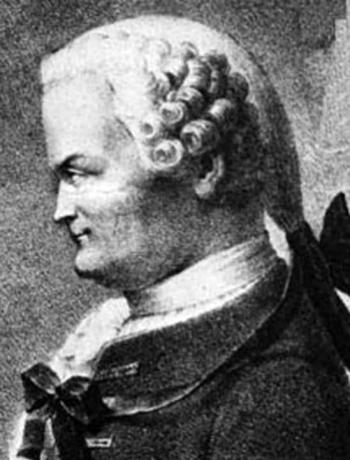
Lambert Investigates Parallel Postulate
Johann Heinrich Lambert writes Theorie der Parallellinien, exploring the consequences of denying the parallel postulate and anticipating hyperbolic geometry. #geometry #math
Lambert Investigates Parallel Postulate By Unknown author, Public domain, https://commons.wikimedia.org/w/index.php?curid=370155
1795 CE
Legendre's Elements of Geometry
Adrien-Marie Legendre publishes a highly influential textbook that attempts to prove the parallel postulate and standardizes Euclidean geometry teaching. #geometry #education
Legendre's Elements of Geometry By Julien-Léopold Boilly - https://www.numericana.com/answer/record.htm#legendre where it was cropped from here, Public domain, https://commons.wikimedia.org/w/index.php?curid=6092195
1823 CE
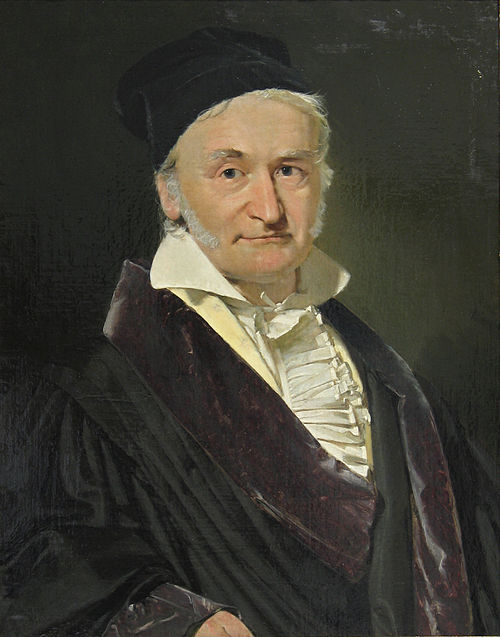
Gauss Discovers Non-Euclidean Geometry
Carl Friedrich Gauss privately realizes the possibility of a consistent non-Euclidean geometry but does not publish, fearing controversy. #geometry #math
Gauss Discovers Non-Euclidean Geometry By Christian Albrecht Jensen - http://archiv.bbaw.de/archiv/archivbestaende/abteilung-sammlungen/gesamtbestand-des-kunstbesitzes/gelehrtengemaelde/gelehrtengemalde-seiten/ZIMM-0001.html, Public domain, https://commons.wikimedia.org/w/index.php?curid=6886354
1829 CE
Lobachevsky Publishes Hyperbolic Geometry
Nikolai Lobachevsky publishes On the Foundations of Geometry, the first public account of hyperbolic geometry, challenging Euclid's fifth postulate. #geometry #math
Lobachevsky Publishes Hyperbolic Geometry By Lev Kryukov - http://cczy.blog.ru/?year=2009&month=11, Public domain, https://commons.wikimedia.org/w/index.php?curid=12821190
1832 CE
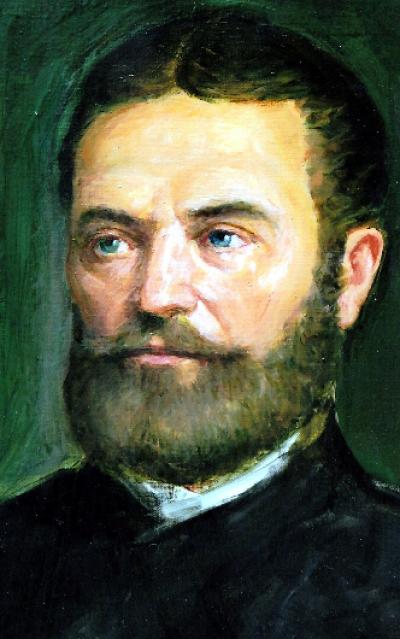
Bolyai Develops Absolute Geometry
János Bolyai independently develops non-Euclidean geometry, published as an appendix to his father's book, expanding the frontiers of spatial proofs. #geometry #math
Bolyai Develops Absolute Geometry By Ferenc Márkos - Transferred from hu.wikipedia to Commons by Tambo., CC BY-SA 3.0, https://commons.wikimedia.org/w/index.php?curid=24338736
1854 CE
Riemann's Lecture on the Hypotheses of Geometry
Bernhard Riemann gives a transformative lecture defining Riemannian geometry, generalizing curvature and enabling the geometry of curved spaces. #geometry #math
Riemann's Lecture on the Hypotheses of Geometry By Unknown author - http://www.sil.si.edu/digitalcollections/hst/scientific-identity/explore.htm according to the German Wikipedia., Public domain, https://commons.wikimedia.org/w/index.php?curid=27383
1868 CE
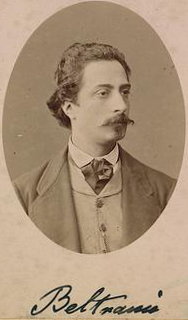
Beltrami Models Hyperbolic Geometry
Eugenio Beltrami provides concrete models (pseudosphere) proving the consistency of hyperbolic geometry. #geometry #math
Beltrami Models Hyperbolic Geometry By Unknown author, Public domain, https://commons.wikimedia.org/w/index.php?curid=2094478
1872 CE
Felix Klein's Erlangen Program
Felix Klein classifies geometries via group theory, unifying Euclidean and non-Euclidean geometries under a common framework. #geometry #math
Felix Klein's Erlangen Program By Unknown author, Public domain, https://commons.wikimedia.org/w/index.php?curid=38617
1882 CE
Poincaré Discovers the Hyperbolic Disk Model
Henri Poincaré introduces the Poincaré disk model, a convenient representation of hyperbolic geometry. #geometry #math
Poincaré Discovers the Hyperbolic Disk Model By Trevorgoodchild - Own work, Public domain, https://commons.wikimedia.org/w/index.php?curid=36685779
1899 CE
Hilbert's Axioms of Geometry
David Hilbert publishes Grundlagen der Geometrie, providing a complete and rigorous set of Euclidean axioms, resolving foundational issues. #geometry #math
1900 CE
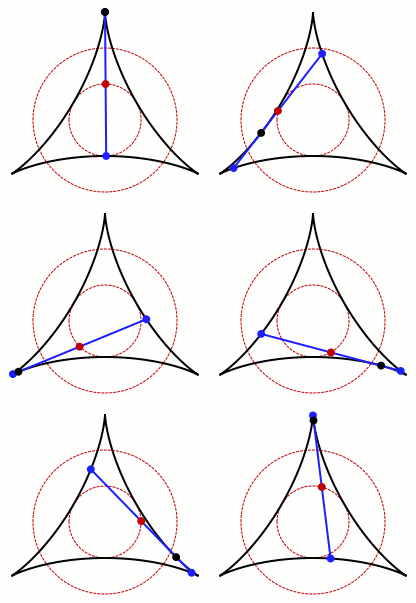
Hilbert's 3rd Problem on Volume
David Hilbert poses the problem of proving the equivalence of volume of polyhedra, leading to Dehn's solution using invariants. #geometry #math
Hilbert's 3rd Problem on Volume By WatchduckYou can name the author as "T. Piesk", "Tilman Piesk" or "Watchduck". - Own work, CC BY-SA 4.0, https://commons.wikimedia.org/w/index.php?curid=109215760
1915 CE
Einstein's General Relativity Uses Riemannian Geometry
Albert Einstein applies Riemannian geometry to describe gravity, showing non-Euclidean geometry as a physical reality. #physics #geometry
Einstein's General Relativity Uses Riemannian Geometry By Simulating eXtreme Spacetimes Lensing (SXS) - https://www.ligo.caltech.edu/video/ligo20160211v3 (video link); see also http://www.black-holes.org/gw150914, CC BY-SA 4.0, https://commons.wikimedia.org/w/index.php?curid=46994894
1930 CE
Banach-Tarski Paradox
Stefan Banach and Alfred Tarski prove that a sphere can be decomposed into finitely many pieces and reassembled into two identical spheres, challenging intuitive notions of volume. #geometry #paradox
1955 CE
Hirsch Conjecture on Polytopes
Warren M. Hirsch conjectures on the diameter of convex polytopes, influencing combinatorial geometry; disproved in 2010. #geometry #combinatorics
Hirsch Conjecture on Polytopes By Tomruen - Own work, CC BY-SA 4.0, https://commons.wikimedia.org/w/index.php?curid=37728262
1964 CE
Coxeter Publishes Regular Polytopes
H. S. M. Coxeter's influential book Regular Polytopes systematizes higher-dimensional geometry and symmetry. #geometry #math )
1975 CE
Benoit Mandelbrot Discovers Fractal Geometry
Benoit Mandelbrot introduces fractal geometry, describing irregular shapes using self-similarity and new spatial concepts. #geometry #math
Benoit Mandelbrot Discovers Fractal Geometry By Steve Jurvetson - https://www.flickr.com/photos/jurvetson/4770047266/, CC BY 2.0, https://commons.wikimedia.org/w/index.php?curid=155438846
1982 CE
Thurston's Geometrization Conjecture
William Thurston proposes the geometrization conjecture, classifying 3-manifolds using eight geometric structures, later proved by Perelman. #geometry #topology
Thurston's Geometrization Conjecture By George Bergman - https://opc.mfo.de/detail?photo_id=6119, GFDL 1.2, https://commons.wikimedia.org/w/index.php?curid=6090942
1995 CE
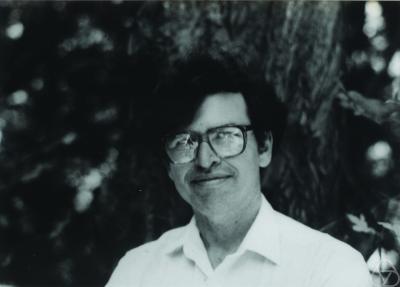
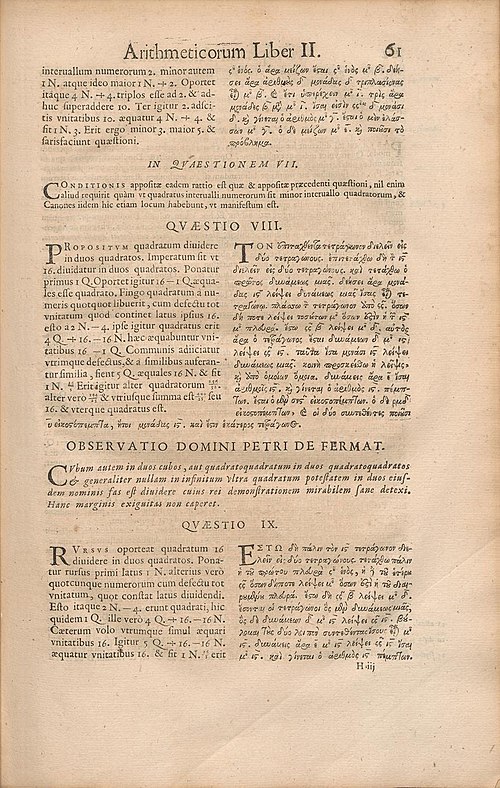
Wiles Proves Fermat's Last Theorem
Andrew Wiles proves Fermat's Last Theorem using modern algebraic geometry, linking elliptic curves and modular forms. #geometry #math
Wiles Proves Fermat's Last Theorem By Unknown author, Public domain, https://commons.wikimedia.org/w/index.php?curid=533640
2000 CE
Perelman Solves Poincaré Conjecture
Grigori Perelman proves the Poincaré conjecture, the first of the Millennium Problems solved, using Ricci flow and geometric analysis. #geometry #topology
Perelman Solves Poincaré Conjecture By George Bergman - Scanned via Epson Perfection V370; see also https://opc.mfo.de/detail?photo_id=12890, CC BY-SA 4.0, https://commons.wikimedia.org/w/index.php?curid=126338668
2005 CE
Census of Small Triangulations of 3-Manifolds
Mathematicians compile a census of triangulations, advancing computational geometry and spatial proof verification. #geometry #computational )
2010 CE
Disproof of Hirsch Conjecture
Francisco Santos finds a counterexample to the Hirsch conjecture, a major theorem in convex geometry. #geometry #combinatorics
2012 CE
Zhang Yitang's Prime Gap Breakthrough
Zhang Yitang proves that there are infinitely many prime pairs within a bounded gap, using analytic geometry methods. #geometry #numbertheory
Zhang Yitang's Prime Gap Breakthrough By VOA - http://www.voachinese.com/media/video/i-america-math-zhang-yitang-20131204/1803128.html, Public domain, https://commons.wikimedia.org/w/index.php?curid=33336006
DeepMind's AlphaFold employs geometric deep learning to predict protein structures, a major application of spatial reasoning. #geometry #ai
AlphaFold Uses Geometric Deep Learning By Kathryn Tunyasuvunakool, Jonas Adler, Zachary Wu, Tim Green, Michal Zielinski, Augustin Žídek, Alex Bridgland, Andrew Cowie, Clemens Meyer, Agata Laydon, Sameer Velanka *, Gerard J Kleywegt *, Alex Bateman *, Richard Evans, Alexander Pritzel, Michael Figurnov, Olaf Ronneberger, Russ Bates, Simon A. A. Kohl, Anna Potapenko, Andrew J Ballard, Bernardino Romera-Paredes, Stanislav Nikolov, Rishub Jain, Ellen Clancy, David Reiman, Stig Petersen, Andrew Senior, Koray Kavukcuoglu, Ewan Birney *, Pushmeet Kohli, John Jumper, Demis Hassabis - https://deepmind.google/blog/enabling-high-accuracy-protein-structure-prediction-at-the-proteome-scale/, CC BY 4.0, https://commons.wikimedia.org/w/index.php?curid=188769148
2020 CE
Solution to the Unsolved Kakeya Conjecture in Finite Fields
A breakthrough in combinatorial geometry: the Kakeya conjecture in finite fields is resolved by Dvir and later improvements. #geometry #math
Solution to the Unsolved Kakeya Conjecture in Finite Fields By Claudio Rocchini - Own work, CC BY 2.5, https://commons.wikimedia.org/w/index.php?curid=1395511
2022 CE
New Proof of the Pythagoras Theorem Using Trigonometry
Two high school students present a novel proof of the Pythagorean theorem using trigonometric functions, previously thought impossible. #geometry #math
New Proof of the Pythagoras Theorem Using Trigonometry By en:User:Wapcaplet - Transwikied from en:. Originally created by en:User:Michael Hardy, then scaled, with colour and labels being added by en:User:Wapcaplet, transformed in svg format by fr:Utilisateur:Steff, changed colors and font by de:Leo2004, CC BY-SA 3.0, https://commons.wikimedia.org/w/index.php?curid=640875