Encyclopedia/1. The Cosmos & The Natural World/1. Mathematics & Formal Systems/01. Geometry & Spatial Systems • Curated by Admin Timeline.sg
Historical events timeline.
Chronological Storyline (39 Milestones)
3000 BCE
Earliest geometry in Egypt and Mesopotamia
Early civilizations use practical geometry for land surveying and construction. The Rhind Papyrus and Babylonian tablets contain area and volume formulas. #history #geometry
Earliest geometry in Egypt and Mesopotamia By Unknown author, Public domain, https://commons.wikimedia.org/w/index.php?curid=619493
1900 BCE
Babylonian Plimpton 322 tablet
The Plimpton 322 clay tablet lists Pythagorean triples, indicating advanced geometric knowledge in Mesopotamia. It is one of the earliest known mathematical artifacts. #math #history
Babylonian Plimpton 322 tablet By photo author unknown - image copied from http://www.math.ubc.ca/~cass/courses/m446-03/pl322/pl322.html, Public domain, https://commons.wikimedia.org/w/index.php?curid=1170904
600 BCE
Thales introduces deductive geometry
Thales of Miletus uses logical deduction to prove geometric propositions, such as that a circle is bisected by its diameter. He is considered the first mathematician in the Greek tradition. #geometry #philosophy
Thales introduces deductive geometry By Wilhelm Meyer - own scan, Public domain, https://commons.wikimedia.org/w/index.php?curid=11037570
500 BCE
Pythagorean theorem established
The Pythagorean school proves the relationship between sides of a right triangle. The theorem is known in Babylon and India earlier, but Pythagoras systematizes it. #math #history
Pythagorean theorem established By en:User:Wapcaplet - Transwikied from en:. Originally created by en:User:Michael Hardy, then scaled, with colour and labels being added by en:User:Wapcaplet, transformed in svg format by fr:Utilisateur:Steff, changed colors and font by de:Leo2004, CC BY-SA 3.0, https://commons.wikimedia.org/w/index.php?curid=640875
400 BCE
Plato's Academy emphasizes geometry
Plato's Academy promotes geometry as essential for philosophy and education. Theaetetus classifies regular polyhedra, laying groundwork for solid geometry. #philosophy #geometry
Plato's Academy emphasizes geometry By Silanion - User:Bibi Saint-Pol, own work, 2007-02-08, Public domain, https://commons.wikimedia.org/w/index.php?curid=1775137
300 BCE
Euclid's Elements published
Euclid compiles and axiomatizes Greek geometry in 13 books, introducing the Euclidean axioms. It becomes the most influential textbook in history, used for over 2,000 years. #geometry #axioms
Euclid's Elements published By University of Pennsylvania Museum of Archaeology and Anthropology - https://openn.library.upenn.edu/Data/0016/html/e2748.html, CC BY-SA 4.0, https://commons.wikimedia.org/w/index.php?curid=169166171
250 BCE
Archimedes uses method of exhaustion
Archimedes calculates areas and volumes using infinitesimals and the method of exhaustion, anticipating integral calculus. He finds the area of a circle and volume of a sphere. #math #invention
Archimedes uses method of exhaustion By Domenico Fetti - http://archimedes2.mpiwg-berlin.mpg.de/archimedes_templates/popup.htm, Public domain, https://commons.wikimedia.org/w/index.php?curid=146592
50 CE
Heron of Alexandria describes triangle area formula
Heron (or Hero) of Alexandria derives Heron's formula for the area of a triangle given side lengths. He also works on mechanics and pneumatics. #math #invention
Heron of Alexandria describes triangle area formula By Unknown author - Historia n° 767 - Novembre 2010 - page, Public domain, https://commons.wikimedia.org/w/index.php?curid=12080168
300 CE
Pappus of Alexandria on projective geometry
Pappus collects Greek geometric works and proves the Pappus hexagon theorem, a foundational result in projective geometry. His collection preserves many earlier theorems. #geometry #history
Pappus of Alexandria on projective geometry By Pappus Alexandrinus - https://www.christies.com/en/lot/lot-6069499, Public domain, https://commons.wikimedia.org/w/index.php?curid=132586197
499 CE
Aryabhata writes Aryabhatiya
Indian mathematician Aryabhata presents geometric and trigonometric formulas, including tables of sines and approximations of pi. His work influences later Islamic and European mathematics. #india #math
Aryabhata writes Aryabhatiya By Krishnachandranvn - Verses in Devanagari saved as image. Previously published: Publishing for the first time., CC BY-SA 3.0, https://commons.wikimedia.org/w/index.php?curid=47811589
628 CE
Brahmagupta: cyclic quadrilaterals
Brahmagupta writes Brahmasphutasiddhanta, giving formulas for the area of cyclic quadrilaterals and a correct formula for the volume of a pyramid. He also works on zero and negative numbers. #india #math
820 CE
Al-Khwarizmi translates Euclid into Arabic
Al-Khwarizmi and other scholars translate Greek works into Arabic, preserving Euclid's Elements during the Islamic Golden Age. These translations later reach Europe. #islam #translation
Al-Khwarizmi translates Euclid into Arabic By Zarateman - Own work, CC0, https://commons.wikimedia.org/w/index.php?curid=162213187
1021 CE
Alhazen (Ibn al-Haytham) on optics and geometry
Alhazen combines geometry and physics in his Book of Optics. He solves the problem of spherical aberration using conic sections and geometric reasoning. #optics #geometry
Alhazen (Ibn al-Haytham) on optics and geometry By Adolph Boÿ, engraved by Jeremias Falck. Used as the frontispiece to Johannes Hevelius, Selenographia, 1647 - https://www.loc.gov/resource/rbctos.2017rosen1321/?sp=9&r=0.059,0.617,0.327,0.182,0, Public domain, https://commons.wikimedia.org/w/index.php?curid=165125519
1070 CE
Omar Khayyam: cubic equations via geometry
Persian mathematician and poet Omar Khayyam solves cubic equations using intersecting conic sections, a geometric approach. He also works on the parallel postulate. #geometry #algebra
Omar Khayyam: cubic equations via geometry By Alireza Javaheri - https://web.archive.org/web/20161024154356/http://www.panoramio.com/photo/85093358, CC BY 3.0, https://commons.wikimedia.org/w/index.php?curid=55909539
1247 CE
Qin Jiushao's Mathematical Treatise in Nine Sections
Chinese mathematician Qin Jiushao develops methods for solving high-degree equations using geometric transformation. His work includes early forms of the Horner scheme. #chinese #math
Qin Jiushao's Mathematical Treatise in Nine Sections By Qin Jiushao 秦九韶 - 1842 printing Shu Shu Jiu Zhang, Public domain, https://commons.wikimedia.org/w/index.php?curid=3414657
1450 CE
Gutenberg's printing press spreads Euclid
Johannes Gutenberg's invention of movable type allows mass production of Euclid's Elements, making the axioms widely accessible across Europe. #printing #education
Gutenberg's printing press spreads Euclid By Kenneth C. Zirkel - Own work, CC BY-SA 4.0, https://commons.wikimedia.org/w/index.php?curid=163942915
1569 CE
Mercator's cylindrical projection
Gerardus Mercator creates the Mercator projection for navigation, which preserves angles but distorts area. This map projection relies on geometric transformation. #cartography #geometry
Mercator's cylindrical projection By Strebe - Own work, CC BY-SA 3.0, https://commons.wikimedia.org/w/index.php?curid=17700069
1609 CE
Kepler uses ellipse for planetary orbits
Johannes Kepler discovers that planetary orbits are ellipses with the Sun at one focus, overturning circular models. He uses geometry to derive his laws. #astronomy #geometry
Kepler uses ellipse for planetary orbits By Hankwang - Own work, CC BY 2.5, https://commons.wikimedia.org/w/index.php?curid=2102578
1637 CE
Descartes introduces analytic geometry
René Descartes publishes La Géométrie, linking algebra and geometry via coordinates. This allows geometric problems to be solved algebraically. #algebra #geometry
Descartes introduces analytic geometry By Original uploader was User:Caton at [1] - Originally from fr.wikipedia; description page is/was here., Public domain, https://commons.wikimedia.org/w/index.php?curid=1379032
1650 CE
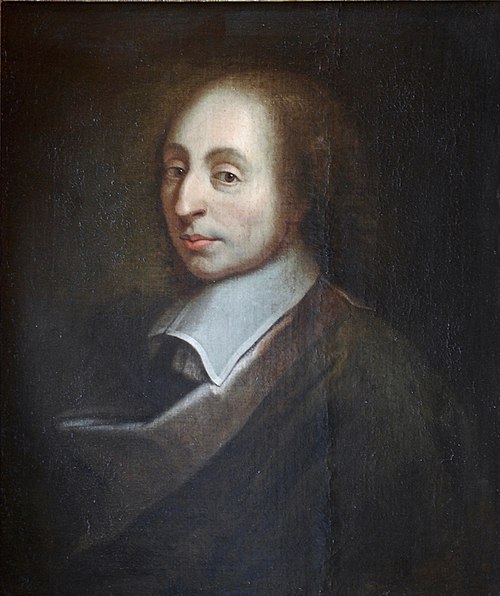
Pascal: conic sections and projective geometry
Blaise Pascal writes Essay pour les coniques, proving Pascal's theorem on conics. He lays groundwork for projective geometry and the concept of harmonic division. #geometry #projective
Pascal: conic sections and projective geometry By unknown; a copy of the painting of François II Quesnel, which was made for Gérard Edelinck en 1691[réf. nécessaire]. - Own work, Public domain, https://commons.wikimedia.org/w/index.php?curid=12193020
1665 CE
Newton develops calculus using geometry
Isaac Newton develops fluxions (calculus) and uses geometric reasoning in his Principia. He proves Kepler's laws and universal gravitation via geometric methods. #calculus #physics
Newton develops calculus using geometry By Godfrey Kneller - File:Portrait of Sir Isaac Newton, 1689.jpg from https://exhibitions.lib.cam.ac.uk/linesofthought/artifacts, Public domain, https://commons.wikimedia.org/w/index.php?curid=132521185
1733 CE
Saccheri attempts to prove parallel postulate
Girolamo Saccheri publishes Euclides ab omni naevo vindicatus, trying to prove the parallel postulate by contradiction. His work unknowingly explores non-Euclidean geometry. #geometry #axioms
Saccheri attempts to prove parallel postulate By Girolamo Saccheri (book author) - Girolamo Saccheri Euclide Ab Omni Naevo Vindicatus, Public domain, https://commons.wikimedia.org/w/index.php?curid=680440
1761 CE
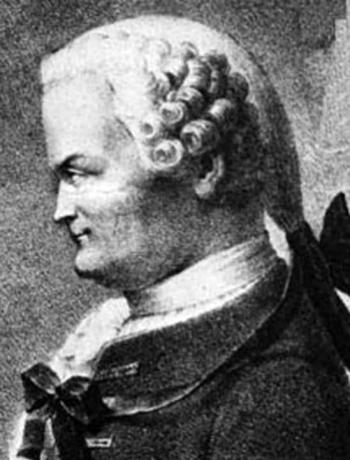
Johann Lambert: hyperbolic geometry precursor
Johann Heinrich Lambert investigates the parallel postulate and develops hyperbolic trigonometric functions. He is among the first to consider the possibility of non-Euclidean geometry. #geometry #math
Johann Lambert: hyperbolic geometry precursor By Unknown author, Public domain, https://commons.wikimedia.org/w/index.php?curid=370155
1795 CE
Legendre: Elements of Geometry and elliptic integrals
Adrien-Marie Legendre publishes Éléments de géométrie, revising Euclid. He also works on elliptic integrals and the Legendre transformation, influencing analysis and geometry. #geometry #analysis
Legendre: Elements of Geometry and elliptic integrals By Julien-Léopold Boilly - https://www.numericana.com/answer/record.htm#legendre where it was cropped from here, Public domain, https://commons.wikimedia.org/w/index.php?curid=6092195
1799 CE
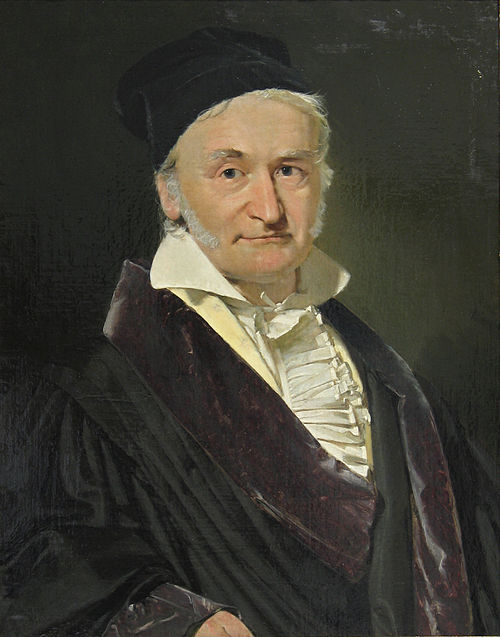
Gauss: fundamental theorem of algebra
Carl Friedrich Gauss proves the fundamental theorem of algebra in his doctoral dissertation, using geometric reasoning. His work deeply influences algebraic geometry. #algebra #geometry
Gauss: fundamental theorem of algebra By Christian Albrecht Jensen - http://archiv.bbaw.de/archiv/archivbestaende/abteilung-sammlungen/gesamtbestand-des-kunstbesitzes/gelehrtengemaelde/gelehrtengemalde-seiten/ZIMM-0001.html, Public domain, https://commons.wikimedia.org/w/index.php?curid=6886354
1829 CE
Lobachevsky publishes non-Euclidean geometry
Nikolai Lobachevsky presents the first complete system of hyperbolic geometry, replacing Euclid's parallel postulate. Initially controversial, it revolutionizes geometry. #geometry #nonEuclidean
Lobachevsky publishes non-Euclidean geometry By Lev Kryukov - http://cczy.blog.ru/?year=2009&month=11, Public domain, https://commons.wikimedia.org/w/index.php?curid=12821190
1832 CE
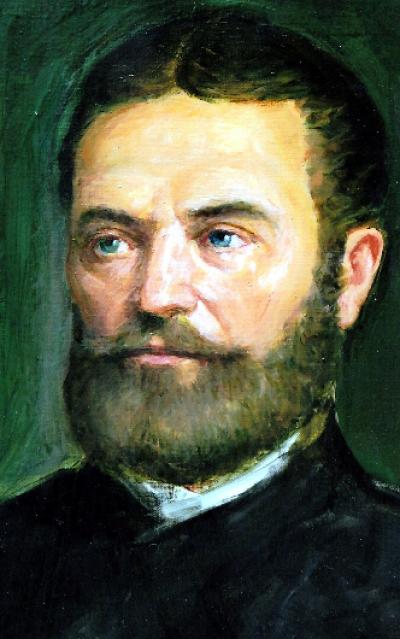
János Bolyai independently discovers hyperbolic geometry
János Bolyai publishes Appendix scientiam spatii absolute veram, introducing hyperbolic geometry independent of Lobachevsky. His work is later recognized by Gauss. #geometry #math
János Bolyai independently discovers hyperbolic geometry By Ferenc Márkos - Transferred from hu.wikipedia to Commons by Tambo., CC BY-SA 3.0, https://commons.wikimedia.org/w/index.php?curid=24338736
1868 CE
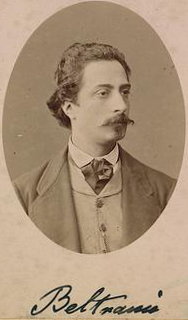
Beltrami models hyperbolic geometry
Eugenio Beltrami produces the pseudosphere, a model of hyperbolic geometry, and uses differential geometry to show consistency. This solidifies non-Euclidean geometry. #geometry #model
Beltrami models hyperbolic geometry By Unknown author, Public domain, https://commons.wikimedia.org/w/index.php?curid=2094478
1872 CE
Klein's Erlangen Program classifies geometries
Felix Klein presents the Erlangen Program, unifying Euclidean, hyperbolic, and projective geometries via group theory. He classifies geometries by their transformation groups. #geometry #groups
Klein's Erlangen Program classifies geometries By Unknown author, Public domain, https://commons.wikimedia.org/w/index.php?curid=38617
1899 CE
Hilbert's Grundlagen der Geometrie
David Hilbert publishes Foundations of Geometry, providing a complete axiom system for Euclidean geometry. He fills gaps in Euclid and establishes rigorous foundations. #axioms #geometry
Jun 30, 1905 CE
Einstein: special relativity uses Euclidean geometry
Albert Einstein's special relativity is based on Minkowski spacetime, which uses a pseudo-Euclidean geometry. This geometry combines space and time into a four-dimensional continuum. #relativity #geometry
Einstein: special relativity uses Euclidean geometry By Lucien Chavan [1] (1868 - 1942), a friend of Einstein's when he was living in Berne. - Cropped from original at the The Albert Einstein Archives, The Hebrew University of Jerusalem., Public domain, https://commons.wikimedia.org/w/index.php?curid=16699199
Nov 25, 1915 CE
Einstein's general relativity: curved spacetime
Einstein completes general relativity, describing gravity as curvature of spacetime governed by Riemannian geometry. This revolutionizes physics and geometry. #relativity #diffgeom
Einstein's general relativity: curved spacetime By Simulating eXtreme Spacetimes Lensing (SXS) - https://www.ligo.caltech.edu/video/ligo20160211v3 (video link); see also http://www.black-holes.org/gw150914, CC BY-SA 4.0, https://commons.wikimedia.org/w/index.php?curid=46994894
1930 CE
Veblen and Whitehead axiomatize geometry
Oswald Veblen and Alfred North Whitehead publish The Foundations of Differential Geometry, providing axiomatic treatment. They contribute to the formalization of geometry. #geometry #axioms
Veblen and Whitehead axiomatize geometry By unknown photographer circa 1915 - http://legacyrlmoore.org/photos/veblen_o.html, Public domain, https://commons.wikimedia.org/w/index.php?curid=26331215
1955 CE
Nash embedding theorem
John Nash proves every Riemannian manifold can be isometrically embedded into Euclidean space. This deep theorem has applications in geometry and physics. #diffgeom #theorem
1982 CE
Gromov: hyperbolic groups and geometric group theory
Mikhail Gromov introduces hyperbolic groups, linking geometry and group theory. His work on metric spaces and curvature influences modern geometric understanding. #geometry #groups
Gromov: hyperbolic groups and geometric group theory By Original: Jakob.scholbach Vector: Pbroks13 - Own work based on: Cyclic group.png, CC BY-SA 3.0, https://commons.wikimedia.org/w/index.php?curid=4370108
Nov 11, 2003 CE
Perelman proves Poincaré conjecture
Grigori Perelman posts proof of the Poincaré conjecture using Ricci flow with surgery, a geometric analysis method. The conjecture, about 3-manifolds, is a landmark in topology. #topology #geometry
2010 CE
Computational geometry emerges as a field
Advances in algorithms for geometric problems (e.g., convex hull, triangulation) lead to computational geometry's growth. It is used in computer graphics, robotics, and GIS. #computing #geometry
2020 CE
Deep learning applied to geometric problems
Neural networks are trained to recognize geometric shapes and solve symmetry problems. Geometric deep learning becomes an active research area, merging AI with geometry. #AI #geometry
2023 CE
Mirzakhani's legacy in moduli spaces
Maryam Mirzakhani's work on Riemann surfaces and moduli spaces continues to influence geometry. She was the first woman to win the Fields Medal in 2014. #geometry #awards