Erwin Schrödinger: Wave Equation, Quantum Mechanics & What is Life
Encyclopedia/1. The Cosmos & The Natural World/2. Physics & Chemistry/13. Physical & Chemical Biographies • Curated by Admin Timeline.sg
Erwin Schrödinger was an Austrian physicist who formulated the wave equation in quantum mechanics, earned the 1933 Nobel Prize, and later wrote the influential book 'What is Life?'. This timeline covers his life from birth in 1887 to death in 1961.
Chronological Storyline (31 Milestones)
Aug 12, 1887 CE
Erwin Schrödinger Born in Vienna
Erwin Rudolf Josef Alexander Schrödinger was born in Erdberg, Vienna, Austria-Hungary. His father was a botanist and his mother was of British descent. #physics #biography
Erwin Schrödinger Born in Vienna By Unknown author - Narodowe Archiwum Cyfrowe - Sygnatura 1-E-939 (Original picture), Public domain, https://commons.wikimedia.org/w/index.php?curid=113379275
Oct 1, 1906 CE
Enrolls at the University of Vienna
Schrödinger began studying at the University of Vienna, focusing on physics and mathematics. He attended lectures by Ludwig Boltzmann and Friedrich Hasenöhrl. #physics #education
Enrolls at the University of Vienna By Original: Universität Wien Vector: Lệ Xuân - This file was derived from: Uni wien siegel.png:, Public domain, https://commons.wikimedia.org/w/index.php?curid=106367114
May 20, 1910 CE
Doctorate in Physics
Schrödinger earned his PhD from the University of Vienna under Friedrich Hasenöhrl, with a dissertation on the electrical conductivity of insulators. #physics #phd
1911 CE
Research Assistant at University of Vienna
After his doctorate, Schrödinger worked as an assistant to Franz Exner at the University of Vienna, conducting experiments and theoretical work. #physics #research
1914 CE
World War I Service
During World War I, Schrödinger served as an artillery officer in the Austro-Hungarian Army. He continued to work on scientific papers when possible. #physics #worldwari
World War I Service By Collection DocAnciens/docpix.fr - www.docpix.fr, Public domain, https://commons.wikimedia.org/w/index.php?curid=45603415
Apr 6, 1920 CE
Marries Annemarie Bertel
Schrödinger married Annemarie (Anny) Bertel, from Salzburg. The marriage was unconventional, with Schrödinger having numerous affairs. #physics #personal
1920 CE
Assistant at University of Jena
Schrödinger took a position as an assistant to Max Wien at the University of Jena, but stayed only briefly. #physics #career
Assistant at University of Jena By Uni-Jena-logo.png: UnknownUnknown derivative work: Ba10r (talk) - Uni-Jena-logo.png, Public domain, https://commons.wikimedia.org/w/index.php?curid=12786372
1921 CE
Appointed Professor at University of Zurich
Schrödinger moved to the University of Zurich, where he would develop his wave equation. #physics #zurich
Appointed Professor at University of Zurich By Unknown author - http://www.designtagebuch.de/cd-manuals/UZH_CDManual_Basiselemente.pdf, Public domain, https://commons.wikimedia.org/w/index.php?curid=92865744
1921 CE
Professorship at University of Stuttgart
He became a full professor at the University of Stuttgart (then Technische Hochschule Stuttgart). #physics #professorship
1925 CE
Begins Work on Wave Mechanics
Inspired by Louis de Broglie's matter waves, Schrödinger began developing a wave equation for quantum systems, leading to a series of seminal papers. #physics #quantummechanics
Jan 27, 1926 CE
First Paper on Wave Equation Submitted
Schrödinger submitted his first paper 'Quantization as an Eigenvalue Problem' to Annalen der Physik, introducing the time-independent Schrödinger equation. #physics #waveequation
Feb 23, 1926 CE
Second Paper: Time-Dependent Equation
His second paper extended the wave equation to time-dependent systems, forming the foundation of quantum wave mechanics. #physics #quantum
May 1, 1926 CE
Proof of Equivalence with Matrix Mechanics
Schrödinger demonstrated the mathematical equivalence of his wave mechanics and Werner Heisenberg's matrix mechanics, unifying quantum theory. #physics #quantum
1927 CE
Succeeds Max Planck at University of Berlin
Schrödinger accepted a prestigious chair at the University of Berlin, succeeding Max Planck. He interacted with Einstein and other leading physicists. #physics #berlin
Succeeds Max Planck at University of Berlin By Humboldt-Universität Berlin - http://zope.hu-berlin.de/hu-intern/design/downloads/logo, Public domain, https://commons.wikimedia.org/w/index.php?curid=15509950
Nov 9, 1933 CE
Awarded Nobel Prize in Physics
Schrödinger shared the 1933 Nobel Prize in Physics with Paul Dirac for the discovery of new productive forms of atomic theory. He was at the time in Oxford, having left Germany due to the Nazi regime. #physics #nobelprize
Awarded Nobel Prize in Physics By Photograph: JonathunderMedal: Erik Lindberg (1873-1966) - Derivative of File:NobelPrize.JPG, PD-US, https://en.wikipedia.org/w/index.php?curid=58432969
1933 CE
Leaves Berlin for Oxford
Despising the Nazi regime, Schrödinger left his Berlin position and moved to Magdalen College, Oxford, where he was offered a fellowship. #physics #exile
Leaves Berlin for Oxford By Ed Webster - Magdalen College, Oxford, CC BY 2.0, https://commons.wikimedia.org/w/index.php?curid=73203877
1934 CE
Lectures at Princeton University
Schrödinger visited Princeton University, giving lectures on wave mechanics. He was offered a permanent position but declined. #physics #princeton
Lectures at Princeton University By Original author unknown. The shield was described in an 1896 minutes of the meeting - Logo and graphic identity, Public domain, https://commons.wikimedia.org/w/index.php?curid=92818487
Nov 1, 1935 CE
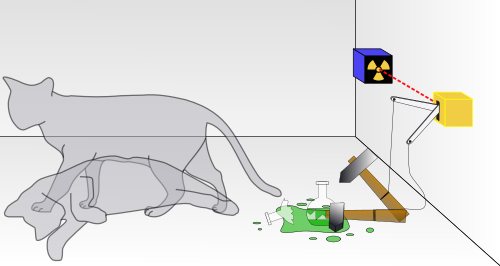
Schrödinger's Cat Thought Experiment
In a paper discussing the Copenhagen interpretation, Schrödinger devised the cat paradox—a cat simultaneously dead and alive—to highlight quantum superposition at macroscopic scales. #physics #quantum
Schrödinger's Cat Thought Experiment By Dhatfield - Own work, CC BY-SA 3.0, https://commons.wikimedia.org/w/index.php?curid=4279886
1936 CE
Returns to Austria: Graz Professorship
Back in Austria, Schrödinger accepted a position at the University of Graz. However, political tensions grew as Austria annexed by Nazi Germany in 1938. #physics #graz
Mar 12, 1938 CE
Anschluss: Forced to Flee Austria
After the Nazi annexation of Austria, Schrödinger was forced to leave his Graz post due to his anti-Nazi stance. He fled to Italy and then to the U.S. briefly before settling in Ireland. #physics #exile
Anschluss: Forced to Flee Austria By Heinrich Hoffmann - USA National Archive in Washington, D.C., Public domain, https://commons.wikimedia.org/w/index.php?curid=5261160
1939 CE
Joins Dublin Institute for Advanced Studies
Invited by Irish Taoiseach Éamon de Valera, Schrödinger became a professor at the newly founded Dublin Institute for Advanced Studies, where he would stay for 17 years. #physics #dublin
Joins Dublin Institute for Advanced Studies By Marc O'Sullivan - www.dias.ie, CC BY 4.0, https://commons.wikimedia.org/w/index.php?curid=73470846
1940 CE
Directory of Cosmic Physics at Dublin
He was appointed Director of the School of Cosmic Physics at the Dublin Institute, leading research on wave equations and unified field theory. #physics #cosmicphysics
1944 CE
Publishes 'What is Life?'
Schrödinger's influential book 'What is Life? The Physical Aspect of the Living Cell' explored the connection between quantum physics and biology, inspiring many scientists to pursue molecular biology. #biology #physics
1945 CE
Irish Citizenship
Schrödinger became a naturalized Irish citizen, though he retained his Austrian citizenship. He often expressed fondness for Ireland. #physics #ireland
Irish Citizenship By Éire - Drawn by User:SKopp, Public domain, https://commons.wikimedia.org/w/index.php?curid=343611
1949 CE
Elected Fellow of the Royal Society
He was elected a Fellow of the Royal Society for his contributions to quantum mechanics. #physics #royalsociety
Elected Fellow of the Royal Society By Royal Society uploader - Own work, CC BY-SA 4.0, https://commons.wikimedia.org/w/index.php?curid=34293939
1950 CE
Published 'Space-Time Structure'
Schrödinger published a book on general relativity and unified field theory, continuing his work on classical and quantum physics. #physics #relativity
1952 CE
Publication of 'Science and Humanism'
He published a collection of essays reflecting on the relationship between science and human values. #physics #philosophy
1955 CE
Retires from Dublin Institute
Schrödinger retired from his position at the Dublin Institute for Advanced Studies and returned to his native Austria. #physics #retirement
1956 CE
Returns to Vienna: Professorship Emeritus
He moved back to Vienna and was awarded an honorary professorship at the University of Vienna, spending his final years in the city. #physics #vienna
1957 CE
Recipient of the Pour le Mérite
He received the Pour le Mérite for Sciences and Arts, one of Germany's highest civil awards. #physics #award
Recipient of the Pour le Mérite By Borodun - Own work, CC BY-SA 4.0, https://commons.wikimedia.org/w/index.php?curid=57223967
Jan 4, 1961 CE
Death of Erwin Schrödinger
Erwin Schrödinger died in Vienna at the age of 73 of tuberculosis. He was buried in Alpbach, Tyrol. #physics #obituary