Encyclopedia/1. The Cosmos & The Natural World/1. Mathematics & Formal Systems/06. Number Theory & Cryptography • Curated by Admin Timeline.sg
Diophantine equations and modular forms are central to number theory, with roots in ancient Greek mathematics and evolving through Islamic, European, and modern developments, culminating in the proof of Fermat's Last Theorem and deep connections to elliptic curves.
Chronological Storyline (43 Milestones)
250 BCE
Diophantus Writes Arithmetica
Greek mathematician Diophantus of Alexandria compiles Arithmetica, a seminal work on solving polynomial equations with integer solutions, laying the foundation for Diophantine equations. #mathematics #history
499 CE
Aryabhata's Integer Solutions
Indian mathematician Aryabhata in his Aryabhatiya presents methods for solving linear Diophantine equations using the kuttaka (pulverizer) algorithm, an early approach to integer solutions. #mathematics #india
Aryabhata's Integer Solutions By Cpjha13 - Own work, CC BY-SA 4.0, https://commons.wikimedia.org/w/index.php?curid=49883192
820 CE
Al-Khwarizmi's Algebra
Persian scholar Al-Khwarizmi writes Al-Kitab al-Mukhtasar, systematically solving linear and quadratic equations, influencing later Diophantine analysis. #mathematics #islamicgoldenage
Al-Khwarizmi's Algebra By Zarateman - Own work, CC0, https://commons.wikimedia.org/w/index.php?curid=162213187
1202 CE
Fibonacci's Liber Abaci
Fibonacci introduces Hindu-Arabic numerals and presents Diophantine problems, including systems of equations, spreading algebraic methods in Europe. #mathematics #europe
Fibonacci's Liber Abaci By Unknown author, Public domain, https://commons.wikimedia.org/w/index.php?curid=720501
1637 CE
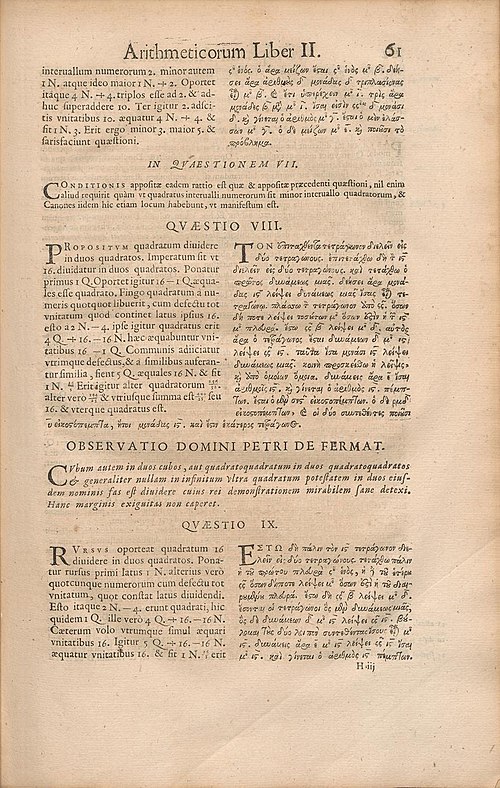
Fermat's Last Theorem Conjectured
Pierre de Fermat claims that no three positive integers satisfy a^n + b^n = c^n for n>2, writing a marginal note in his copy of Arithmetica, spurring centuries of effort. #mathematics #history
Fermat's Last Theorem Conjectured By Unknown author, Public domain, https://commons.wikimedia.org/w/index.php?curid=533640
1753 CE
Euler Solves n=4 Case
Leonhard Euler proves Fermat's Last Theorem for n=4 using infinite descent, a key Diophantine method. #mathematics #numbertheory
Euler Solves n=4 Case By Jakob Emanuel Handmann - This file was derived from: Leonhard Euler.jpg Edited by: Bammesk Original source: Kunstmuseum Basel, Public domain, https://commons.wikimedia.org/w/index.php?curid=113056351
1801 CE
Gauss's Disquisitiones Arithmeticae
Carl Friedrich Gauss publishes Disquisitiones Arithmeticae, establishing modern number theory and introducing modular arithmetic, fundamental to modular forms. #mathematics #numbertheory
Gauss's Disquisitiones Arithmeticae By Unknown author, Public domain, https://commons.wikimedia.org/w/index.php?curid=641724
1823 CE
Sophie Germain's Work on FLT
Sophie Germain proves a case of Fermat's Last Theorem for primes where 2p+1 is also prime, pioneering modular forms and number theory. #mathematics #womeninstem
Sophie Germain's Work on FLT By s:fr:Auteur:Sophie Germain - Bibliothèque nationale de France, Public domain, https://commons.wikimedia.org/w/index.php?curid=53372327
1825 CE
Dirichlet and Legendre Prove n=5
Peter Gustav Lejeune Dirichlet and Adrien-Marie Legendre independently prove Fermat's Last Theorem for n=5, using advanced modular techniques. #mathematics #numbertheory
1837 CE
Dirichlet's Theorem on Arithmetic Progressions
Dirichlet proves infinitely many primes in arithmetic progressions using L-functions, a precursor to modular form L-functions. #mathematics #numbertheory
Dirichlet's Theorem on Arithmetic Progressions By Unknown author - http://www.york.ac.uk/depts/maths/histstat/people/, Public domain, https://commons.wikimedia.org/w/index.php?curid=2914309
1840 CE
Lamé Proves n=7, Incorrectly
Gabriel Lamé claims a proof for n=7 but later found flawed; his attempt spurs more rigorous approaches. #mathematics #history
1847 CE
Kummer's Ideal Numbers
Ernst Kummer introduces ideal numbers to rescue a flawed proof of FLT, creating algebraic number theory and influencing modular forms. #mathematics #numbertheory
Kummer's Ideal Numbers By Unknown author - https://veryimportantlot.com/fr/overview/author/artist-ernst-eduard-kummer-1810-1893#artist, Public domain, https://commons.wikimedia.org/w/index.php?curid=185413544
1850 CE
Eisenstein Series Defined
Gotthold Eisenstein introduces Eisenstein series, key building blocks of modular forms. #mathematics #modularforms
1860 CE
Riemann Zeta Function
Bernhard Riemann's memoir on the zeta function connects analytic number theory to modular forms, influencing later conjectures. #mathematics #numbertheory
Riemann Zeta Function By Nschloe - Own work, CC BY-SA 4.0, https://commons.wikimedia.org/w/index.php?curid=112207479
1874 CE
Dedekind Eta Function
Richard Dedekind introduces the Dedekind eta function, a modular form of weight 1/2, crucial in partition theory. #mathematics #modularforms
1877 CE
Klein's Modular Forms
Felix Klein studies modular forms associated with the modular group, introducing the j-invariant. #mathematics #modularforms
1892 CE
Poincaré's Automorphic Forms
Henri Poincaré develops the theory of automorphic forms, generalizing modular forms to discrete subgroups. #mathematics #automorphicforms
1900 CE
Hilbert's Tenth Problem
David Hilbert poses the solvability of Diophantine equations as the 10th problem, later shown undecidable. #mathematics #logic
1913 CE
Ramanujan's Modular Forms Discoveries
Srinivasa Ramanujan sends a letter to Hardy with identities on theta functions and modular forms, revolutionizing the field. #mathematics #india
Ramanujan's Modular Forms Discoveries By Unknown author - https://mss-cat.trin.cam.ac.uk/manuscripts/uv/view.php?n=Add.Ms.a.94.7#?c=0&m=0&s=0&cv=6&xywh=-2849%2C-273%2C9238%2C5258, CC BY 4.0, https://commons.wikimedia.org/w/index.php?curid=153767257
1916 CE
Ramanujan's Tau Function
Ramanujan defines the tau function and conjectures its multiplicativity, later proven and linked to modular forms. #mathematics #modularforms
Ramanujan's Tau Function By Alfred E. Neumann 1 - Own work, CC BY-SA 3.0, https://commons.wikimedia.org/w/index.php?curid=23581665
1926 CE
Hecke Operators Introduced
Erich Hecke develops Hecke operators, a powerful tool for study of modular forms and L-functions. #mathematics #modularforms
1937 CE
Hecke's Theory of Modular Forms
Hecke publishes his foundational work on modular forms of weight k, establishing the theory of newforms. #mathematics #modularforms
1940 CE
Weil Conjectures Proposed
André Weil conjectures deep connections between zeta functions of varieties and algebraic topology, influencing modular forms. #mathematics #algebraicgeometry
1950 CE
Modular Forms and Elliptic Curves Link
Martin Eichler and Goro Shimura discover a relationship between modular forms and elliptic curves, laying groundwork for the Taniyama–Shimura conjecture. #mathematics #numbertheory
1955 CE
Taniyama–Shimura Conjecture Formulated
Yutaka Taniyama and Goro Shimura propose that every elliptic curve over Q is modular, later crucial for Wiles' proof. #mathematics #numbertheory
1957 CE
Weil's Conjectures for Curves Proved
André Weil proves his conjectures for curves, reinforcing connections between zeta functions and modular forms. #mathematics #algebraicgeometry
1965 CE
Deligne Proves Ramanujan's Tau Conjecture
Pierre Deligne proves Ramanujan's tau conjecture using algebraic geometry and Weil conjectures, linking modular forms to motives. #mathematics #modularforms
1967 CE
Langlands Program Initiated
Robert Langlands outlines a vast web of conjectures connecting automorphic forms (including modular forms) to number theory and representation theory. #mathematics #langlands
1970 CE
Diophantine Equations Undecidable
Yuri Matiyasevich, building on work of Davis and Robinson, proves Hilbert's 10th problem is unsolvable: no algorithm exists for all Diophantine equations. #mathematics #logic
1975 CE
Mordell's Conjecture Proved by Faltings
Gerd Faltings proves the Mordell conjecture (Faltings' theorem) that curves of genus >1 have finitely many rational points, limiting Diophantine solutions. #mathematics #numbertheory
Mordell's Conjecture Proved by Faltings By Renate Schmid - https://opc.mfo.de/detail?photoID=7513, CC BY-SA 2.0 de, https://commons.wikimedia.org/w/index.php?curid=5427105
1983 CE
Faltings Proves Mordell Conjecture
Gerd Faltings proves the Mordell conjecture (Faltings' theorem) that curves of genus >1 have finitely many rational points, limiting Diophantine solutions. #mathematics #numbertheory
1985 CE
Frey's Elliptic Curve and FLT
Gerhard Frey suggests that Fermat's Last Theorem would follow from the Taniyama–Shimura conjecture, linking Diophantine equations to modular forms. #mathematics #numbertheory
1986 CE
Ribet Proves Epsilon Conjecture
Kenneth Ribet proves the epsilon conjecture, showing that FLT is a consequence of modularity of semistable elliptic curves. #mathematics #numbertheory
Jun 23, 1993 CE
Wiles Announces Proof of FLT
Andrew Wiles presents a proof of Fermat's Last Theorem at a Cambridge conference, later found to have a gap. #mathematics #history
Wiles Announces Proof of FLT By "copyright C. J. Mozzochi, Princeton N.J" - http://www.mozzochi.org/deligne60/Deligne1/_DSC0024.jpg, Attribution, https://commons.wikimedia.org/w/index.php?curid=2635913
Sep 19, 1994 CE
Wiles and Taylor Fix the Proof
Andrew Wiles, with Richard Taylor, corrects the gap using the theory of Hecke algebras, completing the proof of FLT. #mathematics #numbertheory
1995 CE
Modularity Theorem Proven (in part)
Christophe Breuil, Brian Conrad, Fred Diamond, and Richard Taylor prove the full modularity theorem for all elliptic curves over Q. #mathematics #modularforms
1996 CE
Wiles Awarded Fermat Prize
Andrew Wiles receives the Fermat Prize for his proof of Fermat's Last Theorem, highlighting the triumph of Diophantine and modular methods. #mathematics #awards
2001 CE
Full Modularity Theorem Proved
Breuil, Conrad, Diamond, and Taylor complete the proof that all elliptic curves over Q are modular, a key milestone. #mathematics #modularforms
2005 CE
Bhargava's Higher Composition Laws
Manjul Bhargava develops new composition laws for quadratic forms, connecting classical Diophantine equations to modern number theory. #mathematics #numbertheory
Bhargava's Higher Composition Laws By IMU - http://www.mathunion.org/general/prizes/2014, FAL, https://commons.wikimedia.org/w/index.php?curid=35855138
2012 CE
Zhang's Prime Gap Result
Yitang Zhang proves bounded gaps between primes using analytic number theory and modular forms, a Diophantine breakthrough. #mathematics #numbertheory
Zhang's Prime Gap Result By VOA - http://www.voachinese.com/media/video/i-america-math-zhang-yitang-20131204/1803128.html, Public domain, https://commons.wikimedia.org/w/index.php?curid=33336006
2015 CE
Modular Forms in Cryptography
Cryptographic protocols using pairing-based cryptography rely on modular forms and elliptic curves, showcasing real-world applications. #cryptography #mathematics
2018 CE
Langlands Correspondence Advances
Vincent Lafforgue proves the Langlands correspondence for function fields using modular forms techniques, a major step. #mathematics #langlands
Langlands Correspondence Advances By ICM 2018 - https://www.flickr.com/photos/icm_2018/44497909931/, Public domain, https://commons.wikimedia.org/w/index.php?curid=108702196
2020 CE
Perfectoid Spaces and Diophantine Geometry
Peter Scholze develops perfectoid spaces, revolutionizing Diophantine geometry and p-adic modular forms. #mathematics #numbertheory