Differential Equations & Dynamical Systems: Newton to Chaos Theory
Encyclopedia/1. The Cosmos & The Natural World/1. Mathematics & Formal Systems/10. Differential Equations & Dynamical Systems • Curated by Admin Timeline.sg
The mathematical modeling of change: Newton's fluxional equations, Fourier heat equations, Navier-Stokes fluid equations, Poincaré three-body problem, and Lorenz butterfly chaos.
Chronological Storyline (44 Milestones)
1687 CE
Newton Publishes Principia Mathematica
Isaac Newton publishes Philosophiæ Naturalis Principia Mathematica, introducing his laws of motion and universal gravitation, which are formulated using differential equations (fluxions). This work lays the foundation for classical mechanics and differential equations. #mathematics #physics
Newton Publishes Principia Mathematica By The original uploader was Zhaladshar at English Wikisource. - Transferred from en.wikisource to Commons. (previous image from another copy) Internet Archive (current image from the Bern Dibner copy), Public domain, https://commons.wikimedia.org/w/index.php?curid=2681838
1693 CE
Newton Publishes Method of Fluxions
Newton's treatise on calculus, Method of Fluxions, is published posthumously, detailing his approach to differential equations and the concept of fluxions (derivatives). This work formalizes the use of differential equations in physics. #mathematics #calculus
Newton Publishes Method of Fluxions By Isaac Newton - File:The method of fluxions and infinite series.djvu, Public domain, https://commons.wikimedia.org/w/index.php?curid=54955387
1736 CE
Euler Publishes Mechanica
Leonhard Euler publishes Mechanica, which applies differential equations to the motion of rigid bodies, introducing Euler's equations of motion. This work advances the field of analytical mechanics. #mathematics #physics
1743 CE
d'Alembert Publishes Traité de Dynamique
Jean le Rond d'Alembert publishes Traité de Dynamique, introducing d'Alembert's principle, which reformulates Newton's laws into a differential equation form. This work influences the development of analytical mechanics. #mathematics #physics
1748 CE
Euler Publishes Introductio in Analysin Infinitorum
Euler publishes Introductio in Analysin Infinitorum, a foundational text on analysis that includes the study of differential equations and introduces the concept of the exponential function. #mathematics #analysis
Euler Publishes Introductio in Analysin Infinitorum By Cronholm144 at English Wikipedia - Transferred from en.wikipedia to Commons., CC BY-SA 3.0, https://commons.wikimedia.org/w/index.php?curid=3128774
1760 CE
Lagrange Develops Calculus of Variations
Joseph-Louis Lagrange develops the calculus of variations, leading to the Euler-Lagrange equation, a differential equation that describes the path of least action. This becomes a cornerstone of classical mechanics. #mathematics #physics
1788 CE
Lagrange Publishes Mécanique Analytique
Lagrange publishes Mécanique Analytique, a comprehensive work on analytical mechanics that uses differential equations and variational principles, without geometric diagrams. It unifies mechanics through Lagrangian mechanics. #mathematics #physics
Lagrange Publishes Mécanique Analytique By Joseph-Louis Lagrange - https://libserv.aip.org/ipac20/ipac.jsp?session=IR67574T35919.44001&profile=rev-nbl&source=~!horizon&view=subscriptionsummary&uri=full=3100006~!44233~!15&ri=5&aspect=power&menu=search&ipp=20&spp=20&staffonly=&term=M?anique+Analytique&index=.GW&uindex=&aspect=power&menu=search&ri=5, Public domain, https://commons.wikimedia.org/w/index.php?curid=125029899
1807 CE
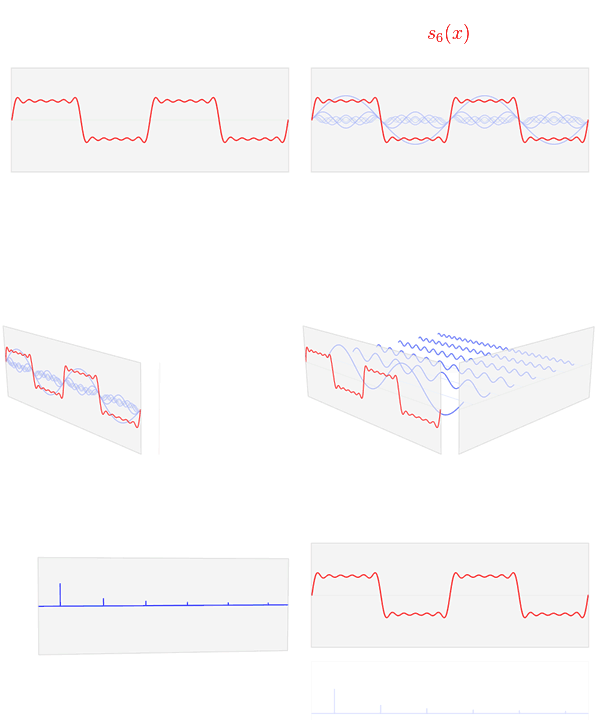
Fourier Presents Heat Equation Solution
Joseph Fourier presents his work on the heat equation to the Institut de France, introducing Fourier series to solve partial differential equations. This revolutionizes the study of heat conduction and mathematical physics. #mathematics #physics
Fourier Presents Heat Equation Solution By Lucas Vieira - File:Fourier transform time and frequency domains (small).gif, CC0, https://commons.wikimedia.org/w/index.php?curid=28399050
1822 CE
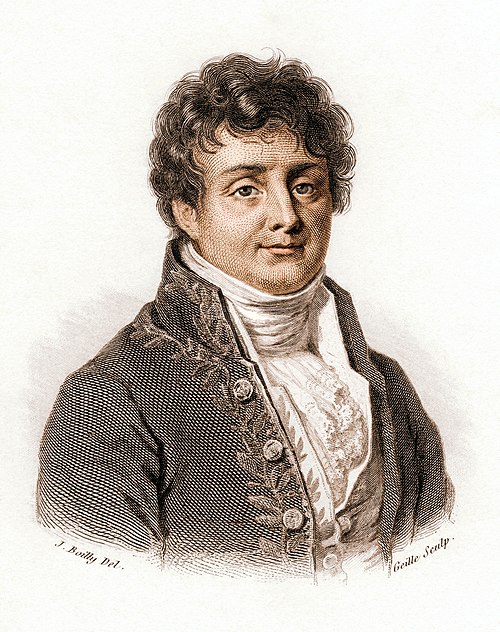
Fourier Publishes Théorie Analytique de la Chaleur
Fourier publishes Théorie Analytique de la Chaleur, which fully develops the Fourier series and the heat equation, establishing the field of Fourier analysis. This work has profound impacts on engineering and physics. #mathematics #physics
Fourier Publishes Théorie Analytique de la Chaleur By Julien-Léopold Boilly - This file was derived from: Fourier2.jpg Restored by: Bammesk Original source: https://www.gettyimages.com.au/license/169251384 https://wellcomecollection.org/works/b4qh352u, Public domain, https://commons.wikimedia.org/w/index.php?curid=114366437
1824 CE
Navier Derives Navier-Stokes Equations
Claude-Louis Navier derives the Navier-Stokes equations for fluid flow, incorporating viscosity. These partial differential equations become fundamental in fluid dynamics and are still a focus of research today. #mathematics #physics
1837 CE
Poisson Publishes on Heat and Elasticity
Siméon Denis Poisson publishes works on heat conduction and elasticity, using partial differential equations. His contributions include Poisson's equation, which appears in electrostatics and gravitation. #mathematics #physics
Poisson Publishes on Heat and Elasticity By François-Séraphin Delpech / After Nicolas Eustache Maurin - This image has been extracted from another file, Public domain, https://commons.wikimedia.org/w/index.php?curid=536305
1845 CE
Stokes Publishes Paper on Fluid Motion
George Gabriel Stokes publishes a paper on the motion of viscous fluids, refining the Navier-Stokes equations. This work solidifies the mathematical foundation for fluid dynamics. #mathematics #physics
1854 CE
Riemann Introduces Riemannian Geometry
Bernhard Riemann presents his habilitation lecture on the foundations of geometry, introducing Riemannian geometry, which later becomes essential for Einstein's general relativity and differential equations on manifolds. #mathematics #geometry
1864 CE
Maxwell Publishes Electromagnetic Equations
James Clerk Maxwell publishes A Dynamical Theory of the Electromagnetic Field, presenting Maxwell's equations, a system of partial differential equations that unify electricity and magnetism. This is a landmark in mathematical physics. #physics #mathematics
Maxwell Publishes Electromagnetic Equations By FF-UK - Own work, CC BY-SA 4.0, https://commons.wikimedia.org/w/index.php?curid=59542523
1889 CE
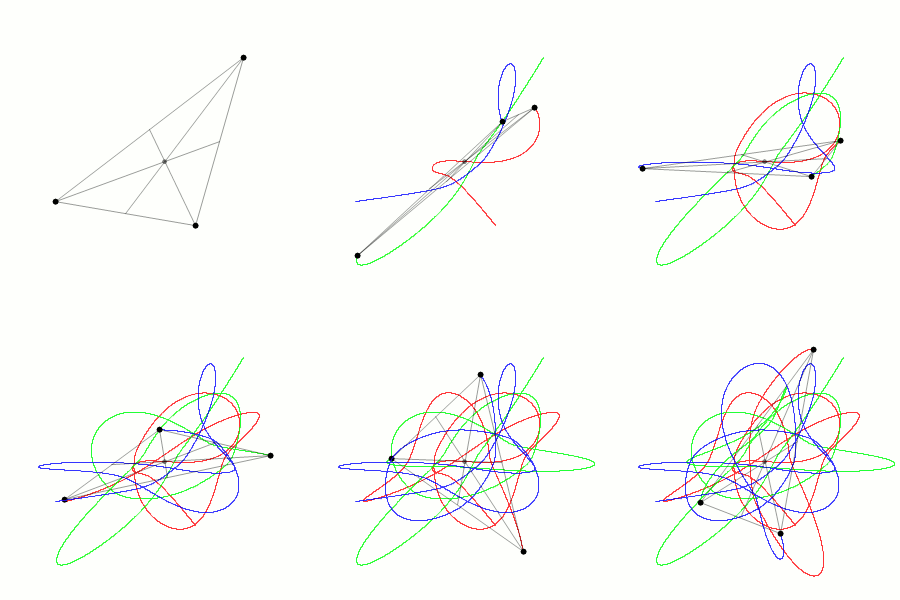
Poincaré Wins King Oscar II Prize
Henri Poincaré wins the King Oscar II Prize for his work on the three-body problem, showing that the gravitational interaction of three bodies leads to chaotic behavior. This is a foundational result in dynamical systems and chaos theory. #mathematics #physics
Poincaré Wins King Oscar II Prize By Dnttllthmmnm - Own work, CC BY-SA 4.0, https://commons.wikimedia.org/w/index.php?curid=59538221
1892 CE
Poincaré Publishes Les Méthodes Nouvelles de la Mécanique Céleste
Poincaré publishes the first volume of Les Méthodes Nouvelles de la Mécanique Céleste, introducing qualitative methods for differential equations and the concept of homoclinic tangles, a precursor to chaos theory. #mathematics #astronomy
1899 CE
Poincaré Publishes Volume 3 of Celestial Mechanics
Poincaré completes his three-volume work on celestial mechanics, further developing the theory of dynamical systems and the stability of the solar system. #mathematics #astronomy
1900 CE
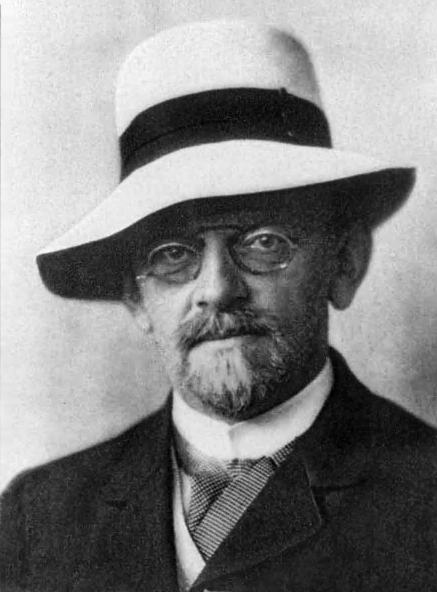
Hilbert Poses 23 Problems
David Hilbert presents his list of 23 unsolved problems at the International Congress of Mathematicians, including problems related to differential equations and dynamical systems, such as the 16th problem on limit cycles. #mathematics
Hilbert Poses 23 Problems By Unknown author - Possibly Reid, Constance (1970) Hilbert, Berlin, Heidelberg: Springer Berlin Heidelberg Imprint Springer, p. 230 ISBN: 978-3-662-27132-2., Public domain, https://commons.wikimedia.org/w/index.php?curid=36302
1908 CE
Hadamard Studies Geodesic Flow
Jacques Hadamard publishes a paper on geodesic flow on surfaces of negative curvature, demonstrating chaotic behavior in a deterministic system. This is an early example of chaos in dynamical systems. #mathematics #dynamics
Hadamard Studies Geodesic Flow By WatchduckYou can name the author as "T. Piesk", "Tilman Piesk" or "Watchduck". - Own work, CC BY-SA 4.0, https://commons.wikimedia.org/w/index.php?curid=121360842
1913 CE
Birkhoff Proves Poincaré's Last Geometric Theorem
George David Birkhoff proves Poincaré's last geometric theorem, a result in dynamical systems about the existence of periodic orbits in the restricted three-body problem. This advances the qualitative theory of differential equations. #mathematics #dynamics
1927 CE
Birkhoff Publishes Dynamical Systems
Birkhoff publishes Dynamical Systems, a seminal book that systematizes the qualitative theory of differential equations and introduces the concept of the Birkhoff ergodic theorem. #mathematics #dynamics
Birkhoff Publishes Dynamical Systems By Wikimol, Dschwen - Own work based on: images Lorenz system r28 s10 b2-6666.png by Wikimol and Lorenz attractor.svg by Dschwen, CC BY-SA 3.0, https://commons.wikimedia.org/w/index.php?curid=495592
1937 CE
Andronov and Pontryagin Introduce Structural Stability
Aleksandr Andronov and Lev Pontryagin introduce the concept of structural stability in dynamical systems, a key idea in understanding how systems behave under small perturbations. #mathematics #dynamics
1942 CE
Krylov and Bogoliubov Develop Averaging Method
Nikolay Krylov and Nikolay Bogoliubov develop the method of averaging for nonlinear differential equations, a technique widely used in perturbation theory and dynamical systems. #mathematics #dynamics
1954 CE
Kolmogorov Proposes KAM Theory
Andrey Kolmogorov presents a paper at the International Congress of Mathematicians outlining the ideas that become KAM theory, which explains the persistence of quasi-periodic motions under small perturbations in Hamiltonian systems. #mathematics #physics
1963 CE
Lorenz Publishes Deterministic Nonperiodic Flow
Edward Lorenz publishes 'Deterministic Nonperiodic Flow' in the Journal of the Atmospheric Sciences, describing the Lorenz attractor and the butterfly effect, a landmark in chaos theory. #mathematics #chaos
Lorenz Publishes Deterministic Nonperiodic Flow By Dan Quinn - Own work, CC BY-SA 3.0, https://commons.wikimedia.org/w/index.php?curid=29370723
1967 CE
Smale Proves Horseshoe Map
Stephen Smale introduces the Smale horseshoe map, a key example of chaotic dynamics in a deterministic system, demonstrating the existence of an invariant set with infinitely many periodic points. #mathematics #dynamics
Smale Proves Horseshoe Map By SyntaxError55 at English Wikipedia - Transferred from en.wikipedia to Commons by IngerAlHaosului using CommonsHelper., CC BY-SA 3.0, https://commons.wikimedia.org/w/index.php?curid=9017281
1971 CE
Ruelle and Takens Propose Strange Attractors
David Ruelle and Floris Takens publish 'On the Nature of Turbulence', introducing the concept of strange attractors to describe chaotic behavior in fluid dynamics. #mathematics #physics
Ruelle and Takens Propose Strange Attractors By Bvsydow - Own work, CC BY-SA 4.0, https://commons.wikimedia.org/w/index.php?curid=103472067
1975 CE
Li and Yorke Coin 'Chaos'
Tien-Yien Li and James A. Yorke publish 'Period Three Implies Chaos', coining the term 'chaos' in mathematics and proving that a simple logistic map can exhibit chaotic behavior. #mathematics #chaos
1976 CE
May Studies Logistic Map in Population Biology
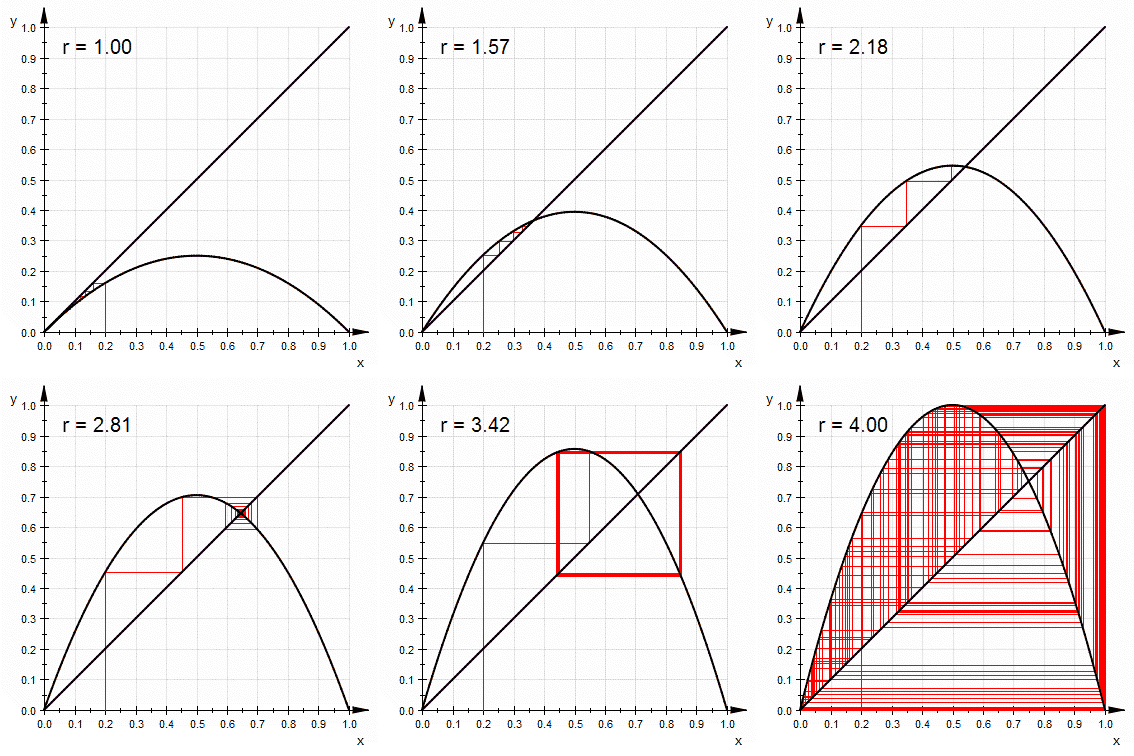
Robert May publishes a paper in Nature showing that the logistic map, a simple nonlinear difference equation, can produce chaotic dynamics, influencing population biology and chaos theory. #mathematics #biology
May Studies Logistic Map in Population Biology By Sam Derbyshire at English Wikipedia - Transferred from en.wikipedia to Commons by Derlay using CommonsHelper., CC BY-SA 3.0, https://commons.wikimedia.org/w/index.php?curid=10405115
1977 CE
Feigenbaum Discovers Universality
Mitchell Feigenbaum discovers the Feigenbaum constants, universal scaling laws in period-doubling cascades to chaos, a major breakthrough in chaos theory. #mathematics #physics
Feigenbaum Discovers Universality By Jarosław Bielak - pl:, uploaded by Claudemonet, CC BY 2.5, https://commons.wikimedia.org/w/index.php?curid=1250389
1980 CE
Mandelbrot Publishes The Fractal Geometry of Nature
Benoit Mandelbrot publishes The Fractal Geometry of Nature, linking fractals to chaos theory and dynamical systems, with the Mandelbrot set becoming an iconic image. #mathematics #fractals
1983 CE
Grebogi, Ott, and Yorke Develop OGY Control
Edward Ott, Celso Grebogi, and James A. Yorke develop the OGY method for controlling chaos, a technique to stabilize unstable periodic orbits in chaotic systems. #mathematics #engineering
1986 CE
Parrondo's Paradox Discovered
Juan Parrondo discovers Parrondo's paradox, where two losing games can combine to produce a winning outcome, illustrating counterintuitive behavior in dynamical systems. #mathematics #probability
1990 CE
Pecora and Carroll Achieve Chaos Synchronization
Louis Pecora and Thomas Carroll demonstrate synchronization of chaotic systems, a phenomenon with applications in secure communications and laser dynamics. #mathematics #physics
1993 CE
Chua's Circuit Introduced
Leon Chua introduces Chua's circuit, a simple electronic circuit that exhibits chaotic behavior, becoming a standard model for studying chaos in engineering. #engineering #chaos
Chua's Circuit Introduced By Chetvorno - Own work, CC0, https://commons.wikimedia.org/w/index.php?curid=31049859
1994 CE
Wiggins Publishes Introduction to Applied Nonlinear Dynamical Systems
Stephen Wiggins publishes a comprehensive textbook on nonlinear dynamical systems and chaos, widely used in graduate education. #mathematics #education
1998 CE
Strogatz Publishes Sync
Steven Strogatz publishes Sync: The Emerging Science of Spontaneous Order, popularizing the study of synchronization in dynamical systems, from fireflies to Josephson junctions. #mathematics #science )
2000 CE
Clay Institute Poses Navier-Stokes Millennium Problem
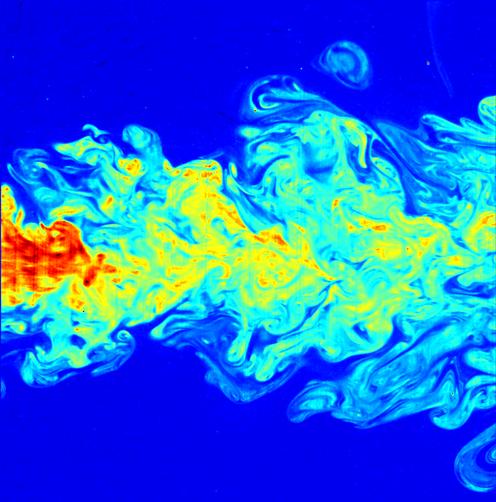
The Clay Mathematics Institute lists the Navier-Stokes existence and smoothness problem as one of its seven Millennium Prize Problems, highlighting its importance in mathematics and physics. #mathematics #physics
Clay Institute Poses Navier-Stokes Millennium Problem By C. Fukushima and J. Westerweel, Technical University of Delft, The Netherlands - Own work, CC BY 3.0, https://commons.wikimedia.org/w/index.php?curid=3082535
2002 CE
Perelman Proves Poincaré Conjecture
Grigori Perelman posts a proof of the Poincaré conjecture using Ricci flow, a partial differential equation, solving a century-old problem in topology and differential equations. #mathematics #topology
2004 CE
Kuramoto Model Studied for Synchronization
The Kuramoto model, a system of coupled oscillators, becomes a paradigmatic model for synchronization in dynamical systems, with applications in neuroscience and physics. #mathematics #physics
2010 CE
Hasselblatt and Katok Publish Handbook of Dynamical Systems
The Handbook of Dynamical Systems, edited by Boris Hasselblatt and Anatole Katok, provides a comprehensive reference on the state of the art in dynamical systems theory. #mathematics #reference
2014 CE
Machine Learning Applied to Dynamical Systems
Researchers begin applying machine learning techniques, such as reservoir computing, to predict and model chaotic dynamical systems, opening new avenues for data-driven dynamics. #mathematics #AI
2018 CE
Deep Learning Solves High-Dimensional PDEs
Deep learning methods, such as physics-informed neural networks, are developed to solve high-dimensional partial differential equations, revolutionizing computational differential equations. #mathematics #AI
Deep Learning Solves High-Dimensional PDEs By Riccardo Munafò - Own work, CC BY-SA 4.0, https://commons.wikimedia.org/w/index.php?curid=106672278
2020 CE
COVID-19 Modeling Uses Differential Equations
Differential equation models, such as SIR and SEIR, are widely used to model the COVID-19 pandemic, demonstrating the ongoing relevance of dynamical systems in public health. #mathematics #epidemiology