Deng Xiaoping: Architect of Modern China's Reforms
Encyclopedia/6. Governance, Politics & Economy/3. Law, Politics & International Relations/03. Political & Legal Biographies • Curated by Admin Timeline.sg
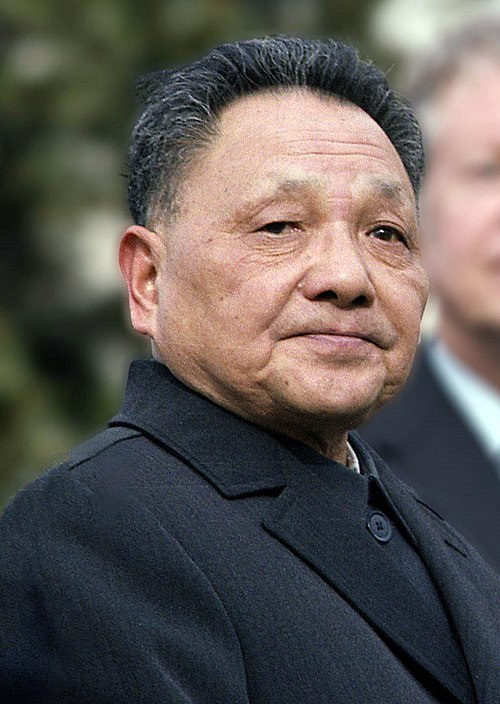
Deng Xiaoping (1904–1997) was a paramount leader of China who spearheaded economic reforms and opening-up policies from 1978, transforming China into a global economic powerhouse. His key initiatives included the establishment of Special Economic Zones, the 'One Country, Two Systems' framework for Hong Kong, and the 1992 Southern Tour to reaffirm reformist policies.
Chronological Storyline (32 Milestones)
Aug 22, 1904 CE
Birth of Deng Xiaoping
Deng Xiaoping was born in Guang'an, Sichuan province, China. He would later become the paramount leader of China and architect of its economic reforms. #China #Biography
Birth of Deng Xiaoping By Unknown author - This tag does not indicate the copyright status of the attached work. A normal copyright tag is still required. See Commons:Licensing., Public domain, https://commons.wikimedia.org/w/index.php?curid=118539852
1920 CE
Deng Xiaoping Goes to France
Deng traveled to France under a work-study program, where he was exposed to Marxist ideas and joined the Chinese Communist Party (CCP). This experience shaped his revolutionary outlook. #China #Revolution
1926 CE
Deng Studies in Moscow
Deng studied at the Communist University of the Toilers of the East in Moscow, deepening his understanding of Marxism-Leninism. He returned to China to participate in revolutionary activities. #China #Communism
1929 CE
Deng Leads Baise Uprising
Deng co-led the Baise Uprising in Guangxi, establishing a short-lived Soviet area. This demonstrated his early military and organizational skills. #China #Revolution
Deng Leads Baise Uprising By N509FZ - Own work, CC BY-SA 4.0, https://commons.wikimedia.org/w/index.php?curid=130480839
Oct 1, 1934 CE
Deng Participates in the Long March
Deng joined the Long March, the CCP's strategic retreat from Nationalist forces. He served as a political commissar and later as editor of the Red Army newspaper. #China #LongMarch
Deng Participates in the Long March By Chinese_civil_war_map_03.jpg: User:Guimard derivative work: Rowanwindwhistler (talk) - LaLargaMarcha19341935.svg by Rowanwindwhistler., CC BY-SA 3.0, https://commons.wikimedia.org/w/index.php?curid=45277819
1937 CE
Deng Serves in the Second Sino-Japanese War
During the war, Deng held key political and military positions, including political commissar of the 129th Division. He helped expand CCP-controlled areas. #China #War
Deng Serves in the Second Sino-Japanese War By Unknown photographer, Ministry of the Navy - Brent Jones: Rising Sun in the East 1937, Public domain, https://commons.wikimedia.org/w/index.php?curid=27384072
1945 CE
Deng Elected to CCP Central Committee
At the 7th CCP National Congress, Deng was elected to the Central Committee, marking his rise in the party hierarchy. #China #Politics
Deng Elected to CCP Central Committee By 不详 - http://www.ynfumin.gov.cn/ynjc/723953640099807232/20060630/49341.html, Public domain, https://commons.wikimedia.org/w/index.php?curid=9892140
Oct 1, 1949 CE
Deng Helps Establish People's Republic
Deng played a key role in the Chinese Civil War victory and the founding of the People's Republic. He was appointed to important posts in Southwest China. #China #History
Deng Helps Establish People's Republic By Unknown author - https://www.suibe.edu.cn/ztjy/2021/0330/c17572a136175/page.psp, Public domain, https://commons.wikimedia.org/w/index.php?curid=168068981
1952 CE
Deng Becomes Vice Premier
Deng was appointed Vice Premier of the State Council, overseeing economic planning. He supported moderate policies during the early socialist transformation. #China #Economy
Sep 1, 1956 CE
Deng Becomes CCP General Secretary
At the 8th CCP Congress, Deng was elected General Secretary, becoming a key figure in the party's daily operations. He advocated for collective leadership. #China #Politics
Deng Becomes CCP General Secretary By 齐观山 吕厚民 - 《新闻摄影选集》上海人民美术出版社 1957.09, Public domain, https://commons.wikimedia.org/w/index.php?curid=41691238
1966 CE
Deng Purged During Cultural Revolution
Deng was labeled a 'capitalist roader' and purged from his posts. He was sent to work in a tractor factory in Jiangxi, enduring hardship. #China #CulturalRevolution
1973 CE
Deng Rehabilitated and Returns to Power
Premier Zhou Enlai facilitated Deng's rehabilitation. Deng resumed his posts as Vice Premier and began to rectify the economy and military. #China #Politics
1975 CE
Deng Leads Comprehensive Rectification
Deng initiated reforms in industry, agriculture, and education to counter Cultural Revolution excesses. His efforts were interrupted by a second purge in 1976. #China #Reform
Apr 1, 1976 CE
Deng Purged Again After Tiananmen Incident
Following the Tiananmen Incident (1976), Deng was accused of supporting protesters and was stripped of his posts. He went into hiding. #China #Politics
Jul 1, 1977 CE
Deng Rehabilitated Again
After Mao's death and the fall of the Gang of Four, Deng was reinstated to all his positions. He began to consolidate power and plan reforms. #China #Politics
Dec 18, 1978 CE
Third Plenum of the 11th Central Committee
This landmark meeting marked the beginning of China's reform and opening-up. Deng shifted the focus from class struggle to economic modernization. #China #Reform
Jan 1, 1979 CE
China Establishes Diplomatic Relations with US
Deng's policy of opening up led to normalized relations with the United States. This facilitated trade, technology transfer, and investment. #China #Diplomacy
China Establishes Diplomatic Relations with US By Canuckguy et al., amended by en:User:Bazonka, The original uploader was Bazonka at English Wikipedia. - Transferred from en.wikipedia to Commons. Image based on File:BlankMap-World6, compact.svg, Public domain, https://commons.wikimedia.org/w/index.php?curid=32926087
Jan 28, 1979 CE
Deng Visits the United States
Deng became the first senior Chinese leader to visit the US since 1949. His trip symbolized China's new openness and sought American support for modernization. #China #Diplomacy
Jul 1, 1979 CE
Shenzhen Designated as Special Economic Zone
Shenzhen was chosen as one of the first SEZs to experiment with market-oriented reforms. It became a symbol of China's economic transformation. #China #Economy
Shenzhen Designated as Special Economic Zone By Steve Jurvetson from Menlo Park, USA - glue works Uploaded by Zolo, CC BY 2.0, https://commons.wikimedia.org/w/index.php?curid=9968048
1980 CE
Household Responsibility System Introduced
Deng supported decollectivization in agriculture, allowing farmers to lease land and sell surplus produce. This boosted agricultural productivity and rural incomes. #China #Agriculture
Household Responsibility System Introduced By luchangjiang~鲁昌江 - https://web.archive.org/web/20161014223854/http://www.panoramio.com/photo/30240781, CC BY-SA 3.0, https://commons.wikimedia.org/w/index.php?curid=52726279
Jun 1, 1981 CE
Deng Becomes Chairman of the Central Military Commission
Deng assumed leadership of the military, consolidating his authority. He oversaw military modernization and downsizing. #China #Military
Deng Becomes Chairman of the Central Military Commission By Netson - Own work, CC BY-SA 4.0, https://commons.wikimedia.org/w/index.php?curid=1316673
Sep 1, 1982 CE
Deng Proposes 'One Country, Two Systems'
Deng articulated the concept to reunify with Hong Kong, Macau, and Taiwan. It allowed these regions to maintain their capitalist systems under Chinese sovereignty. #China #Policy
Deng Proposes 'One Country, Two Systems' By luchangjiang~鲁昌江 - https://web.archive.org/web/20161015162955/http://www.panoramio.com/photo/37213068, CC BY-SA 3.0, https://commons.wikimedia.org/w/index.php?curid=54112186
Jan 1, 1984 CE
Deng Tours Shenzhen and Southern China
Deng's first Southern Tour reaffirmed support for SEZs and reforms. He famously wrote 'The development of Shenzhen is evidence that our policy is correct.' #China #Reform
Deng Tours Shenzhen and Southern China By 山胖z - https://web.archive.org/web/20161013063038/http://www.panoramio.com/photo/14996500, CC BY 3.0, https://commons.wikimedia.org/w/index.php?curid=50491305
Dec 19, 1984 CE
Sino-British Joint Declaration Signed
The agreement paved the way for Hong Kong's return to China in 1997 under 'One Country, Two Systems'. Deng's vision was key to the negotiations. #China #Diplomacy
Sino-British Joint Declaration Signed By Tomoaki INABA from Brussels, Belgium - Great Hall of the People 人民大会堂, CC BY-SA 2.0, https://commons.wikimedia.org/w/index.php?curid=107729573
1985 CE
Deng Announces Military Reduction of 1 Million Troops
Deng ordered a major downsizing of the People's Liberation Army to free resources for economic development. This reflected his priority on modernization. #China #Military
Deng Announces Military Reduction of 1 Million Troops By Original uploader was Nicolau at zh.wikipedia - Originally from zh.wikipedia; description page is/was China Emblem PLA.svg., Public domain, https://commons.wikimedia.org/w/index.php?curid=2531982
Oct 1, 1987 CE
Deng Retires from Central Committee
Deng stepped down from the CCP Central Committee but retained influence as Chairman of the Central Military Commission. He promoted younger leaders. #China #Politics
Jun 4, 1989 CE
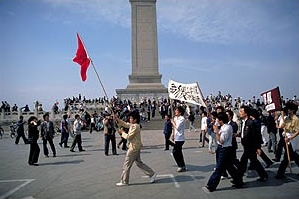
Tiananmen Square Protests and Crackdown
Deng authorized the military crackdown on pro-democracy protesters. The event tarnished China's international image but Deng maintained control. #China #Politics
Tiananmen Square Protests and Crackdown By Jiří Tondl (Blow up) - Own work, CC BY-SA 4.0, https://commons.wikimedia.org/w/index.php?curid=68125236
1990 CE
Deng Pushes for Further Reforms Amid Stagnation
After Tiananmen, conservative backlash threatened reforms. Deng argued for continued opening up, warning against isolation. #China #Reform
Jan 18, 1992 CE
Deng's Southern Tour (Nanxun)
Deng toured Shenzhen, Zhuhai, and Shanghai, delivering speeches that revived reform momentum. He famously stated, 'Development is the absolute principle.' #China #Reform
Oct 1, 1992 CE
14th CCP Congress Endorses 'Socialist Market Economy'
The Congress formally adopted Deng's concept of a socialist market economy, cementing market-oriented reforms as party policy. #China #Economy
14th CCP Congress Endorses 'Socialist Market Economy' By Ericmetro - Own work based on the photos in the above links ., Public domain, https://commons.wikimedia.org/w/index.php?curid=35438812
1993 CE
Deng Retires from Military Commission
Deng finally stepped down from his last official post, the chairmanship of the Central Military Commission, handing power to Jiang Zemin. #China #Politics
Feb 19, 1997 CE
Death of Deng Xiaoping
Deng died at age 92. His death prompted an outpouring of grief and reflection on his role in transforming China into a global economic power. #China #Obituary