Fragments of pottery vessels from Xianrendong Cave in China date to around 20,000 BP, representing some of the earliest known containers that transformed food storage and cooking. Source — Wikipedia:
Jiangxi Wannian Xianren Cave Site, National Key Cultural Relics Protection Unit By Zhangzhugang - Own work, CC BY-SA 3.0, https://commons.wikimedia.org/w/index.php?curid=15220548
6500 BCE
Çatalhöyük housing and material culture
Neolithic settlers at Çatalhöyük in Anatolia built closely packed mud-brick houses accessed through roofs, preserving rich evidence of early domestic life, wall paintings, and figurines. Source — Wikipedia:
Population 5,000 - 7,000. Large numbers of buildings clustered together. The inhabitants lived in mudbrick houses. No footpaths or streets between the dwellings. Most were accessed by holes in the ceiling and doors on the side of the houses, with doors reached by ladders and stairs. By Murat Özsoy 1958 - Own work, CC BY-SA 4.0, https://commons.wikimedia.org/w/index.php?curid=91011948
3500 BCE
Earliest board games in the Middle East
The Royal Game of Ur, played in ancient Sumer, is among the oldest known board games, with surviving examples found in the Royal Cemetery of Ur by Leonard Woolley. Source — Wikipedia:
Wooden game-board; the face is of 20 variously inlaid square shell plaques; edges made of small plaques and strips, some sculptured with an eye and some possibly with rosettes; on the back are three lines of shell triangular ornamental inlays. By Unknown author - BabelStone (Own work), CC0, https://commons.wikimedia.org/w/index.php?curid=10861909
3000 BCE
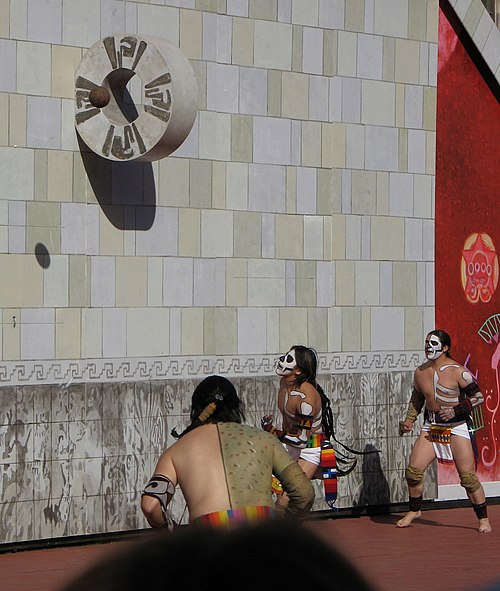
Earliest Mesoamerican ballgame evidence
Ballcourts and rubber balls from the Gulf Coast of Mexico mark the emergence of the Mesoamerican ballgame, a ritual sport with deep cosmological significance for Olmec and later civilizations. Source — Wikipedia:
The ball in front of the goal during a game of pok-ta-pok By de:User:Sputnik - shot by myself, CC BY-SA 2.5, https://commons.wikimedia.org/w/index.php?curid=785963
2600 BCE
Indus Valley urban housing
Cities like Mohenjo-daro featured standardized fired-brick houses with private wells and covered drains, representing advanced civic planning for daily domestic life. Source — Wikipedia:
A view of the Buddhist stupa in the background located in the higher settlement to the west, generally referred to as the citadel mound, and it is mostly comprised of the ruins of ancient administrative buildings constructed on top of a massive mud-brick platform. By Saqib Qayyum - Own work, CC BY-SA 3.0, https://commons.wikimedia.org/w/index.php?curid=31519717
2500 BCE
Earliest silk production in China
Archaeological finds from Neolithic sites in China, including fabric fragments and sericulture tools, indicate silk production had begun by the third millennium BCE. Source — Wikipedia:
Cropped from a Song dynasty painting attributed to Emperor Huizong in the style of Tang dynasty painter Zhang Xuan. By Emperor Huizong of Song / After Zhang Xuan - The Yorck Project (2002) 10.000 Meisterwerke der Malerei (DVD-ROM), distributed by DIRECTMEDIA Publishing GmbH. ISBN: 3936122202. Museum of Fine Arts, online collection, Public domain, https://commons.wikimedia.org/w/index.php?curid=153058
2350 BCE
Earliest evidence of beer in Mesopotamia
Chemical residues on pottery from Godin Tepe in Iran and tablets from Mesopotamia document large-scale brewing, making beer a staple of daily diet and ritual. Source — Wikipedia:
Philistine pottery קרמיקה פלשתית From Tel Eton פך בירה מעוטר בציפורים, דגים ומוטיבים גיאומטריים, תל עיטון המאה ה-12 לפני הספירה By Hanay - Own work, CC BY-SA 3.0, https://commons.wikimedia.org/w/index.php?curid=19472476
2000 BCE
Minoan palatial furniture and craft
Excavations at Knossos reveal elaborately decorated rooms with inlaid stone benches and storage jars, illustrating early elite furniture and organized craft production. Source — Wikipedia:
Integrated map of Crete island, Greece By Eric Gaba (Sting) - Own work, based on Image:Crete_topographic_map-fr.svg (modified and translated) created by myself ;Compass rose : Image:Brújula.svg (modified) created by Serg!o under GFDL, CC BY-SA 4.0, https://commons.wikimedia.org/w/index.php?curid=3180935
1500 BCE
Vedic fire rituals codified
The Rigveda documents sacrificial fire ceremonies (yajna) central to early South Asian religious life, establishing ritual practices that persist in modified form today. Source — Wikipedia:
"haviryajna done by a Nambudiri in Kerala"[1] By Srkris at English Wikipedia - Transferred from en.wikipedia to Commons by आशीष भटनागर., Public domain, https://commons.wikimedia.org/w/index.php?curid=7824179
1000 BCE
Go emerges in ancient China
The board game Go (Weiqi) is traditionally said to have been invented by Emperor Yao, with reliable references appearing by the Zhou dynasty, becoming one of China's four arts. Source — Wikipedia: )
My floor goban with a game in progress. By Goban1 - Own work, Public domain, https://commons.wikimedia.org/w/index.php?curid=15223468
800 BCE
Homer describes funerary games
The Iliad vividly describes athletic competitions held at Patroclus's funeral, showing sport and death ritual intertwined in ancient Greek culture. Source — Wikipedia:
Gladiators Fighting During Funeral Games In Ancient Rome By Unknown author - https://www.posterazzi.com/gladiators-fighting-during-funeral-games-in-ancient-rome-from-a-19th-century-engraving-posterprint-item-vardpi1904594/?srsltid=AfmBOorzd6uQKTNyIo2UfJAtCkxDko1TeT7CIw9p1TnXfa2df5IP_EgE, Public domain, https://commons.wikimedia.org/w/index.php?curid=181120770
776 BCE
First recorded Olympic Games
The first Olympiad was held at Olympia in Greece, establishing a quadrennial athletic festival that became a cornerstone of Greek cultural identity. Source — Wikipedia:
Olympia: Palaestra By Bgabel - Own work, CC BY-SA 3.0, https://commons.wikimedia.org/w/index.php?curid=22678207The Ancient Greek Olympics (776 BC-393 AD)
700 BCE
Kalaripayattu tradition in Kerala
Kalaripayattu, one of the oldest surviving martial arts, is traditionally traced to this period in South India, combining combat training with healing and ritual practice. Source — Wikipedia:
Kalari Pattu, also known as Kalaripayattu, is one of the oldest martial arts in the world, originating in Kerala, India. Its history dates back thousands of years, with roots in the ancient Indian texts such as the Dhanurveda (science of warfare) and the Vedas. The term "Kalari" refers to the training ground or battlefield, while "Pattu" translates to technique or practice. Historically, Kalari Pattu was not only a means of combat but also a way of life for warriors in Kerala. It was practiced by various communities, including the Nairs, Thiyyas, and Ezhavas, and was an integral part of their cultural and social fabric. Training in Kalari Pattu involved rigorous physical conditioning, including exercises to enhance flexibility, strength, and agility. The art form encompasses a wide range of techniques, including strikes, kicks, grappling, weaponry, and healing methods. These techniques are classified into different stages of training, with students progressing from basic exercises to advanced combat maneuvers. Kalari practitioners are trained to use their entire body as a weapon, mastering both armed and unarmed combat. Beyond its martial aspects, Kalari Pattu also incorporates elements of spirituality and holistic health. Traditional Kalari schools often include teachings on Ayurveda (traditional Indian medicine), yoga, and meditation, emphasizing the importance of mental discipline and inner balance alongside physical prowess. Over time, Kalari Pattu has evolved from a battlefield skill to a performing art and a means of physical fitness. It has gained international recognition for its effectiveness as a self-defense system and its contribution to the development of other martial arts around the world. Today, Kalari Pattu continues to be practiced in Kerala and has spread to other parts of India and the world. It is preserved through dedicated Kalari schools (known as Kalari koodams) where experienced masters pass on their knowledge to the next generation, ensuring that this ancient martial art form remains alive and vibrant in contemporary times. By The pixelwriter2309 - Own work, CC BY-SA 4.0, https://commons.wikimedia.org/w/index.php?curid=146587913
500 BCE
Xiangqi documented in China
References to Xiangqi (Chinese chess) appear in literary sources during the Warring States period, establishing a strategic board game tradition distinct from Western chess. Source — Wikipedia:
A xiangqi board in the starting position. The black pieces would normally be facing the player, but here they are rotated to be readable. By Inductiveload - Own work, Public domain, https://commons.wikimedia.org/w/index.php?curid=5546543
500 BCE
Etruscan and Roman funerary customs
Elaborate tombs with frescoes depicting banquets, games, and daily life reveal Etruscan and early Roman approaches to death and the afterlife. Source — Wikipedia:
A map showing the extent of Etruria and the Etruscan civilization. The map includes the 12 cities of the Etruscan League and notable cities founded by the Etruscans. The dates on the map are an approximation. By NormanEinstein - Based on a map from The National Geographic Magazine Vol.173 No.6 June 1988., CC BY-SA 3.0, https://commons.wikimedia.org/w/index.php?curid=241378
400 BCE
Celtic feasting culture
Archaeological finds of large cauldrons and drinking vessels across Europe indicate communal feasting was central to Celtic social and political life. Source — Wikipedia:
Celts in Europe the core Hallstatt territory, expansion before 500 BC maximum Celtic expansion by the 270s BC Lusitanian, Autrigones, Varduli and Caristi areas of Iberia, "Celticity" uncertain the boundaries of the six commonly-recognized 'Celtic nations', which remained Celtic speaking throughout the Middle Ages (viz. Brittany, Wales, Cornwall, Isle of Man, Ireland, Scotland) areas that remain Celtic-speaking today By QuartierLatin1968,The Ogre,Dbachmann - Atlas of the Celtic World, by John Haywood; London Thames & Hudson Ltd., 2001, pp.30-37 and other sources (see talkpage for details)., CC BY-SA 3.0, https://commons.wikimedia.org/w/index.php?curid=638312
300 BCE
Diwali origins in ancient India
The festival of lights is mentioned in early Sanskrit texts, evolving from autumn harvest celebrations into one of the most significant festivals in Hindu, Jain, and Sikh traditions. Source — Wikipedia:
Rangoli, decorations made from colored powder, is popular during Diwali. By Subharnab Majumdar - originally posted to Flickr as The Rangoli of Lights, CC BY 2.0, https://commons.wikimedia.org/w/index.php?curid=8101819
250 BCE
Terracotta Army funerary complex
Qin Shi Huang's vast terracotta army was constructed to accompany the emperor in the afterlife, representing the most monumental funerary assemblage in history. Source — Wikipedia:
Terracotta Army in Xi'an, China By xiquinhosilva - https://www.flickr.com/photos/xiquinho/27718581472/in/album-72157669496699682/, CC BY 2.0, https://commons.wikimedia.org/w/index.php?curid=147287690The Terra-Cotta Warriors | National Geographic
200 BCE
Silk Road transforms material culture
Overland trade routes linking China, Central Asia, and the Mediterranean enabled the exchange of textiles, spices, ceramics, and craft techniques across Eurasia. Source — Wikipedia:
Silk road on a globe with modern-day borders, centred on Kazakhstan By User:Kelvin Case User:Turkish Flame User:SmallJarsWithGreenLabels - File:Kazakhstan (orthographic projection).svg overlaid with vectorised (by my own work) path taken from this bitmap image, per the request of user:CactiStaccingCrane, CC BY-SA 4.0, https://commons.wikimedia.org/w/index.php?curid=132527200
100 BCE
Roman bread and garum industries
Commercial bakeries and fish-sauce (garum) production became widespread in the Roman world, illustrating industrialized food processing in antiquity. Source — Wikipedia:
left: two amphores for garum; deutsch: Zwei Amphoren für die durch enzymatische Zerlegung gewonnene römische Fischwürzsoße Garum; Aufgenommen während der Pompeji-Ausstellung Europäischer Kulturpark Bliesbruck By Claus Ableiter - Own work, CC BY-SA 3.0, https://commons.wikimedia.org/w/index.php?curid=4719373
79 CE
Pompeii preserves daily life snapshot
The eruption of Vesuvius buried Pompeii and Herculaneum, preserving houses, furniture, food, graffiti, and everyday objects in extraordinary detail. Source — Wikipedia:
Aerial image of Pompeii and Mount Vesuvius (view from the southeast) By Carsten Steger - Own work, CC BY-SA 4.0, https://commons.wikimedia.org/w/index.php?curid=194206863What Life Was Like In Pompeii During Ancient Rome's Glory Days | Lost Treasures | Timeline
200 CE
Maya ballgame at its height
Ballcourts were built in nearly every Maya city, and the sport was embedded in mythic narratives like the Popol Vuh, symbolizing cosmic struggle and sacrifice. Source — Wikipedia:
The ball in front of the goal during a game of pok-ta-pok By de:User:Sputnik - shot by myself, CC BY-SA 2.5, https://commons.wikimedia.org/w/index.php?curid=785963
300 CE
Shogi tradition begins in Japan
Shogi (Japanese chess) is traditionally said to have arrived in Japan by this period, later evolving into the unique dropping-rule variant played today. Source — Wikipedia:
Shogi - Japanese chess. Board, pieces and komadai in a typical game situation. By Oliver Orschiedt - Own work, CC BY-SA 3.0, https://commons.wikimedia.org/w/index.php?curid=11038951
600 CE
Sumo ritual documented in Japan
The Nihon Shoki records a wrestling contest in 642 CE, and sumo evolved from Shinto ritual into a professional sport deeply tied to Japanese cultural identity. Source — Wikipedia:
Sumo Wrestler Asashōryū fighting against Kotoshogiku at the January Tournament 2008 By Eckhard Pecher User:Arcimboldo - Own work, CC BY 3.0, https://commons.wikimedia.org/w/index.php?curid=3381800
700 CE
Kimono tradition takes shape
During the Nara and Heian periods, Japanese court attire evolved into what would become the kimono, a garment whose wrapping technique and seasonal aesthetics became culturally iconic. Source — Wikipedia:
Young Woman at Kennin-ji Zen Temple - Kyoto - Japan - 01 By Adam Jones from Kelowna, BC, Canada - Young Woman at Kennin-ji Zen Temple - Kyoto - Japan - 01, CC BY-SA 2.0, https://commons.wikimedia.org/w/index.php?curid=79666915
800 CE
Viking Age funerary ship burials
Norse elites were buried in ships with grave goods, weapons, and everyday items, reflecting a worldview where material culture accompanied the dead into the afterlife. Source — Wikipedia:
900 CE
Coffee cultivated in Ethiopia
Coffee was discovered and cultivated in the Ethiopian highlands, eventually spreading to Yemen and the wider Islamic world, transforming social and leisure practices globally. Source — Wikipedia:
Coffee cultivated in Ethiopia By John Frederick Lewis - The Yorck Project (2002) 10.000 Meisterwerke der Malerei (DVD-ROM), distributed by DIRECTMEDIA Publishing GmbH. ISBN: 3936122202., Public domain, https://commons.wikimedia.org/w/index.php?curid=153851
1000 CE
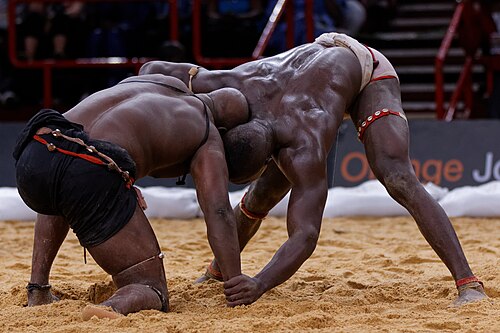
Senegalese laamb wrestling tradition
Traditional wrestling in Senegal, known as laamb, has roots going back centuries among the Serer people, combining sport with spiritual ritual and communal celebration. Source — Wikipedia:
World African Wrestling world tour, Paris Bercy. Mame Balla vs Pape Mor Lô. By Pierre-Yves Beaudouin - Own work, CC BY-SA 3.0, https://commons.wikimedia.org/w/index.php?curid=26586273
1100 CE
Mongolian bökh tradition
Mongolian wrestling (bökh) was a key test of strength among nomadic warriors, later becoming a centerpiece of the Naadam festival and a symbol of national identity. Source — Wikipedia:
Burumbators (mongolian warriors) on the traditional Naadam festival in Mongolia, near Ulan Bator. By hu:Burumbátor - Image taken by hu:Burumbátor on 2005-06-17. Originally at hu:Kép:2390.jpg., Public domain, https://commons.wikimedia.org/w/index.php?curid=509872
1200 CE
Turkish yağlı güreş established
Oil wrestling in Turkey, documented from the Seljuk era, became the national sport, with the annual Kırkpınar tournament becoming the world's oldest continuously held sporting event. Source — Wikipedia:
Yağlı güreş tournament in Istanbul on 6th August 2006 By No machine-readable author provided. Math34 assumed (based on copyright claims). - No machine-readable source provided. Own work assumed (based on copyright claims)., Public domain, https://commons.wikimedia.org/w/index.php?curid=1029063
1300 CE
Hanbok style crystallizes in Korea
The distinctive Korean hanbok, with its high waistband and voluminous skirt, took recognizable form during the Goryeo and Joseon periods, reflecting Confucian dress codes. Source — Wikipedia:
The Day of Hanbok October 22. 2016 Gyeongbokgung, Jongno-gu, Seoul Ministry of Culture, Sports and Tourism Korean Culture and Information Service Korea.net (<a href="http://www.korea.net" rel="nofollow">www.korea.net</a>) Official Photographer : Jeon Han This official Republic of Korea photograph is being made available only for publication by news organizations and/or for personal printing by the subject(s) of the photograph. The photograph may not be manipulated in any way. Also, it may not be used in any type of commercial, advertisement, product or promotion that in any way suggests approval or endorsement from the government of the Republic of Korea. 2016 한복의 날 2016-10-22 경복궁 문화체육관광부 해외문화홍보원 코리아넷 전한 By Republic of Korea from Seoul, Republic of Korea - Hanbok_Day_2016_29, CC BY-SA 2.0, https://commons.wikimedia.org/w/index.php?curid=109106205
1400 CE
Aztec Day of the Dead precursors
Mesoamerican traditions of honoring the dead with offerings of food and marigolds, practiced by Aztecs and earlier civilizations, merged with Catholicism to form Día de los Muertos. Source — Wikipedia:
This image represents the Catrina, a female character representing the dead created by Guadalupe Posadas By Paolaricaurte - Own work, CC BY-SA 4.0, https://commons.wikimedia.org/w/index.php?curid=44667651
1450 CE
Ming furniture reaches apex
Chinese cabinetmakers of the Ming dynasty perfected minimalist hardwood furniture using mortise-and-tenon joinery, setting aesthetic standards that influence design to this day. Source — Wikipedia:
Chinese lacquerware table, 1425-1436 V&A Museum no. FE.6:1 to 4-1973 Techniques - Carved lacquer on wood Place - Beijing Dimensions - Height 79.2 cm Length 119.5 cm (of table top) Source: http://images.vam.ac.uk/indexplus/page/Home.html By The original uploader was VAwebteam at English Wikipedia. - Transferred from en.wikipedia to Commons by NotFromUtrecht using CommonsHelper., CC BY-SA 3.0, https://commons.wikimedia.org/w/index.php?curid=8931921
1492 CE
Columbian Exchange reshapes food
The transfer of crops like maize, potatoes, tomatoes, and chili peppers between the Old and New Worlds transformed global cuisines and daily diets on every continent. Source — Wikipedia:
Columbian Exchange reshapes food By Unknown author, Public domain, https://commons.wikimedia.org/w/index.php?curid=153505656How potatoes took over the world: The Columbian Exchange | Modern World History 10 of 30| Study Hall
1600 CE
Kabuki theater and leisure culture
Kabuki emerged in Edo-period Japan as popular entertainment, reflecting the growth of urban leisure culture among townspeople and shaping fashion and social customs. Source — Wikipedia:
k, in Sugawara Denju Tenarai Kagami By Unknown author - http://www2.ntj.jac.go.jp/dglib/exp2/w/187.html, Public domain, https://commons.wikimedia.org/w/index.php?curid=4722892
1648 CE
Kırkpınar oil wrestling tournament formalized
The annual Kırkpınar oil wrestling festival in Edirne, Turkey, was formally established after Ottoman conquest, becoming the longest continuously held sporting event. Source — Wikipedia:
Yağlı güreş tournament in Istanbul on 6th August 2006 By No machine-readable author provided. Math34 assumed (based on copyright claims). - No machine-readable source provided. Own work assumed (based on copyright claims)., Public domain, https://commons.wikimedia.org/w/index.php?curid=1026553
1687 CE
Lunar New Year traditions formalized
The Qing dynasty codified Lunar New Year customs including family reunions, red envelopes, firecrackers, and lion dances, traditions shared across Chinese and Vietnamese communities. Source — Wikipedia:
The traditional, and famous, Chinese New Year Firework Display over Victoria Harbour was a spectacular event lasting 25-minutes. Tens of thousands of people lined the shores of Kowloon and Hong Kong Island up to 4-hours early in order to get the best views. By Michael Elleray from England, United Kingdom - Kung Hei Fat Choi!, CC BY 2.0, https://commons.wikimedia.org/w/index.php?curid=25661192
1750 CE
Industrial Revolution transforms housing
Mass production of textiles, furniture, and building materials began to transform domestic life in Britain, making manufactured goods available to a wider population. Source — Wikipedia:
Illustration of power loom weaving. By Illustrator T. Allom, Engraver J. Tingle - History of the cotton manufacture in Great Britain by Sir Edward Baines,, Public domain, https://commons.wikimedia.org/w/index.php?curid=9430141
1867 CE
Sumo tournament system established
Japan's first professional sumo tournament under the Japan Sumo Association was held at Ekō-in in Edo, formalizing the sport's professional structure. Source — Wikipedia:
Sumo Wrestler Asashōryū fighting against Kotoshogiku at the January Tournament 2008 By Eckhard Pecher User:Arcimboldo - Own work, CC BY 3.0, https://commons.wikimedia.org/w/index.php?curid=3381800
Apr 6, 1896 CE
Modern Olympic Games revived
Pierre de Coubertin organized the first modern Olympics in Athens, reviving the ancient tradition as an international amateur sporting festival. Source — Wikipedia:
Cover of the official commemorative album of the 1896 Olympic Games in Athens: S. Lambros, N. G. Politis, T. Philimon, C. Anninos, P. de Coubertin, A. Meyer, Ὀλυμιακοὶ Ἀγῶνες – Les Jeux Olympiques / Ἀθῆναι – Athens Designed by Émile Gilliéron; printed by Ch. Beck. Two editions were issued, one in Greek and French (shown here), the other in German and English. The same painting was used as the cover of the program of Olympic events and as a promotional poster. By Émile Gilliéron - L'Olympisme. Une invention moderne, un héritage antique au Louvre (Alain R. Truong, 8 May 2024), Public domain, https://commons.wikimedia.org/w/index.php?curid=152344155
1908 CE
Ford Model T transforms daily transport
Henry Ford's affordable automobile reshaped housing patterns, leisure travel, and material expectations of daily life throughout the twentieth century. Source — Wikipedia:
1925 Ford Model T touring, built at Henry Ford’s Highland Park Plant in Dearborn, Michigan. This example now resides in Australia, owned by the founder of FordModelT.net By ModelTMitch - Own work, Public domain, https://commons.wikimedia.org/w/index.php?curid=69615054How Henry Ford Invented the Model T | The Men Who Built America (S1, E8) | Full Episode | History
1919 CE
Bauhaus redefines furniture and craft
The Bauhaus school in Weimar unified art and industrial production, producing furniture and household designs that defined modernist material culture. Source — Wikipedia:
Dessau-Bauhaus By Spyrosdrakopoulos - Own work, CC BY-SA 4.0, https://commons.wikimedia.org/w/index.php?curid=38946836
1947 CE
Sari post-independence identity
After Indian independence, the sari became a symbol of national identity, with handloom revival movements led by figures like Kamaladevi Chattopadhyay. Source — Wikipedia:
Maharani Vijaya Raje Scindia of Gwalior, ca. 1940. By Sir Victor Sassoon (1881–1961) - Hamilton Studios is a photo studio in Mumbai, India that was founded in 1928 by Sir Victor Sassoon., Public domain, https://commons.wikimedia.org/w/index.php?curid=158978041
Sep 24, 1972 CE
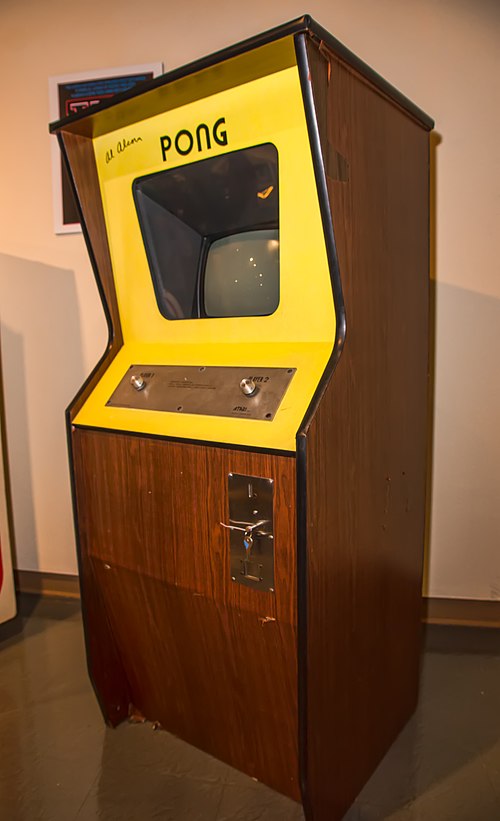
Pong launches video game industry
Atari's release of Pong as an arcade game marked the commercial birth of the video game industry, creating a new form of global leisure. Source — Wikipedia:
Pong cabinet signed by Pong creator Allan Alcorn in the 'Golden Age of Video Games' exhibit at Neville Public Museum in Green Bay, Wisconsin. By Chris Rand - Own work, CC BY-SA 3.0, https://commons.wikimedia.org/w/index.php?curid=28364913
1985 CE
Nintendo Entertainment System revives gaming
The NES launched in North America, bringing video games into the home as a mainstream leisure activity and establishing Japan's dominance in game design. Source — Wikipedia:
Transparent version of NES console By Evan-Amos - Own work, Public domain, https://commons.wikimedia.org/w/index.php?curid=11408831
1997 CE
StarCraft and Korean esports culture
StarCraft's release in South Korea sparked professional competitive gaming leagues, laying the groundwork for modern esports as a spectator phenomenon. Source — Wikipedia: )
2000 CE
UNESCO recognizes intangible heritage
UNESCO's proclamation of the first Masterpieces of the Oral and Intangible Heritage of Humanity formalized global protection of festivals, crafts, and traditional practices. Source — Wikipedia:
2003 CE
Day of the Dead inscribed by UNESCO
Mexico's Día de los Muertos was proclaimed a Masterpiece of the Oral and Intangible Heritage of Humanity, recognizing indigenous funerary traditions as world heritage. Source — Wikipedia:
This image represents the Catrina, a female character representing the dead created by Guadalupe Posadas By Paolaricaurte - Own work, CC BY-SA 4.0, https://commons.wikimedia.org/w/index.php?curid=44667651
2010 CE
Slow Food movement goes global
Founded in Italy in 1989, the Slow Food movement reached over 100 countries, promoting local food traditions and sustainable cuisine as a counter to fast-food culture. Source — Wikipedia:
2018 CE
Asian Games include esports
The 2018 Asian Games in Jakarta featured esports as a demonstration event, marking a major step toward recognition of competitive gaming alongside traditional sports. Source — Wikipedia:
2020 CE
Pandemic reshapes daily life globally
COVID-19 lockdowns worldwide transformed work, leisure, and social customs, accelerating remote living, digital socializing, and esports viewership while disrupting traditional festivals. Source — Wikipedia:
2023 CE
Esports at Olympic Esports Week
The IOC's inaugural Olympic Esports Week in Singapore featured virtual sports competitions, signaling the Olympic movement's formal engagement with competitive gaming. Source — Wikipedia:
Olympic Esports Series logo By IOC - https://sailranks.com/v/regattas/9278, Public domain, https://commons.wikimedia.org/w/index.php?curid=160072787




!["haviryajna done by a Nambudiri in Kerala"[1]](https://upload.wikimedia.org/wikipedia/commons/thumb/9/91/Yajna1.jpg/500px-Yajna1.jpg)