WW2/Battles of WW2/Hour-by-Hour • Curated by Admin Timeline.sg
Hour-by-hour account of the Allied invasion of Normandy on 6 June 1944 — the airborne drops before dawn, the naval bombardment, and the five beach landings. (6 June 1944)
Chronological Storyline (27 Milestones)
Jun 6, 1944 CE
21st Panzer Division counterattacks at Sword
The German 21st Panzer Division launched a counterattack toward the British forces at Sword Beach, reaching the coast before being halted by Allied anti-tank fire. · Wikipedia: https://en.wikipedia.org/wiki/21st_Panzer_Division_(Wehrmacht)
Jun 6, 1944 CE
Allied beachheads remain unconnected at Omaha
By evening, a gap of several miles still existed between the American forces at Omaha and the Anglo-Canadian forces to the east, leaving the Allied front divided. · Wikipedia: https://en.wikipedia.org/wiki/Normandy_landings
A LCVP (Landing Craft, Vehicle, Personnel) from the U.S. Coast Guard-manned USS Samuel Chase disembarks troops of Company A, 16th Infantry, 1st Infantry Division (the Big Red One) wading onto the Fox Green section of Omaha Beach (Calvados, Basse-Normandie, France) on the morning of June 6, 1944. American soldiers encountered the newly formed German 352nd Division when landing. During the initial landing two-thirds of Company E became casualties. By Chief Photographer's Mate (CPHoM) Robert F. Sargent - This tag does not indicate the copyright status of the attached work. A normal copyright tag is still required. See Commons:Licensing., Public domain, https://commons.wikimedia.org/w/index.php?curid=17040973
Jun 6, 1944 CE
US 4th Division lands at Utah Beach
The US 4th Infantry Division landed at Utah Beach against light resistance, with the first wave touching down south of the intended position where defences were weaker. · Wikipedia: https://en.wikipedia.org/wiki/Utah_Beach
Des soldats américains débarquent sur la plage de Utah Beach à partir d'un navire. Sur la plage, des carcasses de véhicules détruits gisent. By Conseil Régional de Basse-Normandie / National Archives USA - http://www.archivesnormandie39-45.org/specificPhoto.php?ref=p011976, Public domain, https://commons.wikimedia.org/w/index.php?curid=8024584
Jun 6, 1944 CE
British 3rd Division lands at Sword Beach
The British 3rd Infantry Division landed at Sword Beach, the easternmost Allied landing site, and began pushing toward the city of Caen. ) · Wikipedia: https://en.wikipedia.org/wiki/Sword_Beach
OPERATION OVERLORD (THE NORMANDY LANDINGS): D-DAY 6 JUNE 1944 The British 2nd Army: Infantry waiting to move off 'Queen White' Beach, SWORD Area, while under enemy fire, on the morning of 6 June. The first landings on Sword were made by the British 3rd Infantry Division, 27th Armoured Brigade and Royal Marine and Army Commando units from General Crocker's I Corps. By nightfall the British had 28,850 men ashore and the Orne bridge had been seized. By Unknown author - This photograph B 5091 comes from the collections of the Imperial War Museums., Public domain, https://commons.wikimedia.org/w/index.php?curid=183473
Jun 6, 1944 CE
Rundstedt requests panzer reserves
Field Marshal Gerd von Rundstedt requested release of German panzer reserves, but Hitler's headquarters refused to authorize their movement without the Führer's personal approval. · Wikipedia: https://en.wikipedia.org/wiki/Gerd_von_Rundstedt
For documentary purposes the German Federal Archive often retained the original image captions, which may be erroneous, biased, obsolete or politically extreme. Gerd v. Rundstedt Am 12. Dezember begeht General der Infanterie Gerd von Rundstedt, der Oberbefehlshaber der Gruppe I Berlin seinen 60. Geburtstag. General von Rundstedt wurde am 12. Dezember 1875 in Aschersleben geboren und begann seine Laufbahn im Jahre 1892 beim Infanterie-Regiment Nr. 83. Im Jahre 1902 wurde er zur Kriegs-Akademie berufen und 1909 zum Grossen Generalstab versetzt, dem er auch während des grössten Teils des Weltkrieges angehörte. Der Name Rundstedts wurde besonders am 20. Juli 1930 bekannt, als ihm die vollziehende Gewalt bei Verhängung des militärischen Ausnahmezustandes über Berlin und die Mark Brandenburg übertragen wurde. [Aufnahme 1932] [General Gerd von Rundstedt (Porträt)] Abgebildete Personen: Rundstedt, Gerd von: Generalfeldmarschall, Ritterkreuz (RK), Heer, Deutschland (GND 118939327) By Unknown - This image was provided to Wikimedia Commons by the German Federal Archive (Deutsches Bundesarchiv) as part of a cooperation project. The German Federal Archive guarantees an authentic representation only using the originals (negative and/or positive), resp. the digitalization of the originals as provided by the Digital Image Archive., CC BY-SA 3.0 de, https://commons.wikimedia.org/w/index.php?curid=183664060
Jun 6, 1944 CE
Allied naval bombardment opens on beaches
The Allied naval bombardment of the five invasion beaches began, with battleships, cruisers, and destroyers targeting German gun emplacements and fortifications along the coast. ) · Wikipedia: https://en.wikipedia.org/wiki/Operation_Neptune
A LCVP (Landing Craft, Vehicle, Personnel) from the U.S. Coast Guard-manned USS Samuel Chase disembarks troops of Company A, 16th Infantry, 1st Infantry Division (the Big Red One) wading onto the Fox Green section of Omaha Beach (Calvados, Basse-Normandie, France) on the morning of June 6, 1944. American soldiers encountered the newly formed German 352nd Division when landing. During the initial landing two-thirds of Company E became casualties. By Chief Photographer's Mate (CPHoM) Robert F. Sargent - This tag does not indicate the copyright status of the attached work. A normal copyright tag is still required. See Commons:Licensing., Public domain, https://commons.wikimedia.org/w/index.php?curid=17040973
Jun 6, 1944 CE
Canadian 3rd Division lands at Juno Beach
The Canadian 3rd Infantry Division landed at Juno Beach, pushing through coastal villages and advancing further inland by day's end than any other Allied force on D-Day. · Wikipedia: https://en.wikipedia.org/wiki/Juno_Beach
Ces soldats de l'infanterie canadienne débarquent sur la plage de Juno Beach. En arrière-plan, on aperçoit Bernières-sur-Mer. Les soldats canadiens marchent en direction de Bernières-sur-Mer. By Ken Bell - http://www.archivesnormandie39-45.org/specificPhoto.php?ref=p004593 Archives Nationales du CANADA, Public domain, https://commons.wikimedia.org/w/index.php?curid=8028451
Jun 6, 1944 CE
US 101st Airborne begins parachute drop
The first serials of the US 101st Airborne Division began parachuting into the Cotentin Peninsula to secure causeway exits behind Utah Beach, despite heavy scattering due to cloud cover. · Wikipedia: https://en.wikipedia.org/wiki/American_airborne_landings_in_Normandy
Allied invasion plans and German positions in Normandy. By Unknown author - http://www.dean.usma.edu/history/Atlases/WorldWarTwoEurope/EuropeanTheaterGIF/WWIIEurope54.gif, Public domain, https://commons.wikimedia.org/w/index.php?curid=167322
Jun 6, 1944 CE
British pathfinders drop into Normandy
British 22nd Independent Parachute Company pathfinders parachuted into Normandy to mark drop zones for the 6th Airborne Division, initiating the Allied invasion of occupied France. · Wikipedia: https://en.wikipedia.org/wiki/Operation_Tonga
Four 'stick' commanders of 22nd Independent Parachute Company, 6th Airborne Division, synchronising their watches in front of an Armstrong Whitworth Albemarle at about 11 pm on 5 June 1944, just prior to take off from RAF Harwell in Oxfordshire. They were among the first troops to land in France. The Final Embarkation: Four 'stick' commanders of 22nd Independent Parachute Company, British 6th Airborne Division, synchronising their watches in front of an Armstrong Whitworth Albemarle of No 38 Group, Royal Air Force, at about 11 pm on 5 June, just prior to take off from RAF Harwell, Oxfordshire. This pathfinder unit parachuted into Normandy in advance of the rest of the division in order to mark out the landing zones, and these officers, (left to right, - Lieutenants, Bobby de la Tour, Don Wells, John Vischer and Bob Midwood), were among the first Allied troops to land in France. By War Office official photographer, Malindine E G (Capt) - http://media.iwm.org.uk/iwm/mediaLib//36/media-36002/large.jpg This photograph H 39070 comes from the collections of the Imperial War Museums., Public domain, https://commons.wikimedia.org/w/index.php?curid=30910756D-Day: From Start To Finish | Normandy 44
Jun 6, 1944 CE
21st Panzer assault repulsed at Sword
The German 21st Panzer Division's counterattack toward the coast was repelled by British forces, ending the only major German armoured assault on D-Day. · Wikipedia: https://en.wikipedia.org/wiki/21st_Panzer_Division_(Wehrmacht)
Jun 6, 1944 CE
Omaha Beach assault stalls under heavy fire
The US assault at Omaha Beach stalled as German machine-gun fire and artillery raked the beach, leaving troops pinned behind obstacles with mounting casualties. · Wikipedia: https://en.wikipedia.org/wiki/Omaha_Beach
A LCVP (Landing Craft, Vehicle, Personnel) from the U.S. Coast Guard-manned USS Samuel Chase disembarks troops of Company A, 16th Infantry, 1st Infantry Division (the Big Red One) wading onto the Fox Green section of Omaha Beach (Calvados, Basse-Normandie, France) on the morning of June 6, 1944. American soldiers encountered the newly formed German 352nd Division when landing. During the initial landing two-thirds of Company E became casualties. By Chief Photographer's Mate (CPHoM) Robert F. Sargent - This tag does not indicate the copyright status of the attached work. A normal copyright tag is still required. See Commons:Licensing., Public domain, https://commons.wikimedia.org/w/index.php?curid=17040973
Jun 6, 1944 CE
Allied naval armada approaches Normandy coast
The massive Allied invasion fleet of over 5,000 ships approached the Normandy coast, with troops beginning to transfer to landing craft in rough seas for the assault. ) · Wikipedia: https://en.wikipedia.org/wiki/Operation_Neptune
A LCVP (Landing Craft, Vehicle, Personnel) from the U.S. Coast Guard-manned USS Samuel Chase disembarks troops of Company A, 16th Infantry, 1st Infantry Division (the Big Red One) wading onto the Fox Green section of Omaha Beach (Calvados, Basse-Normandie, France) on the morning of June 6, 1944. American soldiers encountered the newly formed German 352nd Division when landing. During the initial landing two-thirds of Company E became casualties. By Chief Photographer's Mate (CPHoM) Robert F. Sargent - This tag does not indicate the copyright status of the attached work. A normal copyright tag is still required. See Commons:Licensing., Public domain, https://commons.wikimedia.org/w/index.php?curid=17040973
Jun 6, 1944 CE
Utah Beach links with 101st Airborne
US forces advancing from Utah Beach made contact with elements of the 101st Airborne Division, connecting the amphibious and parachute assault forces. · Wikipedia: https://en.wikipedia.org/wiki/Utah_Beach
Des soldats américains débarquent sur la plage de Utah Beach à partir d'un navire. Sur la plage, des carcasses de véhicules détruits gisent. By Conseil Régional de Basse-Normandie / National Archives USA - http://www.archivesnormandie39-45.org/specificPhoto.php?ref=p011976, Public domain, https://commons.wikimedia.org/w/index.php?curid=8024584
Jun 6, 1944 CE
Allies establish foothold across five beaches
By nightfall, Allied forces had secured lodgements across all five invasion beaches, though none had achieved their first-day objectives and Caen remained in German hands. · Wikipedia: https://en.wikipedia.org/wiki/Normandy_landings
A LCVP (Landing Craft, Vehicle, Personnel) from the U.S. Coast Guard-manned USS Samuel Chase disembarks troops of Company A, 16th Infantry, 1st Infantry Division (the Big Red One) wading onto the Fox Green section of Omaha Beach (Calvados, Basse-Normandie, France) on the morning of June 6, 1944. American soldiers encountered the newly formed German 352nd Division when landing. During the initial landing two-thirds of Company E became casualties. By Chief Photographer's Mate (CPHoM) Robert F. Sargent - This tag does not indicate the copyright status of the attached work. A normal copyright tag is still required. See Commons:Licensing., Public domain, https://commons.wikimedia.org/w/index.php?curid=17040973
Jun 6, 1944 CE
Rommel's absence from Normandy noted
Field Marshal Erwin Rommel was in Germany celebrating his wife's birthday, believing an invasion was unlikely due to poor weather, leaving German forces without their senior commander. · Wikipedia: https://en.wikipedia.org/wiki/Erwin_Rommel
For documentary purposes the German Federal Archive often retained the original image captions, which may be erroneous, biased, obsolete or politically extreme. Generaloberst Rommel Pk-Aufnahme: Kriegsberichter Otto herausg. 6.6.42 By Otto - This image was provided to Wikimedia Commons by the German Federal Archive (Deutsches Bundesarchiv) as part of a cooperation project. The German Federal Archive guarantees an authentic representation only using the originals (negative and/or positive), resp. the digitalization of the originals as provided by the Digital Image Archive., CC BY-SA 3.0 de, https://commons.wikimedia.org/w/index.php?curid=194054898
Jun 6, 1944 CE
US 82nd Airborne parachutes into Cotentin
The US 82nd Airborne Division began its parachute drop west of the Merderet River to secure bridges and block German counterattacks toward Utah Beach, though troops were widely scattered. · Wikipedia: https://en.wikipedia.org/wiki/American_airborne_landings_in_Normandy
Allied invasion plans and German positions in Normandy. By Unknown author - http://www.dean.usma.edu/history/Atlases/WorldWarTwoEurope/EuropeanTheaterGIF/WWIIEurope54.gif, Public domain, https://commons.wikimedia.org/w/index.php?curid=167322
Jun 6, 1944 CE
German 7th Army receives invasion alert
German Seventh Army headquarters received the first reports of parachute drops and alerted all units, though the German High Command initially judged it a diversionary attack. · Wikipedia: https://en.wikipedia.org/wiki/German_7th_Army_(Wehrmacht)
Jun 6, 1944 CE
British glider troops capture Pegasus Bridge
Major John Howard's D Company, 2nd Oxfordshire and Buckinghamshire Light Infantry, landed by glider and captured Pegasus Bridge over the Caen Canal in a coup de main assault. ) · Wikipedia: https://en.wikipedia.org/wiki/Operation_Deadstick
Pegasus Bridge, June 1944 Transport moving across the Caen Canal Bridge at Benouville. The bridge was renamed Pegasus Bridge, after the mythical winged horse on the formation sign of British airborne forces. By Christie (Sgt), No 5 Army Film & Photographic Unit - http://media.iwm.org.uk/iwm/mediaLib//36/media-36070/large.jpg This photograph B 5288 comes from the collections of the Imperial War Museums., Public domain, https://commons.wikimedia.org/w/index.php?curid=24488751
Jun 6, 1944 CE
British 6th Airborne destroys bridges
Paratroopers of the British 6th Airborne Division destroyed bridges over the River Dives to prevent German panzer reinforcements from reaching the eastern flank of the invasion beaches. · Wikipedia: https://en.wikipedia.org/wiki/Operation_Tonga
Four 'stick' commanders of 22nd Independent Parachute Company, 6th Airborne Division, synchronising their watches in front of an Armstrong Whitworth Albemarle at about 11 pm on 5 June 1944, just prior to take off from RAF Harwell in Oxfordshire. They were among the first troops to land in France. The Final Embarkation: Four 'stick' commanders of 22nd Independent Parachute Company, British 6th Airborne Division, synchronising their watches in front of an Armstrong Whitworth Albemarle of No 38 Group, Royal Air Force, at about 11 pm on 5 June, just prior to take off from RAF Harwell, Oxfordshire. This pathfinder unit parachuted into Normandy in advance of the rest of the division in order to mark out the landing zones, and these officers, (left to right, - Lieutenants, Bobby de la Tour, Don Wells, John Vischer and Bob Midwood), were among the first Allied troops to land in France. By War Office official photographer, Malindine E G (Capt) - http://media.iwm.org.uk/iwm/mediaLib//36/media-36002/large.jpg This photograph H 39070 comes from the collections of the Imperial War Museums., Public domain, https://commons.wikimedia.org/w/index.php?curid=30910756
Jun 6, 1944 CE
Allied bombers strike coastal defences
Over 1,000 RAF heavy bombers attacked German coastal batteries across Normandy in the hours before the landings, dropping thousands of tons of bombs to weaken defences. · Wikipedia: https://en.wikipedia.org/wiki/Operation_Neptune
A LCVP (Landing Craft, Vehicle, Personnel) from the U.S. Coast Guard-manned USS Samuel Chase disembarks troops of Company A, 16th Infantry, 1st Infantry Division (the Big Red One) wading onto the Fox Green section of Omaha Beach (Calvados, Basse-Normandie, France) on the morning of June 6, 1944. American soldiers encountered the newly formed German 352nd Division when landing. During the initial landing two-thirds of Company E became casualties. By Chief Photographer's Mate (CPHoM) Robert F. Sargent - This tag does not indicate the copyright status of the attached work. A normal copyright tag is still required. See Commons:Licensing., Public domain, https://commons.wikimedia.org/w/index.php?curid=17040973
Jun 6, 1944 CE
US 82nd secures Sainte-Mère-Église
Paratroopers of the US 82nd Airborne Division entered and secured the town of Sainte-Mère-Église, giving the Allies their first liberated town in France on D-Day. · Wikipedia: https://en.wikipedia.org/wiki/Sainte-M%C3%A8re-%C3%89glise
This building is classé au titre des monuments historiques de la France. It is indexed in the base Mérimée, a database of architectural heritage maintained by the French Ministry of Culture, under the reference PA00110593 . brezhoneg ∙ català ∙ Deutsch ∙ English ∙ español ∙ Esperanto ∙ euskara ∙ français ∙ italiano ∙ magyar ∙ Nederlands ∙ português do Brasil ∙ português ∙ română ∙ sicilianu ∙ slovenščina ∙ suomi ∙ svenska ∙ Ελληνικά ∙ беларуская (тарашкевіца) ∙ македонски ∙ русский ∙ українська ∙ বাংলা ∙ 中文 ∙ +/− By Elliesram13 - Own work, CC BY-SA 3.0, https://commons.wikimedia.org/w/index.php?curid=21511440
Jun 6, 1944 CE
US Eighth Air Force bombs Omaha sector
Over 1,300 US Eighth Air Force heavy bombers struck German defences and beach obstacles along the Normandy coast, though many bombs fell inland behind Omaha Beach. · Wikipedia: https://en.wikipedia.org/wiki/Operation_Neptune
A LCVP (Landing Craft, Vehicle, Personnel) from the U.S. Coast Guard-manned USS Samuel Chase disembarks troops of Company A, 16th Infantry, 1st Infantry Division (the Big Red One) wading onto the Fox Green section of Omaha Beach (Calvados, Basse-Normandie, France) on the morning of June 6, 1944. American soldiers encountered the newly formed German 352nd Division when landing. During the initial landing two-thirds of Company E became casualties. By Chief Photographer's Mate (CPHoM) Robert F. Sargent - This tag does not indicate the copyright status of the attached work. A normal copyright tag is still required. See Commons:Licensing., Public domain, https://commons.wikimedia.org/w/index.php?curid=17040973
Jun 6, 1944 CE
US 1st Division lands at Omaha Beach
The US 1st Infantry Division assaulted Omaha Beach and met fierce German resistance from the 352nd Infantry Division, suffering heavy casualties in the opening hours. · Wikipedia: https://en.wikipedia.org/wiki/Omaha_Beach
A LCVP (Landing Craft, Vehicle, Personnel) from the U.S. Coast Guard-manned USS Samuel Chase disembarks troops of Company A, 16th Infantry, 1st Infantry Division (the Big Red One) wading onto the Fox Green section of Omaha Beach (Calvados, Basse-Normandie, France) on the morning of June 6, 1944. American soldiers encountered the newly formed German 352nd Division when landing. During the initial landing two-thirds of Company E became casualties. By Chief Photographer's Mate (CPHoM) Robert F. Sargent - This tag does not indicate the copyright status of the attached work. A normal copyright tag is still required. See Commons:Licensing., Public domain, https://commons.wikimedia.org/w/index.php?curid=17040973
Jun 6, 1944 CE
British 50th Division lands at Gold Beach
The British 50th (Northumbrian) Infantry Division landed at Gold Beach, overcoming German strongpoints and advancing inland toward Bayeux by the afternoon. ) · Wikipedia: https://en.wikipedia.org/wiki/Gold_Beach
Caption 1: "The infantry, the humble foot soldiers, now about to fulfil their classical role." Caption 2: "Commando troops coming ashore from LCIs (Landing Craft Infantry)." The photograph shows commandos of the 50th (Northumbrian) Infantry Division of the British Army coming ashore from Landing Craft Infantry at Gold Beach near La Rivière-Saint-Sauveur, Normandy, France, on 6 June 1944 at the start of the Invasion of Normandy during World War II. By Sgt Midgley, No 5 Army Film & Photographic Unit. - Caption 1 and photograph from Clay, Major Ewart W. (1950) The Path of the 50th: The Story of the 50th (Northumbrian) Division in the Second World War, Gale and Polden, p. 238 ISBN: 1-87006-707-X. Caption 2, information on the photographer, and the photograph also located at the Imperial War Museum collection number 4700-29, reference number B 5245. This photograph B 5245 comes from the collections of the Imperial War Museums., Public domain, https://commons.wikimedia.org/w/index.php?curid=7283371
Jun 6, 1944 CE
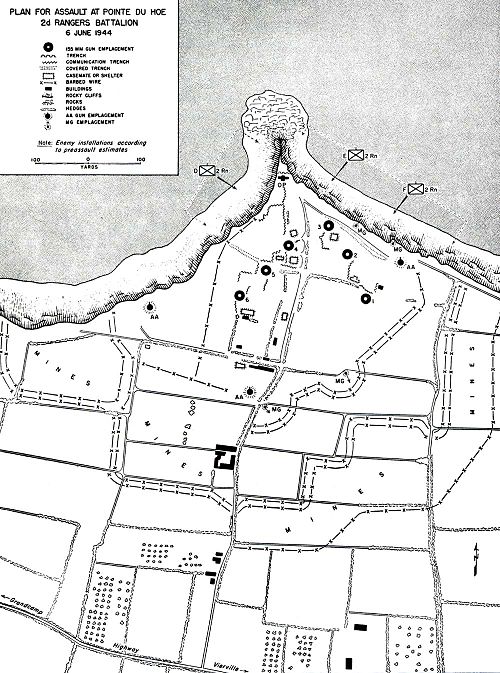
US Rangers scale Pointe du Hoc cliffs
US 2nd Ranger Battalion scaled the cliffs at Pointe du Hoc under enemy fire to neutralize German coastal artillery, only to find the guns had been removed inland. · Wikipedia: https://en.wikipedia.org/wiki/Pointe_du_Hoc
US Rangers scale Pointe du Hoc cliffs By Unknown author, Public domain, https://commons.wikimedia.org/w/index.php?curid=489763
Jun 6, 1944 CE
Omaha Beach breakthrough begins
Small groups of US soldiers began breaching the seawall and advancing up the bluffs at Omaha Beach, using gaps in the German defences to push inland. · Wikipedia: https://en.wikipedia.org/wiki/Omaha_Beach
A LCVP (Landing Craft, Vehicle, Personnel) from the U.S. Coast Guard-manned USS Samuel Chase disembarks troops of Company A, 16th Infantry, 1st Infantry Division (the Big Red One) wading onto the Fox Green section of Omaha Beach (Calvados, Basse-Normandie, France) on the morning of June 6, 1944. American soldiers encountered the newly formed German 352nd Division when landing. During the initial landing two-thirds of Company E became casualties. By Chief Photographer's Mate (CPHoM) Robert F. Sargent - This tag does not indicate the copyright status of the attached work. A normal copyright tag is still required. See Commons:Licensing., Public domain, https://commons.wikimedia.org/w/index.php?curid=17040973
Jun 6, 1944 CE
British link Gold and Juno beachheads
British and Canadian forces linked the Gold and Juno beachheads, creating a continuous Allied front along the central Normandy coast. ) · Wikipedia: https://en.wikipedia.org/wiki/Gold_Beach
Caption 1: "The infantry, the humble foot soldiers, now about to fulfil their classical role." Caption 2: "Commando troops coming ashore from LCIs (Landing Craft Infantry)." The photograph shows commandos of the 50th (Northumbrian) Infantry Division of the British Army coming ashore from Landing Craft Infantry at Gold Beach near La Rivière-Saint-Sauveur, Normandy, France, on 6 June 1944 at the start of the Invasion of Normandy during World War II. By Sgt Midgley, No 5 Army Film & Photographic Unit. - Caption 1 and photograph from Clay, Major Ewart W. (1950) The Path of the 50th: The Story of the 50th (Northumbrian) Division in the Second World War, Gale and Polden, p. 238 ISBN: 1-87006-707-X. Caption 2, information on the photographer, and the photograph also located at the Imperial War Museum collection number 4700-29, reference number B 5245. This photograph B 5245 comes from the collections of the Imperial War Museums., Public domain, https://commons.wikimedia.org/w/index.php?curid=7283371


![For documentary purposes the German Federal Archive often retained the original image captions, which may be erroneous, biased, obsolete or politically extreme. Gerd v. Rundstedt Am 12. Dezember begeht General der Infanterie Gerd von Rundstedt, der Oberbefehlshaber der Gruppe I Berlin seinen 60. Geburtstag. General von Rundstedt wurde am 12. Dezember 1875 in Aschersleben geboren und begann seine Laufbahn im Jahre 1892 beim Infanterie-Regiment Nr. 83. Im Jahre 1902 wurde er zur Kriegs-Akademie berufen und 1909 zum Grossen Generalstab versetzt, dem er auch während des grössten Teils des Weltkrieges angehörte. Der Name Rundstedts wurde besonders am 20. Juli 1930 bekannt, als ihm die vollziehende Gewalt bei Verhängung des militärischen Ausnahmezustandes über Berlin und die Mark Brandenburg übertragen wurde. [Aufnahme 1932] [General Gerd von Rundstedt (Porträt)] Abgebildete Personen: Rundstedt, Gerd von: Generalfeldmarschall, Ritterkreuz (RK), Heer, Deutschland (GND 118939327)](https://upload.wikimedia.org/wikipedia/commons/thumb/d/d6/Bundesarchiv_Bild_183-S37772%2C_Gerd_v._Rundstedt_%28cropped%29.jpg/500px-Bundesarchiv_Bild_183-S37772%2C_Gerd_v._Rundstedt_%28cropped%29.jpg)