Encyclopedia/2. Technology & The Built World/1. Computing, AI & Information Technology/01. Hardware & Electronics • Curated by Admin Timeline.sg
This timeline covers the foundational milestones in cybersecurity and cryptography from ancient times to the mid-20th century, highlighting key breakthroughs in encryption, cryptanalysis, and secure communication that shaped the field.
Chronological Storyline (51 Milestones)
1500 BCE
Non-standard Hieroglyphic Cipher
Ancient Egyptian scribes used non-standard hieroglyphs in tomb inscriptions, one of the earliest known examples of cryptography to obscure meaning. This demonstrated early awareness of secret communication. #cryptography #history
Non-standard Hieroglyphic Cipher By Unknown author, Public domain, https://commons.wikimedia.org/w/index.php?curid=226312
500 BCE
Spartan Scytale Cipher
The Spartans used a scytale, a wooden rod around which a strip of parchment was wound, to encrypt military messages. This transposition cipher is one of the first known cryptographic devices. #cryptography #ancient
Spartan Scytale Cipher By Unknown author, CC BY-SA 3.0, https://commons.wikimedia.org/w/index.php?curid=1698345
100 BCE
Julius Caesar's Cipher
Julius Caesar used a simple substitution cipher shifting letters by three positions to protect military communications. The Caesar cipher became a classic example of early encryption. #cryptography #ancient
Julius Caesar's Cipher By Roy Zuo - Own work, CC BY-SA 4.0, https://commons.wikimedia.org/w/index.php?curid=147647748
800 CE
Al-Kindi's Cryptanalysis
Arab mathematician Al-Kindi wrote 'A Manuscript on Deciphering Cryptographic Messages', introducing frequency analysis to break substitution ciphers. This is considered the birth of cryptanalysis. #cryptography #cryptanalysis
Al-Kindi's Cryptanalysis By Iraqi Post - Personal collection, Public domain, https://commons.wikimedia.org/w/index.php?curid=91832934
1466 CE
Alberti Cipher Disk
Leon Battista Alberti invented the cipher disk, a polyalphabetic cipher device that used two concentric disks to shift alphabets. This was a major advance over simple substitution. #cryptography #renaissance
Alberti Cipher Disk By Augusto Buonafalce - Converted from JPG at https://commons.wikimedia.org/wiki/File:Alberti_cipher_disk.JPG, CC BY-SA 3.0, https://commons.wikimedia.org/w/index.php?curid=110919406
1518 CE
Trithemius' Steganographia
Johannes Trithemius wrote 'Steganographia', a book on cryptography and steganography, describing methods to hide messages. It was placed on the Catholic Church's Index of Forbidden Books. #cryptography #steganography
Trithemius' Steganographia By CSvBibra - Own work, Public domain, https://commons.wikimedia.org/w/index.php?curid=7474171
1553 CE
Bellaso's Vigenère Cipher
Giovan Battista Bellaso described a polyalphabetic cipher using a key phrase, later misattributed to Vigenère. The Vigenère cipher became famous for its resistance to frequency analysis. #cryptography #history
Bellaso's Vigenère Cipher By Thomas de Leu - Woodcut Photograph. No date found., Public domain, https://commons.wikimedia.org/w/index.php?curid=80100
1586 CE
Blaise de Vigenère's Treatise
Blaise de Vigenère published 'Traicté des Chiffres', detailing a polyalphabetic cipher with a key. His work solidified the cipher that bears his name, though Bellaso had earlier described it. #cryptography #history
Blaise de Vigenère's Treatise By Unknown author - File: Vigenere.jpg, Public domain, https://commons.wikimedia.org/w/index.php?curid=22661625
1790 CE
Jefferson's Wheel Cipher
Thomas Jefferson invented the wheel cipher, a cylindrical device with 36 disks for encrypting messages. It was a precursor to modern rotor machines but not widely used in his time. #cryptography #us
Jefferson's Wheel Cipher By Unknown author, Public domain, https://commons.wikimedia.org/w/index.php?curid=258129
1854 CE
Babbage's Cryptanalysis of Vigenère
Charles Babbage discovered a method to break the Vigenère cipher using Kasiski examination, but his work remained unpublished. Friedrich Kasiski later independently published the method in 1863. #cryptography #cryptanalysis
Babbage's Cryptanalysis of Vigenère By Unknown author - http://images.google.com/hosted/life/l?q=Charles+Babbage&prev=/search%3Fq%3DCharles%2BBabbage%26um%3D1%26hl%3Den%26sa%3DX%26biw%3D1680%26bih%3D916%26tbs%3Disz:l%26tbm%3Disch&imgurl=19fc9fba4ea4a1cb, Public domain, https://commons.wikimedia.org/w/index.php?curid=15392737
1883 CE
Kerckhoffs's Principle
Auguste Kerckhoffs published 'La Cryptographie Militaire', stating that a cryptosystem should be secure even if everything except the key is public. This principle became fundamental to cryptography. #cryptography #principles
Kerckhoffs's Principle By Unknown author - Eugen Drezen, Historio de la Mondo Lingvo (Leipzig, 1931), 102, Public domain, https://commons.wikimedia.org/w/index.php?curid=39712823
1917 CE
Zimmermann Telegram
British cryptanalysts decrypted the Zimmermann Telegram, a German proposal to Mexico, using captured codebooks. This interception helped bring the United States into World War I. #cryptography #wwi
Zimmermann Telegram By Unknown authorUnknown author or not provided - U.S. National Archives and Records Administration, Public domain, https://commons.wikimedia.org/w/index.php?curid=27222069
1918 CE
Gilbert Vernam's One-Time Pad
Gilbert Vernam invented the one-time pad cipher, which uses a random key as long as the message. It is provably unbreakable if used correctly, but key distribution remains a challenge. #cryptography #security
Gilbert Vernam's One-Time Pad By US National Security Agency - https://www.governmentattic.org/18docs/Hist_US_COMSEC_Boak_NSA_1973u.pdf A History of U.S. Communications Security; the David G. Boak Lectures, National Security Agency (NSA), Volumes I, 1973, Volumes II 1981, partially released 2008, additional portions declassified October 14, 2015, Public domain, https://commons.wikimedia.org/w/index.php?curid=45783652
1926 CE
Enigma Machine Patented
Arthur Scherbius patented the Enigma machine, an electromechanical rotor cipher device. It became the most famous encryption machine of World War II, used by Nazi Germany. #cryptography #wwii
Enigma Machine Patented By Alessandro Nassiri - Museo della Scienza e della Tecnologia "Leonardo da Vinci", CC BY-SA 4.0, https://commons.wikimedia.org/w/index.php?curid=47910919
1931 CE
William Friedman's Cryptanalysis
William F. Friedman, a US Army cryptanalyst, developed statistical methods for breaking ciphers and co-authored 'The Index of Coincidence'. His work laid the foundation for modern cryptanalysis. #cryptography #cryptanalysis
William Friedman's Cryptanalysis By Unknown author, Public domain, https://commons.wikimedia.org/w/index.php?curid=224898
1939 CE
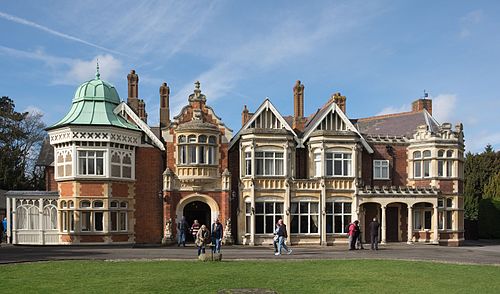
Bletchley Park Established
The UK's Government Code and Cypher School moved to Bletchley Park, where cryptanalysts including Alan Turing worked to break German ciphers. Their efforts significantly shortened World War II. #cryptography #wwii
Bletchley Park Established By DeFacto - Own work, CC BY-SA 4.0, https://commons.wikimedia.org/w/index.php?curid=56815741
1940 CE
Bombe Machine Developed
Alan Turing designed the Bombe, an electromechanical device to decrypt Enigma messages. The Bombe automated the search for Enigma settings, enabling large-scale decryption. #cryptography #wwii
Bombe Machine Developed By Unknown author - Set of wartime photos of GC&CS at Bletchley Park, Public domain, https://commons.wikimedia.org/w/index.php?curid=72819587
1943 CE
Colossus Computer Built
Tommy Flowers built Colossus, the world's first programmable electronic computer, to break the Lorenz cipher. Colossus was used at Bletchley Park and remained secret for decades. #cryptography #computing
Colossus Computer Built By Unknown author - This file is from the collections of The National Archives (United Kingdom), catalogued under document record FO850/234. For high quality reproductions of any item from The National Archives collection please contact the image library., Public domain, https://commons.wikimedia.org/w/index.php?curid=501979
1945 CE
Shannon's Communication Theory
Claude Shannon published 'A Mathematical Theory of Cryptography', establishing information theory and formalizing concepts like entropy and perfect secrecy. This work revolutionized cryptography. #cryptography #theory
Shannon's Communication Theory By Unknown author - Tekniska Museet of Sweden, Item 43069 via Flickr, CC BY 2.0, https://commons.wikimedia.org/w/index.php?curid=190273293
1949 CE
Shannon's 'Communication Theory of Secrecy Systems'
Shannon's paper unified cryptography with information theory, proving that the one-time pad is perfectly secure. It introduced the concepts of confusion and diffusion. #cryptography #theory
1951 CE
M-209 Cipher Machine
The M-209, a portable rotor cipher machine, was widely used by the US military during and after World War II. It was based on the Hagelin C-38 and provided moderate security. #cryptography #military
M-209 Cipher Machine By Rama - Own work, CC BY-SA 2.0 fr, https://commons.wikimedia.org/w/index.php?curid=17222324
1952 CE
NSA Founded
The National Security Agency (NSA) was established in the US to handle signals intelligence and information security. It became the world's largest intelligence agency focused on cryptography. #cryptography #intelligence
NSA Founded By U.S. government - www.nsa.gov http://quicksearch.dla.mil/qsDocDetails.aspx?ident_number=275845, Public domain, https://commons.wikimedia.org/w/index.php?curid=2976322
1956 CE
DES Development Begins
IBM began developing a block cipher under contract with the NSA, leading to the Data Encryption Standard (DES). DES became the first publicly available standardized encryption algorithm. #cryptography #standard
DES Development Begins By Hellisp - File:Data Encryption Standard InfoBox Diagram.png, CC0, https://commons.wikimedia.org/w/index.php?curid=33316542
1960 CE
Feistel Network Introduced
Horst Feistel, working at IBM, developed the Feistel network structure for block ciphers. This design became the basis for many ciphers including DES and Lucifer. #cryptography #design
Feistel Network Introduced By Feistel_cipher_diagram.svg: Amirki derivative work: Amirki (talk) - Feistel_cipher_diagram.svg, CC BY-SA 3.0, https://commons.wikimedia.org/w/index.php?curid=16419258
1967 CE
Kahn's 'The Codebreakers' Published
David Kahn published 'The Codebreakers', a comprehensive history of cryptography. The book brought cryptology to public attention and inspired a new generation of cryptographers. #cryptography #history
1970 CE
Lucifer Cipher Developed
IBM's Lucifer cipher, designed by Horst Feistel, was a precursor to DES. It used a 128-bit key and Feistel structure, influencing later block cipher designs. #cryptography #ibm
1971 CE
ARPANET Email and Security Concerns
As ARPANET grew, early email systems raised security issues. Researchers began considering encryption for network communications, leading to later developments in network security. #cybersecurity #networking
ARPANET Email and Security Concerns By ARPANET - The Computer History Museum ([1]), en:File:Arpnet-map-march-1977.png, Public domain, https://commons.wikimedia.org/w/index.php?curid=9990864
1973 CE
NBS Calls for Encryption Standard
The US National Bureau of Standards (NBS) issued a public call for a standard encryption algorithm. This led to the adoption of DES after evaluation by the NSA. #cryptography #standard
1975 CE
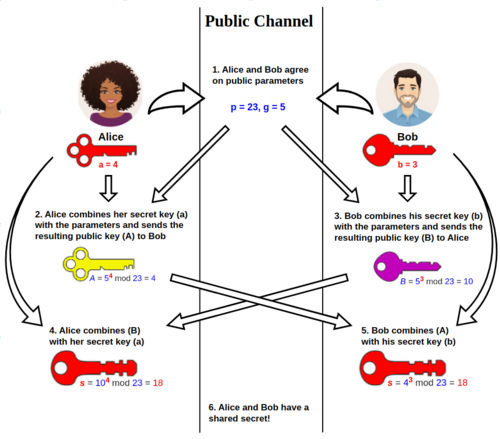
Diffie-Hellman Key Exchange
Whitfield Diffie and Martin Hellman published 'New Directions in Cryptography', introducing public-key cryptography and the Diffie-Hellman key exchange. This revolutionized secure communication. #cryptography #publickey
Diffie-Hellman Key Exchange By Epachamo - Own work, CC BY-SA 4.0, https://commons.wikimedia.org/w/index.php?curid=142206661
1976 CE
DES Standardized
The Data Encryption Standard (DES) was adopted as a US federal standard for encryption. DES used a 56-bit key and became widely used in banking and government. #cryptography #standard
1977 CE
RSA Algorithm Published
Ron Rivest, Adi Shamir, and Leonard Adleman published the RSA algorithm, the first practical public-key cryptosystem. RSA enabled secure digital signatures and encryption. #cryptography #publickey
1978 CE
Merkle's Puzzles
Ralph Merkle proposed Merkle's puzzles as an early public-key distribution scheme. Though less efficient than Diffie-Hellman, it contributed to the development of public-key cryptography. #cryptography #publickey
1979 CE
Shamir's Secret Sharing
Adi Shamir introduced secret sharing, a method to split a secret into parts distributed among participants. This became fundamental in cryptographic key management. #cryptography #security
1980 CE
First Computer Virus 'Elk Cloner'
Rich Skrenta created Elk Cloner, a boot sector virus for Apple II computers. It spread via floppy disks, marking the beginning of malware and the need for cybersecurity. #cybersecurity #malware
First Computer Virus 'Elk Cloner' By Richard Skrenta - Own work (Own screenshot), Public domain, https://commons.wikimedia.org/w/index.php?curid=107324652
1981 CE
IBM PC Introduced
IBM launched the IBM Personal Computer, which became the standard for business computing. Its popularity increased the attack surface for malware and security threats. #cybersecurity #computing
IBM PC Introduced By Own work (based on graphics by International Business Machines Corporation) - Own work, derived from various photographs of IBM PCs, Public domain, https://commons.wikimedia.org/w/index.php?curid=115457047
1982 CE
Morris Worm Precursor
The first known worm, the 'Morris Worm' precursor, was created as an experiment but accidentally caused widespread damage. It highlighted vulnerabilities in networked systems. #cybersecurity #worm
1983 CE
Kerberos Protocol Developed
MIT researchers developed Kerberos, a network authentication protocol using symmetric-key cryptography. It became a standard for secure authentication in distributed systems. #cryptography #authentication
1984 CE
Chaum's Blind Signatures
David Chaum introduced blind signatures, enabling anonymous digital transactions. This work laid the foundation for privacy-preserving cryptographic protocols and digital cash. #cryptography #privacy
Chaum's Blind Signatures By Rudd84 at Italian Wikipedia - Own work, CC BY-SA 3.0, https://commons.wikimedia.org/w/index.php?curid=37310164
1985 CE
Elliptic Curve Cryptography Proposed
Neal Koblitz and Victor Miller independently proposed using elliptic curves for public-key cryptography. ECC offers equivalent security with smaller key sizes than RSA. #cryptography #publickey
1986 CE
First Computer Emergency Response Team (CERT)
The CERT Coordination Center was established at Carnegie Mellon University to respond to computer security incidents. It became a model for incident response worldwide. #cybersecurity #incidentresponse
First Computer Emergency Response Team (CERT) By CERT/CC - http://www.cert.org, Public domain, https://commons.wikimedia.org/w/index.php?curid=38817369
1987 CE
MD5 Hash Function Developed
Ronald Rivest designed MD5, a widely used cryptographic hash function. It produced 128-bit hashes but later found to have vulnerabilities, leading to more secure alternatives. #cryptography #hashing
1988 CE
Morris Worm Spreads
Robert Tappan Morris released the Morris worm, infecting about 6,000 Unix machines. It was one of the first major internet worms, leading to the creation of the first CERT. #cybersecurity #worm
1989 CE
Pretty Good Privacy (PGP) Released
Phil Zimmermann released PGP, an encryption program for email and files using public-key cryptography. It sparked legal battles over export controls and became a symbol of digital privacy. #cryptography #privacy
1990 CE
First Firewall Technology
Early packet-filtering firewalls were developed to control network traffic. The first commercial firewall, DEC's SEAL, was released, marking the beginning of network security appliances. #cybersecurity #networking
1991 CE
Secure Sockets Layer (SSL) Developed
Netscape developed SSL to secure web communications. SSL used public-key cryptography for authentication and encryption, becoming the foundation for HTTPS. #cryptography #websecurity
1992 CE
First Intrusion Detection System
Dorothy Denning developed the Intrusion Detection Expert System (IDES), a real-time intrusion detection system. This laid the groundwork for modern IDS/IPS technologies. #cybersecurity #intrusiondetection
1993 CE
Clipper Chip Controversy
The US government proposed the Clipper chip, a tamper-resistant chip with key escrow for law enforcement access. It faced strong opposition from privacy advocates and was eventually abandoned. #cryptography #privacy
Clipper Chip Controversy By Travis Goodspeed - MYK-78 Package Markings, CC BY 2.0, https://commons.wikimedia.org/w/index.php?curid=26694403
1994 CE
Secure Hash Algorithm (SHA-1) Published
NIST published SHA-1, a 160-bit hash function designed by the NSA. It became widely used but later found to be vulnerable to collision attacks. #cryptography #hashing
1995 CE
Netscape Navigator and SSL 2.0
Netscape Navigator 1.0 included SSL 2.0, enabling secure e-commerce. This accelerated the adoption of HTTPS and online transactions. #cybersecurity #web
1996 CE
IPsec Standard Proposed
The Internet Engineering Task Force (IETF) proposed IPsec, a suite of protocols for securing IP communications. IPsec became a standard for VPNs and network-layer security. #cryptography #networking
1997 CE
AES Competition Announced
NIST announced a public competition to replace DES with the Advanced Encryption Standard (AES). The competition aimed to select a secure, efficient block cipher. #cryptography #standard
AES Competition Announced By John Savard - https://www.eng.tau.ac.il/~yash/crypto-netsec/rijndael.htm, CC0, https://commons.wikimedia.org/w/index.php?curid=103718081