Encyclopedia/1. The Cosmos & The Natural World/1. Mathematics & Formal Systems/06. Number Theory & Cryptography • Curated by Admin Timeline.sg
Biographical timeline tracking the seminal contributions, inventions, and lasting legacies of leading figures in Cryptography & Mathematical Security, from ancient cipher systems to modern post-quantum cryptography.
Chronological Storyline (40 Milestones)
100 BCE
Julius Caesar Uses Substitution Cipher
Julius Caesar reportedly used a simple substitution cipher (shift by 3) for military communications, one of the earliest recorded uses of cryptography. #cryptography #history
Julius Caesar Uses Substitution Cipher By Roy Zuo - Own work, CC BY-SA 4.0, https://commons.wikimedia.org/w/index.php?curid=147647748
800 CE
Al-Kindi Writes on Cryptanalysis
Arab polymath Al-Kindi (Alkindus) writes 'A Manuscript on Deciphering Cryptographic Messages', introducing frequency analysis and describing multiple cipher methods. #cryptography #islamicgoldenage
Al-Kindi Writes on Cryptanalysis By Iraqi Post - Personal collection, Public domain, https://commons.wikimedia.org/w/index.php?curid=91832934
1465 CE
Alberti Invents Polyalphabetic Cipher
Leon Battista Alberti invents the first polyalphabetic cipher using a cipher disk, a major advance over simple substitution. #cryptography #renaissance
Alberti Invents Polyalphabetic Cipher By Leon Battista Alberti - This file was donated to Wikimedia Commons as part of a project by the National Gallery of Art. Please see the Gallery's Open Access Policy., CC0, https://commons.wikimedia.org/w/index.php?curid=80615353
1518 CE
Trithemius Writes Steganographia
Johannes Trithemius writes 'Steganographia', a book combining cryptography and steganography, inspiring later European cryptographers. #cryptography #history
Trithemius Writes Steganographia By CSvBibra - Own work, Public domain, https://commons.wikimedia.org/w/index.php?curid=7474171
1585 CE
Vigenère Describes Vigenère Cipher
Blaise de Vigenère publishes his influential book 'Traicté des chiffres', describing a polyalphabetic cipher that would remain unbroken for centuries. #cryptography #history
Vigenère Describes Vigenère Cipher By Thomas de Leu - Woodcut Photograph. No date found., Public domain, https://commons.wikimedia.org/w/index.php?curid=80100
1795 CE
Jefferson Invents Wheel Cipher
Thomas Jefferson designs a wheel cipher, a polyalphabetic device using rotating discs, though it was not widely used. #cryptography #usa
Jefferson Invents Wheel Cipher By Unknown author, Public domain, https://commons.wikimedia.org/w/index.php?curid=258129
1854 CE
Babbage Breaks Vigenère Cipher
Charles Babbage discovers a method to break the Vigenère cipher using frequency patterns, but his work remains unpublished until the 20th century. #cryptography #mathematics
Babbage Breaks Vigenère Cipher By Unknown author - http://images.google.com/hosted/life/l?q=Charles+Babbage&prev=/search%3Fq%3DCharles%2BBabbage%26um%3D1%26hl%3Den%26sa%3DX%26biw%3D1680%26bih%3D916%26tbs%3Disz:l%26tbm%3Disch&imgurl=19fc9fba4ea4a1cb, Public domain, https://commons.wikimedia.org/w/index.php?curid=15392737
1863 CE
Kasiski Publishes Kasiski Examination
Friedrich Kasiski publishes 'Die Geheimschriften und die Dechiffrir-Kunst', detailing a method for determining the key length of polyalphabetic ciphers. #cryptography #history
1877 CE
Chinese Telegraph Code Compilation
The Chinese Commercial Telegraph Code is developed, a book of code for transmitting Chinese characters via telegraph, integrating cryptography with language. #cryptography #china
1917 CE
Vernam Invents One-Time Pad
Gilbert Vernam of AT&T invents the one-time pad cipher, a theoretically unbreakable system when used correctly, later refined by Claude Shannon. #cryptography #security
1922 CE
Friedman Publishes 'Index of Coincidence'
William F. Friedman publishes 'The Index of Coincidence and Its Applications in Cryptography', a foundational work in statistical cryptanalysis. #cryptography #mathematics
Friedman Publishes 'Index of Coincidence' By Unknown author, Public domain, https://commons.wikimedia.org/w/index.php?curid=224898
1926 CE
Arne Beurling Breaks G-Schreiber Cipher
Swedish mathematician Arne Beurling single-handedly cracks a German teletype cipher (G-Schreiber) during WWII, a feat of manual cryptanalysis. #cryptography #wwii
Arne Beurling Breaks G-Schreiber Cipher By Unknown photographer - TT News Agency, Public domain, https://commons.wikimedia.org/w/index.php?curid=116619421
1927 CE
Kautilya's Arthashastra Describes Cryptography
Ancient Indian text Arthashastra by Kautilya (Chanakya) recommends secret writing for espionage, reflecting early Indian cryptographic practice. #cryptography #ancientindia
1929 CE
Hill Invents Hill Cipher
Lester S. Hill introduces the Hill cipher, which uses linear algebra and matrix multiplication, an early example of applying advanced mathematics to cryptography. #cryptography #mathematics
Hill Invents Hill Cipher By patents.google.com - Figure 4 from Hill's "Message Protector" patent, US patent 1,845,947 of 1929. Sourced from https://patents.google.com/patent/US1845947A/en, Public domain, https://commons.wikimedia.org/w/index.php?curid=44483288
1933 CE
Soviet Union Uses One-Time Pads for Espionage
The USSR employs one-time pads for diplomatic and intelligence communications, famously broken in the Venona project using duplications. #cryptography #history
1939 CE
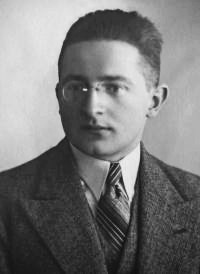
Polish Mathematicians Break Enigma
Marian Rejewski, Henryk Zygalski, and Jerzy Różycki in Poland develop techniques to decrypt German Enigma messages, laying groundwork for Allied efforts. #cryptography #wwii
Polish Mathematicians Break Enigma By Unknown author - Rejewski's daughter's private archive, CC BY-SA 2.5, https://commons.wikimedia.org/w/index.php?curid=216461
1940 CE
Turing Designs Bombe at Bletchley Park
Alan Turing, building on Polish work, designs the Bombe machine to rapidly decode Enigma messages, a major boost to Allied intelligence. #cryptography #computing
Turing Designs Bombe at Bletchley Park By Elliott & Fry - https://commons.wikimedia.org/wiki/File:Alan_Turing_(1951).jpg, Public domain, https://commons.wikimedia.org/w/index.php?curid=158923803
1949 CE
Shannon Publishes 'Communication Theory of Secrecy Systems'
Claude Shannon formalizes cryptography using information theory, establishing the theoretical foundations of secure communication. #cryptography #informationtheory
Shannon Publishes 'Communication Theory of Secrecy Systems' By Unknown author - Tekniska Museet of Sweden, Item 43069 via Flickr, CC BY 2.0, https://commons.wikimedia.org/w/index.php?curid=190273293
1973 CE
Feistel Develops Feistel Cipher Structure
Horst Feistel of IBM designs the Feistel network, a balanced structure used in many later block ciphers including DES. #cryptography #computing
Feistel Develops Feistel Cipher Structure By Feistel_cipher_diagram.svg: Amirki derivative work: Amirki (talk) - Feistel_cipher_diagram.svg, CC BY-SA 3.0, https://commons.wikimedia.org/w/index.php?curid=16419258
1974 CE
NSA Publishes DES (Classified) Comments
The NSA works with IBM on DES, making influential but controversial modifications (including S-box design) that later spark debate about potential backdoors. #cryptography #history
1976 CE
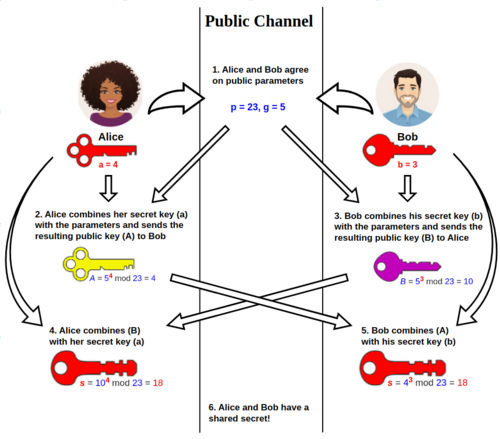
Diffie-Hellman Key Exchange Published
Whitfield Diffie and Martin Hellman publish 'New Directions in Cryptography', introducing public-key cryptography and the Diffie-Hellman key exchange. #cryptography #security
Diffie-Hellman Key Exchange Published By Epachamo - Own work, CC BY-SA 4.0, https://commons.wikimedia.org/w/index.php?curid=142206661
1977 CE
DES Adopted as Federal Standard
The Data Encryption Standard (DES), based on Feistel's Lucifer cipher, is adopted by the U.S. NIST, becoming the most widely used symmetric cipher. #cryptography #security
DES Adopted as Federal Standard By Hellisp - File:Data Encryption Standard InfoBox Diagram.png, CC0, https://commons.wikimedia.org/w/index.php?curid=33316542
1977 CE
RSA Algorithm Published
Ron Rivest, Adi Shamir, and Leonard Adleman create RSA, the first practical public-key cryptosystem based on the difficulty of factoring large primes. #cryptography #security )
1985 CE
Elliptic Curve Cryptography Introduced
Neal Koblitz and Victor Miller independently propose using elliptic curves in cryptography (ECC), offering equivalent security with smaller key sizes. #cryptography #mathematics
1991 CE
Zimmermann Releases PGP
Phil Zimmermann releases Pretty Good Privacy (PGP), bringing strong public-key encryption to the masses and sparking legal battles over crypto export controls. #cryptography #privacy
1994 CE
Shor's Algorithm for Quantum Factoring
Peter Shor publishes a polynomial-time quantum algorithm for factoring integers and computing discrete logarithms, threatening RSA and Diffie-Hellman. #cryptography #quantum
1997 CE
AES Competition Announced
The National Institute of Standards and Technology (NIST) calls for submissions for the Advanced Encryption Standard (AES) to replace DES. #cryptography #security
AES Competition Announced By John Savard - https://www.eng.tau.ac.il/~yash/crypto-netsec/rijndael.htm, CC0, https://commons.wikimedia.org/w/index.php?curid=103718081
1998 CE
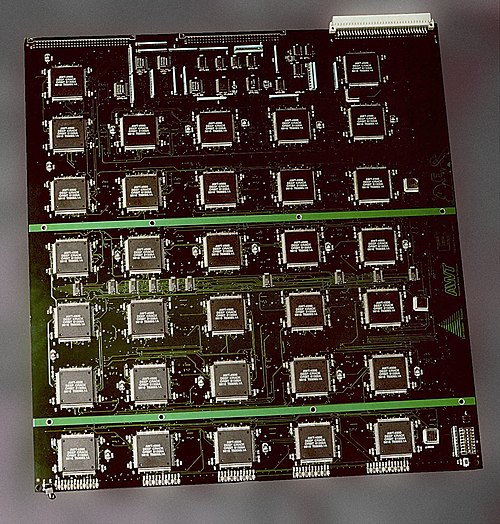
EFF Builds DES Cracker
The Electronic Frontier Foundation constructs a DES cracker for under $250,000, demonstrating DES's vulnerability to brute force and hastening AES adoption. #cryptography #security
EFF Builds DES Cracker By The original uploader was Matt Crypto at English Wikipedia. Later versions were uploaded by Ed g2s at en.wikipedia. - http://w2.eff.org/Privacy/Crypto/Crypto_misc/DESCracker/ (Via en:)., CC BY 3.0 us, https://commons.wikimedia.org/w/index.php?curid=2437815
2000 CE
Rijndael Selected as AES
NIST selects the Rijndael cipher (by Joan Daemen and Vincent Rijmen) as the Advanced Encryption Standard, now used globally. #cryptography #security
2001 CE
NIST Publishes SHA-1 Standard
NIST publishes SHA-1 as a secure hash standard, though later cryptanalysis reveals vulnerabilities. #cryptography #hashing
2004 CE
SHA-1 Cryptanalysis Breakthrough
Researchers, including Xiaoyun Wang, publish a collision attack on SHA-1, eventually leading to its deprecation. #cryptography #security
2008 CE
Bitcoin Uses SHA-256 for Proof-of-Work
Satoshi Nakamoto's Bitcoin whitepaper uses SHA-256 as the hash function for its proof-of-work consensus mechanism, driving interest in cryptographic currencies. #cryptography #blockchain
Bitcoin Uses SHA-256 for Proof-of-Work By Grayliptrot - This file was derived from: Bitcoin logo.svg, Public domain, https://commons.wikimedia.org/w/index.php?curid=30202095
2012 CE
Keccak Selected as SHA-3
NIST selects Keccak (by Guido Bertoni et al.) as the SHA-3 standard, a sponge-based hash function alternative to SHA-2. #cryptography #hashing
2013 CE
Snowden Revelations Impact Cryptography
Edward Snowden leaks NSA documents revealing mass surveillance and efforts to weaken cryptographic standards, sparking global debate on encryption. #cryptography #privacy
Snowden Revelations Impact Cryptography By https://www.youtube.com/user/TheWikiLeaksChannel - Derived from: File:Edward Snowden speaks about government transparency at Sam Adams award presentation in Moscow.webm @20s, CC BY 3.0, https://commons.wikimedia.org/w/index.php?curid=28971285
NIST launches a process to evaluate and standardize quantum-resistant cryptographic algorithms to prepare for future quantum computers. #cryptography #quantum
2016 CE
Apple-FBI Encryption Dispute
The FBI demands Apple create a backdoor into an iPhone, focusing public attention on the tension between security and privacy. #cryptography #privacy
Apple-FBI Encryption Dispute By Kārlis Dambrāns - Flickr: iPhone 5C, CC BY 2.0, https://commons.wikimedia.org/w/index.php?curid=31603399
Oct 23, 2019 CE
Google Claims Quantum Supremacy
Google's Sycamore processor performs a computation deemed infeasible for classical supercomputers, raising urgency for post-quantum cryptography. #cryptography #quantum
2020 CE
Homomorphic Encryption Advances
Practical implementations of fully homomorphic encryption (FHE) mature, allowing computation on encrypted data while preserving privacy. #cryptography #privacy
2022 CE
NIST Selects First Post-Quantum Algorithms
NIST announces four candidate algorithms for post-quantum cryptography standardization, including CRYSTALS-Kyber and CRYSTALS-Dilithium. #cryptography #quantum
2024 CE
Quantum Attack on RSA-2048 Feared Imminent
Advancements in quantum error correction and qubit counts bring realistic threats to current public-key infrastructure closer. #cryptography #quantum