Cryptography & Mathematical Security: Modern Frontiers & Breakthrough Innovations
Encyclopedia/1. The Cosmos & The Natural World/1. Mathematics & Formal Systems/06. Number Theory & Cryptography • Curated by Admin Timeline.sg
Historical events timeline.
Chronological Storyline (40 Milestones)
1900 BCE
Egyptian Non-Standard Hieroglyphics (c. 1900 BCE)
Ancient Egyptian scribes used non-standard hieroglyphics in inscriptions to obscure meaning, representing one of the earliest known cryptographic practices. This early use of symbolic substitution provided confidentiality for ceremonial texts. #cryptography #history
Egyptian Non-Standard Hieroglyphics (c. 1900 BCE) By Unknown author, Public domain, https://commons.wikimedia.org/w/index.php?curid=226312
600 BCE
Kama Sutra Mentions Secret Writing (c. 600 BCE)
The Indian Kama Sutra by Vatsyayana lists mlecchita-vikalpa (secret writing) among 64 arts, advocating for substitution ciphers to convey messages discreetly. This early textual reference highlights cryptography's role in ancient Indian culture. #cryptography #history
Kama Sutra Mentions Secret Writing (c. 600 BCE) By Ms Sarah Welch - Own work, CC BY-SA 4.0, https://commons.wikimedia.org/w/index.php?curid=73935933
500 BCE
Scytale Cipher of Sparta (c. 500 BCE)
The Spartans used a scytale, a rod wrapped with a leather strip, for transposition cipher communication. This device enabled secure military messaging by requiring an identical rod for decryption. #cryptography #history
Scytale Cipher of Sparta (c. 500 BCE) By Unknown author, CC BY-SA 3.0, https://commons.wikimedia.org/w/index.php?curid=1698345
400 BCE
Polybius Square (c. 200 BCE)
Greek historian Polybius described a grid cipher that encoded letters into numbers for signal communication, known as the Polybius square. This system influenced later cryptographic techniques and remains a classic educational tool. #cryptography #history
Polybius Square (c. 200 BCE) By Gre regiment - Self-photographed, Public domain, https://commons.wikimedia.org/w/index.php?curid=109563083
800 CE
Al-Kindi Writes on Cryptanalysis (c. 855 CE)
Arab mathematician Al-Kindi authored 'A Manuscript on Deciphering Cryptographic Messages,' introducing frequency analysis as a method to break substitution ciphers. This foundational work established cryptanalysis as a science. #cryptography #history
Al-Kindi Writes on Cryptanalysis (c. 855 CE) By Iraqi Post - Personal collection, Public domain, https://commons.wikimedia.org/w/index.php?curid=91832934
1467 CE
Alberti Cipher Disk (1467)
Italian polymath Leon Battista Alberti invented the cipher disk, a polyalphabetic cipher using a rotating wheel to switch alphabets. This device marked a significant advance over simple substitution and is considered the first mechanical cipher. #cryptography #history
Alberti Cipher Disk (1467) By Augusto Buonafalce - Converted from JPG at https://commons.wikimedia.org/wiki/File:Alberti_cipher_disk.JPG, CC BY-SA 3.0, https://commons.wikimedia.org/w/index.php?curid=110919406
1585 CE
Vigenère Cipher Published (1585)
French diplomat Blaise de Vigenère published the Vigenère cipher, a polyalphabetic substitution using a keyword. Although later broken, it was considered unbreakable for centuries and remains a classic example of cryptographic design. #cryptography #history
Vigenère Cipher Published (1585) By Thomas de Leu - Woodcut Photograph. No date found., Public domain, https://commons.wikimedia.org/w/index.php?curid=80100
1790 CE
Jefferson Disk (1790s)
Thomas Jefferson created the Jefferson disk, a wheel cipher using 36 wooden disks for encryption and decryption. This device prefigured modern rotor machines and demonstrated early American cryptographic innovation. #cryptography #history
Jefferson Disk (1790s) By Unknown author, Public domain, https://commons.wikimedia.org/w/index.php?curid=258129
1835 CE
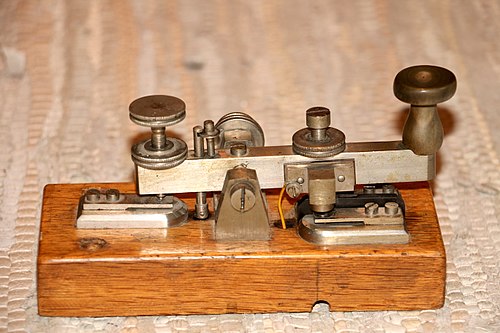
Morse Code (1835)
Samuel Morse developed Morse code, a method of encoding text into sequences of dots and dashes for telegraph communication. While not a cipher, it enabled efficient long-distance message transmission and influenced later encoding schemes. #cryptography #history
Morse Code (1835) By Hp.Baumeler - Own work, CC BY-SA 4.0, https://commons.wikimedia.org/w/index.php?curid=61723472
1854 CE
Babbage Breaks Vigenère Cipher (1854)
British mathematician Charles Babbage discovered a method to break the Vigenère cipher using frequency analysis, but his work remained unpublished until the 20th century. This feat demonstrated advanced cryptanalytic skills. #cryptography #history
Babbage Breaks Vigenère Cipher (1854) By Unknown author - http://images.google.com/hosted/life/l?q=Charles+Babbage&prev=/search%3Fq%3DCharles%2BBabbage%26um%3D1%26hl%3Den%26sa%3DX%26biw%3D1680%26bih%3D916%26tbs%3Disz:l%26tbm%3Disch&imgurl=19fc9fba4ea4a1cb, Public domain, https://commons.wikimedia.org/w/index.php?curid=15392737
1917 CE
Zimmermann Telegram Decrypted (1917)
British cryptanalysts in Room 40 decrypted the Zimmermann Telegram, a German diplomatic message proposing a Mexican alliance against the U.S. This decryption helped bring the United States into World War I. #cryptography #history
Zimmermann Telegram Decrypted (1917) By Unknown authorUnknown author or not provided - U.S. National Archives and Records Administration, Public domain, https://commons.wikimedia.org/w/index.php?curid=27222069
1926 CE
Gilbert Vernam Invents One-Time Pad (1926)
AT&T engineer Gilbert Vernam patented a unbreakable cipher using a random key as long as the message, combined with XOR operation. The one-time pad remains information-theoretically secure when keys are truly random and never reused. #cryptography #history
Gilbert Vernam Invents One-Time Pad (1926) By US National Security Agency - https://www.governmentattic.org/18docs/Hist_US_COMSEC_Boak_NSA_1973u.pdf A History of U.S. Communications Security; the David G. Boak Lectures, National Security Agency (NSA), Volumes I, 1973, Volumes II 1981, partially released 2008, additional portions declassified October 14, 2015, Public domain, https://commons.wikimedia.org/w/index.php?curid=45783652
1932 CE
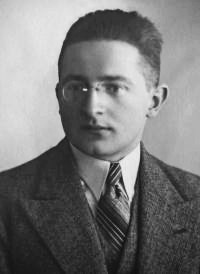
Polish Bomba Breaks Enigma (1932)
Polish mathematician Marian Rejewski reconstructed the German Enigma machine and developed the bomba, a device aiding decryption. This breakthrough laid the groundwork for later Allied code-breaking efforts in World War II. #cryptography #history
Polish Bomba Breaks Enigma (1932) By Unknown author - Rejewski's daughter's private archive, CC BY-SA 2.5, https://commons.wikimedia.org/w/index.php?curid=216461
1941 CE
Navajo Code Talkers (1941)
The U.S. Marine Corps recruited Navajo speakers to develop a cryptographic code based on their language for secure battlefield communication. The Navajo code was never broken by Japan and proved vital in the Pacific Theater. #cryptography #history
Navajo Code Talkers (1941) By Unknown author - https://www.choctawnation.com/history-culture/people/code-talkers, Public domain, https://commons.wikimedia.org/w/index.php?curid=79650510
1948 CE
Claude Shannon's Communication Theory (1948)
Claude Shannon published 'A Mathematical Theory of Communication,' laying the foundation for information theory. His concepts of entropy and perfect secrecy provided a mathematical framework for cryptography. #cryptography #mathematics
Claude Shannon's Communication Theory (1948) By Unknown author - Tekniska Museet of Sweden, Item 43069 via Flickr, CC BY 2.0, https://commons.wikimedia.org/w/index.php?curid=190273293
1973 CE
DES Adopted by NBS (1973)
The U.S. National Bureau of Standards selected the Data Encryption Standard (DES), a symmetric key block cipher derived from IBM's Lucifer. DES became the first publicly available encryption algorithm certified by a government agency. #cryptography #security
DES Adopted by NBS (1973) By Hellisp - File:Data Encryption Standard InfoBox Diagram.png, CC0, https://commons.wikimedia.org/w/index.php?curid=33316542
1976 CE
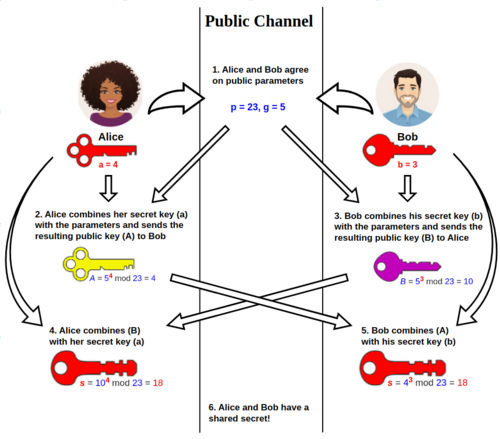
Diffie-Hellman Key Exchange Published (1976)
Whitfield Diffie and Martin Hellman published 'New Directions in Cryptography,' introducing public key cryptography and the Diffie-Hellman key exchange. This breakthrough enabled secure key exchange over insecure channels. #cryptography #security
Diffie-Hellman Key Exchange Published (1976) By Epachamo - Own work, CC BY-SA 4.0, https://commons.wikimedia.org/w/index.php?curid=142206661
1977 CE
RSA Algorithm Developed (1977)
Ron Rivest, Adi Shamir, and Leonard Adleman invented the RSA cryptosystem, the first practical asymmetric algorithm using prime factorization. RSA became fundamental for secure internet communications. #cryptography #security )
1984 CE
Blum-Blum-Shub PRNG (1984)
Lenore Blum, Manuel Blum, and Michael Shub proposed the Blum-Blum-Shub pseudorandom number generator, relying on the difficulty of integer factorization. It offered a provably secure method for generating random bits in cryptographic applications. #cryptography #mathematics
1985 CE
Elliptic Curve Cryptography Proposed (1985)
Neal Koblitz and Victor Miller independently proposed using elliptic curves in cryptography (ECC), offering equivalent security with smaller key sizes. ECC is now widely used in modern protocols like TLS. #cryptography #security
1991 CE
Pretty Good Privacy Released (1991)
Philip Zimmermann released Pretty Good Privacy (PGP), a free encryption program using RSA and IDEA to secure email. PGP sparked debates on privacy and export controls, leading to public awareness of cryptography. #cryptography #privacy
1994 CE
Shor's Algorithm for Quantum Factoring (1994)
Peter Shor devised a quantum algorithm that can factor integers and compute discrete logarithms in polynomial time, threatening RSA and ECC security. This discovery spurred research into post-quantum cryptography. #cryptography #quantum
1999 CE
AES Selected as Encryption Standard (1999)
The Advanced Encryption Standard (AES) was chosen by NIST after a public competition; Rijndael, designed by Joan Daemen and Vincent Rijmen, won. AES replaced DES as the global symmetric cipher. #cryptography #security
AES Selected as Encryption Standard (1999) By John Savard - https://www.eng.tau.ac.il/~yash/crypto-netsec/rijndael.htm, CC0, https://commons.wikimedia.org/w/index.php?curid=103718081
2001 CE
RSA-768 Factored (2001)
A team factored a 768-bit RSA modulus using hundreds of computers over years. The factorization demonstrated the increasing vulnerability of shorter key lengths and pushed for larger keys. #cryptography #security
2002 CE
AACS Cryptographic Key Compromise (2002)
The Advanced Access Content System (AACS) used for Blu-ray and HD DVD protection suffered a key compromise, leading to widespread circumvention. This incident highlighted challenges in content protection. #cryptography #security
AACS Cryptographic Key Compromise (2002) By Temporaluploader - Own work, Public domain, https://commons.wikimedia.org/w/index.php?curid=3743557
2008 CE
Bitcoin Whitepaper Introduces Blockchain (2008)
Satoshi Nakamoto published the Bitcoin whitepaper, combining cryptographic hash functions, public keys, and a proof-of-work consensus mechanism. Blockchain technology enabled decentralized digital currency. #cryptography #blockchain
Bitcoin Whitepaper Introduces Blockchain (2008) By Grayliptrot - This file was derived from: Bitcoin logo.svg, Public domain, https://commons.wikimedia.org/w/index.php?curid=30202095
2009 CE
MD5 Collision Attack (2009)
Researchers demonstrated a practical collision attack on the MD5 hash function using a chosen-prefix technique. This undermined MD5's security, leading to its deprecation in certificates and digital signatures. #cryptography #security
2010 CE
Stuxnet Exploits Digital Signatures (2010)
The Stuxnet worm used stolen digital certificates from two Taiwanese companies to appear legitimate, damaging Iran's nuclear centrifuges. This attack highlighted the importance of certificate security. #cryptography #security
2012 CE
Dual EC DRBG Backdoor Controversy (2012)
The NSA's Dual EC DRBG random number generator was revealed to contain a potential backdoor, leading to widespread criticism. The incident fueled distrust in cryptographic standards and government surveillance. #cryptography #security
2013 CE
Snowden Revelations of NSA Cryptography (2013)
Edward Snowden leaked documents revealing NSA programs to weaken encryption standards and collect data. The disclosures triggered global debates on privacy, encryption backdoors, and mass surveillance. #cryptography #privacy
Snowden Revelations of NSA Cryptography (2013) By https://www.youtube.com/user/TheWikiLeaksChannel - Derived from: File:Edward Snowden speaks about government transparency at Sam Adams award presentation in Moscow.webm @20s, CC BY 3.0, https://commons.wikimedia.org/w/index.php?curid=28971285
2014 CE
SHA-1 Collision Explained (2014)
Google and CWI Amsterdam demonstrated the first practical collision for SHA-1, sending a shockwave through the security community. This led to the phasing out of SHA-1 in favor of SHA-2 or SHA-3. #cryptography #security
2015 CE
NIST Selects SHA-3 as Hash Standard (2015)
The National Institute of Standards and Technology (NIST) chose Keccak as the SHA-3 standard after a public competition. SHA-3 provides an alternative hash function with a different internal structure. #cryptography #security
NIST launched a process to standardize post-quantum cryptographic algorithms resistant to quantum attacks. The competition evaluated candidates for encryption, digital signatures, and key exchange. #cryptography #quantum
2018 CE
GDPR Tightens Encryption Requirements (2018)
The European Union's General Data Protection Regulation (GDPR) mandated strong encryption for personal data protection, influencing global data security practices. Compliance pushed organizations to adopt robust cryptographic solutions. #cryptography #privacy
GDPR Tightens Encryption Requirements (2018) By User:Verdy p, User:-xfi-, User:Paddu, User:Nightstallion, User:Funakoshi, User:Jeltz, User:Dbenbenn, User:Zscout370 - File created by various Wikimedia users (see "Author"). File based on the specification given at [1]., Public domain, https://commons.wikimedia.org/w/index.php?curid=2615952
2019 CE
Apple-FBI Encryption Battle (2019)
Apple resisted FBI demands to create a backdoor into an iPhone encryption system, sparking a high-profile legal and public debate on privacy versus security. The case highlighted tensions between law enforcement and strong encryption. #cryptography #privacy
Apple-FBI Encryption Battle (2019) By Kārlis Dambrāns - Flickr: iPhone 5C, CC BY 2.0, https://commons.wikimedia.org/w/index.php?curid=31603399
2020 CE
Quantum Supremacy Claimed by Google (2020)
Google announced achieving quantum supremacy with its Sycamore processor solving a problem in 200 seconds. While not directly cryptographic, it underscored the urgency of quantum-resistant cryptography. #cryptography #quantum
2022 CE
NIST Selects First Post-Quantum Algorithms (2022)
NIST selected CRYSTALS-Kyber for key encapsulation and CRYSTALS-Dilithium, FALCON, and SPHINCS+ for signatures as the first post-quantum cryptographic standards. This marked a major step toward quantum-safe security. #cryptography #quantum
2023 CE
LLM-Based Side-Channel Attacks (2023)
Researchers demonstrated side-channel attacks using deep learning to recover cryptographic keys from electromagnetic emissions. This highlighted new threats from AI in cryptanalysis. #cryptography #AI
2024 CE
Large-Scale Quantum Key Distribution Network (2024)
China reports the world's largest quantum key distribution (QKD) network spanning over 4,600 km. QKD offers theoretically unbreakable encryption based on quantum principles. #cryptography #quantum
2025 CE
First Fully Homomorphic Encryption Breakthrough (2025)
Researchers achieve a practical speedup in fully homomorphic encryption (FHE) enabling real-time computation on encrypted data. This breakthrough could revolutionize cloud security and privacy. #cryptography #security