Cryptography & Mathematical Security: Major Case Studies & Paradigm Shifts
Encyclopedia/1. The Cosmos & The Natural World/1. Mathematics & Formal Systems/06. Number Theory & Cryptography • Curated by Admin Timeline.sg
A deep dive timeline into major case studies, experimental breakthroughs, and paradigm shifts in Cryptography & Mathematical Security, spanning ancient foundations to modern post-quantum developments.
Chronological Storyline (40 Milestones)
500 BCE
Spartan Scytale Cipher
The scytale is an ancient transposition cipher used by Spartans for military communications. A strip of leather was wound around a rod to encode messages. #cryptography #ancient
Spartan Scytale Cipher By Unknown author, CC BY-SA 3.0, https://commons.wikimedia.org/w/index.php?curid=1698345
400 BCE
Kautilya's Arthashastra on Secret Writing
The ancient Indian text Arthashastra by Kautilya mentions secret writing techniques for espionage, including substitution ciphers. It represents one of the earliest recorded references to cryptography. #cryptography #india
100 BCE
Julius Caesar Cipher
Julius Caesar used a simple substitution cipher, shifting letters by 3, for private correspondence. This method became a classic example in cryptography. #cryptography #rome
Julius Caesar Cipher By Roy Zuo - Own work, CC BY-SA 4.0, https://commons.wikimedia.org/w/index.php?curid=147647748
800 CE
Al-Kindi's Cryptanalysis Manuscript
Arab scholar Al-Kindi wrote the earliest known work on cryptanalysis, describing frequency analysis to break substitution ciphers. This marked a major paradigm shift in cryptographic security. #cryptography #islamicgoldenage
Al-Kindi's Cryptanalysis Manuscript By Iraqi Post - Personal collection, Public domain, https://commons.wikimedia.org/w/index.php?curid=91832934
1470 CE
Alberti Cipher Disk
Leon Battista Alberti invented the cipher disk, an early polyalphabetic cipher. His invention advanced cryptography by enabling more complex encryption. #cryptography #renaissance
Alberti Cipher Disk By Leon Battista Alberti - This file was donated to Wikimedia Commons as part of a project by the National Gallery of Art. Please see the Gallery's Open Access Policy., CC0, https://commons.wikimedia.org/w/index.php?curid=80615353
1553 CE
Vigenère Cipher Invented
Giovan Battista Bellaso described the Vigenère cipher, a polyalphabetic cipher that remained unbroken for centuries. It later became known as 'le chiffre indéchiffrable'. #cryptography
Vigenère Cipher Invented By Thomas de Leu - Woodcut Photograph. No date found., Public domain, https://commons.wikimedia.org/w/index.php?curid=80100
1586 CE
Trithemius' Steganographia
Johannes Trithemius wrote Steganographia, a treatise on steganography and cryptography. It included the first known polyalphabetic table. #cryptography #steganography
Trithemius' Steganographia By Trithemius, Johannes. Steganographia. Frankfurt: Johannes Saurius?, 1606. Digitized photographic reproduction. - http://diglib.hab.de/drucke/fb-243/start.htm?image=00001, Public domain, https://commons.wikimedia.org/w/index.php?curid=63528432
1623 CE
Francis Bacon's Biliteral Cipher
Francis Bacon devised a biliteral cipher using variations of type to encode messages. It was an early example of steganography and binary encoding. #cryptography #renaissance
Francis Bacon's Biliteral Cipher By Unknown author, Public domain, https://commons.wikimedia.org/w/index.php?curid=646209
1795 CE
Jefferson Wheel Cipher
Thomas Jefferson invented the wheel cipher, a mechanical device for polyalphabetic encryption. It was later used by the US military. #cryptography #usa
Jefferson Wheel Cipher By Unknown author, Public domain, https://commons.wikimedia.org/w/index.php?curid=258129
1854 CE
Babbage Breaks Vigenère
Charles Babbage discovered a method to break the Vigenère cipher, but his work was not published until later. This demonstrated early cryptanalysis. #cryptography #mathematics
Babbage Breaks Vigenère By Unknown author - http://images.google.com/hosted/life/l?q=Charles+Babbage&prev=/search%3Fq%3DCharles%2BBabbage%26um%3D1%26hl%3Den%26sa%3DX%26biw%3D1680%26bih%3D916%26tbs%3Disz:l%26tbm%3Disch&imgurl=19fc9fba4ea4a1cb, Public domain, https://commons.wikimedia.org/w/index.php?curid=15392737
1854 CE
Playfair Cipher
Charles Wheatstone invented the Playfair cipher, the first digraph substitution cipher. It was used by the British in World War I. #cryptography
Playfair Cipher By Davidtheterp - Own work, CC0, https://commons.wikimedia.org/w/index.php?curid=110923142
1917 CE
One-Time Pad Invented
Gilbert Vernam patented the one-time pad, a theoretically unbreakable cipher when used correctly. It became fundamental to secure communications. #cryptography #security
One-Time Pad Invented By US National Security Agency - https://www.governmentattic.org/18docs/Hist_US_COMSEC_Boak_NSA_1973u.pdf A History of U.S. Communications Security; the David G. Boak Lectures, National Security Agency (NSA), Volumes I, 1973, Volumes II 1981, partially released 2008, additional portions declassified October 14, 2015, Public domain, https://commons.wikimedia.org/w/index.php?curid=45783652
1918 CE
Hebern Rotor Machine
Edward Hebern invented the first rotor machine, an electromechanical encryption device. It influenced later machines like Enigma. #cryptography #invention
Hebern Rotor Machine By en:User:Matt Crypto - [1], CC BY-SA 3.0, https://commons.wikimedia.org/w/index.php?curid=296701
1923 CE
Enigma Machine Patented
Arthur Scherbius patented the Enigma machine, a rotor-based cipher device used by Germany in World War II. Its cracking was a major cryptographic feat. #cryptography #worldwarII
Enigma Machine Patented By Alessandro Nassiri - Museo della Scienza e della Tecnologia "Leonardo da Vinci", CC BY-SA 4.0, https://commons.wikimedia.org/w/index.php?curid=47910919
1932 CE
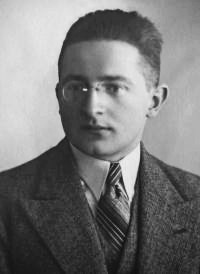
Rejewski Breaks Enigma
Polish mathematician Marian Rejewski used mathematical analysis to break early Enigma ciphers, laying groundwork for Allied cryptanalysis. #cryptography #poland
Rejewski Breaks Enigma By Unknown author - Rejewski's daughter's private archive, CC BY-SA 2.5, https://commons.wikimedia.org/w/index.php?curid=216461
1939 CE
Turing at Bletchley Park
Alan Turing joined Bletchley Park and designed the Bombe to speed up Enigma decryption. His work revolutionized cryptanalysis and computing. #cryptography #wwii
Turing at Bletchley Park By Elliott & Fry - https://commons.wikimedia.org/wiki/File:Alan_Turing_(1951).jpg, Public domain, https://commons.wikimedia.org/w/index.php?curid=158923803
1940 CE
US Breaks Japanese Purple Cipher
US cryptanalysts broke the Japanese Purple cipher, used for diplomatic communications. This provided critical intelligence during World War II. #cryptography #japan )
US Breaks Japanese Purple Cipher By Daderot - Cropped and rotated from File:PURPLE analog, improved version of March 1944 - National Cryptologic Museum - DSC07831.JPG and said improvements released under CC0 by--agr (talk) 00:10, 25 April 2019 (UTC), Public domain, https://commons.wikimedia.org/w/index.php?curid=78321046
1942 CE
Navajo Code Talkers
The US Marine Corps used Navajo speakers to transmit coded messages in their native language, which proved unbreakable by the Japanese. #cryptography #nativeamerican
Navajo Code Talkers By Unknown author - https://www.choctawnation.com/history-culture/people/code-talkers, Public domain, https://commons.wikimedia.org/w/index.php?curid=79650510
1945 CE
Shannon's Secrecy Systems
Claude Shannon published a paper on the mathematical theory of secrecy systems, establishing information theory foundations for cryptography. #cryptography #informationtheory
Shannon's Secrecy Systems By Unknown author - Tekniska Museet of Sweden, Item 43069 via Flickr, CC BY 2.0, https://commons.wikimedia.org/w/index.php?curid=190273293
1949 CE
Communication Theory of Secrecy Systems
Shannon's seminal work formalized concepts like entropy and perfect secrecy, laying the groundwork for modern cryptography. #cryptography
1963 CE
Venona Project Decrypts Soviet One-Time Pads
The US Venona project partially broke Soviet one-time pad messages due to repetitive key use, revealing espionage. #cryptography #coldwar
1970 CE
Feistel Network Developed
Horst Feistel at IBM developed the Feistel cipher structure, used in Lucifer and later DES. It became a standard design for block ciphers. #cryptography
Feistel Network Developed By Feistel_cipher_diagram.svg: Amirki derivative work: Amirki (talk) - Feistel_cipher_diagram.svg, CC BY-SA 3.0, https://commons.wikimedia.org/w/index.php?curid=16419258
1976 CE
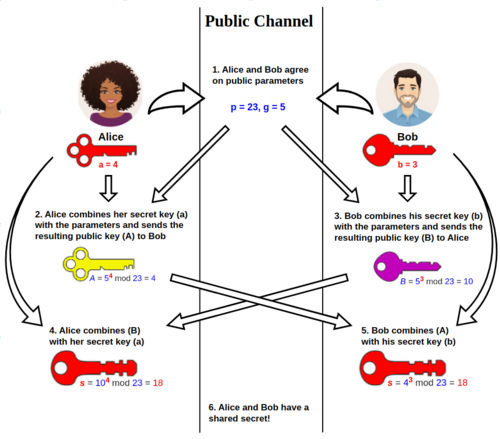
Diffie-Hellman Key Exchange
Whitfield Diffie and Martin Hellman published a method for secure key exchange over public channels, revolutionizing symmetric cryptography. #cryptography #publickey
Diffie-Hellman Key Exchange By Epachamo - Own work, CC BY-SA 4.0, https://commons.wikimedia.org/w/index.php?curid=142206661
1977 CE
DES Adopted as US Standard
The Data Encryption Standard (DES) was adopted as a federal standard. It became the most widely used symmetric cipher, but its 56-bit key later proved insufficient. #cryptography #standard
DES Adopted as US Standard By Hellisp - File:Data Encryption Standard InfoBox Diagram.png, CC0, https://commons.wikimedia.org/w/index.php?curid=33316542
1977 CE
RSA Algorithm
Ron Rivest, Adi Shamir, and Leonard Adleman introduced RSA, the first practical public-key cryptosystem, based on the difficulty of factoring large primes. #cryptography #publickey )
1984 CE
BB84 Quantum Key Distribution
Charles Bennett and Gilles Brassard proposed BB84, the first quantum key distribution protocol, using quantum mechanics for secure key exchange. #cryptography #quantum
1990 CE
Differential Cryptanalysis Discovered
Eli Biham and Adi Shamir introduced differential cryptanalysis, a powerful method for attacking block ciphers, including DES. #cryptography #cryptanalysis
1991 CE
PGP Released
Phil Zimmermann released Pretty Good Privacy (PGP), a public-key encryption program for email, sparking debates over privacy and government restrictions. #cryptography #privacy
1993 CE
Linear Cryptanalysis Introduced
Mitsuru Matsui developed linear cryptanalysis, a known-plaintext attack on block ciphers, effectively breaking DES. #cryptography #cryptanalysis
1994 CE
Clipper Chip Controversy
The US government proposed the Clipper chip with key escrow for law enforcement access, sparking privacy and security concerns. It was eventually abandoned. #cryptography #privacy
Clipper Chip Controversy By Travis Goodspeed - MYK-78 Package Markings, CC BY 2.0, https://commons.wikimedia.org/w/index.php?curid=26694403
1997 CE
AES Competition Announced
NIST announced a public competition to replace DES with a more secure Advanced Encryption Standard (AES). It marked a new era of open cryptographic design. #cryptography #standard
AES Competition Announced By John Savard - https://www.eng.tau.ac.il/~yash/crypto-netsec/rijndael.htm, CC0, https://commons.wikimedia.org/w/index.php?curid=103718081
1998 CE
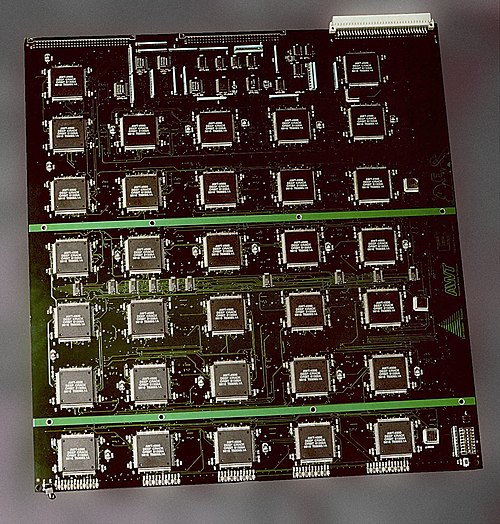
EFF DES Cracker
The Electronic Frontier Foundation built the DES Cracker, a machine that brute-forced DES keys in days, demonstrating its insecurity. #cryptography #hardware
EFF DES Cracker By The original uploader was Matt Crypto at English Wikipedia. Later versions were uploaded by Ed g2s at en.wikipedia. - http://w2.eff.org/Privacy/Crypto/Crypto_misc/DESCracker/ (Via en:)., CC BY 3.0 us, https://commons.wikimedia.org/w/index.php?curid=2437815
2000 CE
AES Selection: Rijndael
NIST selected Rijndael as the Advanced Encryption Standard, designed by Belgian cryptographers Joan Daemen and Vincent Rijmen. It became the global symmetric cipher. #cryptography #standard
2001 CE
SHA-1 Published as FIPS
SHA-1 was published as a federal standard for hash functions. Later, vulnerabilities were found, leading to SHA-2 and SHA-3. #cryptography #hashing
2005 CE
SHA-1 Collision Attack Demonstraton
Researchers demonstrated a theoretical collision attack on SHA-1, leading to its deprecation in favor of SHA-2. #cryptography #vulnerability
2009 CE
Bitcoin Introduces Blockchain
Satoshi Nakamoto launched Bitcoin, using cryptographic hash functions and public-key cryptography for a decentralized digital currency. #cryptography #blockchain
Bitcoin Introduces Blockchain By Grayliptrot - This file was derived from: Bitcoin logo.svg, Public domain, https://commons.wikimedia.org/w/index.php?curid=30202095
2010 CE
Chinese Cryptographic Standards SM2/SM3/SM4
China released national cryptographic standards including SM2 (public-key), SM3 (hash), and SM4 (symmetric cipher), promoting indigenous security. #cryptography #china
2012 CE
SHA-3 Standard: Keccak
NIST selected Keccak as the SHA-3 hash function after a public competition. It uses a sponge construction, different from SHA-2. #cryptography #hashing
2016 CE
NIST Post-Quantum Cryptography Competition
NIST initiated a competition to develop quantum-resistant cryptographic algorithms, anticipating future quantum computers. #cryptography #quantum
2022 CE
NIST Selects Post-Quantum Algorithms
NIST announced four algorithms selected for standardization in post-quantum cryptography, including CRYSTALS-Kyber and Dilithium. #cryptography #quantum