Cryptography & Mathematical Security: Global Cross-Cultural Perspectives
Encyclopedia/1. The Cosmos & The Natural World/1. Mathematics & Formal Systems/06. Number Theory & Cryptography • Curated by Admin Timeline.sg
A global timeline of cryptography and mathematical security, highlighting contributions from ancient civilizations, Islamic scholars, European innovators, and modern digital pioneers. This timeline spans from early secret writing to post-quantum cryptography.
Chronological Storyline (37 Milestones)
1900 BCE
Egyptian Non-standard Hieroglyphs
Ancient Egyptian scribes used non-standard hieroglyphs in tomb inscriptions, possibly to obscure meanings. This is one of the earliest known examples of cryptographic intent. #cryptography #history
600 BCE
Hebrew Atbash Cipher
The Atbash cipher, a simple substitution cipher reversing the alphabet, appears in the Hebrew Bible (Book of Jeremiah). It represents an early known cryptographic method in the Middle East. #cryptography #bible
500 BCE
Spartan Scytale
The scytale, a transposition cipher device used by Spartan military, wrapped a strip of leather around a rod to encode messages. It is one of the earliest cryptographic tools in ancient Greece. #cryptography #ancientGreece
Spartan Scytale By Unknown author, CC BY-SA 3.0, https://commons.wikimedia.org/w/index.php?curid=1698345
200 BCE
Polybius Square
The Greek historian Polybius described a grid for encoding letters into numbers, used for signaling. This is an early example of a polyalphabetic cipher concept. #cryptography #ancientGreece
Polybius Square By Gre regiment - Self-photographed, Public domain, https://commons.wikimedia.org/w/index.php?curid=109563083
100 BCE
Caesar Cipher
Julius Caesar used a simple substitution cipher shifting letters by three places in his private correspondence. The cipher is named after him and is a foundational example of classical cryptography. #cryptography #Roman
Caesar Cipher By Roy Zuo - Own work, CC BY-SA 4.0, https://commons.wikimedia.org/w/index.php?curid=147647748
350 CE
Kamasutra Describes Secret Writing
The Indian text Kamasutra lists mlecchita vikalpa (secret writing) as one of 64 arts, including cryptographic methods like word and character substitution. This is one of the earliest non-Western references to cryptography. #cryptography #India
Kamasutra Describes Secret Writing By Ms Sarah Welch - Own work, CC BY-SA 4.0, https://commons.wikimedia.org/w/index.php?curid=73935933
850 CE
Al-Kindi's Cryptanalysis
The Arab scholar Al-Kindi wrote 'A Manuscript on Deciphering Cryptographic Messages', describing frequency analysis. This is the first known description of cryptographic codebreaking. #cryptography #IslamicGoldenAge
Al-Kindi's Cryptanalysis By Iraqi Post - Personal collection, Public domain, https://commons.wikimedia.org/w/index.php?curid=91832934
1250 CE
Roger Bacon's Cryptographic Writings
The English philosopher Roger Bacon wrote on secret writing techniques, including the use of ciphers to conceal knowledge. His works contributed to medieval European cryptography. #cryptography #medieval
Roger Bacon's Cryptographic Writings By Unknown author, CC BY-SA 3.0, https://commons.wikimedia.org/w/index.php?curid=131754
1412 CE
Al-Qalqashandi's Encyclopedic Work
The Egyptian scholar Al-Qalqashandi included a section on cryptography in his encyclopedia Subh al-A'sha, describing substitution and transposition ciphers. It is a key Islamic contribution to cryptology. #cryptography #IslamicWorld
1465 CE
Alberti Cipher Disk
Leon Battista Alberti invented the cipher disk, a polyalphabetic cipher mechanism, considered the first mechanical encryption device in Europe. His work marked the beginning of Western cryptology. #cryptography #Renaissance
Alberti Cipher Disk By Leon Battista Alberti - This file was donated to Wikimedia Commons as part of a project by the National Gallery of Art. Please see the Gallery's Open Access Policy., CC0, https://commons.wikimedia.org/w/index.php?curid=80615353
1518 CE
Trithemius' Steganographia
Johannes Trithemius wrote Steganographia, a book on steganography and cryptography, describing an early polyalphabetic cipher. It was influential but controversial for its occult themes. #cryptography #steganography
Trithemius' Steganographia By Trithemius, Johannes. Steganographia. Frankfurt: Johannes Saurius?, 1606. Digitized photographic reproduction. - http://diglib.hab.de/drucke/fb-243/start.htm?image=00001, Public domain, https://commons.wikimedia.org/w/index.php?curid=63528432
1553 CE
Bellaso's Cipher (Vigenère)
Giovan Battista Bellaso described the polyalphabetic cipher later misattributed to Vigenère. It used a key to shift letters, remaining unbroken for centuries. #cryptography #Renaissance
Bellaso's Cipher (Vigenère) By Giovanni Battista Bellaso - Available in the BEIC digital library and uploaded in partnership with BEIC Foundation., Public domain, https://commons.wikimedia.org/w/index.php?curid=98852403
1585 CE
Vigenère's Book on Ciphers
Blaise de Vigenère published 'Traité des Chiffres', detailing the Vigenère cipher and other cryptographic methods. His work became a standard reference for centuries. #cryptography #history
Vigenère's Book on Ciphers By Thomas de Leu - Woodcut Photograph. No date found., Public domain, https://commons.wikimedia.org/w/index.php?curid=80100
1623 CE
Francis Bacon's Biliteral Cipher
Francis Bacon developed a biliteral cipher encoding letters in binary using two typefaces, a precursor to modern binary encoding and steganography. #cryptography #steganography
Francis Bacon's Biliteral Cipher By Unknown author, Public domain, https://commons.wikimedia.org/w/index.php?curid=646209
1795 CE
Jefferson Disk
Thomas Jefferson invented a wheel cipher device, later known as the Jefferson disk, for encoding messages. It was a precursor to modern rotor machines. #cryptography #American
Jefferson Disk By Unknown author, Public domain, https://commons.wikimedia.org/w/index.php?curid=258129
1854 CE
Babbage Cracks Vigenère
Charles Babbage discovered a method to break the Vigenère cipher using frequency analysis and repeating patterns, but his work was not published. It was later independently rediscovered by Kasiski. #cryptography #Victorian
Babbage Cracks Vigenère By Unknown author - http://images.google.com/hosted/life/l?q=Charles+Babbage&prev=/search%3Fq%3DCharles%2BBabbage%26um%3D1%26hl%3Den%26sa%3DX%26biw%3D1680%26bih%3D916%26tbs%3Disz:l%26tbm%3Disch&imgurl=19fc9fba4ea4a1cb, Public domain, https://commons.wikimedia.org/w/index.php?curid=15392737
1883 CE
Kerckhoffs' Principle
Auguste Kerckhoffs formulated the principle that a cryptosystem should be secure even if everything about the system, except the key, is public. This is a cornerstone of modern cryptography. #cryptography #security
Kerckhoffs' Principle By Unknown author - Eugen Drezen, Historio de la Mondo Lingvo (Leipzig, 1931), 102, Public domain, https://commons.wikimedia.org/w/index.php?curid=39712823
1917 CE
Vernam Cipher
Gilbert Vernam invented the one-time pad, a cipher that combines a key of random bits with plaintext. It is information-theoretically secure if the key is truly random and used once. #cryptography #security
1918 CE
Enigma Patent
Arthur Scherbius patented the Enigma machine, a rotor-based encryption device used by Germany in WWII. Its cryptanalysis by Allied forces was a pivotal event in history. #cryptography #WWII
Enigma Patent By Alessandro Nassiri - Museo della Scienza e della Tecnologia "Leonardo da Vinci", CC BY-SA 4.0, https://commons.wikimedia.org/w/index.php?curid=47910919
1932 CE
Polish Break Enigma
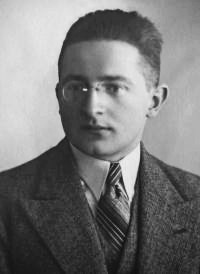
Marian Rejewski and fellow Polish mathematicians cracked early versions of the Enigma machine using mathematics and intelligence, laying the groundwork for later Bletchley Park efforts. #cryptography #Poland
Polish Break Enigma By Unknown author - Rejewski's daughter's private archive, CC BY-SA 2.5, https://commons.wikimedia.org/w/index.php?curid=216461
1940 CE
Turing's Bombe
Alan Turing designed the Bombe, an electromechanical device that automated the decryption of Enigma messages, significantly aiding the Allied war effort. #cryptography #WWII
1943 CE
Navajo Code Talkers
The US military used Navajo Native American language as a code for secure communications in the Pacific theater. The code was never broken by the Japanese. #cryptography #WWII #NativeAmerican
Navajo Code Talkers By Unknown author - https://www.choctawnation.com/history-culture/people/code-talkers, Public domain, https://commons.wikimedia.org/w/index.php?curid=79650510
1949 CE
Shannon's Communication Theory of Secrecy Systems
Claude Shannon published a foundational paper that mathematically formalized cryptography, introducing concepts like perfect secrecy and entropy. It marked the birth of modern cryptographic theory. #cryptography #informationTheory
1969 CE
Feistel Network (Lucifer)
Horst Feistel at IBM developed the Lucifer cipher and the Feistel network structure, which became the basis for the Data Encryption Standard (DES). #cryptography #security
1973 CE
NBS Call for Encryption Standard
The US National Bureau of Standards issued a public call for a cryptographic algorithm to become a national standard, leading to the adoption of DES. #cryptography #standards
NBS Call for Encryption Standard By Hellisp - File:Data Encryption Standard InfoBox Diagram.png, CC0, https://commons.wikimedia.org/w/index.php?curid=33316542
1976 CE
Diffie-Hellman Key Exchange
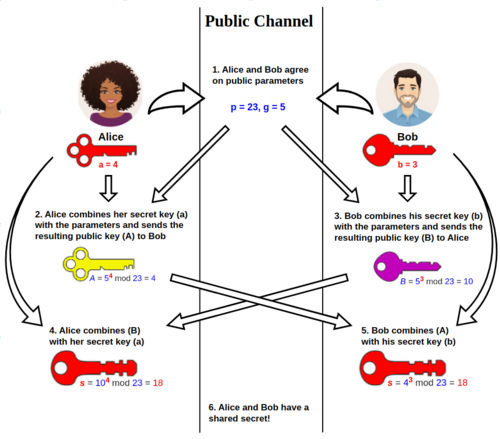
Whitfield Diffie and Martin Hellman published the concept of public key cryptography, enabling secure key exchange over insecure channels. This revolutionized cryptography. #cryptography #publicKey
Diffie-Hellman Key Exchange By Epachamo - Own work, CC BY-SA 4.0, https://commons.wikimedia.org/w/index.php?curid=142206661
Jan 15, 1977 CE
DES Adopted as Standard
The Data Encryption Standard (DES) was adopted as a US federal standard, becoming the most widely used symmetric cipher worldwide for decades, despite growing key length concerns. #cryptography #security
1977 CE
RSA Algorithm
Ron Rivest, Adi Shamir, and Leonard Adleman introduced the RSA cryptosystem, the first practical public key encryption and digital signature scheme, based on the difficulty of factoring large numbers. #cryptography #publicKey )
1985 CE
Elliptic Curve Cryptography
Neal Koblitz and Victor Miller independently proposed using elliptic curves over finite fields to create public key cryptosystems (ECC), offering similar security with smaller keys. #cryptography #ECC
Jun 1, 1991 CE
PGP Released
Phil Zimmermann released Pretty Good Privacy (PGP), a data encryption and decryption program that brought strong cryptography to the public. It sparked legal and political debates about encryption export controls. #cryptography #privacy
1994 CE
Shor's Algorithm
Peter Shor published a quantum algorithm that can factor large integers and compute discrete logarithms exponentially faster than classical algorithms, threatening many public key systems. #cryptography #quantum
Jan 1, 1997 CE
NIST Announces AES Competition
The National Institute of Standards and Technology (NIST) initiated a competition to replace DES with the Advanced Encryption Standard (AES), a new symmetric cipher. #cryptography #standards
NIST Announces AES Competition By John Savard - https://www.eng.tau.ac.il/~yash/crypto-netsec/rijndael.htm, CC0, https://commons.wikimedia.org/w/index.php?curid=103718081
Oct 2, 2000 CE
Rijndael Selected as AES
NIST selected the Rijndael cipher, designed by Joan Daemen and Vincent Rijmen, as the Advanced Encryption Standard (AES). It became the global standard for symmetric encryption. #cryptography #security
Jan 3, 2009 CE
Bitcoin Whitepaper Published
Satoshi Nakamoto published the Bitcoin whitepaper, introducing blockchain technology using cryptographic hashing and elliptic curve cryptography for a decentralized digital currency. #cryptography #blockchain
Bitcoin Whitepaper Published By Grayliptrot - This file was derived from: Bitcoin logo.svg, Public domain, https://commons.wikimedia.org/w/index.php?curid=30202095
Nov 1, 2012 CE
NIST Post-Quantum Cryptography Project
NIST launched a project to standardize post-quantum cryptographic algorithms resistant to quantum computing attacks, reflecting growing concern about quantum threats. #cryptography #postquantum
Aug 16, 2016 CE
Chinese Quantum Satellite Micius
China launched the Micius satellite, enabling the first quantum key distribution (QKD) experiments over long distances, demonstrating unparalleled security based on quantum physics. #cryptography #quantum #China
Jul 5, 2019 CE
NIST Selects First Post-Quantum Algorithms
NIST announced the first set of post-quantum cryptographic algorithms for standardization, including CRYSTALS-Kyber and CRYSTALS-Dilithium, marking a major step in future-proofing cryptography. #cryptography #postquantum