← Open Interactive Timeline Board

Cryptography & Mathematical Security: Foundational Epochs & Key Milestones

Encyclopedia/1. The Cosmos & The Natural World/1. Mathematics & Formal Systems/06. Number Theory & Cryptography  •  Curated by Admin Timeline.sg

A comprehensive timeline of cryptography and mathematical security, from ancient cipher methods to modern quantum-resistant algorithms, highlighting global contributions and pivotal breakthroughs.

Chronological Storyline (45 Milestones)

1900 BCE

Egyptian Hieroglyphic Ciphers

Non-standard hieroglyphs used in Egyptian tombs to obscure inscriptions, representing early cryptographic techniques. #cryptography #history

1500 BCE

Mesopotamian Tablet Encryption

Cuneiform tablets from Mesopotamia contain early examples of secret writing, including a formula for pottery glaze that was encrypted. #cryptography #ancient

500 BCE

Spartan Scytale

The scytale, a transposition cipher using a leather strip wound around a rod, used by ancient Greeks for military communication. #cryptography #Greece

Spartan Scytale
Spartan Scytale
By Unknown author, CC BY-SA 3.0, https://commons.wikimedia.org/w/index.php?curid=1698345
60 BCE

Julius Caesar Cipher

Roman statesman Julius Caesar used a simple substitution cipher shifting letters by three places for military correspondence. #cryptography #Rome

Julius Caesar Cipher
By Roy Zuo - Own work, CC BY-SA 4.0, https://commons.wikimedia.org/w/index.php?curid=147647748
800 CE

Al-Kindi and Frequency Analysis

Arab polymath Al-Kindi wrote 'A Manuscript on Deciphering Cryptographic Messages', introducing frequency analysis to break monoalphabetic ciphers. #cryptography #islamicgoldenage

Al-Kindi and Frequency Analysis
By Iraqi Post - Personal collection, Public domain, https://commons.wikimedia.org/w/index.php?curid=91832934
855 CE

Abu Bakr al-Razi's Cipher Work

Persian scholar Al-Razi contributed to cryptanalysis and described methods for encrypting medical texts. #cryptography #persia

Abu Bakr al-Razi's Cipher Work
By Hossein Behzad - http://sadmu.ir/detail/5999, Public domain, https://commons.wikimedia.org/w/index.php?curid=161546923
1412 CE

Subh al-A'sha's Cryptographic Encyclopedia

Egyptian scholar Al-Qalqashandi's encyclopedia includes a chapter on cryptography, detailing substitution and transposition ciphers. #cryptography #egypt

1466 CE

Alberti Cipher Disk

Leon Battista Alberti invented the cipher disk, a polyalphabetic cipher, considered the first mechanical encryption device. #cryptography #renaissance

Alberti Cipher Disk
Alberti Cipher Disk
By Augusto Buonafalce - Converted from JPG at https://commons.wikimedia.org/wiki/File:Alberti_cipher_disk.JPG, CC BY-SA 3.0, https://commons.wikimedia.org/w/index.php?curid=110919406
1518 CE

Trithemius' Steganographia

Johannes Trithemius wrote 'Steganographia', a work combining cryptography and steganography, influencing later cipher development. #cryptography #steganography

Trithemius' Steganographia
By Trithemius, Johannes. Steganographia. Frankfurt: Johannes Saurius?, 1606. Digitized photographic reproduction. - http://diglib.hab.de/drucke/fb-243/start.htm?image=00001, Public domain, https://commons.wikimedia.org/w/index.php?curid=63528432
1553 CE

Vigenère Cipher (Belaso's Invention)

Giovan Battista Bellaso described the first polyalphabetic cipher with a key, later misattributed to Vigenère. #cryptography #history

Vigenère Cipher (Belaso's Invention)
By Thomas de Leu - Woodcut Photograph. No date found., Public domain, https://commons.wikimedia.org/w/index.php?curid=80100
1586 CE

Blaise de Vigenère's Treatise

Blaise de Vigenère published 'Traicté des chiffres', detailing the autokey cipher and strengthening polyalphabetic techniques. #cryptography #France

Blaise de Vigenère's Treatise
By Unknown author - File: Vigenere.jpg, Public domain, https://commons.wikimedia.org/w/index.php?curid=22661625
1641 CE

Wilkins' Mercury Cryptography

John Wilkins wrote 'Mercury, or the Secret and Swift Messenger', covering cryptographic methods and the first description of a codebook. #cryptography #England

Wilkins' Mercury Cryptography
By Attributed to John Greenhill - https://artuk.org/discover/artworks/john-wilkins-16141672-warden-16481659-223910, Public domain, https://commons.wikimedia.org/w/index.php?curid=52398144
1790 CE

Jefferson Disk Cipher

Thomas Jefferson invented the wheel cipher, a polyalphabetic cipher device using rotating disks, later used by the US Navy. #cryptography #USA

Jefferson Disk Cipher
By Unknown author, Public domain, https://commons.wikimedia.org/w/index.php?curid=258129
1835 CE

Morse Code

Samuel Morse invented Morse code, a telegraphic cipher using dots and dashes, enabling long-distance communication. #cryptography #technology
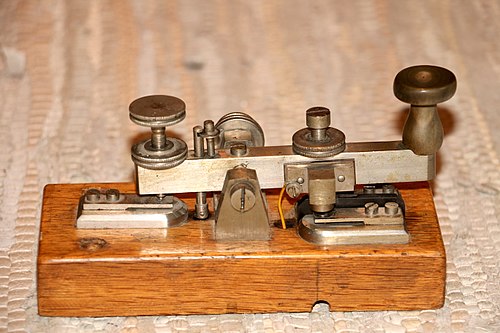
Morse Code
Morse Code
By Hp.Baumeler - Own work, CC BY-SA 4.0, https://commons.wikimedia.org/w/index.php?curid=61723472
1854 CE

Babbage and Kasiski Break Vigenère

Charles Babbage and later Friedrich Kasiski independently developed methods to break the Vigenère cipher using repeated key patterns. #cryptanalysis #cryptography

1917 CE

Zimmermann Telegram

British cryptanalysts decrypted a German diplomatic telegram, bringing the US into World War I and highlighting the importance of cryptography. #cryptography #WWI

Zimmermann Telegram
Zimmermann Telegram
By Unknown authorUnknown author or not provided - U.S. National Archives and Records Administration, Public domain, https://commons.wikimedia.org/w/index.php?curid=27222069
1918 CE

Gilbert Vernam's One-Time Pad

Gilbert Vernam invented the one-time pad cipher, theoretically unbreakable if used correctly, based on XOR with random key. #cryptography #security

Gilbert Vernam's One-Time Pad
By US National Security Agency - https://www.governmentattic.org/18docs/Hist_US_COMSEC_Boak_NSA_1973u.pdf A History of U.S. Communications Security; the David G. Boak Lectures, National Security Agency (NSA), Volumes I, 1973, Volumes II 1981, partially released 2008, additional portions declassified October 14, 2015, Public domain, https://commons.wikimedia.org/w/index.php?curid=45783652
1926 CE

Enigma Machine Commercial Version

German inventor Arthur Scherbius introduced the Enigma machine for commercial use, later adapted by the German military. #cryptography #WWII

Enigma Machine Commercial Version
By Alessandro Nassiri - Museo della Scienza e della Tecnologia "Leonardo da Vinci", CC BY-SA 4.0, https://commons.wikimedia.org/w/index.php?curid=47910919
1931 CE

Japanese PURPLE Cipher

Japan developed the PURPLE cipher machine for diplomatic communications; US cryptanalysts broke it before WWII. #cryptography #WWII

Japanese PURPLE Cipher
By Daderot - Cropped and rotated from File:PURPLE analog, improved version of March 1944 - National Cryptologic Museum - DSC07831.JPG and said improvements released under CC0 by--agr (talk) 00:10, 25 April 2019 (UTC), Public domain, https://commons.wikimedia.org/w/index.php?curid=78321046
1932 CE

Marian Rejewski Breaks Enigma

Polish mathematician Marian Rejewski used permutation theory to reconstruct the Enigma rotor wiring, enabling early decryption. #cryptography #Poland
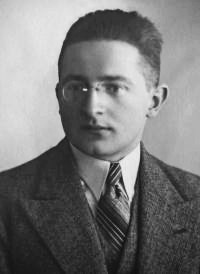
Marian Rejewski Breaks Enigma
By Unknown author - Rejewski's daughter's private archive, CC BY-SA 2.5, https://commons.wikimedia.org/w/index.php?curid=216461
1941 CE

Navajo Code Talkers

US Marine Corps used Navajo language as an unbreakable code in the Pacific theater, a form of cryptology. #cryptography #WWII

Navajo Code Talkers
Navajo Code Talkers
By Unknown author - https://www.choctawnation.com/history-culture/people/code-talkers, Public domain, https://commons.wikimedia.org/w/index.php?curid=79650510
1949 CE

Shannon's Communication Theory of Secrecy Systems

Claude Shannon published a foundational paper unifying cryptography and information theory, defining perfect secrecy. #cryptography #informationtheory

1952 CE

NSA Founded

The US National Security Agency (NSA) was established to centralize signals intelligence and protect government communications. #cryptography #security

NSA Founded
NSA Founded
By U.S. government - www.nsa.gov http://quicksearch.dla.mil/qsDocDetails.aspx?ident_number=275845, Public domain, https://commons.wikimedia.org/w/index.php?curid=2976322
1970 CE

IBM's Feistel Cipher (Lucifer)

IBM cryptographer Horst Feistel developed the Feistel network structure, leading to the Lucifer cipher and later DES. #cryptography #technology

IBM's Feistel Cipher (Lucifer)
By Feistel_cipher_diagram.svg: Amirki derivative work: Amirki (talk) - Feistel_cipher_diagram.svg, CC BY-SA 3.0, https://commons.wikimedia.org/w/index.php?curid=16419258
1976 CE

Diffie-Hellman Key Exchange

Whitfield Diffie and Martin Hellman published the concept of public-key cryptography, enabling secure key exchange over insecure channels. #cryptography #publickey
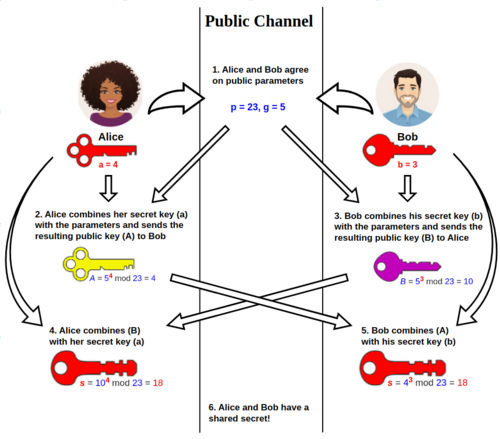
Diffie-Hellman Key Exchange
By Epachamo - Own work, CC BY-SA 4.0, https://commons.wikimedia.org/w/index.php?curid=142206661
1977 CE

RSA Algorithm Published

Ron Rivest, Adi Shamir, and Leonard Adleman invented the RSA cryptosystem based on the difficulty of factoring large primes. #cryptography #RSA )

1977 CE

Data Encryption Standard (DES)

DES became the US federal standard for symmetric encryption, based on the Feistel structure with a 56-bit key. #cryptography #standard

Data Encryption Standard (DES)
By Hellisp - File:Data Encryption Standard InfoBox Diagram.png, CC0, https://commons.wikimedia.org/w/index.php?curid=33316542
1984 CE

ElGamal Encryption

Taher ElGamal published a public-key cryptosystem based on the Diffie-Hellman key exchange, used in many protocols. #cryptography #publickey

1984 CE

Blum Blum Shub PRNG

L. Blum, M. Blum, and M. Shub proposed a pseudorandom number generator based on quadratic residues and factorization hardness. #cryptography #numbertheory

1987 CE

MD5 Hash Function Developed

Ronald Rivest designed MD5, a widely used cryptographic hash function producing a 128-bit hash. #cryptography #hashing

1990 CE

Elliptic Curve Cryptography (ECC) Proposed

Neal Koblitz and Victor Miller independently proposed using elliptic curves for public-key cryptography, offering smaller key sizes. #cryptography #ECC

1991 CE

Pretty Good Privacy (PGP) Released

Phil Zimmermann released PGP, a public-key encryption program for email, sparking debates over privacy and government control. #cryptography #privacy

1992 CE

U.S. Clipper Chip Proposal

The US government proposed the Clipper chip with key escrow for secure communications, facing public criticism over backdoors. #cryptography #policy

U.S. Clipper Chip Proposal
By Travis Goodspeed - MYK-78 Package Markings, CC BY 2.0, https://commons.wikimedia.org/w/index.php?curid=26694403
1993 CE

SHA-0 Hash Function Draft

NIST published the Secure Hash Algorithm (SHA-0), later revised to SHA-1 after flaws were found. #cryptography #hashing

1997 CE

AES Competition Announced

NIST announced the Advanced Encryption Standard (AES) competition to replace DES, resulting in Rijndael as the winner. #cryptography #standard

AES Competition Announced
By John Savard - https://www.eng.tau.ac.il/~yash/crypto-netsec/rijndael.htm, CC0, https://commons.wikimedia.org/w/index.php?curid=103718081
1999 CE

Distributed.net Breaks DES in 22 Hours

Using distributed computing, DES was brute-forced in record time, demonstrating the weakness of 56-bit keys. #cryptography #cryptanalysis

2000 CE

Rijndael Selected as AES

NIST selected the Rijndael cipher, designed by Joan Daemen and Vincent Rijmen, as the Advanced Encryption Standard. #cryptography #AES

2001 CE

Cryptographic Backdoor Debates Post-9/11

After 9/11, governments pushed for lawful access to encryption, intensifying debates over privacy and security. #cryptography #policy

2007 CE

Keith B. F. and the Hash Function SHA-3 Competition

NIST launched a competition for a new hash function, leading to Keccak being selected as SHA-3 in 2012. #cryptography #hashing

2009 CE

Bitcoin and Blockchain Cryptography

Satoshi Nakamoto introduced Bitcoin, using cryptographic hash functions and public-key cryptography for a decentralized digital currency. #cryptography #blockchain

Bitcoin and Blockchain Cryptography
By Grayliptrot - This file was derived from: Bitcoin logo.svg, Public domain, https://commons.wikimedia.org/w/index.php?curid=30202095
2013 CE

Edward Snowden Leaks and Encryption

Snowden revealed global surveillance programs, leading to increased adoption of end-to-end encryption in messaging apps. #cryptography #privacy

Edward Snowden Leaks and Encryption
By https://www.youtube.com/user/TheWikiLeaksChannel - Derived from: File:Edward Snowden speaks about government transparency at Sam Adams award presentation in Moscow.webm @20s, CC BY 3.0, https://commons.wikimedia.org/w/index.php?curid=28971285
2016 CE

Post-Quantum Cryptography Standardization

NIST initiated a process to standardize quantum-resistant cryptographic algorithms due to the threat of quantum computers. #cryptography #quantum

2017 CE

SHA-1 Collision Attack (SHAttered)

Google and CWI Amsterdam demonstrated the first practical collision attack on SHA-1, prompting deprecation. #cryptography #cryptanalysis

2019 CE

China's SM3 and SM4 Cryptographic Standards

China promoted its national cryptographic standards, including SM3 hash and SM4 block cipher, for domestic use and global influence. #cryptography #China )

2022 CE

NIST Selects Finalists for Post-Quantum Cryptography

NIST announced four algorithms for standardization, including CRYSTALS-Kyber for encryption and CRYSTALS-Dilithium for signatures. #cryptography #postquantum