Cradle of Civilization: Sumerian City-States, Code of Hammurabi & Achaemenid Empire
Encyclopedia/3. History, Societies & Civilizations/03. Middle Eastern & Islamic Civilizations/01. Ancient Middle East • Curated by Admin Timeline.sg
The ancient Near East saw the rise of the first cities and empires, from Sumerian city-states and the Code of Hammurabi to the vast Achaemenid Persian Empire under Cyrus and Darius. This timeline spans the invention of writing, monumental architecture, legal codes, and military conquests that shaped Western and Middle Eastern civilization.
Chronological Storyline (40 Milestones)
3500 BCE
Uruk Becomes First Major City
Uruk emerges as the first major urban center in Sumer, with a population exceeding 40,000. It features monumental architecture and early administrative records. #history #ancient
3200 BCE
Earliest Cuneiform Writing
Sumerians develop cuneiform script in Uruk for recording trade and administration. This marks the dawn of written history. #writing #history
Earliest Cuneiform Writing By Bjørn Christian Tørrissen - Own work by uploader, http://bjornfree.com/galleries.html, CC BY-SA 3.0, https://commons.wikimedia.org/w/index.php?curid=8296178
3000 BCE
Sumerian City-States Flourish
Sumer is organized into independent city-states like Ur, Uruk, and Lagash, each with its own ruler and patron deity. #urban #history
Sumerian City-States Flourish By Tobi 87 - Own work, CC BY-SA 3.0, https://commons.wikimedia.org/w/index.php?curid=16844651
2600 BCE
Royal Tombs of Ur
Elaborate royal burials at Ur, including Queen Puabi, reveal immense wealth and craftsmanship of early Sumerian civilization. #archaeology #ancient
2334 BCE
Sargon of Akkad Conquers Sumer
Sargon of Akkad establishes the first empire in history, uniting Sumer and Akkad. His reign marks a shift from city-states to centralized empire. #empire #history
Sargon of Akkad Conquers Sumer By ALFGRN - This image has been extracted from another file, CC BY-SA 2.0, https://commons.wikimedia.org/w/index.php?curid=90062589
2150 BCE
Gutian Rule in Mesopotamia
The Gutians, a barbarian tribe from the Zagros, invade and rule Sumer for about a century, causing decline and disruption. #invasion #history
Gutian Rule in Mesopotamia By Osama Shukir Muhammed Amin FRCP(Glasg) - Own work, CC BY-SA 4.0, https://commons.wikimedia.org/w/index.php?curid=89637024
2112 BCE
Ur-Nammu Founds Third Dynasty of Ur
Ur-Nammu establishes the Neo-Sumerian Empire, with Ur as capital. He issues the earliest known law code. #law #history
Ur-Nammu Founds Third Dynasty of Ur By Middle_East_topographic_map-blank.svg: Sémhur (talk) derivative work: Zunkir (talk) - Middle_East_topographic_map-blank.svg, CC BY-SA 3.0, https://commons.wikimedia.org/w/index.php?curid=12665614
2100 BCE
Ur-Nammu's Law Code
Ur-Nammu issues the oldest known law code, predating Hammurabi's by centuries, covering damages and penalties. #law #history
Ur-Nammu's Law Code By Istanbul Archaeology Museums - Own work, CC0, https://commons.wikimedia.org/w/index.php?curid=34550484
2100 BCE
Great Ziggurat of Ur Built
Ur-Nammu builds the massive step pyramid temple dedicated to the moon god Nanna, a masterpiece of Sumerian architecture. #architecture #religion
Great Ziggurat of Ur Built By Tla2006 at English Wikipedia - Transferred from en.wikipedia to Commons., Public domain, https://commons.wikimedia.org/w/index.php?curid=1974623
2100 BCE
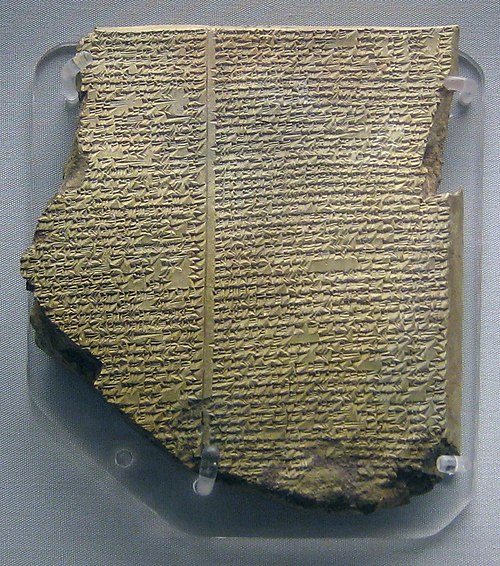
Epic of Gilgamesh Composed
The Epic of Gilgamesh, one of the earliest literary works, is composed in Sumer, exploring themes of friendship and mortality. #literature #mythology
Epic of Gilgamesh Composed By Unknown author - BabelStone (Own work), CC0, https://commons.wikimedia.org/w/index.php?curid=10755114
2000 BCE
Sumerian Language Becomes Extinct as Spoken Language
Sumerian ceases to be spoken but continues as a liturgical and scholarly language in Mesopotamia for centuries. #language #history
Sumerian Language Becomes Extinct as Spoken Language By Unknown author - http://www.schoyencollection.com/religions_files/ms3029.jpg, Public domain, https://commons.wikimedia.org/w/index.php?curid=660521
1754 BCE
Hammurabi Issues Law Code
Babylonian king Hammurabi inscribes his famous law code on a stele, containing 282 laws with severe punishments, influencing later legal systems. #law #history
Hammurabi Issues Law Code By Mbzt - Own work, CC BY 3.0, https://commons.wikimedia.org/w/index.php?curid=16931676
1650 BCE
Hittite Kingdom Founded
Hattusili I unites the Hittite tribes and establishes the Old Kingdom, with Hattusa as capital. The Hittites become a major power in Anatolia. #empire #history
Hittite Kingdom Founded By Ennomus - Own work, CC BY-SA 4.0, https://commons.wikimedia.org/w/index.php?curid=139305272
1595 BCE
Hittites Sack Babylon
The Hittite king Mursili I raids Babylon, ending the dynasty of Hammurabi and initiating a period of instability. #war #history
1500 BCE
Mitanni Kingdom Rises
The Hurrian kingdom of Mitanni dominates northern Mesopotamia, controlling trade routes and rivaling Egypt and the Hittites. #kingdom #history
Mitanni Kingdom Rises By Sémhur, Zunkir, rowanwindwhistler - This file was derived from: Carte du Mitanni.png: OrientePróximoTopográfico.svg:, CC BY-SA 3.0, https://commons.wikimedia.org/w/index.php?curid=149459053
1365 BCE
Ashur-uballit I Expands Assyria
Ashur-uballit I breaks Mitanni control and founds the Middle Assyrian Empire, expanding Assyrian territory and influence. #empire #history
Ashur-uballit I Expands Assyria By Gary Todd - https://www.flickr.com/photos/101561334@N08/36562326005/, CC0, https://commons.wikimedia.org/w/index.php?curid=91138954
1200 BCE
Iron Age Begins in Near East
The widespread adoption of iron smelting leads to stronger tools and weapons, transforming agriculture and warfare. #technology #history
Iron Age Begins in Near East By Unknown author - Own photograph by Sandstein, CC BY 3.0, https://commons.wikimedia.org/w/index.php?curid=8656346
1177 BCE
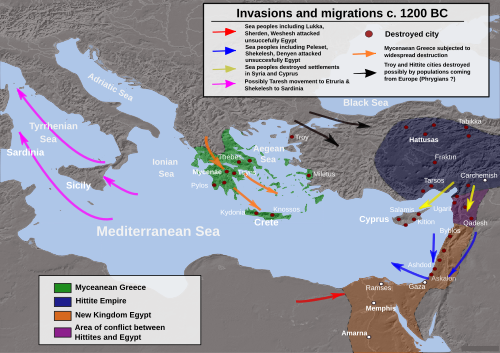
Late Bronze Age Collapse
A series of invasions and societal collapses, including the Sea Peoples, destroys many major empires and leads to a dark age. #collapse #history
Late Bronze Age Collapse By Alexikoua - Own work, CC BY-SA 3.0, https://commons.wikimedia.org/w/index.php?curid=30160275
1050 BCE
Phoenician Alphabet Developed
The Phoenicians create a consonantal alphabet that becomes the ancestor of many modern scripts, facilitating trade. #writing #history
1000 BCE
King David Unites Israel
David captures Jerusalem and establishes a unified Israelite kingdom, which becomes a regional power under his son Solomon. #religion #history )
King David Unites Israel By James Wyld - This map is available from Eran Laor Cartographic Collection of the National Library of Israel. link to the source:Land of Israel Shewing the Purveyorships in the Reign of Solomon. 1. Kings, Chap. 4, Public domain, https://commons.wikimedia.org/w/index.php?curid=137040924
911 BCE
Neo-Assyrian Expansion Begins
Adad-nirari II starts the Neo-Assyrian period, marked by aggressive military campaigns and the creation of the largest empire yet. #empire #military
Neo-Assyrian Expansion Begins By Ningyou - Own work data from Based on a map in 'Atlas of the Bible Lands', C S Hammond & Co (1959), ISBN 9780843709414., Public domain, https://commons.wikimedia.org/w/index.php?curid=600659
860 BCE
Urartu Kingdom Arises
The Urartian kingdom in the Armenian highlands becomes a rival to Assyria, with advanced irrigation and fortifications. #kingdom #history
Urartu Kingdom Arises By Sémhur - Own work (Original text: Own work. ) Sources : Topographic background : NASA Shuttle Radar Topography Mission (SRTM3 v.2) (public domain) Urartu map : Image:Urartu743.png by Jolle upload on Commons by Hardscarf under license « Public Domain », itself from the "Histoire d'Armenie" by Pierre Brosset. Rivers : Demis Scale : Image:Scale_kilometres_miles_svg.svg by Sémhur, under license « Public Domain » Software used : NASA data edited with 3DEM by Visualization Software LLC, and Global Mapper 9 (limited version), by the United States Geological Survey (USGS) Demis data edited with Demis Mapper Vectorized with Inkscape Cartographic tutorial (in french) by Sting Other data : Cartographic projection : UTM Geodetic system : WGS84, CC BY-SA 4.0, https://commons.wikimedia.org/w/index.php?curid=3366717
678 BCE
Medes Form Kingdom
The Median tribes unite under Deioces, with Ecbatana as capital, laying the foundation for the later Persian Empire. #empire #history
Medes Form Kingdom By Friedrich Hottenroth - Detail of table 24 of Friedrich Hottenroth: Trachten, Haus-, Feld- und Kriegsgeräthschaften der Völker alter und neuer Zeit. Vol. 1. 2nd ed. Gustav Weise, Stuttgart 1884. Digitally altered., Public domain, https://commons.wikimedia.org/w/index.php?curid=33244203
650 BCE
Library of Ashurbanipal
Assyrian king Ashurbanipal gathers a vast library of cuneiform tablets in Nineveh, preserving thousands of texts. #libraries #history
Library of Ashurbanipal By Gary Todd - https://www.flickr.com/photos/101561334@N08/36562516345/, CC0, https://commons.wikimedia.org/w/index.php?curid=91138912
612 BCE
Fall of Nineveh
A coalition of Medes, Babylonians, and others sacks Nineveh, ending the Assyrian Empire and reshaping the Near East. #war #history
Fall of Nineveh By (Mu-tamajo) むーたんじょ - Own work, CC BY-SA 4.0, https://commons.wikimedia.org/w/index.php?curid=48411583
605 BCE
Nebuchadnezzar II King of Babylon
Nebuchadnezzar II ascends the throne and leads Babylon to its golden age, building the Hanging Gardens and conquering Jerusalem. #empire #history
Nebuchadnezzar II King of Babylon By Unknown author, Public domain, https://commons.wikimedia.org/w/index.php?curid=87505819
600 BCE
Lydian Coinage Introduced
The Lydians produce the first standardized gold and silver coins, revolutionizing trade and economy. #economy #history
Lydian Coinage Introduced By Ennomus - Own work, CC BY-SA 4.0, https://commons.wikimedia.org/w/index.php?curid=139257001
550 BCE
Cyrus the Great Founds Achaemenid Empire
Cyrus rebels against the Medes and conquers their kingdom, uniting Persians and Medes under his rule. #empire #history
Cyrus the Great Founds Achaemenid Empire By Cattette - This image has been extracted from another file, CC BY 4.0, https://commons.wikimedia.org/w/index.php?curid=113179532
539 BCE
Cyrus Conquers Babylon
Persian king Cyrus the Great takes Babylon without a battle, proclaiming religious tolerance and restoring temples. #history #humanrights
Cyrus Conquers Babylon By Surenae - Own work, CC BY-SA 4.0, https://commons.wikimedia.org/w/index.php?curid=162225973
539 BCE
Cyrus Cylinder Inscribed
The Cyrus Cylinder, a clay cylinder with cuneiform, records Cyrus' conquest of Babylon and his policy of religious tolerance. #artifacts #history
Cyrus Cylinder Inscribed By Prioryman - Own work, CC BY-SA 3.0, https://commons.wikimedia.org/w/index.php?curid=19669413
525 BCE
Cambyses Conquers Egypt
Cambyses II, son of Cyrus, defeats the Egyptian pharaoh, adding Egypt to the Achaemenid Empire. #empire #history
Cambyses Conquers Egypt By Jona Lendering - http://www.livius.org, Public domain, https://commons.wikimedia.org/w/index.php?curid=78408401
522 BCE
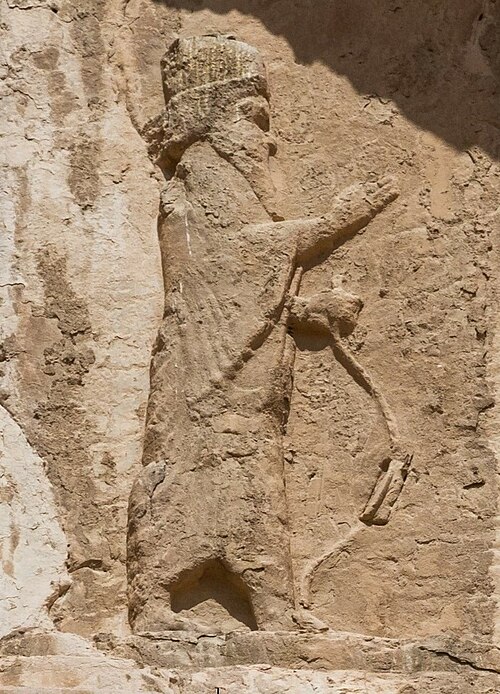
Darius I Becomes King and Reorganizes the Persian Empire
Darius I ascends the throne after a struggle, then reforms the empire into satrapies, builds the Royal Road, and introduces standardized coinage. #administration #history
Darius I Becomes King and Reorganizes the Persian Empire By Rumlu - [1], Public domain, https://commons.wikimedia.org/w/index.php?curid=146053444
515 BCE
Darius Begins Construction of Persepolis
Darius I starts building Persepolis as the ceremonial capital, showcasing Achaemenid wealth and multiculturalism. #architecture #history
492 BCE
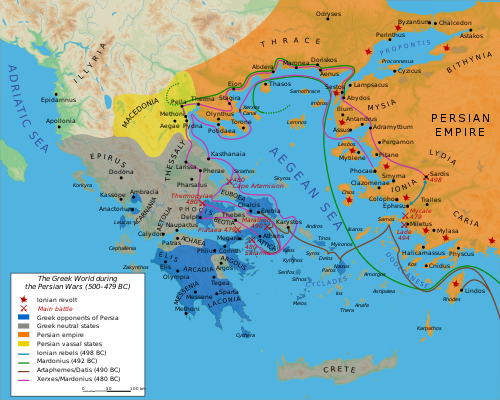
First Persian Invasion of Greece
Darius I launches a punitive expedition against Greece, but is defeated at Marathon in 490 BCE. #war #history
First Persian Invasion of Greece By User:Bibi Saint-Pol - Own work. Data from Image:Perserkriege.jpg by Captain Blood, which uses the dtv-Atlas Weltgeschichte. Von den Anfängen bis zur Gegenwart, p. 56. Blank map from Image:Map greek sanctuaries-fr.svg., CC BY-SA 3.0, https://commons.wikimedia.org/w/index.php?curid=1724898
490 BCE
Battle of Marathon
The Athenian army repels the first Persian invasion at Marathon, a pivotal battle in the Greco-Persian Wars. #war #history
Battle of Marathon By John Steeple Davis - The story of the greatest nations, from the dawn of history to the twentieth century (published in 1900), Public domain, https://commons.wikimedia.org/w/index.php?curid=75078967
480 BCE
Battle of Thermopylae and Persian Invasion
Xerxes I leads a massive invasion of Greece, winning at Thermopylae but losing the naval Battle of Salamis, leading to eventual Persian withdrawal. #war #history
Battle of Thermopylae and Persian Invasion By Brian Boru - This image has been extracted from another file, GFDL, https://commons.wikimedia.org/w/index.php?curid=73415485
465 BCE
Artaxerxes I Becomes King
Artaxerxes I ascends the Persian throne after the assassination of Xerxes I, overseeing the Peace of Callias with Greece and reconstruction. #history #rule
Artaxerxes I Becomes King By Diego Delso - This image has been extracted from another file, CC BY-SA 4.0, https://commons.wikimedia.org/w/index.php?curid=136740321
404 BCE
Egypt Regains Independence from Persia
Egypt rebels successfully under Amyrtaeus, ending Persian rule for several decades, marking the decline of Achaemenid power. #rebellion #history
331 BCE
Battle of Gaugamela
Alexander the Great decisively defeats the Persian army at Gaugamela, leading to the fall of Babylon and Susa. #war #history
Battle of Gaugamela By Pietro da Cortona - Google Arts & Culture — TAFxS-oMiYzUyA, Public domain, https://commons.wikimedia.org/w/index.php?curid=22006940
330 BCE
Alexander Destroys Persepolis, Ends Achaemenid Empire
Alexander of Macedon defeats Darius III and burns Persepolis, marking the end of the Achaemenid Persian Empire. #empire #history
Alexander Destroys Persepolis, Ends Achaemenid Empire By Unknown author - This image has been extracted from another file, Public domain, https://commons.wikimedia.org/w/index.php?curid=182741814