Encyclopedia/1. The Cosmos & The Natural World/2. Physics & Chemistry/10. Foundational & General Physics • Curated by Admin Timeline.sg
This timeline traces the development of cosmology and the Big Bang theory from ancient cosmological ideas to the early 20th century, highlighting key milestones and breakthroughs that shaped our understanding of the universe.
Chronological Storyline (50 Milestones)
600 BCE
Thales Proposes Water as Fundamental Substance
Greek philosopher Thales of Miletus suggests that water is the fundamental substance of the universe, marking one of the earliest attempts at a naturalistic cosmology. This idea laid the groundwork for later philosophical and scientific inquiry into the nature of the cosmos. #cosmology #ancient #philosophy
Thales Proposes Water as Fundamental Substance By Wilhelm Meyer - own scan, Public domain, https://commons.wikimedia.org/w/index.php?curid=11037570
500 BCE
Pythagoreans Propose a Spherical Universe
The Pythagorean school posits that the Earth is spherical and that the universe is ordered by mathematical principles. This concept of a harmonious, geometric cosmos influenced later astronomical models. #cosmology #ancient #mathematics
Pythagoreans Propose a Spherical Universe By Raphael - This image has been extracted from another file, Public domain, https://commons.wikimedia.org/w/index.php?curid=64222774
400 BCE
Democritus Proposes Atomic Universe
Democritus introduces the idea that the universe consists of indivisible atoms moving in a void, suggesting a mechanistic and infinite cosmos. This atomistic view anticipated later scientific materialism. #cosmology #ancient #atoms
Democritus Proposes Atomic Universe By user:shakko - Own work, CC BY-SA 3.0, https://commons.wikimedia.org/w/index.php?curid=5535206
350 BCE
Aristotle's Geocentric Model
Aristotle develops a geocentric cosmology with Earth at the center, surrounded by concentric celestial spheres. This model dominated Western thought for nearly two millennia. #cosmology #ancient #geocentric
Aristotle's Geocentric Model By After Lysippos - Jastrow (2006), Public domain, https://commons.wikimedia.org/w/index.php?curid=1359807
280 BCE
Aristarchus Proposes Heliocentric Model
Greek astronomer Aristarchus of Samos suggests that the Sun, not Earth, is the center of the universe. Although not widely accepted at the time, this heliocentric idea foreshadowed Copernicus. #cosmology #ancient #heliocentric
240 BCE
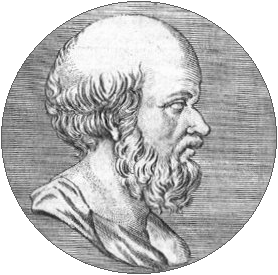
Eratosthenes Measures Earth's Circumference
Eratosthenes calculates the Earth's circumference with remarkable accuracy using shadows and geometry. This achievement demonstrated the power of empirical measurement in cosmology. #cosmology #ancient #measurement
Eratosthenes Measures Earth's Circumference By Unknown author, Public domain, https://commons.wikimedia.org/w/index.php?curid=494949
150 CE
Ptolemy's Almagest
Claudius Ptolemy compiles the Almagest, a comprehensive astronomical treatise that refined the geocentric model with epicycles. This work became the authoritative text on cosmology for over a thousand years. #cosmology #ancient #geocentric
Ptolemy's Almagest By Ptolemy - http://www.univie.ac.at/hwastro/rare/1515_ptolemae.htm, Public domain, https://commons.wikimedia.org/w/index.php?curid=29985717
964 CE
Al-Sufi Publishes Book of Fixed Stars
Persian astronomer Abd al-Rahman al-Sufi publishes the Book of Fixed Stars, which accurately describes the Andromeda Galaxy as a 'small cloud'. This is one of the earliest recorded observations of an external galaxy. #cosmology #medieval #astronomy
Al-Sufi Publishes Book of Fixed Stars By Albrecht Dürer - File:Albrecht_Dürer,_The_Northern_Celestial_Hemisphere,_1515,_NGA_43181.jpg, CC BY-SA 4.0, https://commons.wikimedia.org/w/index.php?curid=131171930
1054 CE
Chinese Astronomers Observe Supernova SN 1054
Chinese and Arab astronomers record the appearance of a 'guest star' in the constellation Taurus, now known as the Crab Nebula supernova. This event later provided evidence for stellar evolution and cosmic change. #cosmology #medieval #supernova
Chinese Astronomers Observe Supernova SN 1054 By NASA, ESA, J. Hester and A. Loll (Arizona State University) - HubbleSite: gallery, release., Public domain, https://commons.wikimedia.org/w/index.php?curid=516106
1543 CE
Copernicus Publishes De Revolutionibus
Nicolaus Copernicus publishes On the Revolutions of the Heavenly Spheres, proposing a heliocentric model with Earth orbiting the Sun. This revolutionary work initiated the Copernican Revolution in cosmology. #cosmology #renaissance #heliocentric
Copernicus Publishes De Revolutionibus By derivative work of Johannes Petreius 1543 edition of File:Nicolai_Copernici_torinensis_De_revolutionibus_orbium_coelestium.djvu - File:Nicolai_Copernici_torinensis_De_revolutionibus_orbium_coelestium.djvu, Public domain, https://commons.wikimedia.org/w/index.php?curid=5611684
1572 CE
Tycho Brahe Observes Supernova SN 1572
Tycho Brahe observes a new star in the constellation Cassiopeia, challenging the Aristotelian notion of an unchanging celestial realm. His precise measurements advanced observational astronomy. #cosmology #renaissance #supernova
Tycho Brahe Observes Supernova SN 1572 By NASA/CXC/Rutgers/J.Warren & J.Hughes et al. - http://chandra.harvard.edu/photo/2005/tycho/; see also https://www.flickr.com/photos/smithsonian/2941525398/, Public domain, https://commons.wikimedia.org/w/index.php?curid=6706920
1609 CE
Galileo Turns Telescope to the Sky
Galileo Galilei uses a telescope to discover Jupiter's moons, lunar craters, and the phases of Venus, providing strong evidence for the heliocentric model. His observations revolutionized cosmology. #cosmology #renaissance #telescope
Galileo Turns Telescope to the Sky By Justus Sustermans - http://collections.rmg.co.uk/collections/objects/14174, Public domain, https://commons.wikimedia.org/w/index.php?curid=62614082
1610 CE
Galileo Discovers the Milky Way's Stars
Galileo resolves the Milky Way into a multitude of individual stars, showing that it is a vast collection of stars. This discovery expanded the known scale of the universe. #cosmology #renaissance #stars
Galileo Discovers the Milky Way's Stars By ESO/Y. Beletsky - https://web.archive.org/web/20081121184421/http://www.eso.org/gallery/v/ESOPIA/Paranal/phot-33a-07.tif.html, CC BY 4.0, https://commons.wikimedia.org/w/index.php?curid=7398904
1687 CE
Newton Publishes Principia Mathematica
Isaac Newton publishes Philosophiæ Naturalis Principia Mathematica, formulating the laws of motion and universal gravitation. This work provided a mathematical framework for understanding celestial mechanics and the cosmos. #cosmology #physics #gravity
Newton Publishes Principia Mathematica By The original uploader was Zhaladshar at English Wikisource. - Transferred from en.wikisource to Commons. (previous image from another copy) Internet Archive (current image from the Bern Dibner copy), Public domain, https://commons.wikimedia.org/w/index.php?curid=2681838
1755 CE
Kant Proposes Island Universes
Immanuel Kant suggests that nebulae are 'island universes'—galaxies like the Milky Way—in his work Universal Natural History and Theory of the Heavens. This idea anticipated the modern concept of galaxies. #cosmology #enlightenment #galaxies
Kant Proposes Island Universes By Immanuel Kant - Scan of book cover, Public domain, https://commons.wikimedia.org/w/index.php?curid=76062534
1781 CE
Herschel Discovers Uranus
William Herschel discovers the planet Uranus, doubling the known size of the solar system. This discovery challenged the traditional boundaries of the cosmos. #cosmology #astronomy #discovery
Herschel Discovers Uranus By Ardenau4 - Own workalso published on Flickr: https://www.flickr.com/photos/197038812@N04/53449450202/, CC0, https://commons.wikimedia.org/w/index.php?curid=143666922
1785 CE
Herschel Maps the Milky Way
William Herschel attempts to map the shape of the Milky Way by counting stars in different directions, concluding it is a flattened disk. This was an early effort to understand our galaxy's structure. #cosmology #astronomy #milkyway
Herschel Maps the Milky Way By Lemuel Francis Abbott - one or more third parties have made copyright claims against Wikimedia Commons in relation to the work from which this is sourced or a purely mechanical reproduction thereof. This may be due to recognition of the "sweat of the brow" doctrine, allowing works to be eligible for protection through skill and labour, and not purely by originality as is the case in the United States (where this website is hosted). These claims may or may not be valid in all jurisdictions. As such, use of this image in the jurisdiction of the claimant or other countries may be regarded as copyright infringement. Please see Commons:When to use the PD-Art tag for more information., Public domain, https://commons.wikimedia.org/w/index.php?curid=224367
1838 CE
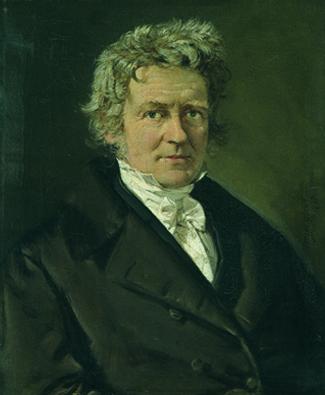
Bessel Measures Stellar Parallax
Friedrich Bessel measures the parallax of the star 61 Cygni, providing the first direct measurement of the distance to a star. This confirmed that stars are far beyond the solar system. #cosmology #astronomy #parallax
Bessel Measures Stellar Parallax By Christian Albrecht Jensen - Ny Carlsberg Glyptotek, Public domain, https://commons.wikimedia.org/w/index.php?curid=11276529
1842 CE
Doppler Describes the Doppler Effect
Christian Doppler describes the shift in frequency of waves due to relative motion, later crucial for measuring radial velocities of stars and galaxies. This effect became a key tool in cosmology. #cosmology #physics #doppler
1864 CE
Huggins Applies Spectroscopy to Nebulae
William Huggins uses spectroscopy to show that some nebulae are composed of glowing gases, while others are stellar. This technique allowed astronomers to study the chemical composition of celestial objects. #cosmology #astronomy #spectroscopy
Huggins Applies Spectroscopy to Nebulae By John Collier - one or more third parties have made copyright claims against Wikimedia Commons in relation to the work from which this is sourced or a purely mechanical reproduction thereof. This may be due to recognition of the "sweat of the brow" doctrine, allowing works to be eligible for protection through skill and labour, and not purely by originality as is the case in the United States (where this website is hosted). These claims may or may not be valid in all jurisdictions. As such, use of this image in the jurisdiction of the claimant or other countries may be regarded as copyright infringement. Please see Commons:When to use the PD-Art tag for more information., Public domain, https://commons.wikimedia.org/w/index.php?curid=6365203
1905 CE
Einstein Publishes Special Relativity
Albert Einstein publishes his theory of special relativity, which revolutionizes concepts of space and time. This theory later becomes fundamental to modern cosmology. #cosmology #physics #relativity
Einstein Publishes Special Relativity By Lucien Chavan [1] (1868 - 1942), a friend of Einstein's when he was living in Berne. - Cropped from original at the The Albert Einstein Archives, The Hebrew University of Jerusalem., Public domain, https://commons.wikimedia.org/w/index.php?curid=16699199
1915 CE
Einstein Publishes General Relativity
Albert Einstein completes his general theory of relativity, describing gravity as the curvature of spacetime. This theory provides the foundation for modern cosmological models. #cosmology #physics #gravity
Einstein Publishes General Relativity By Simulating eXtreme Spacetimes Lensing (SXS) - https://www.ligo.caltech.edu/video/ligo20160211v3 (video link); see also http://www.black-holes.org/gw150914, CC BY-SA 4.0, https://commons.wikimedia.org/w/index.php?curid=46994894
1917 CE
Einstein Introduces Cosmological Constant
Einstein adds a cosmological constant to his field equations to allow for a static universe. He later called this his 'biggest blunder' after the discovery of cosmic expansion. #cosmology #physics #einstein
Einstein Introduces Cosmological Constant By NASA/WMAP Science Team - Original version: NASA; modified by Cherkash, Public domain, https://commons.wikimedia.org/w/index.php?curid=11885244
1917 CE
De Sitter Proposes Expanding Universe Model
Willem de Sitter proposes a model of the universe that expands exponentially, with no matter. This model suggested that distant galaxies might appear to recede from us. #cosmology #physics #expansion
De Sitter Proposes Expanding Universe Model By NASA / WMAP Science Team - http://map.gsfc.nasa.gov/media/121238/ilc_9yr_moll4096.png, Public domain, https://commons.wikimedia.org/w/index.php?curid=23285693
1922 CE
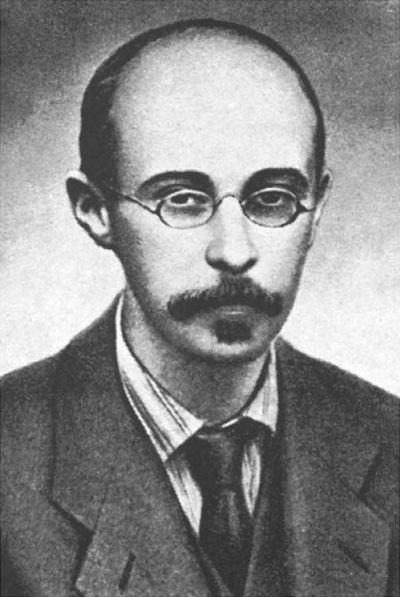
Friedmann Derives Expanding Universe Solutions
Alexander Friedmann derives solutions to Einstein's field equations that describe an expanding universe. His work laid the mathematical groundwork for the Big Bang theory. #cosmology #physics #bigbang
Friedmann Derives Expanding Universe Solutions By Unknown author - Cropped From, Public domain, https://commons.wikimedia.org/w/index.php?curid=2630080
1924 CE
Hubble Proves Andromeda is a Separate Galaxy
Edwin Hubble identifies Cepheid variable stars in the Andromeda Nebula, showing it is far beyond the Milky Way. This discovery expands the known universe to include external galaxies. #cosmology #astronomy #galaxies
Hubble Proves Andromeda is a Separate Galaxy By Johan Hagemeyer - http://hdl.huntington.org/cdm/ref/collection/p15150coll2/id/129, Public domain, https://commons.wikimedia.org/w/index.php?curid=53878391
1927 CE
Lemaître Proposes the Primeval Atom
Georges Lemaître proposes that the universe began from a single 'primeval atom' that expanded, later known as the Big Bang. This is the first formulation of the Big Bang theory. #cosmology #bigbang #theory
Lemaître Proposes the Primeval Atom By Unknown author - https://societyforthehistoryofastronomy.com/wp-content/uploads/2023/01/AA14-June-20.pdf, Public domain, https://commons.wikimedia.org/w/index.php?curid=154504242
1929 CE
Hubble Discovers the Expanding Universe
Edwin Hubble observes that distant galaxies are receding from us at speeds proportional to their distance, now known as Hubble's law. This provides strong evidence for an expanding universe. #cosmology #astronomy #expansion
Hubble Discovers the Expanding Universe By w:en:User:ScienceApologist - This image was copied from wikipedia:en. The original description was: The raisin bread model of the universe explains how each galaxy can perceive every other galaxy in the universe as receding from it. From the WMAP website., Public domain, https://commons.wikimedia.org/w/index.php?curid=2615116
1931 CE
Einstein Embraces Expanding Universe
After visiting Hubble and seeing the evidence, Einstein abandons the cosmological constant and accepts the expanding universe model. He publicly endorses Lemaître's Big Bang theory. #cosmology #physics #bigbang
Einstein Embraces Expanding Universe By Orren Jack Turner - This image is available from the United States Library of Congress's Prints and Photographs division under the digital ID cph.3b46036.This tag does not indicate the copyright status of the attached work. A normal copyright tag is still required. See Commons:Licensing., Public domain, https://commons.wikimedia.org/w/index.php?curid=6372844
1933 CE
Zwicky Discovers Dark Matter
Fritz Zwicky observes that galaxies in the Coma Cluster are moving too fast to be held together by visible matter, inferring the existence of dark matter. This introduces a major component of the universe. #cosmology #darkmatter #astronomy
Zwicky Discovers Dark Matter By Comet Photo AG (Zürich) - http://doi.org/10.3932/ethz-a-000050128, CC BY-SA 4.0, https://commons.wikimedia.org/w/index.php?curid=177261830
1948 CE
Hoyle Coins 'Big Bang' in Radio Broadcast
Fred Hoyle, a proponent of the steady-state theory, uses the term 'Big Bang' derisively in a BBC radio broadcast. The name stuck and became the popular term for the theory. #cosmology #bigbang #history
Hoyle Coins 'Big Bang' in Radio Broadcast By AIP Emilio Segrè Visual Archives, Clayton Collection - https://repository.aip.org/hoyle-sloan-laboratory, Attribution, https://commons.wikimedia.org/w/index.php?curid=172734747
1948 CE
Gamow Proposes Big Bang Nucleosynthesis
George Gamow and colleagues propose that light elements formed in the hot early universe, a process now called Big Bang nucleosynthesis. This theory predicts the cosmic abundance of hydrogen and helium. #cosmology #bigbang #nucleosynthesis
1949 CE
Alpher and Herman Predict Cosmic Microwave Background
Ralph Alpher and Robert Herman predict that the Big Bang should have left behind a faint glow of radiation, now known as the cosmic microwave background (CMB). This prediction was initially overlooked. #cosmology #bigbang #cmb
Alpher and Herman Predict Cosmic Microwave Background By ESA and the Planck Collaboration - Cosmic Microwave Background, CC BY 4.0, https://commons.wikimedia.org/w/index.php?curid=130789180
1964 CE
Penzias and Wilson Discover CMB
Arno Penzias and Robert Wilson accidentally discover the cosmic microwave background radiation, providing strong evidence for the Big Bang. This discovery earns them the Nobel Prize in Physics. #cosmology #bigbang #cmb
1965 CE
Dicke and Peebles Interpret CMB as Big Bang Echo
Robert Dicke and James Peebles interpret the CMB as the remnant radiation from the Big Bang, confirming the hot Big Bang model. This solidifies the Big Bang as the leading cosmological theory. #cosmology #bigbang #cmb
1970 CE
Hawking Proposes Black Hole Radiation
Stephen Hawking shows that black holes emit radiation due to quantum effects, now known as Hawking radiation. This connects cosmology with quantum mechanics. #cosmology #blackholes #quantum
1980 CE
Guth Proposes Cosmic Inflation
Alan Guth proposes the inflationary universe model, a period of rapid expansion in the early universe. Inflation solves several problems of the Big Bang theory, such as the horizon and flatness problems. #cosmology #inflation #bigbang
1992 CE
COBE Satellite Maps CMB Anisotropies
NASA's COBE satellite detects tiny fluctuations in the cosmic microwave background, providing the first detailed map of the early universe. These fluctuations are the seeds of galaxy formation. #cosmology #cmb #nasa
COBE Satellite Maps CMB Anisotropies By NASA - https://science.nasa.gov/toolkits/spacecraft-icons (image link), Public domain, https://commons.wikimedia.org/w/index.php?curid=58072784
1998 CE
Discovery of Dark Energy
Two independent teams studying distant supernovae discover that the universe's expansion is accelerating, implying the existence of dark energy. This revolutionizes cosmology and earns the Nobel Prize. #cosmology #darkenergy #supernova
2001 CE
WMAP Launches to Study CMB
NASA's Wilkinson Microwave Anisotropy Probe (WMAP) launches to measure the cosmic microwave background with high precision. Its data refines the age and composition of the universe. #cosmology #cmb #nasa
WMAP Launches to Study CMB By NASA / WMAP Science Team - [1]; converted from the high-resolution TIFF version to a JPEG, Public domain, https://commons.wikimedia.org/w/index.php?curid=3944989
2003 CE
WMAP First Results Released
WMAP's first data release provides precise measurements of the universe's age (13.7 billion years) and composition (4.6% ordinary matter, 23% dark matter, 72% dark energy). #cosmology #cmb #universe
2009 CE
Planck Satellite Launches
ESA's Planck satellite launches to map the cosmic microwave background with even greater sensitivity than WMAP. Its data further refines cosmological parameters. #cosmology #cmb #esa
Planck Satellite Launches By Photograph by Mike Peel (www.mikepeel.net). - Own work, CC BY-SA 4.0, https://commons.wikimedia.org/w/index.php?curid=14045307
2013 CE
Planck Releases All-Sky CMB Map
Planck's first all-sky map of the CMB is released, providing the most detailed view of the early universe. The data confirms the standard model of cosmology with high precision. #cosmology #cmb #bigbang
2015 CE
LIGO Detects Gravitational Waves
The Laser Interferometer Gravitational-Wave Observatory (LIGO) detects gravitational waves from merging black holes, confirming a prediction of general relativity. This opens a new window on the universe. #cosmology #gravitationalwaves #physics
LIGO Detects Gravitational Waves By Amber Stuver - Own work, CC BY-SA 4.0, https://commons.wikimedia.org/w/index.php?curid=46993713
2016 CE
Discovery of Proxima b
Astronomers announce the discovery of Proxima Centauri b, an Earth-sized exoplanet in the habitable zone of the nearest star. This fuels interest in exoplanet cosmology and the search for life. #cosmology #exoplanets #astrobiology
Discovery of Proxima b By ESO/M. Kornmesser - https://www.eso.org/public/images/ann16056a/, CC BY 4.0, https://commons.wikimedia.org/w/index.php?curid=50869082
2019 CE
Event Horizon Telescope Images Black Hole
The Event Horizon Telescope collaboration releases the first direct image of a black hole's event horizon in galaxy M87. This confirms predictions of general relativity and provides new insights into black hole physics. #cosmology #blackholes #imaging
Event Horizon Telescope Images Black Hole By D. Marrone/UofA - Event Horizon Telescope Collaboration, CC BY 4.0, https://commons.wikimedia.org/w/index.php?curid=133002860
2020 CE
Nobel Prize for Black Hole Discoveries
The Nobel Prize in Physics is awarded to Roger Penrose for theoretical work on black holes, and to Reinhard Genzel and Andrea Ghez for discovering a supermassive black hole at the Milky Way's center. #cosmology #blackholes #nobel
Nobel Prize for Black Hole Discoveries By Photograph: JonathunderMedal: Erik Lindberg (1873-1966) - Derivative of File:NobelPrize.JPG, PD-US, https://en.wikipedia.org/w/index.php?curid=58432969
2021 CE
James Webb Space Telescope Launches
NASA's James Webb Space Telescope (JWST) launches, designed to observe the first galaxies and stars. It promises to revolutionize cosmology by peering deeper into the universe's history. #cosmology #jwst #nasa
James Webb Space Telescope Launches By NASA - https://www.jwst.nasa.gov/content/webbLaunch/whereIsWebb.html, Public domain, https://commons.wikimedia.org/w/index.php?curid=114125719
2022 CE
JWST Reveals Early Universe Galaxies
The James Webb Space Telescope releases its first images, revealing galaxies from the early universe that are more mature than expected. This challenges existing models of galaxy formation. #cosmology #jwst #galaxies
2023 CE
Euclid Mission Launches to Study Dark Energy
ESA's Euclid mission launches to map the geometry of the dark universe, aiming to understand dark energy and dark matter. It will survey billions of galaxies over six years. #cosmology #darkenergy #esa
Euclid Mission Launches to Study Dark Energy By European Space Agency - Euclid looking into the Universe, CC BY-SA 3.0 igo, https://commons.wikimedia.org/w/index.php?curid=128347141