Confucius: Analects, Filial Piety & Moral Philosophy of East Asia
Encyclopedia/5. Human Thought & Philosophy/1. Philosophy, Religion & Ethics/01. Eastern Philosophy & Religious Thought • Curated by Admin Timeline.sg
Confucius (Kong Fuzi, 551–479 BCE) was a Chinese philosopher whose teachings on ethics, filial piety, and social harmony shaped East Asian civilization for over two millennia. This timeline covers his life, key events, and the early propagation of his ideas.
Chronological Storyline (40 Milestones)
551 BCE
Birth of Confucius in Qufu
Confucius is born as Kong Qiu in the state of Lu (modern-day Qufu, Shandong). His father, Shu-liang He, was a military officer. #history #philosophy
Birth of Confucius in Qufu By Wu Daozi, 685-758, Tang Dynasty. - https://i.pinimg.com/originals/77/95/19/7795198cc338e4642d2ce7ac965458b2.jpg, Public domain, https://commons.wikimedia.org/w/index.php?curid=857482
549 BCE
Death of Confucius' Father
Shu-liang He dies when Confucius is three years old. His mother Yan Zhengzai raises him in poverty, instilling a strong sense of filial piety and education. #history #family
537 BCE
Begins Education in Six Arts
Confucius starts studying the Six Arts (ritual, music, archery, charioteering, calligraphy, mathematics) under local masters, laying the foundation for his later teachings. #education #philosophy
532 BCE
Marriage and Birth of Son
Confucius marries a woman from the Qiguan family. Shortly after, his son Kong Li is born. The family struggles financially, and Confucius takes various jobs. #family #history
527 BCE
Death of Confucius' Mother
Confucius' mother Yan Zhengzai dies. He observes a three-year mourning period, emphasizing filial piety. This event deepens his commitment to traditional rituals. #philosophy #ritual
522 BCE
Opens Private School
Confucius begins teaching students privately, accepting pupils from all social classes regardless of wealth. This marks the start of his career as a philosopher-educator. #education #philosophy
517 BCE
Travels to Qi State
To escape political turmoil in Lu, Confucius travels to the neighboring state of Qi. He serves as a tutor to the Qi nobility but returns after a few years. #history #travel
516 BCE
Advises Duke Jing of Qi
Confucius meets Duke Jing of Qi and advises him on proper governance, emphasizing the moral rectification of rulers. The duke admires Confucius but does not fully implement his ideas. #philosophy #politics
515 BCE
Returns to Lu
Confucius returns to Lu after the political situation stabilizes. He continues teaching and gains a reputation for his wisdom. #history #teaching
501 BCE
Appointed Magistrate of Zhongdu
Confucius is appointed as the magistrate of Zhongdu, a small district in Lu. He implements moral governance, improving public order and social harmony. #politics #philosophy
500 BCE
Becomes Minister of Justice in Lu
Confucius is promoted to Minister of Justice (Sikou). He oversees legal reforms and gains a reputation for fairness. His influence in Lu grows. #politics #justice
498 BCE
Diplomatic Mission to Qi
Confucius accompanies the Duke of Lu to a diplomatic meeting with Qi. He successfully negotiates territorial disputes, demonstrating his diplomatic skills. #politics #diplomacy
497 BCE
Departure from Lu
Frustrated with the moral decay of Lu's rulers, Confucius resigns his post and leaves Lu. He begins a 14-year period of wandering through neighboring states. #history #travel
496 BCE
Arrival in Wei State
Confucius arrives in Wei, where he is received by Duke Ling. He teaches and advises but leaves after a conflict with the duke's wife Nanzi. #philosophy #travel
495 BCE
Sojourn in Song State
Confucius travels to Song, where he is threatened by a political rival. He narrowly escapes harm and continues his journey. #history #danger
493 BCE
In Chen State
Confucius settles temporarily in Chen. He spends several years teaching local disciples and reflecting on his philosophy. #philosophy #teaching
492 BCE
Teacher in Cai State
Confucius moves to Cai, where he faces poverty and danger. His disciple Zi Gong helps him survive. Despite hardships, he continues to teach. #history #perseverance
490 BCE
Siege at Kuang
Confucius and his followers are besieged by villagers in Kuang who mistake him for a rebellious official. Confucius remains calm, and they are eventually freed. #philosophy #courage
489 BCE
Meeting with Duke Zhao of Chu
Confucius travels to Chu and meets Duke Zhao, who offers him a position. However, due to opposition, the offer is withdrawn, and Confucius returns north. #politics #travel
488 BCE
Return to Wei
Confucius returns to Wei, where he stays for several years. He teaches and revises his concepts of government and ethics. #philosophy #teaching
484 BCE
Final Return to Lu
At age 67, Confucius is invited back to Lu by the new Duke Ai. He spends his remaining years teaching, editing, and overseeing state ceremonies. #history #homecoming
483 BCE
Edits the Five Classics
Confucius begins editing the Five Classics: Book of Changes, Book of History, Book of Poetry, Book of Rites, and Spring and Autumn Annals. This work preserves ancient culture. #philosophy #classics
Edits the Five Classics By Aethelwolf Emsworth. - Own reproduction of a drawing made by Picnic11219 for Chinese Wikipedia., Public domain, https://commons.wikimedia.org/w/index.php?curid=65689742
482 BCE
Death of Son Kong Li
Confucius' only son, Kong Li, dies at age 50. Confucius is deeply grieved but continues his work, emphasizing the importance of moral legacy over biological lineage. #family #philosophy
481 BCE
Death of Disciple Yan Hui
Confucius' favorite disciple, Yan Hui, dies young. Confucius mourns deeply, lamenting that heaven is destroying him. Yan Hui is later revered as a model of Confucian virtue. #philosophy #disciples
Death of Disciple Yan Hui By anonymous - Portraits of the Sage. Teacher Exemplar for a Myriad Generations: Confucius in Painting, Calligraphy, and Print Through the Ages (exhibit). Taipei: National Palace Museum., Public domain, https://commons.wikimedia.org/w/index.php?curid=64582944
480 BCE
Death of Disciple Zi Lu
Disciple Zi Lu dies in battle. Confucius hears of his death and is heartbroken, as Zi Lu was a loyal follower. #philosophy #sacrifice
Death of Disciple Zi Lu By anonymous - Portraits of the Sage. Teacher Exemplar for a Myriad Generations: Confucius in Painting, Calligraphy, and Print Through the Ages (exhibit). Taipei: National Palace Museum., Public domain, https://commons.wikimedia.org/w/index.php?curid=64583256
479 BCE
Death of Confucius
Confucius dies in Qufu at age 72 of natural causes. His disciples honor him with a three-year mourning period, and his tomb becomes a place of pilgrimage. #history #philosophy
478 BCE
First Temple Built at Qufu
The Duke of Lu orders the construction of a temple at Confucius' former residence to honor him. This becomes the earliest site of Confucian worship. #religion #history
First Temple Built at Qufu By kanegen - https://www.flickr.com/photos/kanegen/2907620144/sizes/o/in/set-72157607671231291/, CC BY 2.0, https://commons.wikimedia.org/w/index.php?curid=7776884
470 BCE
Disciples Compile Early Teachings
Confucius' disciples and their students begin compiling his sayings and dialogues, which later form the Analects. This oral tradition preserves his philosophy. #philosophy #literature
Disciples Compile Early Teachings By Confucius and his disciples, - From here., Public domain, https://commons.wikimedia.org/w/index.php?curid=2581568
420 BCE
Zengzi Passes on Confucian Tradition
Zengzi, a leading disciple of Confucius, compiles the 'Great Learning' (Daxue) essay, emphasizing self-cultivation and filial piety. #philosophy #education
Zengzi Passes on Confucian Tradition By anonymous - Portraits of the Sage. Teacher Exemplar for a Myriad Generations: Confucius in Painting, Calligraphy, and Print Through the Ages (exhibit). Taipei: National Palace Museum., Public domain, https://commons.wikimedia.org/w/index.php?curid=64583214
372 BCE
Mencius, Key Confucian Philosopher, Born
Mencius (Mengzi) is born, later becomes the most famous Confucian philosopher after Confucius, expanding the doctrine of innate human goodness. #philosophy #confucianism
Mencius, Key Confucian Philosopher, Born By anonymous - Portraits of the Sage. Teacher Exemplar for a Myriad Generations: Confucius in Painting, Calligraphy, and Print Through the Ages (exhibit). Taipei: National Palace Museum., Public domain, https://commons.wikimedia.org/w/index.php?curid=64582790
350 BCE
Analects Compiled in Final Form
The Analects (Lunyu) is compiled by Confucius' second-generation disciples. It becomes the central text of Confucianism, containing his conversations and aphorisms. #philosophy #classics
221 BCE
Qin Dynasty Suppresses Confucianism
Emperor Qin Shi Huang orders the burning of Confucian texts and buries scholars alive, but the tradition survives underground. #history #censorship
Qin Dynasty Suppresses Confucianism By Itsmine - Self-published work by Itsmine, CC BY-SA 3.0, https://commons.wikimedia.org/w/index.php?curid=1389340
202 BCE
Han Dynasty Revives Confucianism
The Han dynasty rescinds anti-Confucian policies. Emperor Gaozu offers sacrifices at Confucius' tomb, reinvigorating Confucian learning. #history #confucianism
Han Dynasty Revives Confucianism By DannamEmpire - Own work using: Based on: Map, p. 63, Mapping History: World History (London: Cartographica, 2007), by Dr. Ian Barnes. ISBN 978-1-84573-323-0, CC BY 4.0, https://commons.wikimedia.org/w/index.php?curid=162847450
136 BCE
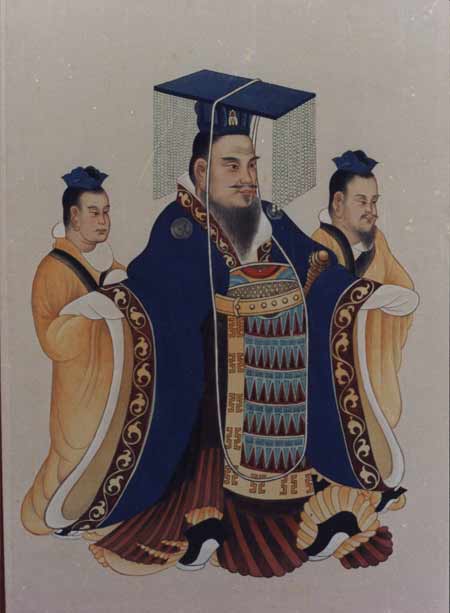
Confucianism Becomes State Orthodoxy
Emperor Wu of Han establishes Confucianism as the official state doctrine. Imperial examinations based on Confucian classics begin, shaping the civil service for centuries. #politics #education
Confucianism Becomes State Orthodoxy By Unknown author - Colored portrait and a black and white rubbing of the portrait, Public domain, https://commons.wikimedia.org/w/index.php?curid=8151462
124 BCE
Imperial Academy Founded
Emperor Wu founds the Imperial Academy (Taixue) to train officials in Confucian texts. This institutionalizes Confucian education. #education #history
Imperial Academy Founded By Internet Archive Book Images - https://www.flickr.com/photos/internetarchivebookimages/14761496004/ Source book page: https://archive.org/stream/cu31924023119880/cu31924023119880#page/n124/mode/1up, No restrictions, https://commons.wikimedia.org/w/index.php?curid=43580680
51 BCE
First Official Confucian Temple State
The Han government expands the Qufu temple, and later emperors regularly offer sacrifices. Confucius is posthumously enshrined as a patron of education. #religion #history
1 CE
Posthumous Title 'Duke Baocheng'
Emperor Ping of Han bestows the title 'Duke Baocheng' on Confucius, initiating a series of noble titles granted to his descendants. #history #honor
100 CE
Sima Qian's Biography of Confucius
Sima Qian includes a biography of Confucius in his 'Records of the Grand Historian', providing the most detailed early account of his life. #literature #history
Sima Qian's Biography of Confucius By Zhonghua Book Company - Photo taken by Chinese Wikipedia user huowax, Public domain, https://commons.wikimedia.org/w/index.php?curid=48989967
581 CE
Confucianism in Korea: Unified Silla
The Korean kingdom of Silla adopts Confucian principles for state administration. Confucian academies spread, influencing East Asian governance. #history #confucianism
Confucianism in Korea: Unified Silla By joonghijung - https://www.flickr.com/photos/27114146@N07/2538174736/, CC BY 2.0, https://commons.wikimedia.org/w/index.php?curid=4675122
1241 CE
Zhu Xi Compiles Four Books
Neo-Confucian scholar Zhu Xi compiles the 'Four Books' (Great Learning, Doctrine of the Mean, Analects, Mencius) as core texts, reshaping Confucian education. #philosophy #education