Encyclopedia/1. The Cosmos & The Natural World/2. Physics & Chemistry/09. Condensed Matter Physics • Curated by Admin Timeline.sg
Condensed matter physics explores the properties of solid and liquid matter, with key advances in superconductivity, semiconductors, and topological insulators spanning from 1911 to the present. This timeline highlights major experimental discoveries and theoretical breakthroughs that have transformed technology and our understanding of quantum materials.
Chronological Storyline (33 Milestones)
Apr 8, 1911 CE
Discovery of Superconductivity in Mercury
Heike Kamerlingh Onnes discovers that mercury's electrical resistance suddenly drops to zero at 4.2 K, marking the first observation of superconductivity. This breakthrough opens the field of low-temperature physics. #physics #superconductivity #history
Discovery of Superconductivity in Mercury By Henry Mühlpfordt - Own work, CC BY-SA 3.0, https://commons.wikimedia.org/w/index.php?curid=9491383
Nov 1, 1933 CE
Meissner Effect Discovered
Walther Meissner and Robert Ochsenfeld discover that superconductors expel magnetic fields, demonstrating perfect diamagnetism. The Meissner effect becomes a defining property of superconductors. #physics #superconductivity #discovery
Meissner Effect Discovered By Piotr Jaworski, PioM EN DE PL; POLAND/Poznań - Own work based on: EXPULSION.png:, Public domain, https://commons.wikimedia.org/w/index.php?curid=325237
Dec 23, 1947 CE
Invention of the Transistor
John Bardeen, Walter Brattain, and William Shockley at Bell Labs create the first point-contact transistor, revolutionizing electronics and laying the foundation for modern semiconductors. #physics #semiconductors #invention
Invention of the Transistor By Ulfbastel - Own work, CC BY-SA 3.0, https://commons.wikimedia.org/w/index.php?curid=3123331
1950 CE
Ginzburg–Landau Theory Published
Vitaly Ginzburg and Lev Landau propose a phenomenological theory of superconductivity using a complex order parameter, successfully describing type-I and type-II superconductors. #physics #superconductivity #theory
Apr 1, 1957 CE
BCS Theory of Superconductivity
John Bardeen, Leon Cooper, and Robert Schrieffer publish the microscopic BCS theory, explaining superconductivity via electron-phonon pairing. This landmark work earns them the 1972 Nobel Prize. #physics #superconductivity #theory
BCS Theory of Superconductivity By Unknown author, CC BY-SA 2.5, https://commons.wikimedia.org/w/index.php?curid=657868
Sep 12, 1958 CE
First Integrated Circuit Invented
Jack Kilby demonstrates the first integrated circuit at Texas Instruments, combining multiple transistors on a single semiconductor substrate, ushering in the microelectronics era. #semiconductors #electronics #invention
First Integrated Circuit Invented By cole8888, https://flickr.com/photos/187597251@N05/ (aka Cole L) - https://www.flickr.com/photos/187597251@N05/49899342293/, CC BY-SA 2.0, https://commons.wikimedia.org/w/index.php?curid=95653492
1962 CE
Josephson Effect Predicted
Brian Josephson predicts that supercurrent can flow between two superconductors separated by a thin insulator, leading to the Josephson effect. This discovery enables sensitive magnetometers and voltage standards. #physics #superconductivity #prediction
Josephson Effect Predicted By NBS - NIST paper A Practical Josephson Voltage Standard at One Volt, Figure 1, Public domain, https://commons.wikimedia.org/w/index.php?curid=319467
Apr 19, 1965 CE
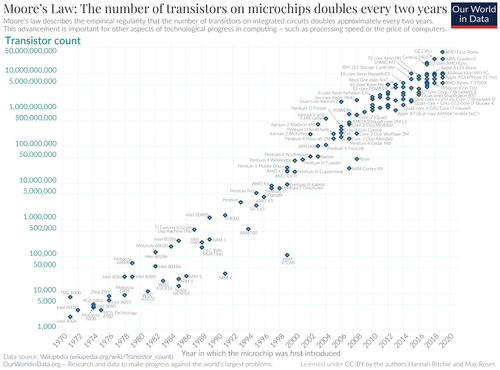
Moore's Law Published
Gordon Moore observes that the number of transistors on a chip doubles every two years, a trend that drives semiconductor advancement for decades. #semiconductors #computing #law
Moore's Law Published By Max Roser, Hannah Ritchie - https://ourworldindata.org/uploads/2020/11/Transistor-Count-over-time.png, CC BY 4.0, https://commons.wikimedia.org/w/index.php?curid=98219918
1980 CE
Integer Quantum Hall Effect Discovered
Klaus von Klitzing discovers the integer quantum Hall effect in a two-dimensional electron gas under strong magnetic fields, revealing quantized Hall resistance. He receives the 1985 Nobel Prize. #physics #quantum #Hall
Mar 1, 1981 CE
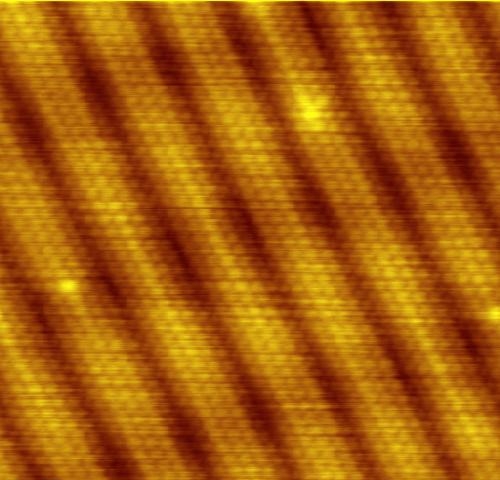
Scanning Tunneling Microscope Invented
Gerd Binnig and Heinrich Rohrer invent the scanning tunneling microscope (STM), enabling atomic-scale imaging of surfaces. The STM becomes a crucial tool in condensed matter physics. #physics #microscopy #invention
Scanning Tunneling Microscope Invented By Erwinrossen - en:File:Atomic_resolution_Au100.JPG, see upload log, Public domain, https://commons.wikimedia.org/w/index.php?curid=1790142
1985 CE
Fractional Quantum Hall Effect Discovered
Horst Störmer, Dan Tsui, and Robert Laughlin discover the fractional quantum Hall effect, unveiling quasiparticles with fractional charge. Laughlin's theory explains the phenomenon. #physics #quantum #Hall
Apr 17, 1986 CE
High-Temperature Superconductivity Discovered
Georg Bednorz and K. Alex Müller discover superconductivity in a lanthanum‑based cuprate at 35 K, sparking a race for higher‑Tc materials. They win the 1987 Nobel Prize. #superconductivity #physics #breakthrough
High-Temperature Superconductivity Discovered By James Slezak, Cornell Laboratory of Atomic and Solid State Physics - Own work, CC BY 2.5, https://commons.wikimedia.org/w/index.php?curid=864046
Feb 17, 1987 CE
YBCO Superconductor Achieves 92 K
Maw‑Kuen Chu and colleagues synthesize yttrium barium copper oxide (YBCO), which superconducts at 92 K, above the boiling point of liquid nitrogen. This enables practical applications. #superconductivity #materials #discovery
YBCO Superconductor Achieves 92 K By Maxim Bilovitskiy - Own work, CC BY-SA 4.0, https://commons.wikimedia.org/w/index.php?curid=45084460
1988 CE
Bismuth‑Based Cuprates Superconduct at 110 K
Hiroshi Maeda and team discover Bi‑Sr‑Ca‑Cu‑O (BSCCO) with a critical temperature above 100 K, expanding the family of high‑Tc superconductors. #superconductivity #materials #discovery
1998 CE
D‑Wave Pairing in Cuprates Confirmed
Multiple experiments confirm that hole‑doped cuprates exhibit d‑wave pairing symmetry, distinct from BCS s‑wave. This deepens understanding of high‑Tc mechanisms. #superconductivity #physics #experiment
Jan 27, 2001 CE
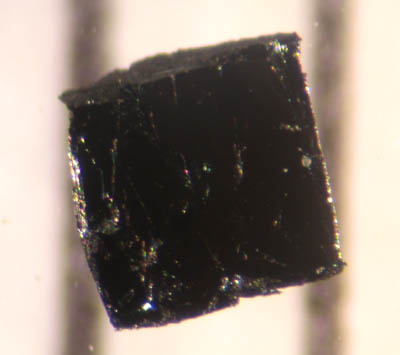
Superconductivity in Magnesium Diboride Discovered
Jun Akimitsu's group discovers that magnesium diboride (MgB2) superconducts at 39 K, a relatively high transition temperature for a simple binary compound, sparking renewed interest. #superconductivity #materials #discovery
Superconductivity in Magnesium Diboride Discovered By Materialscientist - Own work (Original text: I created this work entirely by myself.), CC BY-SA 3.0, https://commons.wikimedia.org/w/index.php?curid=11168594
Oct 22, 2004 CE
Isolation of Graphene
Andre Geim and Konstantin Novoselov isolate a single layer of carbon atoms (graphene) using adhesive tape, revealing extraordinary electronic properties. They receive the 2010 Nobel Prize. #physics #materials #graphene
Isolation of Graphene By AlexanderAlUS - Own work, CC BY-SA 3.0, https://commons.wikimedia.org/w/index.php?curid=11294534
2005 CE
Topological Insulators Predicted
Charles Kane and Eugene Mele predict that certain materials with strong spin‑orbit coupling can host topologically protected surface states, introducing the concept of topological insulators. #physics #topology #prediction
Topological Insulators Predicted By A13ean - Own work, CC BY-SA 3.0, https://commons.wikimedia.org/w/index.php?curid=11101461
2007 CE
First 2D Topological Insulator Realized
Laurens Molenkamp's group experimentally confirms the quantum spin Hall effect in HgTe quantum wells, the first 2D topological insulator. #physics #topology #experiment
Feb 23, 2008 CE
Iron‑Based Superconductors Discovered
Hideo Hosono's group discovers superconductivity in LaFeAsO1‑xFx at 26 K, launching a new family of high‑Tc superconductors with iron‑arsenic layers. #superconductivity #materials #discovery
Iron‑Based Superconductors Discovered By Materialscientist - Own work, CC BY-SA 3.0, https://commons.wikimedia.org/w/index.php?curid=40347835
2009 CE
Topological Insulators in 3D Materials
Experiments confirm that Bi2Se3 and Bi2Te3 are three‑dimensional topological insulators with protected surface states, as predicted by theory. #physics #topology #materials
Oct 5, 2010 CE
Nobel Prize for Graphene
Andre Geim and Konstantin Novoselov are awarded the Nobel Prize in Physics for their groundbreaking experiments on graphene. #physics #graphene #Nobel
Apr 12, 2012 CE
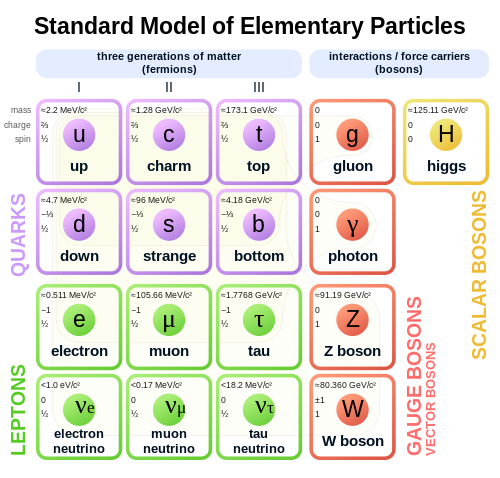
Majorana Fermions in Nanowires
Leo Kouwenhoven's group reports signatures of Majorana zero modes in indium antimonide nanowires coupled with a superconductor, advancing topological quantum computing. #physics #topology #quantum
Majorana Fermions in Nanowires By Cush - Own work using: PBS NOVA [1], Fermilab, Office of Science, United States Department of Energy, Particle Data Group, Public domain, https://commons.wikimedia.org/w/index.php?curid=4286964
2013 CE
Topological Superconductivity Observed
Experiments on topological insulators with conventional superconductors provide evidence for topological superconductivity, hosting Majorana bound states. #superconductivity #topology #discovery
Aug 1, 2015 CE
High‑Pressure Hydrogen Sulfide Superconductor
Mikhail Eremets and colleagues find that hydrogen sulfide under extreme pressure becomes a superconductor at 203 K, a record high transition temperature at the time. #superconductivity #physics #highpressure
High‑Pressure Hydrogen Sulfide Superconductor By Benjah-bmm27 - Own work, Public domain, https://commons.wikimedia.org/w/index.php?curid=1542601
Jan 1, 2016 CE
Discovery of Topological Crystalline Insulators
Liang Fu's group predicts and experimental groups confirm topological crystalline insulators in materials like PbSnSe, protected by crystal mirror symmetry. #physics #topology #materials
Pablo Jarillo‑Herrero's team shows that rotating two layers of graphene to a 'magic angle' of 1.1° enables superconductivity, opening a new platform for strongly correlated physics. #physics #graphene #superconductivity
Dec 9, 2019 CE
Quantum Spin Hall Effect in Monolayer Tungsten Ditelluride
Researchers observe the quantum spin Hall effect in monolayer WTe2 at temperatures up to 100 K, a major step toward practical topological devices. #physics #topology #2Dmaterials
Oct 14, 2020 CE
Room‑Temperature Superconductivity Claimed
Ranga Dias and colleagues report superconductivity at 15°C (288 K) in a carbonaceous sulfur hydride compound under 267 GPa pressure, later retracted due to controversy. #superconductivity #physics #breakthrough
Sep 1, 2021 CE
Superconductivity in Bilayer Nickelates
Harold Hwang's group discovers superconductivity in infinite‑layer nickelates (Nd,Sr)NiO2, adding nickelates to the high‑Tc family. #superconductivity #materials #discovery
2022 CE
Advances in Topological Quantum Computing
Microsoft and other groups demonstrate progress in braiding Majorana zero modes in nanowires, advancing toward fault‑tolerant topological qubits. #quantum #computing #topology
Advances in Topological Quantum Computing By topological quantum computer - website, CC BY 3.0, https://commons.wikimedia.org/w/index.php?curid=154130974
Jul 22, 2023 CE
LK‑99 Room‑Temperature Superconductor Controversy
A Korean team claims room‑temperature ambient‑pressure superconductivity in Pb‑apatite (LK‑99), but subsequent experiments fail to replicate, highlighting challenges in the field. #superconductivity #controversy #science
LK‑99 Room‑Temperature Superconductor Controversy By Hyun-Tak Kim - https://sciencecast.org/casts/suc384jly50n, CC BY 4.0, https://commons.wikimedia.org/w/index.php?curid=135452379
2024 CE
New High‑Tc Superconductors in Hydrides Under Pressure
Continued exploration of superhydrides leads to reports of superconductivity at temperatures exceeding 250 K in LaH10 and YH6 under high pressure, pushing the Tc frontier. #superconductivity #physics #highpressure
New High‑Tc Superconductors in Hydrides Under Pressure By Jü - Own work, Public domain, https://commons.wikimedia.org/w/index.php?curid=88896181